
One Study Cannot Serve Four Different Stakeholder Agendas
You are a mid-level Design Researcher, and the interviewer just handed you a scenario with a launch date attached: a creator-facing mobile feature ships in about 8 weeks, and you get exactly one primary study before the launch call gets made. That alone would be manageable. What makes it hard is that four different people want that one study to answer four different questions, and the interview is built on the real blueprint the InterviewStack.io AI interviewer uses to score this exact scenario at the mid-level bar.
A candidate who tries to satisfy everyone loses points before the study design even starts, because the rubric does not reward coverage. It rewards a clear decision, a defensible scope, and a plan that survives contact with stakeholders who disagree.
Key Findings
- The rubric splits 100 points across four dimensions: Interviewer Objectives Alignment (30), Level-Specific Expectations (30), Technical Proficiency (20), Communication and Problem Solving (20).
- The interview runs 30 minutes across 3 phases: problem framing (0 to 8 minutes), scope negotiation (8 to 20 minutes), and managing disagreement and impact (20 to 30 minutes).
- The scenario gives the candidate exactly 1 primary study to serve 4 distinct stakeholders (product, design, engineering, and policy) inside an 8-week launch window.
- Phase 2, scope negotiation, is the longest single phase at 12 minutes and carries 5 graded checklist items, more than any other phase.
- Across all 3 phases, the blueprint tracks 13 total expected checklist items that define what a complete answer covers.
- 4 skills are explicitly off-limits for this scenario, including coding or algorithm design and deep statistical hypothesis testing, keeping the interview focused on collaboration and judgment rather than technical execution.
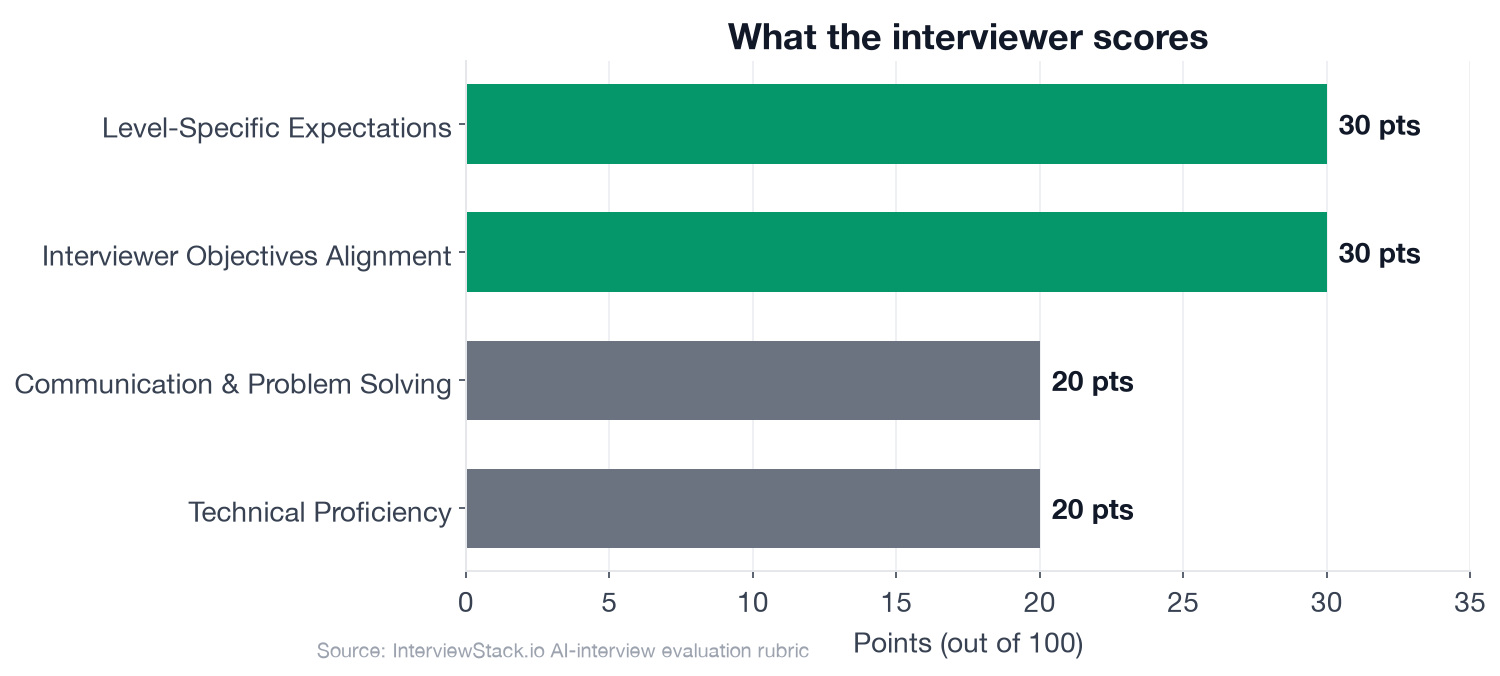 Framing and level-appropriate judgment together account for 60 of the 100 points, more than the technical and communication dimensions combined.
What Is a Design Researcher Research Collaboration and Stakeholder Management Interview Actually Testing?
The interview question
You are supporting a product area at a large consumer tech company. A team is preparing to launch a major update to a creator-facing mobile feature in about 8 weeks. The product manager wants fast directional feedback on whether the new workflow will improve adoption. Design wants deeper understanding of trust and usability risks before launch. Engineering says only small design changes are still feasible. A policy partner has also raised concerns about how some creators may interpret the feature's visibility settings. There is no dedicated research ops support, and only one primary study can run before the launch decision. The work has to inform a recommendation that product, design, engineering, and policy leadership will all review.
How would you approach the research collaboration and stakeholder management for this project, from kickoff through the launch decision?
The interviewer is not grading whether you can design a good usability study in isolation. The objective is whether you can shape and deliver a research plan under real, competing demands: building alignment across product, design, engineering, and an unfamiliar policy partner; negotiating scope instead of trying to satisfy everyone; and creating leverage through transparent stakeholder management rather than working alone. A candidate who jumps straight to methodology, before naming the actual decision and the actual tensions, is already behind.
The Study Gets Smaller With Every Follow-Up
Each follow-up narrows what the one study can realistically still do. Here is where a well-prepared candidate, Amara, still gives up points, and what the stronger version of each answer sounds like.
Turn 1: One Decision, Not Four Requests
Interviewer: "How would you align stakeholders who disagree on what the primary research goal should be?"
Turn 2: What Gets Deferred, and Why
Interviewer: "If multiple teams ask for additional questions after the study is already scoped, how would you decide what to include versus defer?"
Turn 3: The One Aspect Still Worth Testing
Interviewer: "How would you handle the situation if engineering tells you halfway through that only one aspect of the experience can still change before launch?"
Turn 4: A Recommendation That Names the Trade-Off
Interviewer: "What would you communicate to leadership if your findings are mixed and do not support a clean yes-or-no launch recommendation?"
Why Is Prioritizing Out Loud So Much Harder Than Reading About It?
Every mistake above looks obvious once it is printed in red text. In the room, four stakeholders talk over each other, the launch date is genuinely moving closer, and the right call, defer this request, escalate that disagreement, is not printed next to the question. Recognizing scope creep on a page is a different skill from refusing it out loud while a product manager is actively pushing back. The gap between the two only closes with repetition under something like real pressure, which is exactly what a live AI mock interview is built to create.
What Does the Complete Blueprint Reward, Phase by Phase?
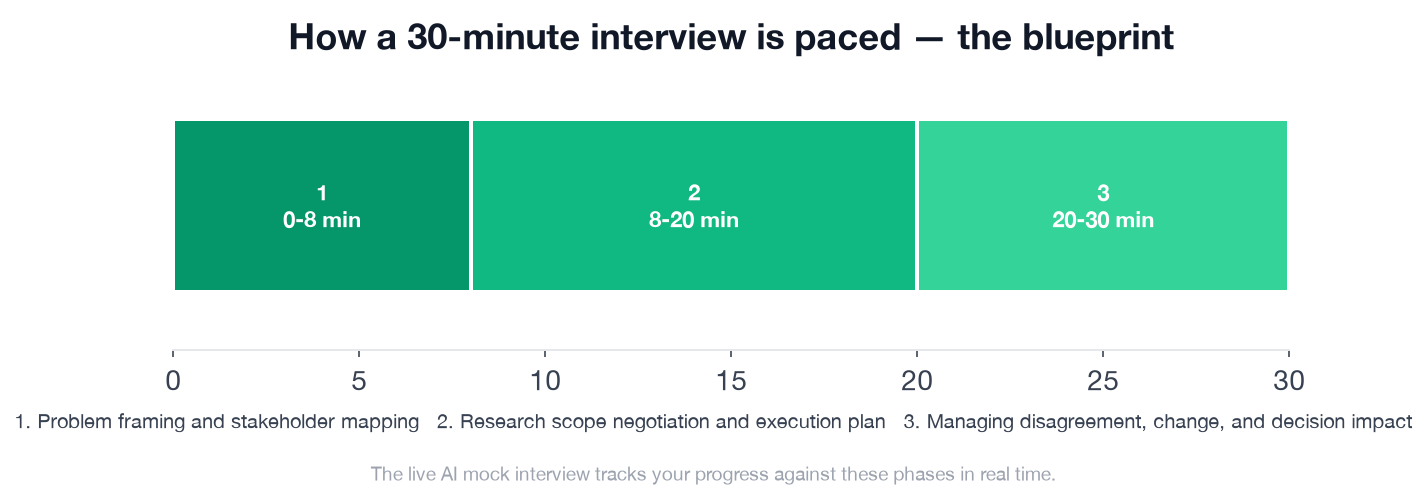 Eight minutes to frame the decision, twelve to negotiate scope, and ten to handle disagreement and communicate the recommendation.
This is the blueprint a strong candidate hits, and it is the exact structure the AI mock interview tracks a candidate against in real time, phase by phase, checklist item by checklist item.
- ✓Clarifies the launch decision or recommendation the research must inform
- ✓Names key cross-functional partners such as PM, design, engineering, and policy
- ✓Surfaces at least two concrete tensions, such as speed versus depth or launch needs versus broader learning
- ✓Acknowledges timeline and implementation constraints before selecting an approach
- ✓Proposes a realistic primary study appropriate for one-study capacity and an 8-week timeline
- ✓Separates critical launch questions from secondary requests and explains why
- ✓Describes how they would secure alignment on scope before execution begins
- ✓Includes a practical communication cadence such as kickoff, mid-study checkpoint, and readout
- ✓Accounts for engineering feasibility and policy concerns in the study design or participant tasks
- ✓Explains how they would handle late-breaking requests without losing study integrity
- ✓Shows a concrete approach to pushback or escalation when alignment cannot be reached
- ✓Describes how mixed findings would be translated into a usable launch recommendation with trade-offs
- ✓Mentions follow-through steps to ensure findings are adopted or reused after the launch decision
Take the Live Version of This Interview
Reading four dramatized answers is not the same as building the reflex to defer a request, re-scope a study, or deliver a conditional recommendation while someone is waiting on you to speak. The fastest way to build that reflex is to run this exact scenario, at this exact level, against InterviewStack.io's AI mock interview, which scores you turn by turn against the same rubric and blueprint used in this post. If you want to drill the underlying judgment calls first, the Research Collaboration and Stakeholder Management question bank breaks the same scenario down into individual, practiceable questions, and the Design Researcher preparation guides cover how this bar shifts at other levels. Once the scope is negotiated, the harder question is often which method actually answers it, a scenario this walkthrough on research methodology selection and trade-offs covers in depth.
FAQ
Q. What does a Design Researcher interview on research prioritization and stakeholder management actually test?
It tests whether you can turn competing stakeholder demands into a single research plan that actually delivers a launch decision, not whether you know research methods. Interviewer Objectives Alignment and Level-Specific Expectations are each worth 30 of the 100 points, so failing to prioritize and negotiate scope costs more than picking the wrong method ever would.
Q. How do you prioritize research questions when multiple teams want different things?
Tie every candidate question back to the one launch decision the study has to inform, then separate what would change that decision from what is merely interesting. The interview's scope-negotiation phase, minutes 8 to 20, specifically grades whether you can explain out loud why a request got deferred rather than silently dropping it or silently folding it in.
Q. What if a stakeholder like a policy partner joins the process late with new concerns?
Bring them in through the same decision-framing you used with everyone else: what specific concern needs to be tested, and can the existing study answer it rather than triggering a full re-scope. Treating a late stakeholder as a disruption instead of an addressable input is a common way candidates lose time they do not have inside an 8-week window.
Q. How should a Design Researcher make findings have impact beyond one launch decision?
Document decisions and rationale somewhere other teams can reuse, and proactively flag findings relevant to adjacent work even when they do not affect the immediate yes-or-no call. The interview's final phase specifically rewards this kind of follow-through, not just a clean handoff to leadership.
Q. What happens if the research findings come back mixed instead of a clean yes or no?
A strong answer resists forcing false certainty and instead frames a conditional recommendation, such as shipping with named mitigations or shipping to a narrower audience with monitoring, while stating plainly what remains unknown. The rubric's Communication and Problem Solving dimension, worth 20 points, specifically grades this kind of structured honesty under ambiguity.
Q. How many stakeholders does this interview scenario ask a candidate to manage?
Four: a product manager who wants fast directional signal, a design partner who wants deeper trust and usability findings, an engineering partner who can only accommodate small changes this late, and a policy partner concerned about a visibility setting, all competing for the output of one study.
Q. How is this AI mock interview scored?
Across four dimensions worth 100 points total: Interviewer Objectives Alignment (30), Level-Specific Expectations (30), Technical Proficiency (20), and Communication and Problem Solving (20), tracked in real time against a phased blueprint like the one in this post.
Choosing What Not to Study Is the Real Skill
Nothing in this scenario rewards the candidate with the most thorough study design. It rewards the candidate who names a single decision early, defends a scope out loud, adapts it when engineering changes the ground the plan stood on, and still delivers a recommendation leadership can act on even when the data refuses to be clean. That is a rehearsable skill, and the version of this interview waiting for you live is the fastest way to rehearse it.
Topics
Ready to practice?
Put what you've learned into practice with AI mock interviews and structured preparation guides.