
Many Design Researchers who stumble on a project ownership question do not lack experience. They lack the word "I." They describe what "the team" aligned on, what "we" explored, what "the study" found, and the interviewer is left wondering what the candidate personally decided.
This walkthrough is a simulated mid-level Design Researcher interview on research project ownership, built from a real AI mock interview blueprint on InterviewStack.io. Any candidate answers shown are dramatized and illustrative, not a transcript of a real person.
Key Findings
- The interview is scored out of 100 points: 30 for interviewer objectives, 30 for level-specific expectations, 20 for technical proficiency, 20 for communication and problem solving.
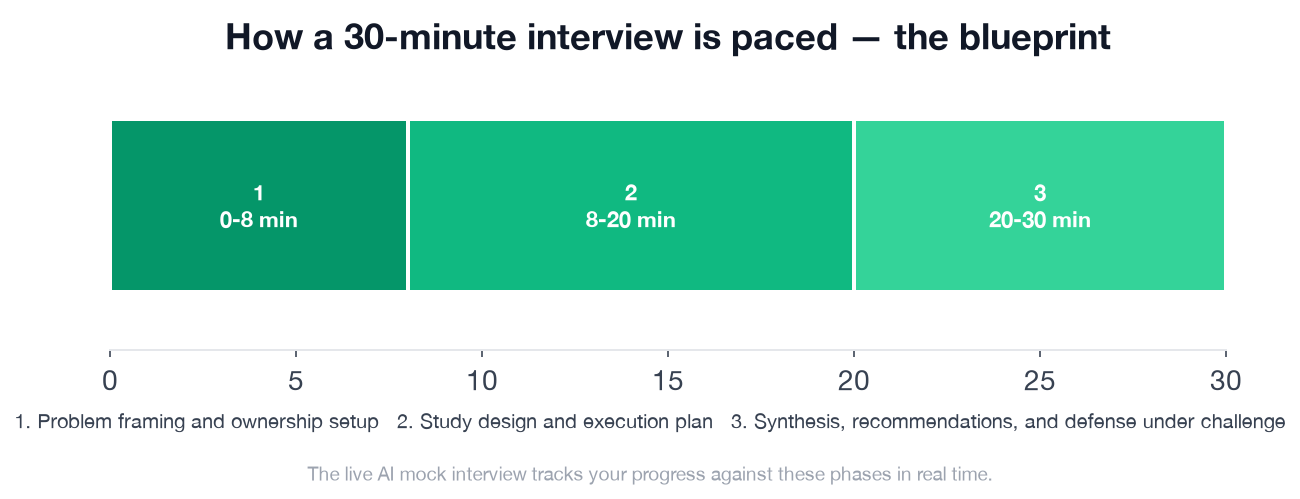
- The simulated interview runs 30 minutes across 3 phases: framing (minutes 0-8), study design (8-20), and synthesis and defense (20-30).
- Study design gets the longest phase: 12 of 30 minutes, 40% of the clock.
- 1 of the 5 Phase 1 checklist items is pure ownership language: speaking in actions you would personally drive, not what "the team" might do.
- Phase 3 requires an explicit evidence threshold for launch, iterate, or follow-up research, one of 6 checklist items.
- The scenario packs 4 competing hypotheses (motivation, comprehension, trust, implementation quality) into a 1-quarter timeline.
What Is a Design Researcher Project Ownership Interview Really Asking?
The interviewer is not asking for a methods lecture. They want to hear you turn a messy disagreement into a decision someone can make before launch, then show you would drive the work yourself. Here is the question as the AI interviewer poses it.
The interview question
You are supporting a product team at a large consumer tech company. The team plans to launch a redesigned onboarding flow for a creator-facing mobile product in one quarter. Early metrics suggest sign-up completion is flat, but activation into the first meaningful creator action is down for newer users in the latest prototype tests. Product, design, and engineering disagree on whether the issue is motivation, comprehension, trust, or simply implementation quality. The team wants research quickly, but they also want confidence that the findings will influence a go/no-go decision before launch.
Tell me about how you would own a research project end to end in this situation, from framing the problem through delivering recommendations the team could act on before launch.
The objectives behind it: independent ownership from ambiguous ask to delivery, sound prioritization and risk management, and personal accountability rather than vague team-level description. Mid-level means you run a moderately ambiguous project with limited oversight. You are not expected to redesign product strategy.
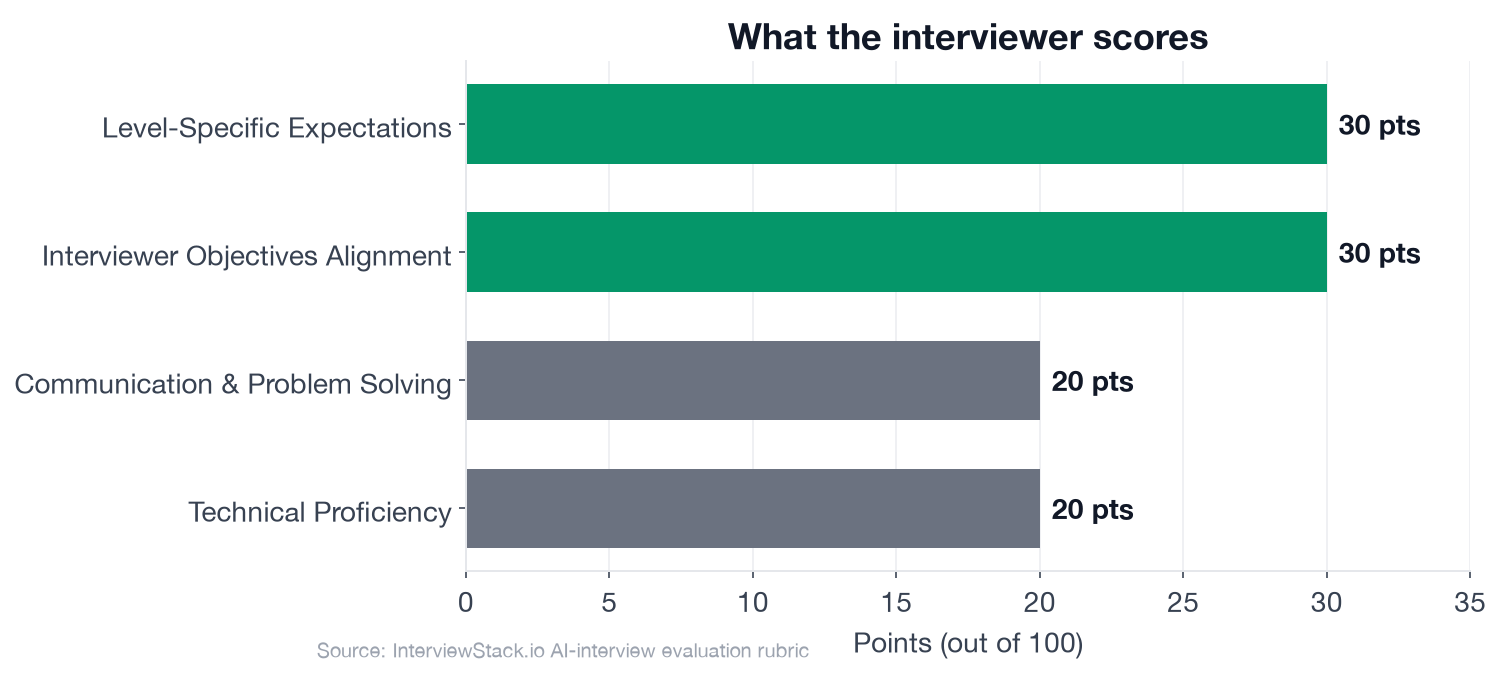
Three fifths of the points (60 of 100) sit in objectives and level expectations, so ownership and judgment outweigh method trivia.
The Walkthrough: Four Turns Where Points Leak
Turn 1: Scope creep after kickoff
Interviewer: "How would you narrow the research scope if stakeholders kept adding questions after kickoff?"
Turn 2: Speed versus rigor
Interviewer: "What would your study design look like, and how would you decide between faster directional work and more rigorous evaluative research here?"
Turn 3: Slow creator recruiting
Interviewer: "Suppose recruiting creator participants turns out to be slower than expected. How would you manage that risk without compromising the decision timeline?"
Turn 4: The PM pushes back
Interviewer: "If a PM challenged your conclusion by pointing to flat sign-up completion metrics, how would you reconcile the behavioral data with your research findings?"
Why Isn't Reading This Enough?
Spotting these mistakes on the page is easy. Avoiding them live is hard, because the interviewer interrupts, changes constraints, and pushes on whatever you said least precisely. Under a running clock, "the team" creeps back into your sentences without you noticing.
That habit only breaks with reps. Saying a scope-defense answer out loud, hearing a follow-up you did not script, and recovering from it is a different skill from knowing the right answer.
The Complete Blueprint: What a Strong Interview Hits
Here is the 30-minute blueprint a strong candidate covers, phase by phase. It mirrors the live Blueprint the AI mock interview tracks you against in real time.
- ✓Clarifies the product decision to be informed before discussing methods
- ✓Identifies key ambiguity in the prompt and proposes a manageable scope
- ✓States what success would look like for the research project itself
- ✓Describes who needs alignment early and what decisions would be locked at kickoff
- ✓Speaks in terms of actions they would personally drive, not just what 'the team' might do
- ✓Selects a method or sequence of methods that fits the timeline and decision stakes
- ✓Explains target participants, sampling logic, and recruitment feasibility
- ✓Describes concrete study tasks, stimuli, or data sources they would use
- ✓Calls out likely execution risks such as recruitment, prototype instability, or stakeholder scope creep
- ✓Provides mitigation plans that preserve decision usefulness within the quarter
- ✓Distinguishes what can be learned directionally versus what would require stronger evidence
- ✓Explains how findings would be prioritized and tied to launch decisions
- ✓Defines what recommendation outputs stakeholders would receive and when
- ✓Describes how they would handle conflicting signals between metrics and qualitative findings
- ✓Shows an evidence threshold for recommending launch, iteration, or deeper follow-up research
- ✓Defends conclusions with specific reasoning rather than vague appeals to user empathy
- ✓Acknowledges limitations and proposes responsible next steps after delivery
Practice It Live
Run this exact scenario in the AI mock interview for the Design Researcher project ownership topic. You get unscripted follow-ups, real-time tracking against the checklist above, and a score on all four rubric dimensions. Try it once cold, then again after fixing your weakest phase.
To drill more topics for this role first, work through the Design Researcher question bank, browse interview prep guides, or see the sibling walkthrough on research methodology selection and trade-offs. If you are also job hunting, browse current Design Researcher openings.
FAQ
Q. What does a Design Researcher project ownership interview test?
It tests whether you can take an ambiguous product concern, turn it into a researchable decision, run the study under real constraints, and defend your recommendation under pushback. The mock interview scores you out of 100 points, with 30 each for interviewer objectives and level-specific expectations.
Q. How long is the interview and how is it paced?
The simulated interview runs 30 minutes in three phases: problem framing and ownership setup (minutes 0-8), study design and execution plan (8-20), and synthesis, recommendations, and defense under challenge (20-30).
Q. What do interviewers expect from a mid-level Design Researcher?
Independent ownership of a moderately ambiguous project, sound judgment in adapting standard methods, proactive risk identification, and the ability to go deep on one concrete plan. Cross-org influence and executive alignment may still require support at this level.
Q. How do I show ownership instead of describing team activity?
Name the decisions you would make yourself, the risks you would anticipate, and the mechanisms you would use to keep the project on track. Phrases like "the team would align" score worse than "I would lock scope with the PM at kickoff."
Q. What should I do if stakeholders keep adding research questions?
Tie every question back to the one launch decision the research must inform, then park the rest in a written backlog with an explicit trade-off. Scope is defended by the decision, not by saying no.
Q. How do I reconcile qualitative findings with a PM's conflicting metrics?
Treat the metric as evidence about what happened and the research as evidence about why. Explain what each can and cannot show, then state which result would change your recommendation.
Q. How can I practice this interview live?
Start the AI mock interview for this exact scenario on InterviewStack.io. It asks unscripted follow-ups, tracks you against the phase checklist in real time, and scores you on the four rubric dimensions.
Say "I" Before the Interviewer Asks
Own the decision, own the risks, and own the recommendation, out loud. The checklist rewards the candidate who says what they would personally do, and the fastest way to build that reflex is to practice it against an interviewer who will not let you hide behind "we."
Topics
Ready to practice?
Put what you've learned into practice with AI mock interviews and structured preparation guides.