
Same commit, two different JARs. That is what the interviewer slides across the table in a mid-level DevOps Engineer build automation interview, and you have 30 minutes to explain why it happens and how to stop it. You know Maven, Gradle, registries, and semver. The points you lose are the ones you never see coming: a pinned dependency with no update path, a cache with no clean-build proof, a minor release that breaks a downstream team.
This post walks one interview turn by turn, using a real AI mock interview blueprint. The answers are dramatized and illustrative, never a transcript of a real person or a real company's questions.
Key Findings
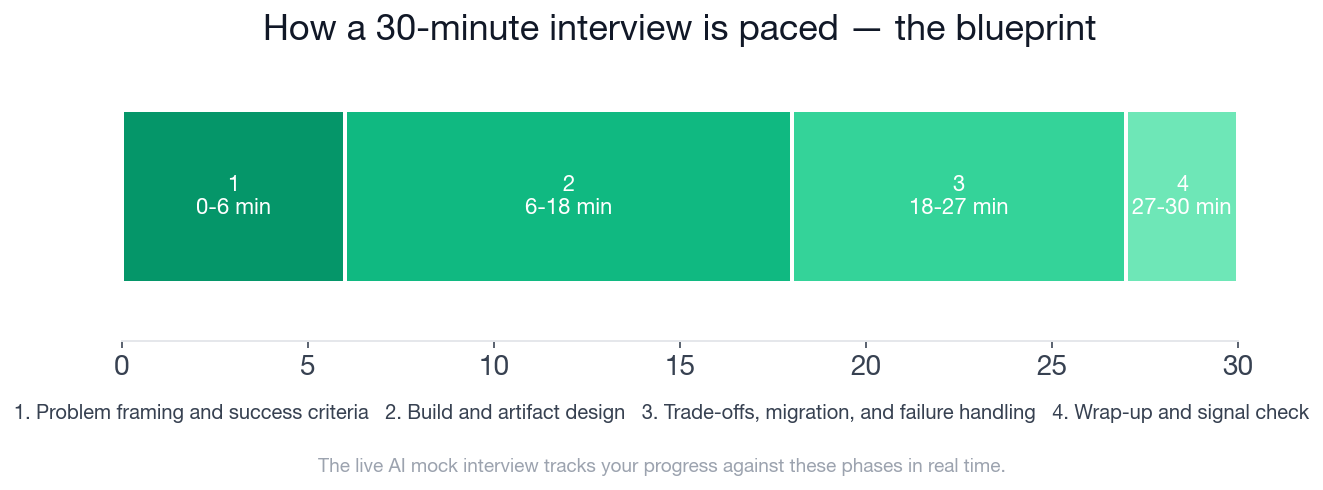
- The interview runs 30 minutes across 4 phases, and the deepest one, build and artifact design, takes 12 of those minutes (minutes 6-18).
- Scoring totals 100 points: 30 objectives alignment, 30 level-specific expectations, 20 technical proficiency, 20 communication.
- Only 20 of 100 points reward technical accuracy; 60 reward addressing the interviewer's objectives and showing mid-level judgment.
- The design phase checks 6 items, from lockfiles and immutable storage to library versus service versioning.
- The trade-offs phase checks 5 items, including a compatibility guard and a phased migration instead of a big-bang switch.
- Framing gets just 6 minutes, yet it holds 4 checklist items that set up everything after it.
What Is the DevOps Engineer Build Automation Interview Really Asking?
Not for a tool tour. The prompt gives you a Java service built dozens of times a day, and the pain list is specific.
The interview question
A backend platform team owns a Java service that is built dozens of times per day by multiple engineers and CI jobs. The team currently has these pain points: builds are slow and sometimes fail because dependencies resolve differently between laptops and CI; the same commit occasionally produces different outputs; application JARs are stored inconsistently across shared storage and a legacy artifact server; container images are built in different ways by different repos and are hard to trace back to source; downstream teams consume shared libraries from this team and have complained about unexpected breaking changes.
Your task is to propose how you would standardize the build automation and artifact management approach for this team over the next quarter. How would you design that build and artifact strategy so the team can produce reproducible, versioned deployable artifacts and container images reliably at scale?
The interviewer is probing whether you can design a team-level workflow with pragmatic trade-offs, communicate with developers, and name failure modes, without drifting into release orchestration. Clarify first: libraries, applications, or both? Who consumes the output? What constraints does CI impose? Then tie your plan to the question bank practice you have already done.
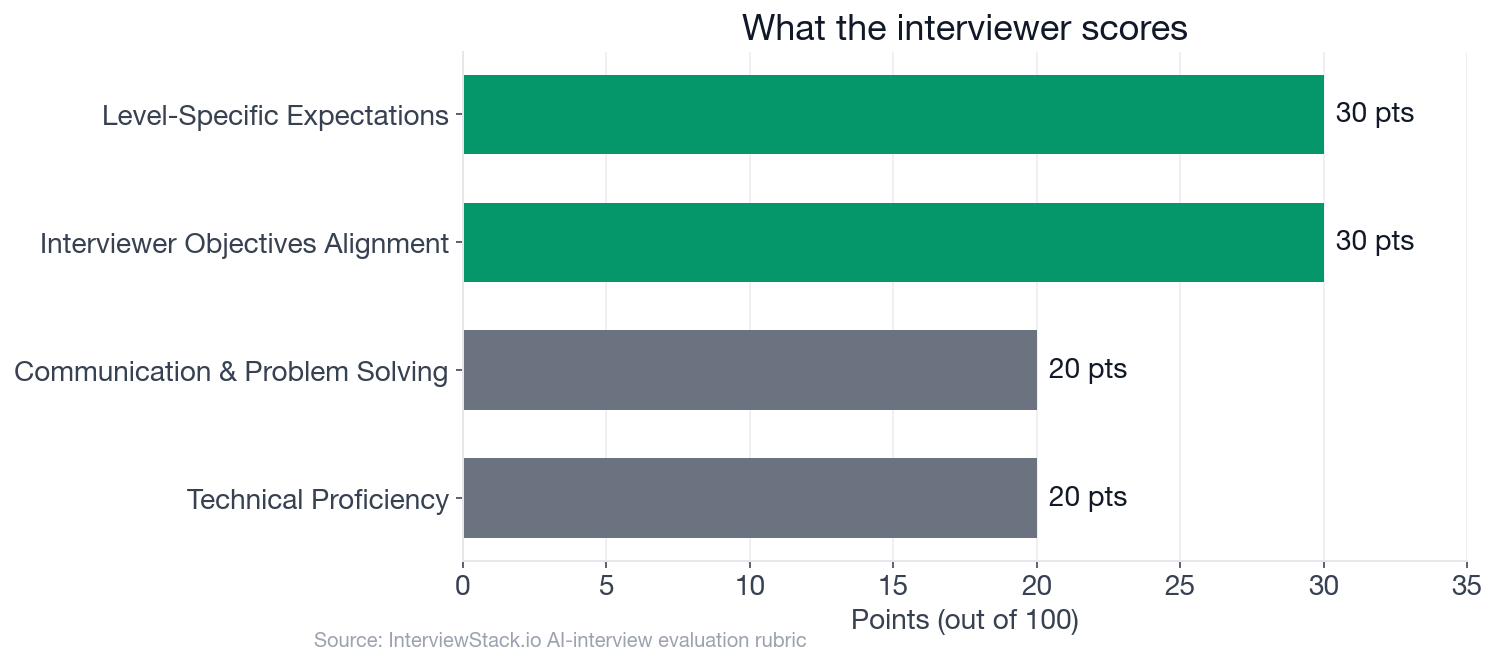
The weights explain why a technically correct answer can still score mid-pack: judgment and fit carry most of the points.
Where Do Prepared Candidates Lose Points?
Four follow-ups, four mistakes. Each maps to a rubric dimension or checklist item.
Turn 1: Pinning Without Control
Interviewer: "How would you make dependency resolution deterministic across developer machines and CI while still allowing teams to receive security updates in a controlled way?"
Turn 2: One Scheme For Everything
Interviewer: "If the team publishes both internal libraries and deployable services, how would you handle versioning and compatibility expectations differently for each?"
Turn 3: Cache Without Safeguards
Interviewer: "Suppose build times become a bottleneck after standardization. Where would you introduce caching, and what safeguards would you put in place so cache usage does not hurt reproducibility?"
Turn 4: Minor Bump, Major Break
Interviewer: "A downstream team says a minor version upgrade broke them. How would you prevent, detect, and respond to that kind of compatibility issue in the build and publishing process?"
Why Isn't Reading This Enough?
You just spotted four mistakes in a few minutes, with the rubric in view and no clock running. Live, you will be mid-sentence on lockfiles when the interviewer asks about a downstream break you did not plan for. Recognizing a gap on a page is easy. Closing it while someone watches, under time pressure, is a different skill, and it only comes from reps. The AI mock interview gives you those reps on this exact topic, and the DevOps Engineer question bank is where you drill the individual pieces. For the adjacent pipeline topic, see the CI/CD pipelines walkthrough.
What Does the Complete Blueprint Look Like?
This is the blueprint a strong candidate hits across the 30 minutes, and it is exactly what the AI mock interview tracks you against in real time.
- ✓Clarifies whether the team publishes libraries, applications, or both
- ✓Distinguishes build/artifact management from deployment orchestration
- ✓Calls out reproducibility, traceability, and compatibility as explicit goals
- ✓Asks at least one question about developer workflow or CI constraints
- ✓Describes a standardized build path for CI and local development using the same build tool and consistent environment
- ✓Proposes deterministic dependency handling such as lockfiles, pinned versions, controlled mirrors, or internal proxies
- ✓Defines where artifacts are stored and how immutable versions are separated from mutable aliases or tags
- ✓Explains how container images are built from versioned binaries or reproducible source inputs and stored in a registry
- ✓Includes traceability metadata such as commit SHA, build ID, dependency manifest, version, and build timestamp policy
- ✓Differentiates handling of library versioning from service image tagging
- ✓Discusses safe migration from legacy storage to a central repository without breaking consumers
- ✓Identifies at least one compatibility guard such as API checks, consumer tests, or semver enforcement expectations
- ✓Explains caching opportunities and associated risks to reproducibility
- ✓Mentions retention, cleanup, or immutability policies for artifacts and images
- ✓Prioritizes a phased rollout rather than a big-bang replacement
- ✓Summarizes the proposed approach in a clear end-to-end sequence
- ✓Names the highest-value first steps for the next quarter
- ✓Acknowledges one or two key risks or open questions
Start Your Mock Interview
Pick the mock interview first, then reinforce it.
- Start the AI mock interview for this blueprint: DevOps Engineer, mid-level, Build Automation and Artifact Management, 30 minutes, with follow-ups you cannot predict.
- Drill the question bank for the weak spots the mock surfaces.
- Read the DevOps Engineer prep guides for role context, or browse open DevOps Engineer roles to see what employers ask for.
FAQ
What does a DevOps Engineer build automation and artifact management interview test?
It tests whether you can standardize how a team turns source into versioned, traceable, deployable units: reproducible builds, dependency control, artifact repositories, container images, and versioning for libraries versus services. Release orchestration is deliberately out of scope. In this blueprint, Interviewer Objectives Alignment and Level-Specific Expectations are worth 30 points each.
How long is this mock interview and how is it scored?
The blueprint runs 30 minutes across four phases: framing (0-6), build and artifact design (6-18), trade-offs and migration (18-27), and wrap-up (27-30). Scoring totals 100 points: 30 for objectives alignment, 30 for level-specific expectations, 20 for technical proficiency, and 20 for communication and problem solving.
How do you make builds reproducible?
Start by removing the sources of drift: lock and pin dependencies, resolve them through one controlled proxy or mirror, build in the same standardized environment on laptops and CI, and set deterministic build options. Then publish immutable artifacts with metadata so any output can be traced to exact inputs.
Should libraries and deployable services be versioned the same way?
No. Libraries are consumed by other teams, so semantic versioning and compatibility checks matter most. Services are deployed, so a unique immutable image identity tied to a commit and build matters most, with mutable tags kept as convenience aliases.
What metadata should every published artifact carry?
At minimum the commit SHA, build ID, version, dependency manifest, and a stated policy for build timestamps. For container images, link the image back to the exact binary and source it was built from, so another team can trace it without asking you.
What level is this interview aimed at?
Mid-level (2-5 years). You should design a solid team-level solution with common tooling and make pragmatic trade-offs. Deep supply-chain security architecture and organization-wide policy frameworks are not expected.
How do I practice this live?
Run the AI mock interview for this exact role, level, and topic. It tracks you against the same four-phase blueprint in real time and asks unscripted follow-ups, which is the part reading cannot replicate.
One Commit, One Artifact
If you can explain why the same commit must always yield the same output, and how you would prove it, you are already ahead of most mid-level answers. Go test that claim live.
Topics
Ready to practice?
Put what you've learned into practice with AI mock interviews and structured preparation guides.