
You're Not Scored on the Fix Yet
From the first minute of a mid-level DevOps Engineer interview on Linux command line and shell fundamentals, you're SSH'd into a host behind a load balancer, and a service called api-gateway is flagged unhealthy. The interviewer's question asks you to investigate and stabilize it, but the first 8 minutes are scored purely on how you investigate, and that distinction is worth more than it sounds. The rubric's first checklist item isn't a command at all: it's whether you confirm the reported symptom before you touch a single file or process, and most candidates blow past it in the first thirty seconds because "just restart it" is the fastest sentence in the room.
That instinct is exactly what InterviewStack.io's AI mock interview is built to catch. Interviewer Objectives Alignment and Level-Specific Expectations carry 60 of the 100 rubric points between them, more than double Technical Proficiency, and both reward the same thing: a coherent, verify-before-you-act investigation sequence you propose without being told which Linux areas to check. Get that sequence right and the exact commands, systemctl, journalctl, grep, awk, barely matter. Get it wrong and no amount of correct syntax saves the score.
Key Findings
- Interviewer Objectives Alignment and Level-Specific Expectations each carry 30 of the interview's 100 rubric points, 60 combined, versus 20 each for Technical Proficiency and Communication and Problem Solving.
- The interview runs 30 minutes across 3 phases: initial investigation plan (0-8 min), deep dive with shell tooling (8-20 min), stabilization and repeatability (20-30 min).
- The 8-20 minute phase is the longest at 12 minutes, but its 5 checklist items tie exactly with each of the other two phases, no phase carries more.
- 15 expected checklist items span the 3 phases (5 per phase), each graded whether or not the interviewer had to prompt for it.
- The interviewer draws from 6 real follow-up prompts; this walkthrough dramatizes 4 of them.
- 4 skill areas are explicitly out of scope: Kubernetes orchestration internals, infrastructure-as-code implementation, kernel-level debugging, and distributed-system redesign.
- The scenario hands the candidate exactly 19 named shell tools and nothing else: no netstat, no cloud console, just bash-native inspection commands.
This Is What the DevOps Engineer Linux Command Line and Shell Interview Actually Grades
Here's the scenario as it's actually presented, tool list and all.
The interview question
You're SSH'd into a Linux application host sitting behind a load balancer during a live onsite round. A service named "api-gateway" is reported unhealthy on this node, and you have standard shell access as an engineer in the ops group. You should avoid any action that could make the incident worse.
# Tools available on this host
bash, systemctl, journalctl, ps, grep, awk, sed, sort, uniq, cut,
find, xargs, tail, less, cat, chmod, chown, kill, curl
You're the first engineer to look at this host during the incident. Walk me through how you would use the Linux command line to investigate and stabilize the problem, and describe the commands or small shell workflow you would rely on.
The interviewer is watching how you navigate logs and the filesystem, chain core utilities with pipes and redirection instead of reaching for one monolithic command, reason about process state and permissions, and decide when an ad hoc investigation should become a safe, repeatable workflow. Production safety runs through all of it: read-only inspection first, commands scoped to what's recent, and no bulk action taken without a way to verify it worked. The scope stays deliberately narrow, too. Kubernetes orchestration, infrastructure-as-code implementation, kernel-level debugging, and distributed-system redesign are all out of bounds; this is a single-host shell investigation, nothing more.
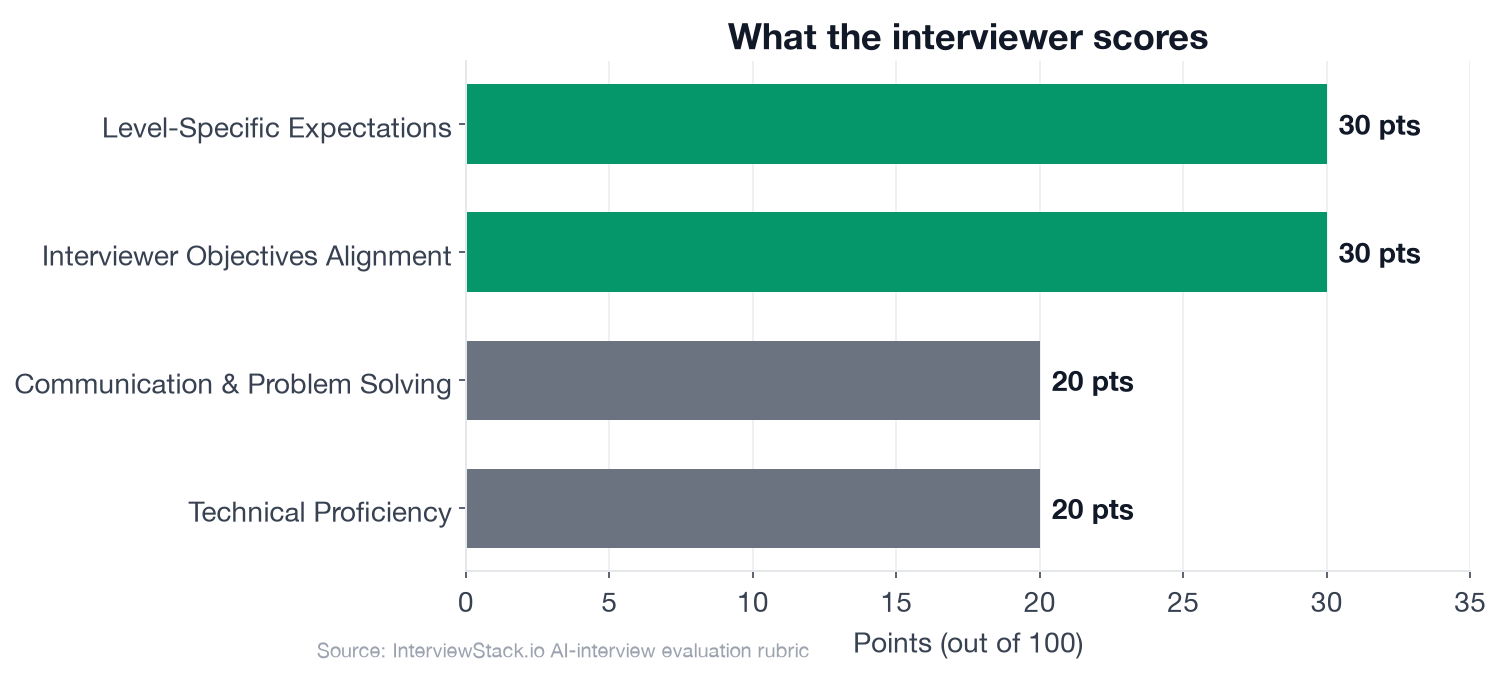 Interviewer Objectives Alignment and Level-Specific Expectations each carry 30 of the 100 points, one and a half times the weight of either Technical Proficiency or Communication and Problem Solving, so how you frame the investigation matters more than which command you reach for first.
The Turns That Decide Whether You Investigated or Just Reacted
Four of the six follow-ups below share one thread: each hands the candidate a reason to act immediately, and each rewards checking first instead. We'll call the candidate Malik.
Turn 1: Healthy Service, Unhealthy Node
Interviewer: "If the service appears to be running but the node is still marked unhealthy by the load balancer, what would you check next from the shell?"
Turn 2: Fifteen Minutes Inside Rotated Logs
Interviewer: "Suppose the logs are very noisy and rotated across multiple files; how would you quickly isolate the most relevant errors from the last 15 minutes?"
Turn 3: The Forceful Signal Reflex
Interviewer: "If you suspect the process is stuck or consuming unexpected resources, what commands would you use to validate that and what signals, if any, would you consider sending?"
Turn 4: The Script That's Just a Restart Button
Interviewer: "After you've identified the root cause, how would you turn your manual investigation into a short, reusable shell script for future incidents?"
What Happens When the Load Balancer Won't Wait for You to Think?
Every mistake above is easy to spot once it's printed in a red box with the fix sitting three inches below it. Live, you don't get the box. You get an interviewer who just asked a follow-up you didn't rehearse, a health check that's still failing while you're mid-sentence, and a clock that's the same 30 minutes whether you spend the first 8 confirming the symptom or skip straight to a command you're not sure will help. The habit Malik keeps missing, verify before you touch anything, sounds obvious on the page and disappears the moment the pressure is real. Reps under that exact pressure are the only thing that makes it stick.
How Does the Blueprint Score the Pause Before the Fix?
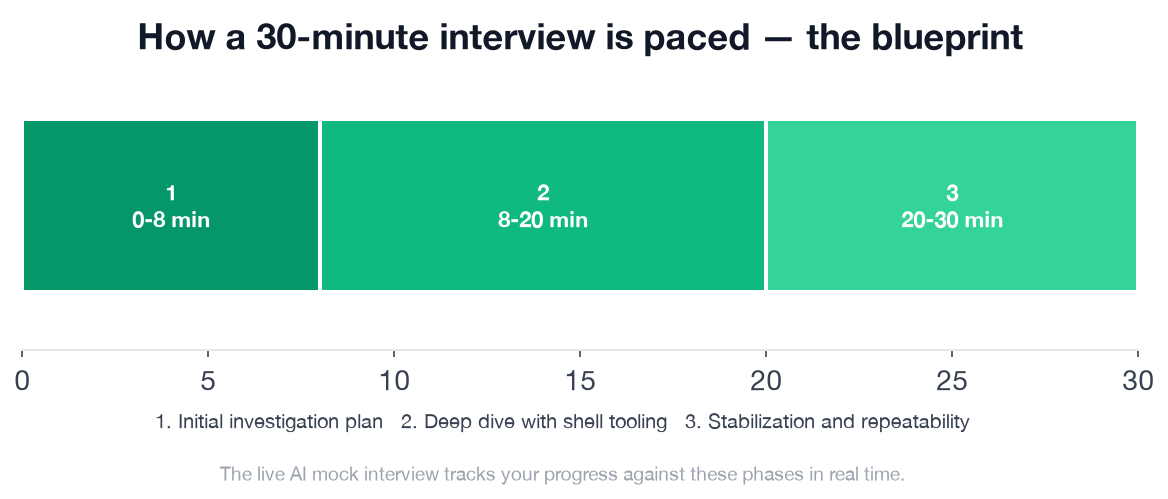 The 30-minute interview paces from a read-only investigation plan through deep shell tooling into stabilization, and the checklist inside each phase is exactly what the live AI mock interview tracks in real time while you talk.
Below is the actual blueprint this scenario is scored against, phase by phase, checklist item by checklist item.
- ✓States they would confirm the reported symptom before changing anything
- ✓Mentions checking service status with a command such as systemctl status or equivalent
- ✓Mentions inspecting recent logs with bounded time or line windows rather than dumping everything
- ✓Checks whether the process exists and whether it matches expected state, not just PID presence
- ✓Includes a basic local verification step such as curl to a health endpoint, local port check, or checking recent failures from journald
- ✓Describes concrete command pipelines to isolate errors, counts, top offenders, or recent events
- ✓Shows awareness of rotated logs or multiple log sources and proposes a practical way to search them
- ✓Explains how to verify a permissions issue using ownership and mode inspection before changing chmod or chown
- ✓Differentiates between graceful and forceful process actions and ties signal choice to observed state
- ✓Mentions checking for common host-side issues that can surface in shell workflows, such as disk space, inode pressure, or file path problems
- ✓Proposes a minimal-risk remediation path tied to the diagnosed issue rather than a reflexive restart only
- ✓Describes how they would verify recovery using both service state and functional checks
- ✓Outlines a small bash script or function with ordered checks, readable output, and simple guardrails
- ✓Includes basic script hygiene such as quoting variables, checking command success, or exiting on failure
- ✓Explains when they would escalate, roll back, or stop if the host shows unexpected behavior
A strong answer hits all 15 items without needing the interviewer to name a single one of them, which is exactly what "should independently propose a reasonable debugging sequence" means in practice.
Practice the Incident Before It's Live
Reading Malik's mistakes is not the same as catching your own mid-sentence with an interviewer waiting on the other end. Start a live AI mock interview scoped to DevOps Engineer, mid-level, Linux Command Line and Shell, and you'll be scored against this exact blueprint while you talk through your own version of the api-gateway incident. If you want to drill the underlying commands first, the question bank breaks the topic into individual questions, and the preparation guide library has structured, company-specific prep if you're aiming at a particular employer. We've also broken down the containerization side of this role if Docker fundamentals are next on your list.
FAQ
Q. What does a DevOps Engineer Linux command line interview actually score at the mid-level?
Interviewer Objectives Alignment and Level-Specific Expectations each carry 30 of the 100 rubric points, 60 combined, more than Technical Proficiency and Communication and Problem Solving (20 points each) put together. That weighting rewards independently proposing a sound investigation sequence and showing production-safe judgment, not reciting command syntax.
Q. How long is this interview and how is the time split?
30 minutes across three phases: initial investigation plan (0-8 minutes), deep dive with shell tooling (8-20 minutes), and stabilization and repeatability (20-30 minutes). The middle phase is the longest at 12 minutes, though its checklist load, 5 items, ties with each of the other two phases.
Q. Is restarting the service ever the right first move?
Only after you've verified what's actually wrong. The rubric's Phase 3 checklist explicitly penalizes a reflexive restart that isn't tied to a diagnosed root cause, so an unverified restart costs Level-Specific Expectations points even if it happens to clear the incident.
Q. What Linux commands should I be fluent in for this interview?
The level-specific bar names systemctl, journalctl, ps, grep, awk, tail, find, chmod, chown, kill, and curl, combined meaningfully with pipes and redirection rather than run one at a time. The scenario itself limits you to 19 named tools, so knowing how to chain what's available matters more than knowing every flag.
Q. Do I need Kubernetes or Terraform knowledge for this interview?
No. Kubernetes-specific orchestration internals, infrastructure-as-code or Terraform implementation, kernel-level debugging, and distributed-system redesign are all explicitly out of scope. The scenario is a single host behind a load balancer, investigated entirely from the shell.
Q. How do candidates typically lose points on the permissions or process-signal questions?
The most common gap is acting before verifying: changing a file's mode or ownership without first checking what it currently is, or sending a forceful kill signal without checking whether the process would respond to a graceful one first. Both skip a named Phase 2 checklist item and read as guessing rather than diagnosing.
Q. Where can I practice this exact scenario?
Start a live AI mock interview scoped to DevOps Engineer, mid-level, Linux Command Line and Shell, or drill individual questions first in the question bank.
Verification Is the Whole Interview
Take away the specific commands and the api-gateway incident, and what's left is a habit: confirm before you touch anything, scope your inspection to what's recent and relevant, and only escalate to a change once you can explain why. Score that habit well and the syntax mostly takes care of itself.
Topics
Ready to practice?
Put what you've learned into practice with AI mock interviews and structured preparation guides.