
These Two Job Titles Share Almost No Skills. The Smaller Market Pays More.
DevOps Engineer and Mobile Developer both show up on the same "software engineering" org chart, but their skill profiles barely touch. Across every top-30 skill list we've compared in this series, these two roles now share the least: an 11% Jaccard overlap, the lowest of any pairing measured to date. We pulled every active DevOps Engineer posting (6,921) and Mobile Developer posting (2,983) on the InterviewStack.io job board as of July 2026, extracted skills, salary, seniority, and location from each, and compared them head to head.
The twist isn't just how little these roles share. It's that the smaller of the two markets pays more. DevOps Engineer has 2.32 times as many open postings as Mobile Developer, yet Mobile Developer's median US base salary runs $18,000 higher. Scale and pay don't move together here, and the skill data explains why.
| DevOps Engineer | Mobile Developer | |
|---|---|---|
| Median US base salary | $152,000 | $170,000 |
| Active postings analyzed | 6,921 | 2,983 |
| Top skill | CI/CD (66.9%) | Android (62.1%) |
| Remote share | 19.9% | 28.5% |
| Entry-level share | 2.1% | 2.2% |
| Skill overlap (Jaccard) | 11% shared (pairwise) | 11% shared (pairwise) |
Key Findings
- Skill overlap between DevOps Engineer and Mobile Developer is 11% (Jaccard on top-30 skills), the lowest measured across this comparison series.
- DevOps Engineer postings outnumber Mobile Developer postings 2.32x (6,921 vs. 2,983 active listings analyzed).
- Despite the smaller market, Mobile Developer's median US base salary is $170,000, $18,000 (11.8%) above DevOps Engineer's $152,000.
- Kubernetes appears in 55.8% of DevOps Engineer postings; Android appears in 62.1% of Mobile Developer postings. Neither shows up at meaningful frequency in the other role.
- Only 6 skills clear the 5% shared-frequency threshold for both roles, and none of them are either role's defining tool.
- Entry-level share is nearly identical: 2.1% for DevOps Engineer, 2.2% for Mobile Developer.
- Mobile Developer is more remote-friendly (28.5% remote) than DevOps Engineer (19.9% remote), though both roles are majority onsite (51%+).
What Each Role Actually Does
A DevOps Engineer builds and operates the automation, cloud infrastructure, and delivery pipelines that let other teams ship code safely and often. The day-to-day is Kubernetes clusters, Terraform-defined infrastructure, CI/CD pipeline configuration, and monitoring dashboards. The output is usually a working, observable production environment, not a user-facing feature.
A Mobile Developer builds the client that end users actually hold: an Android or iOS app, its screens, its offline behavior, its App Store or Play Store release cycle. The output is a shipped release version, reviewed by a platform vendor, running on someone's phone rather than in a data center.
One role operates the substrate that code runs on. The other ships the surface users touch. That split explains why the skill stacks barely intersect: browse current DevOps Engineer openings or Mobile Developer openings and you'll see the difference in the first five requirements listed.
One data note: role-matching on the keyword "mobile" occasionally pulls in unrelated postings, a French-language home-care listing and a mobile-crane-operator role both showed up in our Mobile Developer sample. These are a small minority and don't move the skill or salary findings below, but it's a reason to treat any single data point here as directional rather than exact.
What Skills Does Each Role Actually Require?
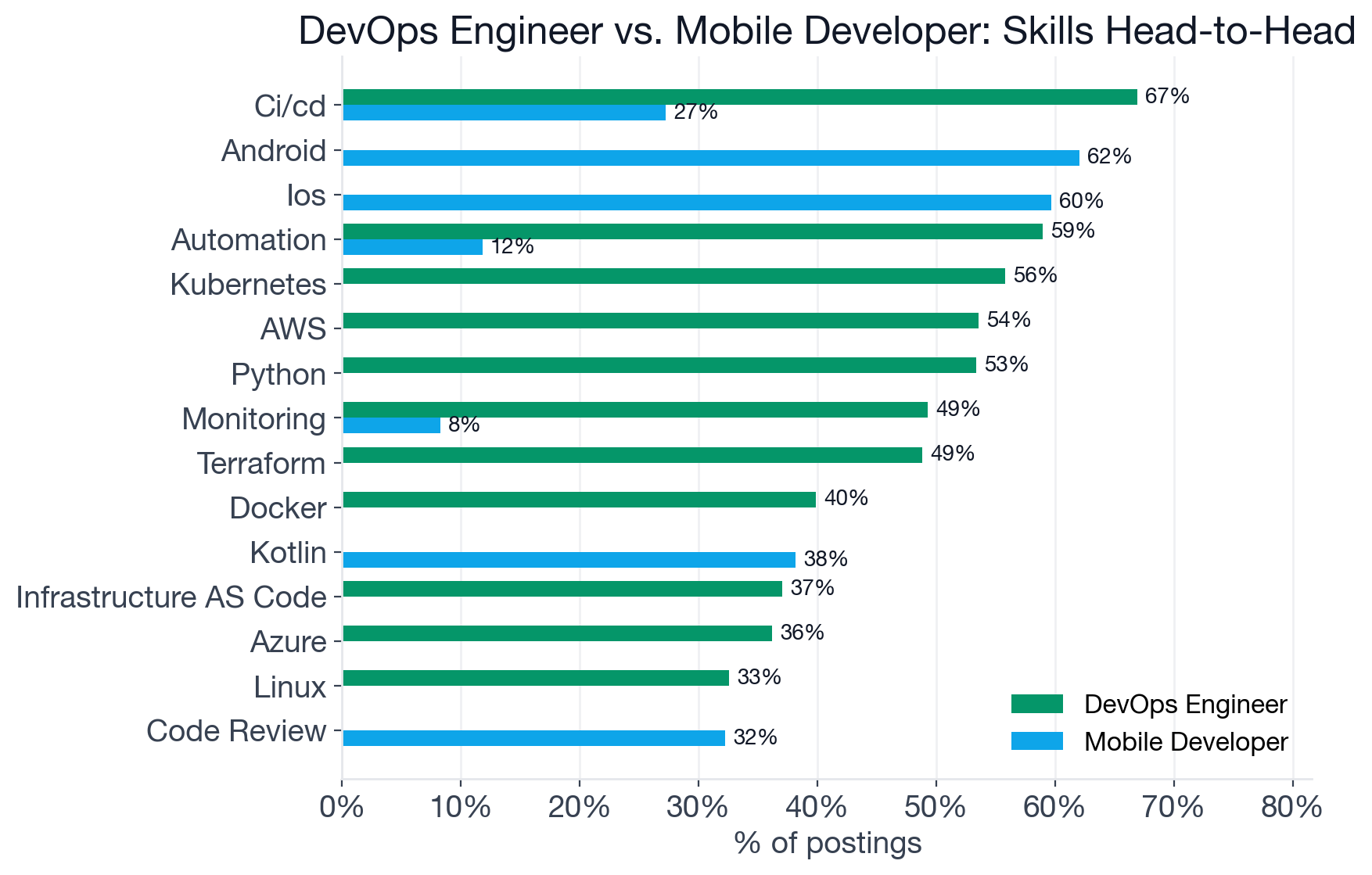 DevOps Engineer's top skills cluster around cloud infrastructure and automation; Mobile Developer's cluster around platform-specific app development. The two bars barely overlap.
Six skills clear the 5% shared-frequency bar in both roles' postings, but "shared" is generous. CI/CD (66.9% DevOps, 27.2% Mobile), Automation (58.9% vs. 11.8%), and Monitoring (49.3% vs. 8.3%) are really DevOps-driven habits that happen to clear Mobile Developer's floor, not skills both roles lean on equally. Only Agile (26.0% vs. 23.5%), Git (18.2% vs. 26.1%), and Java (14.4% vs. 22.2%) sit close enough in both roles to count as genuine common ground, and even those tilt slightly toward Mobile Developer.
The real story is in what each role requires that the other almost never does. DevOps Engineer's defining cluster is a cloud-infrastructure stack: Kubernetes (55.8%), AWS (53.6%), Python (53.4%), Terraform (48.8%), Docker (39.9%), Infrastructure as Code (37.1%), Azure (36.2%), and Linux (32.6%). Mobile Developer's defining cluster is a platform-specific app stack: Android (62.1%), iOS (59.7%), Kotlin (38.1%), Code Review (32.2%), Swift (31.7%), React Native (30.6%), User Experience (24.8%), and MVVM (22.4%, short for Model-View-ViewModel, a common architecture pattern for both Android and iOS apps).
None of Kubernetes, AWS, Terraform, or Docker shows up at meaningful frequency in Mobile Developer postings. None of Android, iOS, Swift, or MVVM shows up at meaningful frequency in DevOps Engineer postings. A DevOps background does not transfer to Mobile Developer hiring, and the reverse is equally true.
Neither Stack Lists AI as a Requirement. That Doesn't Mean Neither Uses It.
Neither role's top-30 skill list in this dataset carries an explicit AI, ML, or LLM entry at meaningful frequency. That is a real finding about what employers write into these two job descriptions, not a finding about whether the people doing this work touch AI tools day to day.
Job postings only name a skill when it's a stated requirement. GitHub Copilot, ChatGPT, Claude Code, and AI-assisted code review have become ambient expectations that most employers no longer bother to spell out, the same way "uses Git" stopped being listed years ago. Industry-wide, developer surveys put AI tool adoption at 84-90% (Stack Overflow 2025, Google/DORA 2025) and daily or heavy use around half of developers. For DevOps specifically, that ambient layer shows up concretely: Copilot retains a strong footprint in Microsoft-adjacent DevOps stacks, and the Perforce State of DevOps Report finds most practitioners expect AI to absorb routine work like YAML generation and alert triage rather than replace the role outright. No mobile-specific adoption survey exists to cite directly, so the same 84-90% figure should be read as an inferred floor for Mobile Developer, not a measured one.
Who Gets Paid More, DevOps Engineer or Mobile Developer?
Mobile Developer wins on salary, even with the smaller job market. Among US postings (where wage-transparency laws produce more consistent disclosure), the median Mobile Developer base is $170,000 against $152,000 for DevOps Engineer, a gap of $18,000. That's an 11.8% premium over the DevOps baseline. These are base-salary figures only; equity, bonus, and sign-on pay aren't disclosed in postings and aren't reflected here. The Mobile Developer sample (467 US data points) is smaller than DevOps Engineer's (1,342), so treat the gap as directionally solid rather than penny-precise. Several unrelated skills in the Mobile Developer breakdown (Java, RESTful APIs, Git, and others) share an identical $62,400 median, the signature of a cluster of fixed-rate outsourcing or nearshore-staffing listings rather than typical direct-hire pay. The reported $170,000 median already includes that cluster, so the real spread between staffing-agency and direct-hire pay in this market is likely wider than a single median suggests.
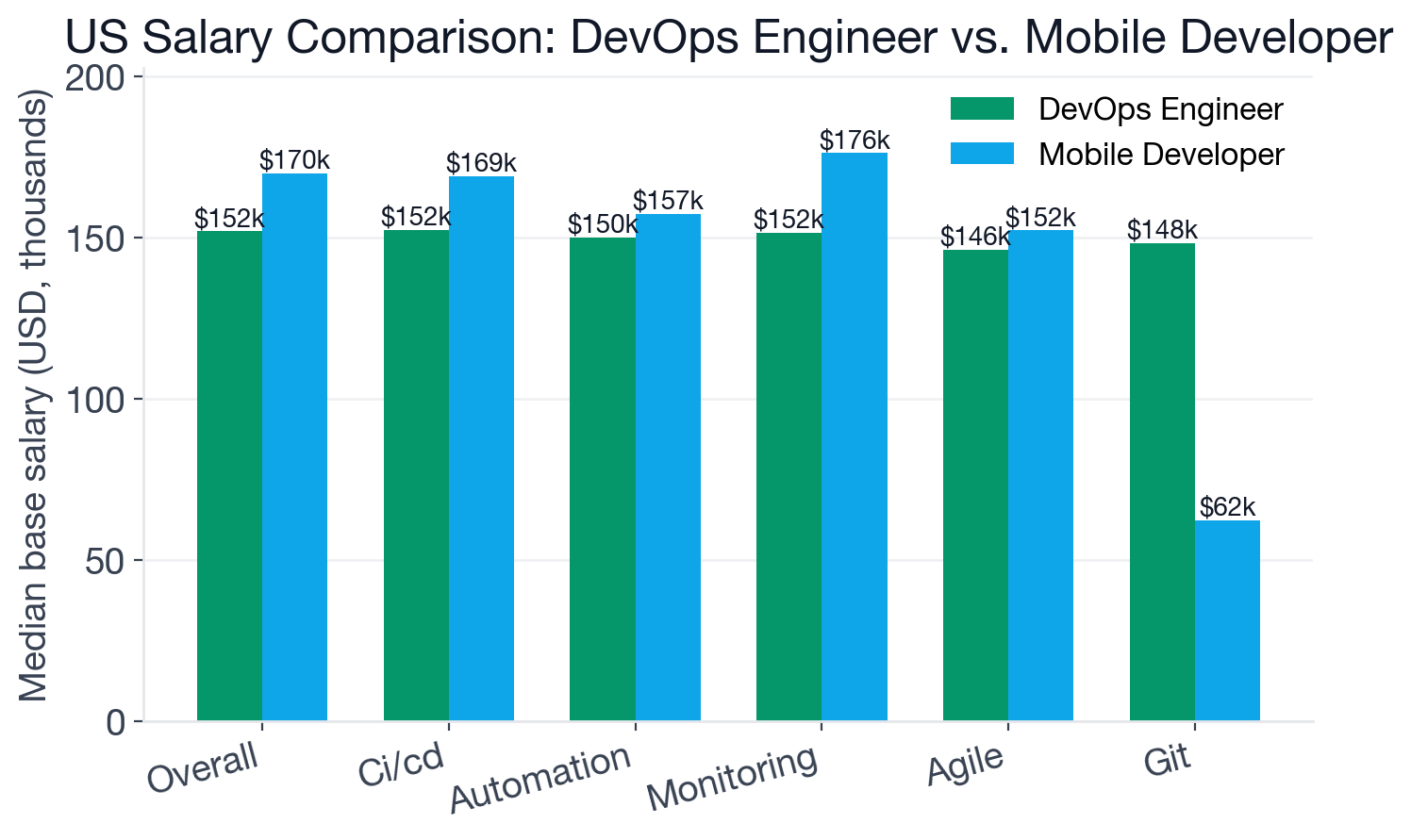 Overall median US base salary plus salary by skill for both roles. Neither role's own defining skill carries much of a premium; the real premiums sit one layer over.
What's notable in both roles is that the defining, most-frequent skills barely move salary. In DevOps Engineer, Kubernetes (+$3,000), AWS (+$2,000), and Python (+$500) sit essentially at baseline, and Azure actually pays $11,000 below baseline. The one real DevOps premium is Observability, at $167,700 (n=442), $15,700 above the role's median. In Mobile Developer, Android, iOS, Kotlin, and User Experience all price at exactly $170,000, zero premium over the role's own baseline despite being the role's defining skills, and Swift, at $150,600 (n=168), actually pays $19,400 below baseline despite showing up in nearly a third of postings. The real Mobile Developer premiums cluster around systems-craft skills that aren't platform-specific at all: Scalability, Observability, and Prototyping each add roughly $30,000-$31,200 over baseline, and Concurrency and Accessibility add another $11,700-$12,500 (each of these five skills has a sample of just 25-32 postings, the thinnest cuts in either role's salary table, so treat the exact dollar figures as directional). In both roles, the title's own defining skill is table stakes, not the thing that gets you paid more.
Which Job Market Is Actually Bigger?
DevOps Engineer is the larger market by a clear margin: 6,921 active postings versus 2,983 for Mobile Developer, a 2.32x volume advantage. If raw hiring volume is what you're optimizing for, DevOps Engineer is the safer bet.
Seniority looks almost identical across both roles. Entry-level share is 2.1% for DevOps Engineer and 2.2% for Mobile Developer, so neither offers an easy junior on-ramp; both markets hire overwhelmingly at mid-level and above (56.0% mid-level for DevOps Engineer, 56.6% for Mobile Developer). DevOps Engineer leads on the senior band specifically (30.3% vs. 26.5% for Mobile Developer), though Mobile Developer has the edge at the staff level (14.6% vs. 11.6%).
Geographically, the US leads both roles (32.7% of DevOps Engineer postings, 24.4% of Mobile Developer postings), followed by India (13.1% and 9.4% respectively). Mobile Developer is the more remote-friendly of the two: 28.5% remote versus 19.9% for DevOps Engineer, though DevOps leans more hybrid (35.0% vs. 21.6%). Onsite share is nearly a wash: 51.4% for DevOps Engineer, 51.9% for Mobile Developer.
Match the Role to the Skills You Already Have
Choose DevOps Engineer if you:
- Want the larger, more available job market: 2.32x more open postings than Mobile Developer.
- Come from a systems, infrastructure, or cloud background rather than UI craft, and already work with Kubernetes, Terraform, or AWS/Azure automation.
- Can build toward Observability specifically. It's the one skill in DevOps's own exclusive stack that carries a real premium over the role's baseline.
Choose Mobile Developer if you:
- Want the higher median paycheck: $170,000 versus $152,000, an $18,000 gap, even with a smaller job market.
- Want to specialize in one platform (Android/Kotlin or iOS/Swift) and own a shipped, user-facing product end to end rather than the infrastructure underneath it.
- Value remote flexibility: 28.5% of Mobile Developer postings are remote against 19.9% for DevOps Engineer.
Because the skill overlap is so thin, this isn't really a lateral move for most people. Someone deciding between the two is choosing between two different disciplines that happen to sit in the same engineering org, not two flavors of the same job.
How to Use This in Your Job Search
If you're deciding between these paths, start by testing your instincts against real interview questions. InterviewStack's Question Bank lets you drill Kubernetes, Terraform, and CI/CD topics for DevOps Engineer roles, or Android/iOS architecture and MVVM patterns for Mobile Developer roles, so you can see which set of questions actually feels natural. If you're building foundational competence rather than refreshing it, our interactive courses cover cloud infrastructure, systems design, and mobile-adjacent topics like API design and concurrency.
Once you have a target role, run a full mock interview through AI Mock Interviews tuned to that role's actual question style before you apply. For a deeper skill breakdown of either role, see our dedicated posts on DevOps Engineer skills and Mobile Developer skills. When you're ready, browse live DevOps Engineer openings or Mobile Developer openings on the InterviewStack.io job board.
FAQ
Q. How much skill overlap is there between DevOps Engineer and Mobile Developer roles?
Very little. The two roles share just an 11% Jaccard overlap on their top 30 skill lists, the lowest overlap measured across every InterviewStack.io role comparison to date. Only six skills clear the 5% shared-frequency threshold in both roles' postings, and three of them (CI/CD, Automation, Monitoring) are really DevOps-driven skills that happen to clear Mobile Developer's floor rather than genuine common ground.
Q. Does DevOps Engineer or Mobile Developer pay more in 2026?
Mobile Developer has the higher median US base salary: $170,000 versus $152,000 for DevOps Engineer, a gap of $18,000 (11.8% above the DevOps baseline), based on 467 and 1,342 US salary data points respectively. Equity, bonus, and sign-on pay are not captured in either figure.
Q. Which role has more job postings, DevOps Engineer or Mobile Developer?
DevOps Engineer, by a wide margin. The dataset analyzed 6,921 active DevOps Engineer postings versus 2,983 for Mobile Developer, a 2.32x volume advantage for DevOps Engineer.
Q. Is entry-level access easier for DevOps Engineer or Mobile Developer?
Neither, they're nearly identical. Entry-level share sits at 2.1% for DevOps Engineer and 2.2% for Mobile Developer, meaning both roles are overwhelmingly mid-level-and-up hiring markets with almost no dedicated junior track.
Q. What skills does Mobile Developer require that DevOps Engineer doesn't?
Android (62.1% of postings), iOS (59.7%), Kotlin (38.1%), Code Review (32.2%), Swift (31.7%), and React Native (30.6%) are the clearest Mobile Developer exclusives, none of which appear at meaningful frequency in DevOps Engineer postings.
Q. What skills does DevOps Engineer require that Mobile Developer doesn't?
Kubernetes (55.8%), AWS (53.6%), Python (53.4%), Terraform (48.8%), Docker (39.9%), and Infrastructure as Code (37.1%) define the DevOps Engineer stack and rarely appear in Mobile Developer postings.
Q. Do DevOps Engineer or Mobile Developer postings explicitly require AI skills?
No. Neither role's top 30 skill list in this dataset includes an AI, ML, or LLM skill at meaningful frequency. That reflects what employers state as a requirement, not actual usage: industry-wide developer surveys put AI tool adoption at 84-90% (Stack Overflow 2025, Google/DORA 2025) and daily use around half of developers, a floor that plausibly applies to both roles even though postings don't name it.
These Aren't Adjacent Careers
DevOps Engineer and Mobile Developer sit on the same engineering org chart and almost nowhere else. The skill overlap is the thinnest we've measured in this series, the job markets differ by more than 2x in size, and the smaller market pays $18,000 more at the median. Treat this as a choice between two distinct disciplines, not a lateral step, and pick based on which stack you'd rather spend your days in: the infrastructure underneath the product, or the product itself.
Topics
Ready to practice?
Put what you've learned into practice with AI mock interviews and structured preparation guides.