
The Digital Forensic Examiner Digital Forensics Methodology, Investigation, and Reporting Interview Starts With a Story That Already Sounds Guilty
A software engineer's company laptop lands on your desk on a Monday. Over the weekend, someone accessed a sensitive internal repository, and shortly after, some of those files may have moved off the host. The employee says they were just working late. Read as a story, this already sounds solved: access, movement, denial, exfiltration. Read as a mid-level Digital Forensic Examiner interview on digital forensics methodology, investigation, and reporting, it's a trap, and the rubric behind it rewards the candidate who refuses to write the ending in the first five minutes.
This walkthrough runs the real 30-minute blueprint the InterviewStack.io AI mock interview uses for this exact role and topic: the same opening scenario, the same follow-up questions, and the same 100-point rubric. You'll watch a candidate answer, see the specific checklist item each mistake costs, and see the stronger version. Browse the Digital Forensic Examiner question bank on investigation methodology if you want to drill the underlying concepts before running the full simulation.
Key Findings
- The interview runs a strict 30 minutes across 3 phases: problem framing (0-8 min), evidence strategy (8-20 min), and reporting (20-30 min).
- 100 rubric points split across 4 dimensions: Interviewer Objectives Alignment (30), Level-Specific Expectations (30), Technical Proficiency (20), and Communication & Problem Solving (20).
- 16 expected-checklist items are scored across the three phases, and 6 of them, more than a third, sit inside the 12-minute evidence-strategy phase alone.
- A strong answer weighs 5 distinct hypotheses for how the files left the system before naming exfiltration as the conclusion.
- Phase 1 gives candidates just 8 minutes to define scope and preserve independence from 3 stakeholders (legal, HR, security) pulling toward 3 different answers, before touching a single artifact.
- 4 skill areas are explicitly out of scope for this interview (malware reverse engineering, live incident containment, forensic-tool command syntax, mobile-device specialization), keeping the test on investigative reasoning, not tool trivia.
- The final 10 minutes score precise confidence language (confirmed, consistent with, unable to determine) as its own checklist item, separate from whether the conclusion itself is right.
What Does This Insider-Access Case Actually Ask You to Prove?
Here's the scenario as the candidate receives it.
The interview question
A corporate security team has escalated a case to you involving a software engineer's company-issued laptop. Over a weekend, source code from a sensitive internal repository appears to have been accessed and shortly afterward some related files may have been moved off-host. The employee says they were working late from home and denies intentionally exfiltrating anything. The laptop is now available to your team, but some logs are missing due to normal retention and the device was powered on by IT before being handed over.
Your task is to explain how you would approach this investigation from intake through final reporting in a way that is forensically sound and useful to stakeholders. Walk me through how you would run this investigation end to end.
The interviewer isn't grading forensic tool trivia here. The objective is whether a candidate can structure and scope an investigation, reason from incomplete and even conflicting evidence, form and test hypotheses without assuming the answer, preserve forensic soundness like chain of custody and contemporaneous notes, and write findings that would survive internal review and, if it comes to that, legal scrutiny.
What's explicitly off the table: malware reverse engineering, live incident containment or SOC triage playbooks, memorizing specific forensic-tool command syntax, and mobile-device forensics specialization. This interview stays on investigative reasoning and defensible judgment, not tool mechanics (that ground is covered separately in the Digital Forensic Examiner tools-and-equipment walkthrough).
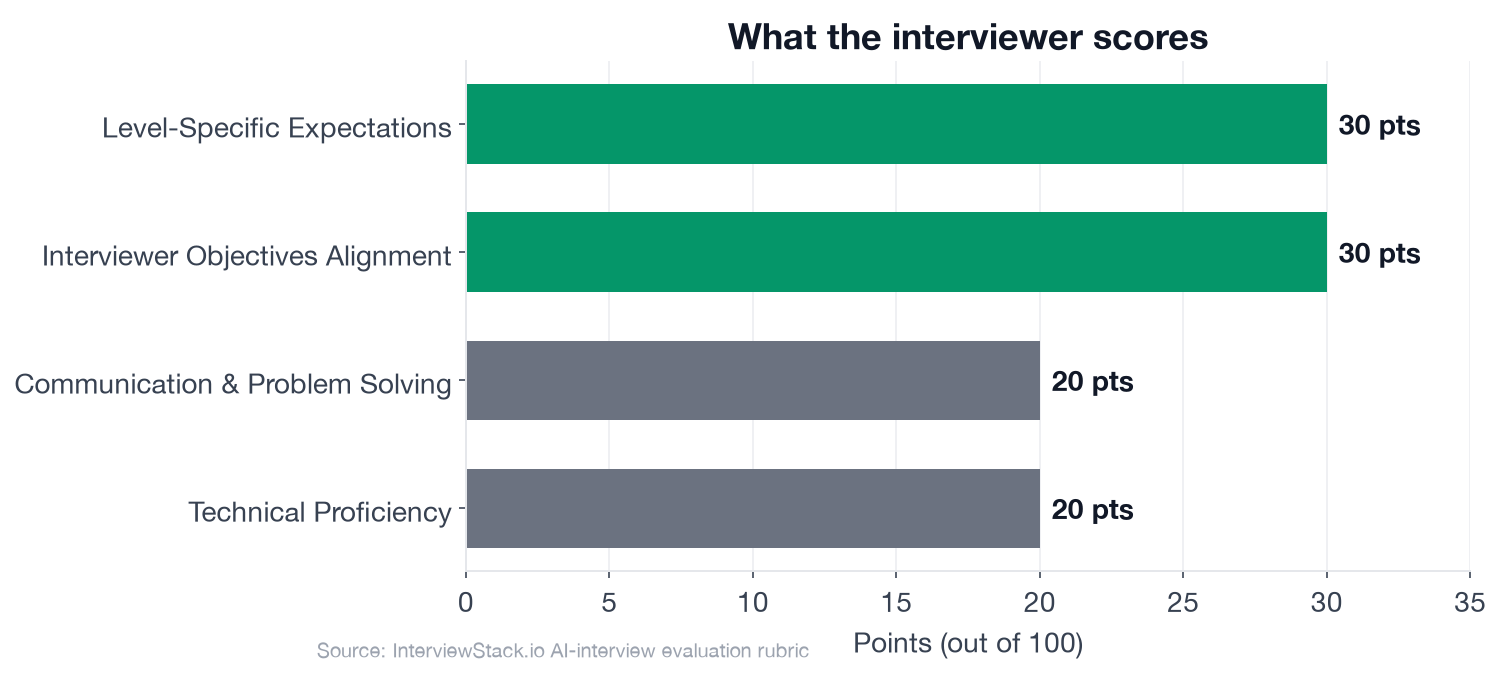 Interviewer Objectives Alignment and Level-Specific Expectations each carry 30 of the 100 points, together worth more than Technical Proficiency and Communication combined (60 vs. 40), which is why judgment under ambiguity outweighs technical polish here.
Four Moments That Decide the Investigation
Four of the interviewer's six follow-ups do the most work at separating a defensible investigation from a guess. Here's how a common answer goes wrong at each, and what the stronger version sounds like.
Turn 1: Scoping Without Picking a Side
Interviewer: "How would you define scope and priorities early on if legal, HR, and security all want different answers from the case?"
Turn 2: The Machine IT Already Touched
Interviewer: "If you discover that IT powered on the laptop before preservation, how does that change your handling, confidence, and documentation?"
Turn 3: One Story or Five
Interviewer: "What hypotheses would you consider for how the files left the system, and how would you test them without anchoring too early on one narrative?"
Turn 4: Knowing When to Stop
Interviewer: "At what point would you stop collecting more data and issue a report, and how would you communicate residual uncertainty?"
What Happens to This Discipline Under an Actual Clock?
Every mistake above is easy to spot on the page. Reid's error in Turn 3, jumping to exfiltration and backfilling the evidence, is a textbook anchoring bias, the kind named in the first week of any decision-science course. Reading it is not the same as resisting it live: at minute fourteen, with an interviewer waiting and a story that already sounds guilty, the pull toward the fast, confident answer is the same pull a working examiner feels with a director waiting for a status update on a real case.
That gap, between recognizing a trap in writing and not falling into it with the clock running and the questions unscripted, only closes with reps. That's what the AI mock interview is actually for: not reading about the anchoring trap, but walking into it live and building the reflex to catch yourself fast enough for it to matter.
Where Do the 16 Checklist Items Actually Live?
Every mistake above maps back to specific items in the same 16-item checklist the AI interviewer tracks in real time, phase by phase. Here's the complete blueprint a strong candidate hits across all three.
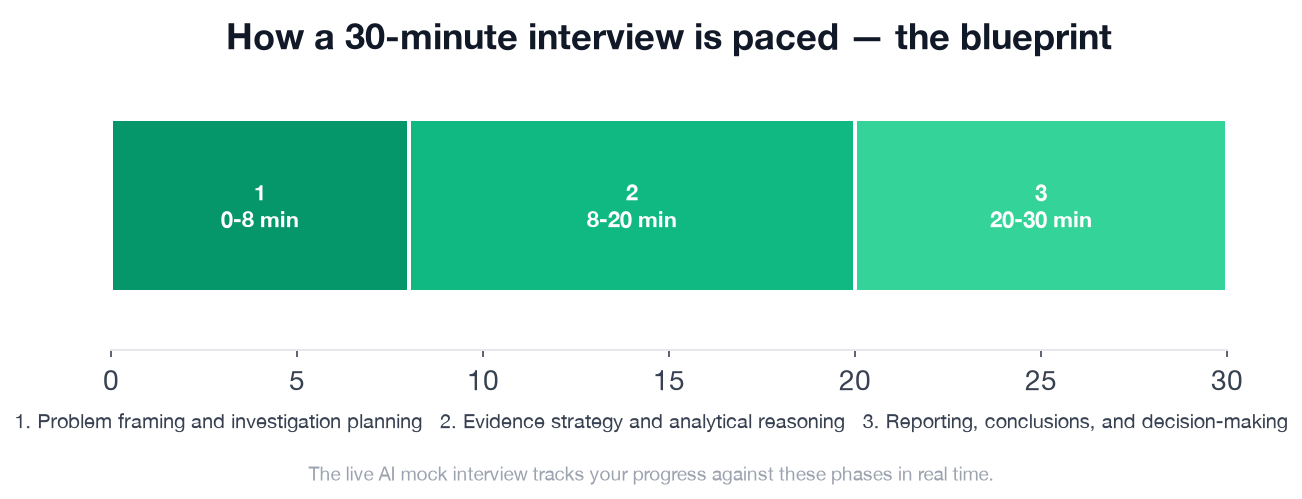 Problem framing gets the first 8 minutes, evidence strategy the next 12, and reporting the final 10, each phase scored independently against its own checklist.
- ✓Clarifies the allegation in operational terms such as unauthorized access, collection, staging, transfer, or exfiltration
- ✓Identifies stakeholders and their likely questions while preserving examiner independence
- ✓Defines scope boundaries such as device(s), accounts, timeframe, repositories, file set, and relevant systems
- ✓States immediate preservation concerns including current device state, potential volatile evidence loss, and chain of custody
- ✓Explains what success looks like for the investigation: timeline, user actions, data movement, confidence, and limitations
- ✓Describes a defensible acquisition approach and notes effect of IT powering on the device before handoff
- ✓Prioritizes likely evidence sources on host and surrounding systems, such as endpoint artifacts, authentication records, repository access logs, removable media history, cloud storage activity, email/chat transfer paths, and network telemetry
- ✓Builds multiple plausible hypotheses instead of assuming guilt, such as legitimate work activity, automated sync, accidental transfer, malicious exfiltration, or third-party access
- ✓Explains how to correlate timestamps, user activity, file access, process execution, device connections, and transfer evidence into a timeline
- ✓Explicitly distinguishes observed facts from inference and calls out where missing logs prevent stronger conclusions
- ✓Mentions validation or peer review steps to reduce error, such as cross-source corroboration or re-running key queries/tools
- ✓Outlines a report structure that includes scope, evidence handled, methodology, findings, timeline, conclusions, limitations, and appendices or supporting artifacts
- ✓Uses precise language around confidence, such as confirmed, consistent with, unable to determine, or no evidence observed
- ✓Explains how technical findings would be translated for legal, HR, and security audiences without overstating certainty
- ✓Identifies when to stop analysis based on sufficiency, diminishing returns, stakeholder need, and preservation of turnaround expectations
- ✓Recommends defensible next steps if the evidence is inconclusive, such as broader log preservation, additional system collection, or targeted follow-on review
Where to Practice This for Real
Start the AI mock interview for Digital Forensic Examiner on digital forensics methodology, investigation, and reporting and run this exact scenario live, complete with unscripted follow-ups and real-time scoring against the blueprint above. If you want to build the underlying reasoning first, the question bank for this topic breaks the same concepts into individual drill questions, and the Digital Forensic Examiner preparation guide rounds out what the rest of a mid-level interview loop covers.
FAQ
Q. What does a mid-level Digital Forensic Examiner interview on investigation methodology actually test?
It tests whether a candidate can structure and scope a digital forensic investigation, reason from incomplete or conflicting evidence, build and test multiple hypotheses instead of assuming guilt, preserve forensic soundness like chain of custody, and write findings that would hold up to internal review and possible legal scrutiny. The 100-point rubric splits 30 points to Interviewer Objectives Alignment, 30 to Level-Specific Expectations, 20 to Technical Proficiency, and 20 to Communication & Problem Solving, across three phases: problem framing (0-8 min), evidence strategy (8-20 min), and reporting (20-30 min).
Q. Why does it matter that IT powered on the laptop before it was handed over for preservation?
Because powering on a device before forensic preservation can alter timestamps, running processes, and volatile data, weakening confidence in anything collected afterward. Phase 2's checklist specifically requires a candidate to describe a defensible acquisition approach and explicitly note the effect of that pre-handoff power-on, rather than ignoring it or treating it as fatal to the case.
Q. How many hypotheses should a Digital Forensic Examiner consider before concluding exfiltration?
At least 5: legitimate work activity, automated sync, accidental transfer, malicious exfiltration, and third-party access. Phase 2's checklist rewards building this full set and testing each one against the evidence rather than anchoring on exfiltration because it matches the original allegation.
Q. How should conflicting requests from legal, HR, and security be handled when scoping the case?
By defining the allegation in neutral, operational terms and setting scope, devices, accounts, timeframe, and file set independent of any single stakeholder's desired outcome, then sharing the same evidence-based findings with all three. Phase 1's checklist explicitly scores whether a candidate identifies stakeholders and their likely questions while preserving examiner independence.
Q. When should a Digital Forensic Examiner stop collecting evidence and issue a report?
Once additional collection stops meaningfully changing the confidence level of the findings, not once the story feels complete. Phase 3's checklist scores recognizing sufficiency and diminishing returns as its own item, separate from using precise confidence language such as confirmed, consistent with, or unable to determine in the final report.
Q. What is the scoring rubric for this Digital Forensic Examiner interview?
Four dimensions totaling 100 points: Interviewer Objectives Alignment (30), Level-Specific Expectations (30), Technical Proficiency (20), and Communication & Problem Solving (20). The two highest-weighted dimensions reward investigative structure and mid-level judgment under ambiguity, not just technical correctness.
Q. How should I prepare for a Digital Forensic Examiner digital forensics and investigation methodology interview?
Practice building multiple hypotheses before committing to one, explicitly separating observed facts from inference, and stating confidence levels precisely instead of overclaiming or stalling. The InterviewStack.io AI mock interview for Digital Forensic Examiner on digital forensics methodology, investigation, and reporting runs the live version of this exact blueprint and scores you against it in real time.
Calibration Beats Conviction
A guilty-sounding story is not evidence, and a clean one isn't either. The mid-level bar for a Digital Forensic Examiner isn't having the fastest theory, it's building the discipline to test 5 competing explanations against the same timeline and report only the one the evidence actually survives. That discipline is exactly what gets scored, minute by minute, in the live version of this interview.
Topics
Ready to practice?
Put what you've learned into practice with AI mock interviews and structured preparation guides.