
The Embedded Developer Co-Design Interview Rewards Math Before the Block Diagram
You are 90 seconds into a mid-level interview. The board has a 48 MHz Cortex-M0+, 16 KB of RAM, 128 KB of flash, and a product spec that says "keep 24 hours of history." A common instinct is to start sketching a main loop. A stronger opening is to multiply 86,400 samples by the record size first, because the answer changes the whole design. This walkthrough follows a Hardware/Software Co-Design and Resource Constraints round from the InterviewStack.io AI mock interview, with an illustrative candidate named Ingrid whose mistakes are common, not transcribed. If you work on embedded developer roles, this is the round that separates firmware writers from system designers.
Key Findings
- The interview is scored out of 100: 30 points for interviewer objectives, 30 for level-specific expectations, 20 for technical proficiency, 20 for communication.
- 60 of 100 points sit in Interviewer Objectives Alignment and Level-Specific Expectations (trade-offs, system thinking); only 20 are for Technical Proficiency.
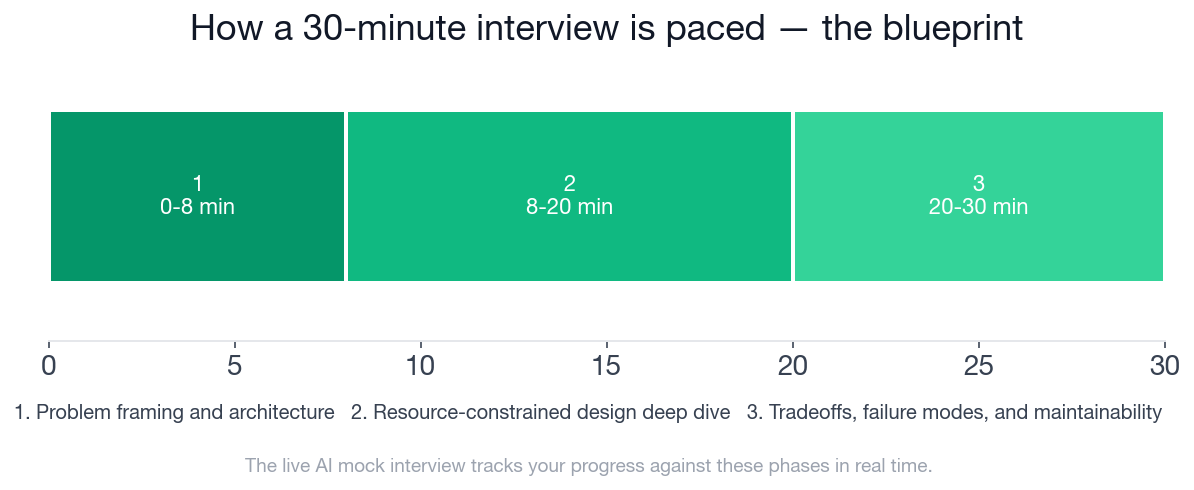
- The blueprint runs 30 minutes in 3 phases: 0 to 8, 8 to 20, and 20 to 30 minutes.
- The deep-dive phase carries the most checklist items (6), versus 4 for framing and 5 for failure modes.
- The device has 16 KB of RAM and 128 KB of flash, yet the spec asks for 86,400 one-per-second samples per day.
- At 4 bytes per sample, 24 hours of raw history is about 338 KiB, roughly 2.6 times the entire flash.
- One hour of raw samples (3,600 at 4 bytes) is about 14 KB, which would consume nearly all 16 KB of RAM.
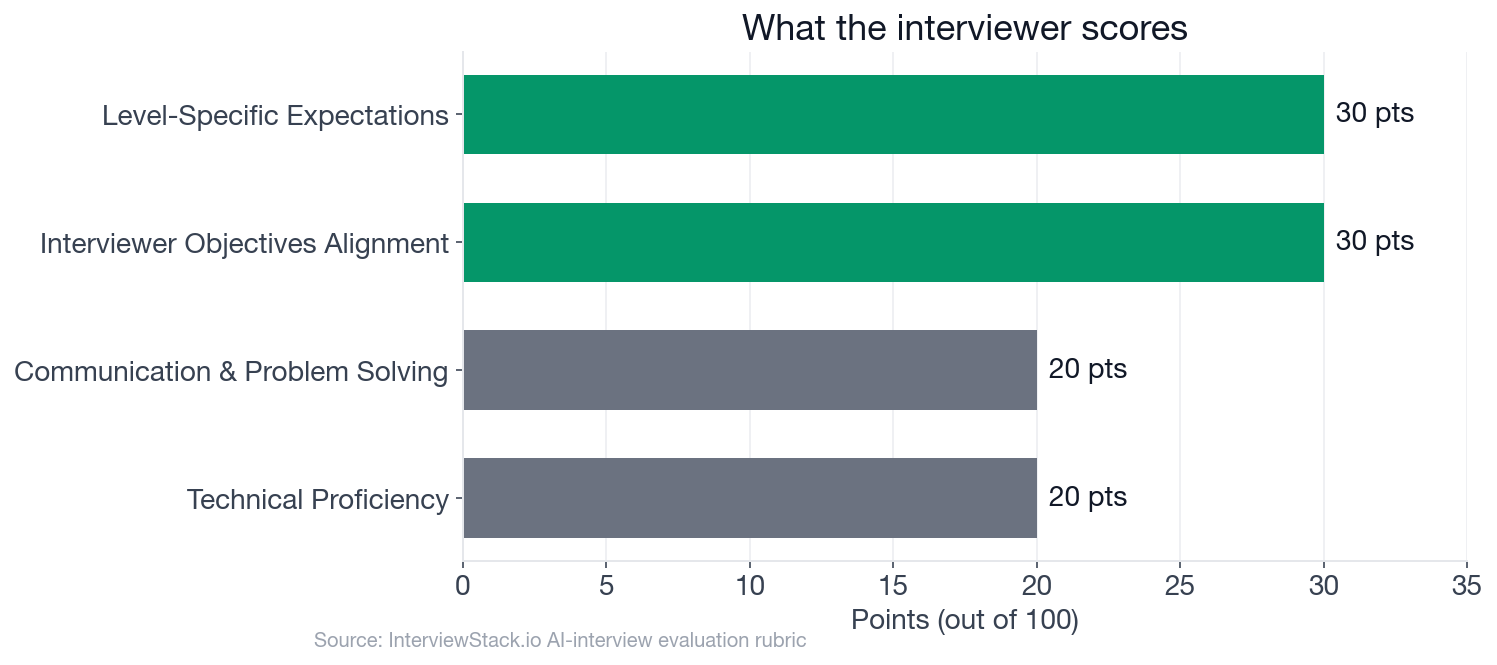
Objectives and level-specific depth dominate the score, so the chart above is a warning: a technically correct answer with no stated tradeoffs puts much of those 60 points at risk.
What Is the Interviewer Actually Asking You to Design?
Here is the scenario, as a strong interview would pose it.
The interview question
You are working on a battery-powered environmental sensor node for a consumer smart-home product. The MCU is a 48 MHz ARM Cortex-M0+ with 128 KB flash, 16 KB RAM, and no RTOS. Peripherals: an I2C controller, an SPI controller, a 12-bit ADC, 2 timers, GPIO, and a UART boot/debug port. External devices: a temperature/humidity sensor on I2C, an SPI flash chip for local buffering, and an LED and button on GPIO. The wireless module belongs to another team and is unavailable for this interview.
Product behavior: sample temperature and humidity once per second, keep a rolling 24-hour history, and on a button press show by LED pattern whether the last hour is rising, falling, or stable. The device must run for months on battery and stay responsive to button presses. Assume fixed-size samples and that basic I2C, SPI, GPIO, and timer drivers can be written if needed.
How would you design the firmware, including what you keep in software versus rely on hardware and peripherals to handle, given these constraints?
The interviewer is probing four things: whether you can partition work between firmware, peripherals, and external parts; whether you reason about interrupts versus polling, buffering, and timing budgets; whether you handle failure; and whether you can justify tradeoffs, including pushing back on the requirement itself.
How Does a Strong Candidate Handle the Follow-Ups?
Four of the six prepared follow-ups carry the most signal. Each shows a mistake that is common in practice and the move that recovers the points.
Turn 1: Fitting 24 Hours of History
Interviewer: "How would you store the 24-hour history within the available RAM and flash budget, and what data layout would you choose?"
Turn 2: Debugging a Missed Press
Interviewer: "If button responsiveness becomes inconsistent during sensor reads or flash writes, how would you debug and redesign the system?"
Turn 3: When Flash Fights Back
Interviewer: "Suppose the SPI flash has limited write endurance and occasional write latency spikes. How would that change your buffering or logging approach?"
Turn 4: More Accuracy, Same MCU
Interviewer: "If product asks for trend detection to become more accurate without changing the MCU, what optimizations or requirement tradeoffs would you consider?"
Why Isn't Watching Someone Else's Mistakes Enough?
You just spotted four mistakes in seconds, with no clock running and the answer one scroll away. Live, the hard part is the unscripted follow-up arriving at minute 14 while you are still defending a buffer size. Knowing about ISR discipline is not the same as saying it fluently when a question redirects you. Only reps close that gap, and each one is more valuable when something is tracking what you skipped. If interrupts are your weak spot, the interrupt handling walkthrough pairs well with this one.
What Does the Live Blueprint Track, Phase by Phase?
This is the blueprint a strong candidate hits. It is also what the AI mock interview tracks you against in real time, so you see which items you covered and which you skipped.
- ✓States or verifies key constraints: 16 KB RAM, 128 KB flash, no RTOS, battery-powered, 1 Hz sampling, 24-hour history, responsive button handling
- ✓Proposes a simple architecture such as main loop plus interrupts/timers/state machines
- ✓Separates periodic sampling, button handling, LED indication, and history storage into distinct responsibilities
- ✓Mentions using hardware timers/peripherals to avoid busy-waiting where possible
- ✓Chooses a storage plan that does not attempt to keep 24 hours of raw samples entirely in RAM
- ✓Describes a concrete representation for samples/history, such as fixed-size records and a circular log in SPI flash
- ✓Explains how button events are captured reliably, e.g. GPIO interrupt plus debounce strategy or periodic sampling with timing justification
- ✓Uses timer/peripheral hardware for periodic wakeup or scheduling rather than software delay loops
- ✓Keeps ISRs short and defers heavier work like flash writes, trend computation, or LED pattern generation to the main loop
- ✓Recognizes flash write latency/endurance implications and proposes buffering, batching, or wear-aware organization
- ✓Discusses how to recover or validate history after reset/power loss, such as sequence numbers, headers, or simple integrity checks
- ✓Offers a reasonable approach for trend computation that matches available CPU/memory resources
- ✓Suggests maintainable layering between low-level drivers, hardware abstraction, and application logic
- ✓Can explain one or two realistic debugging methods for missed events, timing issues, or memory pressure
- ✓Makes pragmatic compromises when asked to improve accuracy or battery life without changing hardware
Practice This Exact Round Live
The fastest way to turn this page into a skill is to start the AI mock interview for this scenario. You get the same Embedded Developer, mid-level, co-design question, a 30-minute clock, and follow-ups that adapt to what you actually say. Afterward you see your score against the four rubric dimensions. Want to drill the underlying concepts first? Work through the hardware/software co-design question bank, and browse the preparation guides for company-specific rounds.
FAQ
Q. What does an embedded developer hardware/software co-design interview test?
It tests whether you can fit a product into fixed RAM, flash, CPU, and I/O limits and decide what the firmware does versus what peripherals, timers, and external chips do. Scoring is out of 100: 30 for interviewer objectives, 30 for level-specific expectations, 20 for technical proficiency, and 20 for communication.
Q. How long is the interview and how is it paced?
The blueprint runs 30 minutes in three phases: problem framing and architecture (minutes 0 to 8), a resource-constrained design deep dive (8 to 20), and tradeoffs, failure modes, and maintainability (20 to 30).
Q. Do I need to know exact register names for a mid-level co-design interview?
No. The mid-level bar is being comfortable with register-level peripheral use and memory-mapped I/O conceptually, even if exact register names are abstracted. Explaining what you would configure and why matters more than recalling a datasheet.
Q. Why can't the 24-hour history just live in RAM?
At one sample per second, 24 hours is 86,400 samples. Even at 4 bytes each that is about 338 KiB, far beyond 16 KB of RAM and 128 KB of flash. A strong answer moves history to the external SPI flash and decides what resolution the trend feature actually needs.
Q. What do interviewers expect around interrupts and button handling?
Keep ISRs short, capture the button edge in hardware, debounce with a timer, and defer heavier work such as flash writes, trend math, and LED patterns to the main loop. Candidates are expected to explain why the button stays responsive during sensor reads and flash writes.
Q. How can I practice this exact scenario?
Start the AI mock interview for Embedded Developer at mid-level on Hardware/Software Co-Design and Resource Constraints. It tracks you against the same three-phase blueprint in real time and asks unscripted follow-ups.
Do the Arithmetic Before You Draw Anything
Every strong answer in this round starts with the same habit: put the numbers on the table, then design to them. Do that out loud twice in a mock interview and it becomes automatic when the clock is real.
Topics
Ready to practice?
Put what you've learned into practice with AI mock interviews and structured preparation guides.