
The Embedded Developer Real-Time Constraints and Interrupt Handling Interview Runs on a Clock You Don't Fully Own
You're six minutes into a mid-level Embedded Developer interview. The prompt is a wearable device: a motion sensor sampling at 1 kHz, a safety event that has to be acted on within 2 ms of being flagged, a Bluetooth Low Energy (BLE) stack that periodically disables lower-priority interrupts, a 30 Hz display, and flash logging running in the background, all on an MCU with no RTOS underneath it. A candidate sketches a clean priority scheme and feels good about it. Then the interviewer asks one question that reframes the whole interview: what happens to that 2 ms guarantee when BLE's own interrupt masking lands at the worst possible moment? The deadline was never just about how fast the candidate's own code runs. It's a timing budget that BLE also gets to spend.
This walkthrough follows one full 30-minute simulated interview, built on the same blueprint InterviewStack's AI mock interviewer uses to run and score real embedded firmware candidates: a hard real-time safety path, a lightweight interrupt-plus-main-loop scheduler with no RTOS, and a 100-point rubric spread across four dimensions. Watch where a well-prepared mid-level candidate still gives points back, then see the complete blueprint an interviewer is actually grading against.
Key Findings
- The safety event must be acted on within 2 ms of the sensor flagging it, while the same MCU also samples at 1 kHz, drives BLE, refreshes a display at 30 Hz, and logs to flash, with no RTOS underneath any of it.
- The 30-minute interview is paced into 4 phases: 0-6 minutes to frame the requirement, 6-18 minutes for the architecture proposal, 18-26 minutes for a latency and concurrency deep dive, and 26-30 minutes for validation.
- The architecture proposal (Phase 2) and the latency-jitter deep dive (Phase 3) each carry 5 checklist items, more than either of the other two phases, but the 4-minute validation phase packs its 4 items into the tightest window of any phase.
- Scoring splits 30/30/20/20 across Interviewer Objectives Alignment, Level-Specific Expectations, Technical Proficiency, and Communication & Problem Solving, so 60 of 100 points sit in judgment and framing before a single instruction gets written.
- 4 distinct systems (sensor sampling, BLE, display, flash logging) compete for the same interrupt and CPU budget the 2 ms safety path also needs.
- At mid-level (2-5 years), the bar is a workable, well-prioritized architecture and proactive hazard-spotting, not a formal schedulability proof.
What Is the Interviewer Actually Probing With This Scenario?
The interview question
You are working on firmware for a battery-powered wearable device. One MCU is responsible for sampling a motion sensor at 1 kHz over SPI, detecting a short safety event that must be acted on within 2 ms of the sensor indicating it, driving a BLE stack that occasionally disables lower-priority interrupts for short periods, updating a display at 30 Hz, and logging diagnostic data to external flash in the background. The device has limited RAM and no full RTOS; the team uses interrupt handlers plus a lightweight main-loop scheduler.
Given the system above, how would you structure the firmware so the safety event consistently meets its timing requirement without making the rest of the device unreliable?
The interviewer isn't grading whether you can wire up an interrupt handler that technically compiles. They're checking whether you can tell a genuine 2 ms hard-real-time path apart from four other things competing for the same MCU, assign interrupt priorities accordingly, and reason credibly about worst-case latency, jitter, and safe data sharing, not just the typical case. Surfacing your assumptions and asking what BLE's masking actually costs matters as much as the architecture itself.
Four Turns Where the Clock Budget Gets Tested
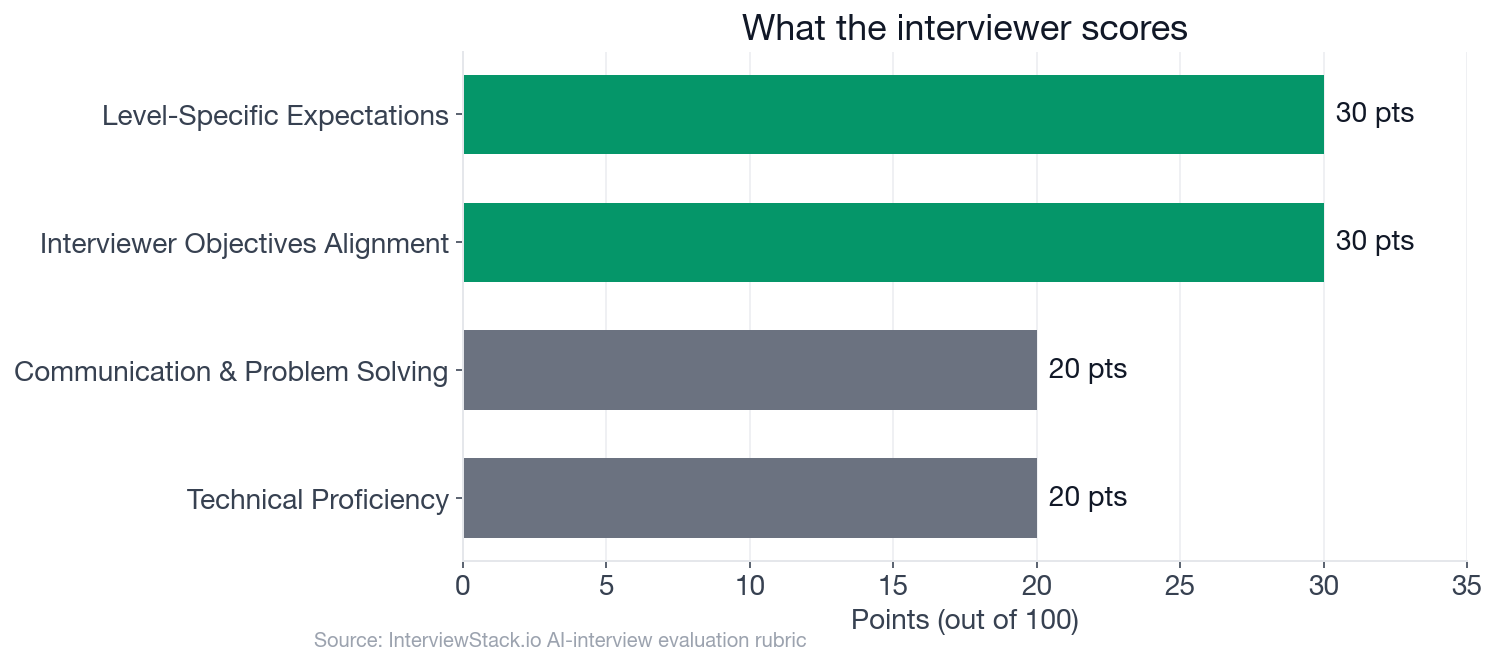
Interviewer Objectives Alignment and Level-Specific Expectations together carry 60 of the 100 points, more than Technical Proficiency and Communication & Problem Solving combined (40). A candidate can sketch a clean-looking architecture and still lose most of the interview in the follow-ups below, which is exactly where a candidate we'll call Declan starts giving points back.
Turn 1: Where the Safety Logic Should Live
Interviewer: "How would you decide what runs inside an interrupt versus what gets deferred to the main loop?"
Turn 2: Is BLE Already Spending Your Margin?
Interviewer: "If BLE activity occasionally increases interrupt latency, how would you reason about whether the 2 ms requirement is still safe?"
Turn 3: A Jitter Spike With No Obvious Cause
Interviewer: "Suppose testing shows occasional jitter spikes during flash writes. How would you debug and mitigate that?"
Turn 4: Proving the Guarantee, Not the Average
Interviewer: "How would you validate in the lab that this design really meets a hard timing guarantee rather than only passing typical-case tests?"
Why Does This Look Obvious Here and Invisible Live?
Every mistake above is easy to spot once it's labeled in a red box. Under real interview pressure, with the interviewer waiting and the architecture phase alone handing you five checklist items in twelve minutes, noticing that you just treated BLE's masking as negligible, or that your validation plan only proves the average case, is a different skill than reading it here. This post teaches you to recognize the pattern after the fact. It doesn't teach you to hold four competing timing budgets in your head while explaining your architecture out loud, and catch yourself before the interviewer has to ask.
That gap only closes with reps. Start a live AI mock interview on interrupt handling and real-time response and get scored against this same rubric while the clock is actually running, not after the fact.
How Do the Four Phases Add Up to One Score?
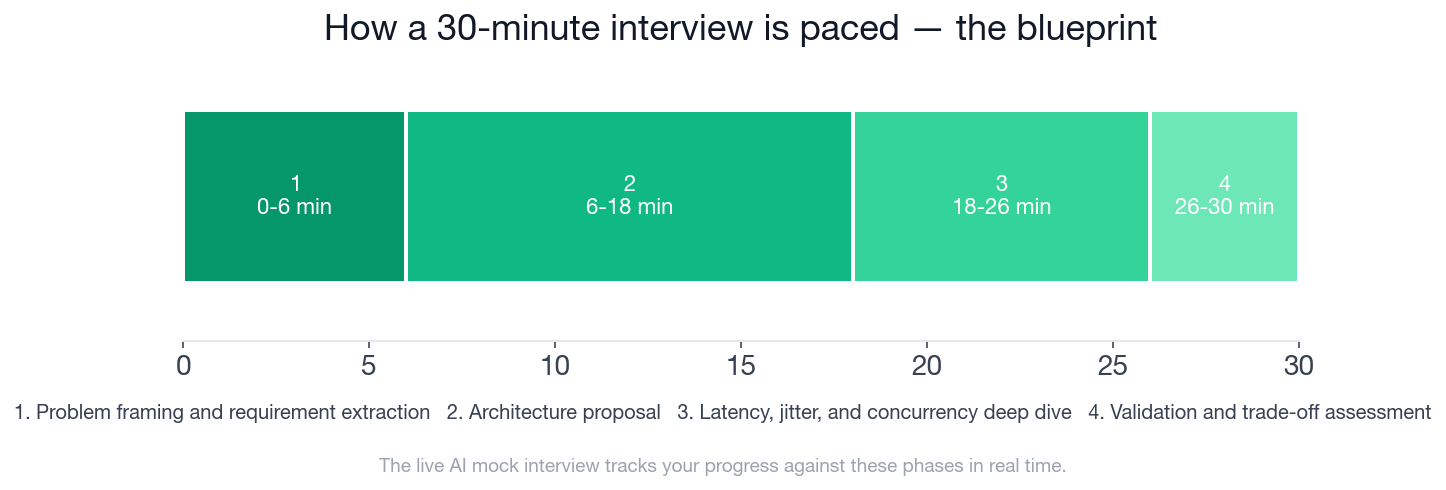
The chart paces the same 30 minutes into the four phases the interviewer is actually timing against: framing first, architecture second, the latency and concurrency deep dive third, validation last. The card below is the full checklist inside each phase, the exact thing the AI mock interviewer tracks against in real time as you talk.
- ✓Asks what event starts the 2 ms clock and what action must complete within it
- ✓Separates safety response from sensor sampling, display, BLE, and logging responsibilities
- ✓Calls out hard vs soft real-time behaviors
- ✓Mentions need to understand interrupt masking/latency introduced by BLE or platform libraries
- ✓Proposes a hardware-timer-driven or sensor-data-ready interrupt mechanism for deterministic 1 kHz acquisition
- ✓Keeps ISR responsibilities intentionally small and bounded
- ✓Places immediate safety action on the highest-priority path or equivalent minimal-latency mechanism
- ✓Defers noncritical work such as display updates and flash logging to the main loop or low-priority handlers
- ✓Describes a simple scheduler pattern such as tick flags, deadline-driven polling, or cooperative work queues
- ✓Discusses sources of latency/jitter including disabled interrupts, nested ISRs, SPI transaction length, and flash write stalls
- ✓Explains safe data exchange using volatile plus atomic access where appropriate, double buffering, or ring buffers
- ✓Avoids broad interrupt disabling as a default synchronization method or clearly bounds it if used
- ✓Offers mitigation ideas for timing spikes, such as chunking flash work, DMA, reprioritization, or isolating critical sections
- ✓Reasons about worst-case timing margin rather than average-case behavior
- ✓Proposes measuring latency with GPIO toggles, logic analyzer, trace, or MCU cycle counters
- ✓Mentions stress scenarios combining BLE activity, sensor load, and flash logging
- ✓Defines pass/fail in terms of worst-case observed timing versus the 2 ms requirement
- ✓Acknowledges residual risks and suggests conservative margin or fallback behavior
Where the Question Bank Ends and the Live Clock Begins
You've now seen every mistake this scenario is built to catch and the full checklist behind it. The next step is doing this live, out loud, on the clock, with follow-ups you can't preview in advance. Start the AI mock interview for interrupt handling and real-time response and get scored against this exact rubric in real time.
Want to drill the individual concepts first, interrupt priorities, worst-case latency reasoning, safe data sharing between an interrupt handler and the main loop, before putting them together live? Work through the interrupt handling and real-time response question bank, or browse company-specific prep guides if a specific interview process is next on your calendar. If interrupt timing isn't your only gap, our assembly and low-level debugging walkthrough covers a different corner of the same role.
FAQ
Q. What does an Embedded Developer interrupt handling and real-time response interview actually test?
It tests whether you can turn a hard real-time requirement into a concrete interrupt and scheduling architecture, not whether you can recite real-time operating system theory. The scoring rubric splits 100 points across four dimensions: Interviewer Objectives Alignment (30), Level-Specific Expectations (30), Technical Proficiency (20), and Communication & Problem Solving (20), so how you reason about priorities, latency, and trade-offs counts as much as whether the design is technically correct.
Q. How is the 30-minute interview paced?
Four phases: minutes 0 to 6 for framing the requirement and clarifying what 'acted on within 2 ms' actually means, minutes 6 to 18 for the architecture proposal (interrupts, timers, and the main-loop scheduler), minutes 18 to 26 for a latency, jitter, and concurrency deep dive, and minutes 26 to 30 for validation and trade-off judgment.
Q. Why does BLE activity matter for a 2 ms deadline that has nothing to do with Bluetooth?
Because the BLE stack periodically disables lower-priority interrupts for short periods, and that masking eats into the same timing budget the safety response depends on. A strong candidate treats that masking as a measurable addition to the worst-case latency calculation instead of assuming it is too brief to matter.
Q. Is disabling interrupts ever an acceptable way to protect shared data in this interview?
Only if it is tightly bounded and justified, not used as the default synchronization method. The rubric rewards safer patterns such as volatile-qualified state with atomic access, double buffering, or ring buffers between the interrupt service routine and the main loop, because broad interrupt disabling can itself blow the 2 ms deadline it is supposed to protect.
Q. How do you prove a design meets a hard real-time guarantee instead of just passing typical-case testing?
Stack the worst-case conditions deliberately (BLE masking, flash logging, and full sensor load at once) instead of testing them separately, then measure the safety path's response time directly with a GPIO toggle, logic analyzer, or cycle counter. Pass or fail is defined against the worst observed latency compared to the 2 ms requirement, not the average.
Q. Can I practice this exact scenario?
Yes. The AI mock interview runs the same interrupt handling and real-time response scenario and scores your answer against this rubric live, with follow-up questions you cannot see in advance.
The 2 Millisecond Budget Was Never Only Yours to Spend
Everything in this interview, the interrupt boundaries, the priority scheme, the validation plan, comes back to one idea: the deadline you're defending shares its budget with systems you don't control. BLE borrows from it. Flash writes borrow from it. A candidate who only accounts for their own code passes the demo and fails the worst case. The only way to know you'd catch that live is to try it live.
Topics
Ready to practice?
Put what you've learned into practice with AI mock interviews and structured preparation guides.