
A 13% Skill Overlap Buys No Salary Premium at All
Embedded Developer and Mobile Developer are both filed under "developer," but their postings share just 13% of their top skills, a strikingly small overlap for two roles that carry the same word in the title. We looked at every active posting for both roles on the InterviewStack.io job board, 3,347 for Embedded Developer and 2,724 for Mobile Developer, as of August 2026. Given how little the two skill stacks have in common, you'd expect the rarer, more specialized stack to command a real premium. It doesn't: median US base pay lands within $1,300 of each other, and that figure, like every dollar amount in this post, is base salary only. Equity, bonus, and sign-on aren't disclosed in postings and aren't part of this dataset.
| Embedded Developer | Mobile Developer | |
|---|---|---|
| Median US base salary | $155,200 | $153,900 |
| Active postings | 3,347 | 2,724 |
| Top skill | Firmware (49.2%) | Android (62.0%) |
| Remote share | 5.9% | 32.8% |
| Entry-level share | 3.3% | 2.3% |
| Skill overlap (Jaccard, symmetric) | 13% | 13% |
Key Findings
- Embedded Developer and Mobile Developer share just 13% Jaccard overlap on their top-30 skill sets, despite both roles carrying the word "developer" in the title.
- Only 7 skills clear a 5% shared-frequency threshold in both roles, and all 7, Debugging, Git, Code Review, Agile, CI/CD, Automation, and Monitoring, are general engineering practices, not domain tools.
- Median US base salary is nearly identical: $155,200 for Embedded Developer (n=1,184) versus $153,900 for Mobile Developer (n=349), a $1,300 (0.84%) gap.
- Mobile Developer postings are remote 32.8% of the time versus just 5.9% for Embedded Developer, a nearly 5.5x difference.
- Embedded Developer's biggest salary premium comes from PCIe (+$28,800), not from Firmware itself, which adds just $11,200.
- Mobile Developer's own platform-identity skills price below its baseline: Android Development is $76,900 below the median, Java is $65,400 below.
- Embedded Developer postings (3,347 active) outnumber Mobile Developer's (2,724) by 1.23x and are far more US-concentrated (50.1% vs 22.8%).
A note on dataset scope: a small share of each title sample sits outside a strict reading of the role. On the Embedded Developer side, that's mostly pure hardware/chip-design roles (physical design, hardware design, EE internships) rather than embedded software; on the Mobile Developer side, it's mostly industrial "mobile" job titles (mobile equipment or facilities engineers) or titles with no clear mobile-development signal. Both are minority slices and don't meaningfully shift the skill or salary numbers below.
What Each Job Actually Looks Like Day to Day
An Embedded Developer writes code that runs directly on a physical device, not a server or browser: C or C++ close to the hardware, debugging with a JTAG probe or an oscilloscope as often as a stack trace, working around fixed memory and real-time deadlines. The deliverable is a firmware image validated against real boards.
A Mobile Developer builds the app that lands on a phone: wiring screens to backend APIs, managing state across a lifecycle the operating system controls, shipping through app-store review. The constraint is a device you don't own rather than a chip you soldered, and the deliverable is a released app version, tracked by crash reports and store ratings.
What Do the Two Roles Actually Have in Common?
Both roles lean on the same engineering hygiene, not the same domain knowledge. Debugging is the strongest shared skill, appearing in 43.6% of Embedded Developer postings and 19.5% of Mobile Developer postings, followed by Code Review, CI/CD, Agile, Git, Automation, and Monitoring. Anyone who already has these seven skills won't need to relearn much moving between titles, but they also aren't what makes either job hireable. They're the baseline every engineering role expects now.
| Skill | Embedded Developer | Mobile Developer |
|---|---|---|
| Debugging | 43.6% | 19.5% |
| Automation | 20.4% | 12.8% |
| Agile | 17.1% | 22.8% |
| Git | 18.4% | 24.3% |
| Code Review | 14.3% | 27.3% |
| CI/CD | 12.0% | 26.0% |
| Monitoring | 7.2% | 8.0% |
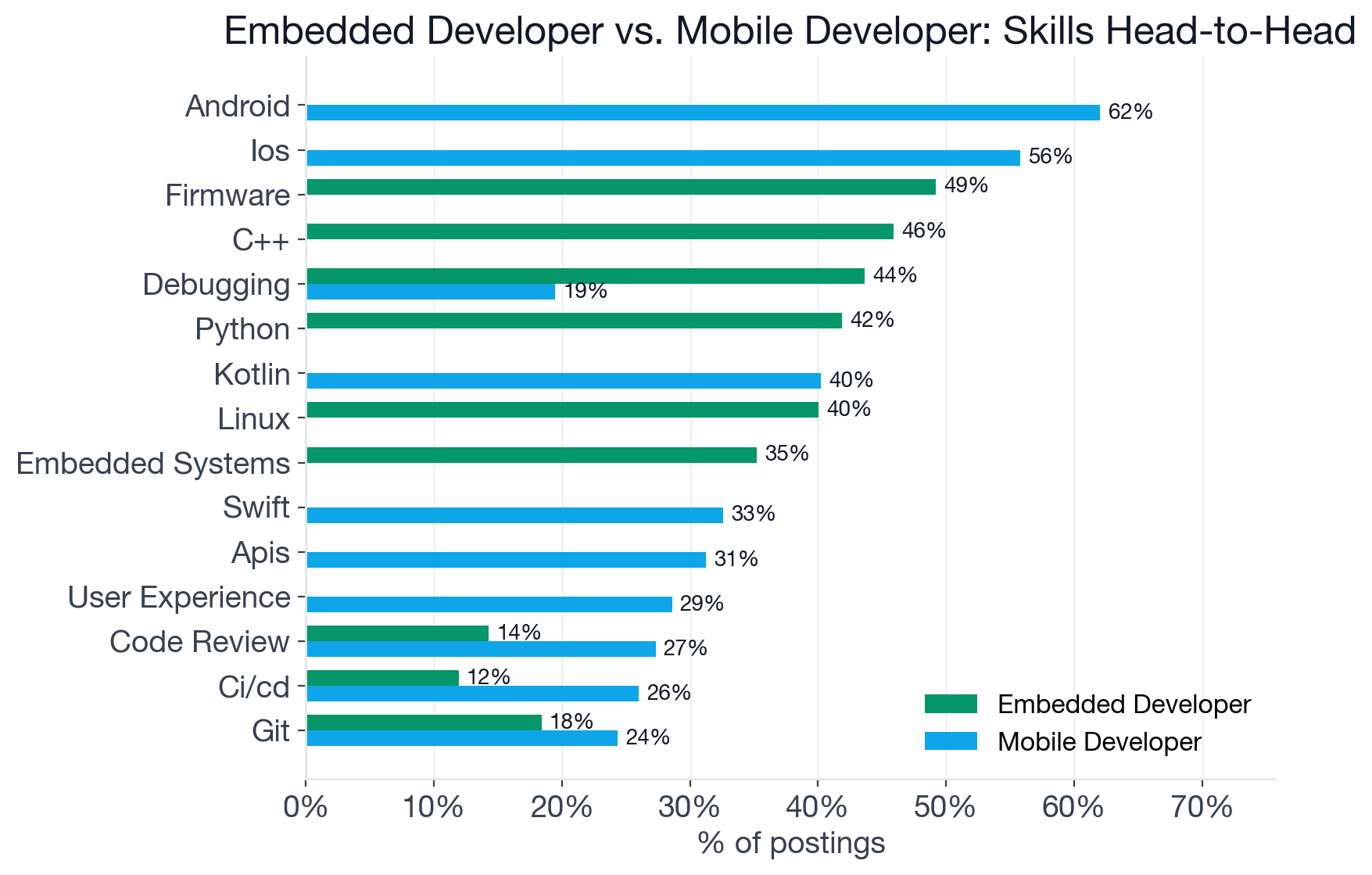 Most of the bars in this chart belong to only one side. The two skill stacks barely touch.
Where Do the Skill Stacks Split Completely?
Embedded Developer's exclusive skills describe hardware. Firmware (49.2%), C++ (45.9%), Python (41.9%), Linux (40.1%), and Embedded Systems (35.2%) anchor the role, followed by SPI and I2C, the low-level protocols microcontrollers use to talk to sensors and peripherals, and RTOS, a real-time operating system whose scheduler guarantees a task executes within a strict deadline.
Mobile Developer's exclusive skills describe platforms. Android (62.0%), iOS (55.8%), Kotlin (40.2%), Swift (32.6%), and APIs (31.2%) anchor the role, the two native mobile operating systems and the languages that ship on them, plus React Native (23.0%) for teams building one codebase for both.
Neither list would prepare you for the other job. Embedded's I2C bus timing has no bearing on Kotlin or SwiftUI, and Mobile's Jetpack Compose never requires reasoning about interrupt latency.
Embedded Developer vs Mobile Developer: Which Role Pays More?
The direct answer is barely a real answer: Embedded Developer's median US base salary is $155,200 (n=1,184) versus Mobile Developer's $153,900 (n=349), a $1,300 (0.84%) gap in Embedded Developer's favor. Mobile Developer's sample is more than 3x smaller, so treat its figure as somewhat more directional, but a swing that size wouldn't erase a gap this thin either way.
The real story is which skills earn a premium over each role's own baseline, and it isn't the skills that define the title. On Embedded Developer's own numbers, PCIe (a high-speed hardware interconnect standard) adds the largest premium at +$28,800 (n=135). Several other skills price close behind: CUDA (+$28,000, n=36), SystemVerilog (+$25,800, n=35, an ASIC/FPGA hardware-design language more associated with chip design than embedded software), Data Structures (+$23,800, n=47), Android (+$23,300, n=45), and Azure (+$21,300, n=28), all ahead of System Design (+$20,200) and Monitoring (+$19,800). Firmware Development itself adds a more modest $14,600, and Firmware, the role's single most common skill at 49.2% of postings, adds just $11,200. C++, present in 45.9% of postings, prices at exactly the baseline: no premium at all.
Mobile Developer shows the same pattern in a sharper form, with one exception. Its own platform-identity skills price at or below its $153,900 baseline: Android and Swift are each about $3,900 under, Kotlin is $24,200 under, and Android Development is $76,900 under (n=107). But the single largest premium actually goes to C++ (+$36,100, n=25, right at the dataset's minimum reliable sample size, likely a small slice of performance-critical native-module postings). Among more broadly-sampled skills, the premiums go to general-purpose engineering ones: Scalability (+$28,600, n=27), Concurrency (+$27,400, n=28), and Observability (+$21,400, n=46). Knowing Kotlin gets you in the door; knowing how to keep a system running under load is what gets paid extra.
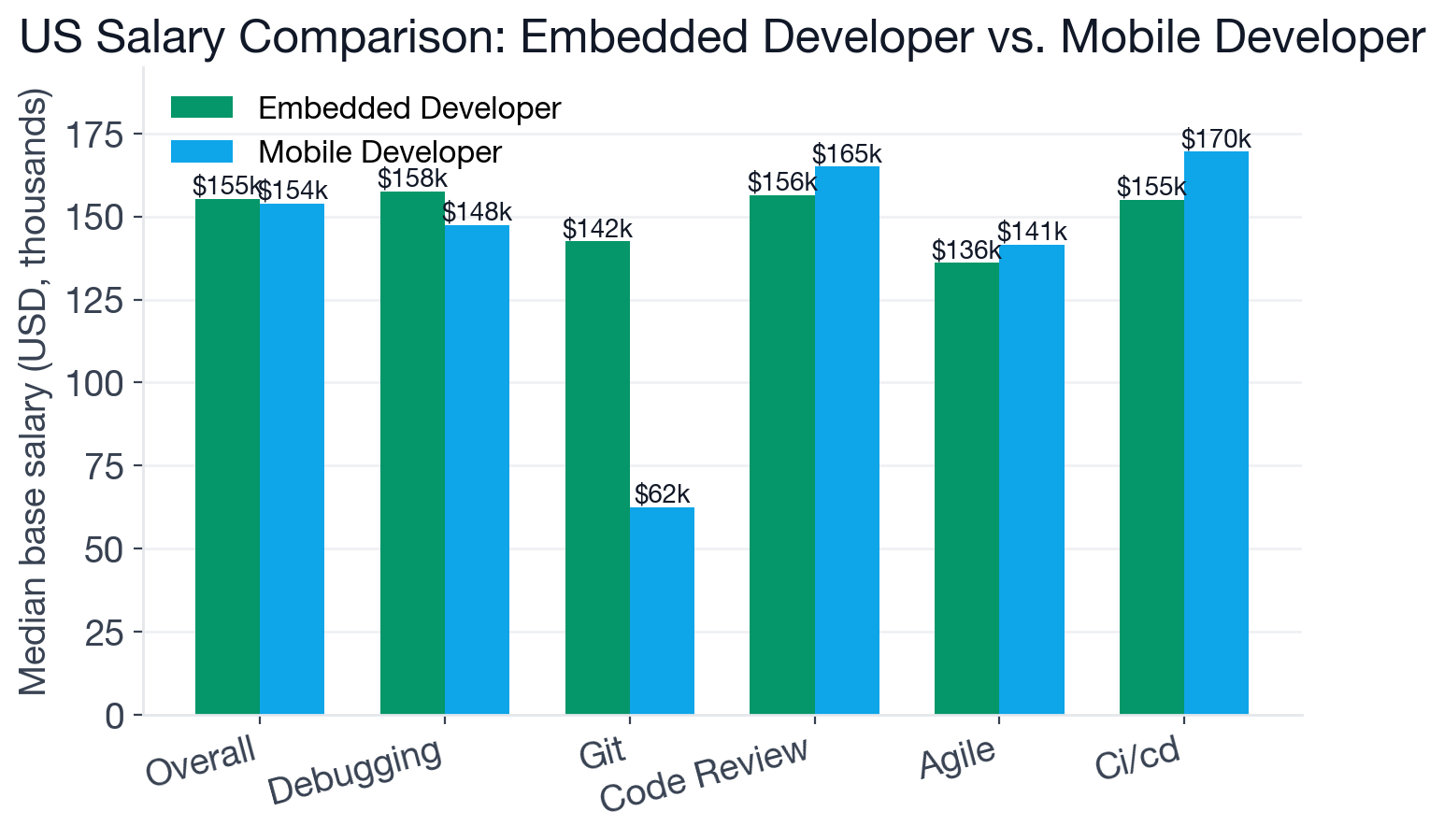 Median US base salary is nearly identical between the two roles, but the skills that clear each one's own baseline are the general-engineering ones, not the platform-defining ones.
Where Are the Jobs, and Can You Work Remotely?
Geography and work mode are where these two roles genuinely diverge. Half of Embedded Developer postings (50.1%) are US-based, clustered around defense and semiconductor employers: Qualcomm, NVIDIA, Anduril Industries, Northrop Grumman, and Micron Technology are among its top employers by distinct openings. Mobile Developer is far more globally distributed, only 22.8% US-based, with India (10.2%), the UK, Germany, Canada, Mexico, Brazil, Poland, and the Philippines rounding out the rest; one company alone accounts for 12.6% of its distinct openings.
That lines up with the sharpest divergence in the comparison: work mode. Mobile Developer postings are remote 32.8% of the time versus just 5.9% for Embedded Developer, a nearly 5.5x gap. Embedded work is tethered to a physical board, a debugger, and often lab equipment that doesn't travel, which keeps 69.9% of its postings onsite. Mobile has no equivalent hardware tether, so remote and hybrid combined make up 51.6% of its postings.
Neither role is a strong entry-level path by job title alone: 3.3% for Embedded Developer, 2.3% for Mobile Developer. Embedded Developer skews more senior overall, 45.7% of postings are senior or staff level versus 35.5% for Mobile Developer, so the bar to break in from outside runs a bit higher on the embedded side even before the specialized toolchain factors in. One caveat: seniority is inferred from title keywords, and a posting with no explicit level defaults to mid-level; Mobile Developer titles ("Android Developer," "iOS Developer") skip a seniority modifier more often than Embedded Developer's do, so Mobile's true senior/staff share may be modestly understated relative to Embedded's.
Which Path Fits You Better?
Choose Embedded Developer if you:
- Want to work close to physical hardware, interrupts, memory-mapped registers, and real-time deadlines, rather than screens and app stores
- Are comfortable being one of the more senior people in the room; 45.7% of postings sit at senior or staff level
- Can work primarily onsite; only 5.9% of postings are remote, so location matters more here than pay does
Choose Mobile Developer if you:
- Want to ship features to a phone people actually see, with app-store review and user ratings as the feedback loop
- Value flexibility over specialization: postings are remote 32.8% of the time, more than five times Embedded Developer's rate
- Are comfortable with a platform skill set (Android, iOS, Kotlin, Swift) that's necessary to get hired but doesn't itself pay a premium over the role's own baseline
How to Use This in Your Job Search
If you already write C or C++ close to hardware, test whether that specialization is paying off against PCIe-focused Embedded Developer roles or System Design-focused ones, where the real premiums sit. Coming from the mobile side and want more flexibility without leaving app development? Mobile Developer roles that ask for Scalability tend to pay above the role's own median.
Before either interview loop, practice with AI mock interviews built around the role you're targeting, since a firmware debugging session and a mobile architecture interview test almost nothing in common. Use the question bank to drill RTOS and memory-management questions for embedded roles, or app-lifecycle questions for mobile ones. For a full breakdown of either skill stack, see our deep dives on Embedded Developer skills and Mobile Developer skills, or how each stacks up against Embedded Developer vs Software Engineer and Mobile Developer vs Software Engineer.
FAQ
Q. How much skill overlap is there between Embedded Developer and Mobile Developer?
Just 13% (Jaccard similarity on each role's top 30 skills). Only 7 skills, Debugging, Git, Code Review, Agile, CI/CD, Automation, and Monitoring, appear at a meaningful frequency (5% or higher) in both roles' postings, and all 7 are general engineering practices rather than domain-specific tools.
Q. Which pays more, Embedded Developer or Mobile Developer?
Embedded Developer's median US base salary is $155,200 (n=1,184) versus Mobile Developer's $153,900 (n=349), a $1,300 (0.84%) difference, effectively a statistical tie. Equity, bonus, and sign-on aren't disclosed in postings and aren't part of this dataset.
Q. Which role has more remote job openings?
Mobile Developer, by a wide margin. 32.8% of Mobile Developer postings are remote versus just 5.9% for Embedded Developer, a nearly 5.5x gap. Embedded work typically requires physical hardware and lab equipment that can't travel with a laptop, which keeps 69.9% of its postings onsite.
Q. Do specialized embedded skills like RTOS, I2C, or SPI pay a premium?
A modest one. RTOS and I2C each add $9,800 over Embedded Developer's own $155,200 baseline, and SPI adds $5,100. The larger premiums go to other skills instead: PCIe (+$28,800), CUDA (+$28,000), SystemVerilog (+$25,800, more of a chip-design skill than embedded software), Data Structures (+$23,800), Android (+$23,300), and Azure (+$21,300) all price above System Design (+$20,200) and Monitoring (+$19,800).
Q. Do Android and iOS skills pay well for Mobile Developer?
No. Android, iOS, Swift, Kotlin, and MVVM all price at or below Mobile Developer's own $153,900 baseline, with Android Development ($77,000, a $76,900 discount) and Java ($88,500, a $65,400 discount) among the steepest. The single largest premium actually goes to C++ (+$36,100, n=25, right at the dataset's minimum reliable sample size). Among more broadly-sampled skills, the largest premiums go to general engineering ones: Scalability adds $28,600, Concurrency adds $27,400, and Observability adds $21,400.
Q. Which role is easier to break into?
Neither is a strong entry-level path by job title alone: entry-level share is 3.3% for Embedded Developer and 2.3% for Mobile Developer. Embedded Developer skews more senior overall, with 45.7% of postings at senior or staff level versus 35.5% for Mobile Developer, though seniority here is inferred from title keywords and Mobile Developer's titles more often skip an explicit level, so this gap may be somewhat overstated.
Q. Do Embedded Developer or Mobile Developer postings ask for AI skills?
Not at all, in either role's top 30 skill list. That doesn't mean AI is absent from the work: Stack Overflow's 2025 developer survey puts daily AI-tool use at 51% industry-wide, and JetBrains puts regular use at 85%. Mobile tooling has folded AI in directly, Android Studio's Gemini agent and Xcode's Gemini integration are now part of the default IDE experience, while embedded engineers use AI for the same ambient tasks but must verify AI-generated code against real-time and safety constraints that general-purpose models weren't trained on.
The Real Difference Is Where You'll Work, Not What You'll Earn
Embedded Developer and Mobile Developer share almost no skills, 13% overlap, and pay almost the same, a $1,300 gap that's really a statistical tie. What actually separates them is where and how you'll spend your day: onsite with a physical board and a 5.9% shot at remote work, or shipping to a phone with a 32.8% shot at doing it from anywhere. Pick the environment you want to work in first; the paycheck isn't going to make the decision for you. Browse live Embedded Developer or Mobile Developer postings on InterviewStack.io to see where you fit today.
Topics
Ready to practice?
Put what you've learned into practice with AI mock interviews and structured preparation guides.