
The Short Answer
Software Engineer and Mobile Developer share an identical median US base salary of $140,000, but that is where the similarity ends. Software Engineer postings outnumber Mobile Developer postings roughly 18 to 1 (46,486 vs. 2,601 active listings analyzed on the InterviewStack.io job board as of June 2026), and the skill profiles overlap only 33% by Jaccard similarity. Two-thirds of the technical toolkit does not transfer directly between the two roles.
| Software Engineer | Mobile Developer | |
|---|---|---|
| Median US base salary | $140,000 | $140,000 |
| Active postings | 46,486 | 2,601 |
| Top skill | Python (34%) | Android (64%) |
| Remote share | 18% | 27% |
| Entry-level share | 4% | 3% |
| Skill overlap (Jaccard) | 33% shared |
Key Findings
- Software Engineer has 46,486 active postings vs. 2,601 for Mobile Developer: roughly 17.9 times more SE openings.
- Both roles share a median US base salary of $140,000 (SE: n=11,093 postings with salary disclosed; Mobile Developer: n=362).
- Skill profiles overlap just 33% (Jaccard), confirming these are genuinely distinct career tracks.
- Mobile Developer is more remote-friendly: 27% of postings tagged remote vs. 18% for Software Engineer.
- CI/CD (27% SE / 32% Mobile), Agile (29% / 27%), Java (28% / 26%), and APIs (23% / 24%) form the shared toolkit.
- Mobile Developer's dominant differentiators: Android (64% of postings), iOS (59%), Kotlin (44%), Swift (37%).
- Software Engineer has an explicit AI-builder layer: Machine Learning ($154.7K median US salary, n=1,090), LLMs ($152K, n=631), and Generative AI ($148K, n=565) all appear in salary data with real sample sizes.
- Entry-level access is tight for both: 4% of SE postings and 3% of Mobile Developer postings are explicitly entry-level.
What Does Each Role Actually Do?
Software Engineer is deliberately broad. Depending on the team, the day involves building REST APIs, refactoring microservices, writing infrastructure-as-code, or shipping front-end features. The exclusive skills tell the full story: SQL (21%), Docker (17%), Kubernetes (17%), Linux (13%), and Distributed Systems (11%) point to a role that frequently lives close to backend infrastructure. A meaningful subset of SWE roles is explicitly about building AI systems, a layer visible in the salary data (more on this below) even when it is absent from job titles.
Mobile Developer is narrower by design. Most of the week is spent writing Kotlin or Swift: building UI components, integrating REST APIs, managing local storage, and tuning performance on physical devices. Unlike the Software Engineer who often builds the APIs, the Mobile Developer consumes them. The exclusive skill cluster (Android 64%, iOS 59%, Kotlin 44%, Swift 37%) leaves no ambiguity: this role is about the phone or tablet, not the server behind it.
What Skills Do Both Roles Require?
CI/CD, Agile, Java, and APIs appear in meaningful shares of both roles' postings, forming the practical foundation a candidate in either track already has.
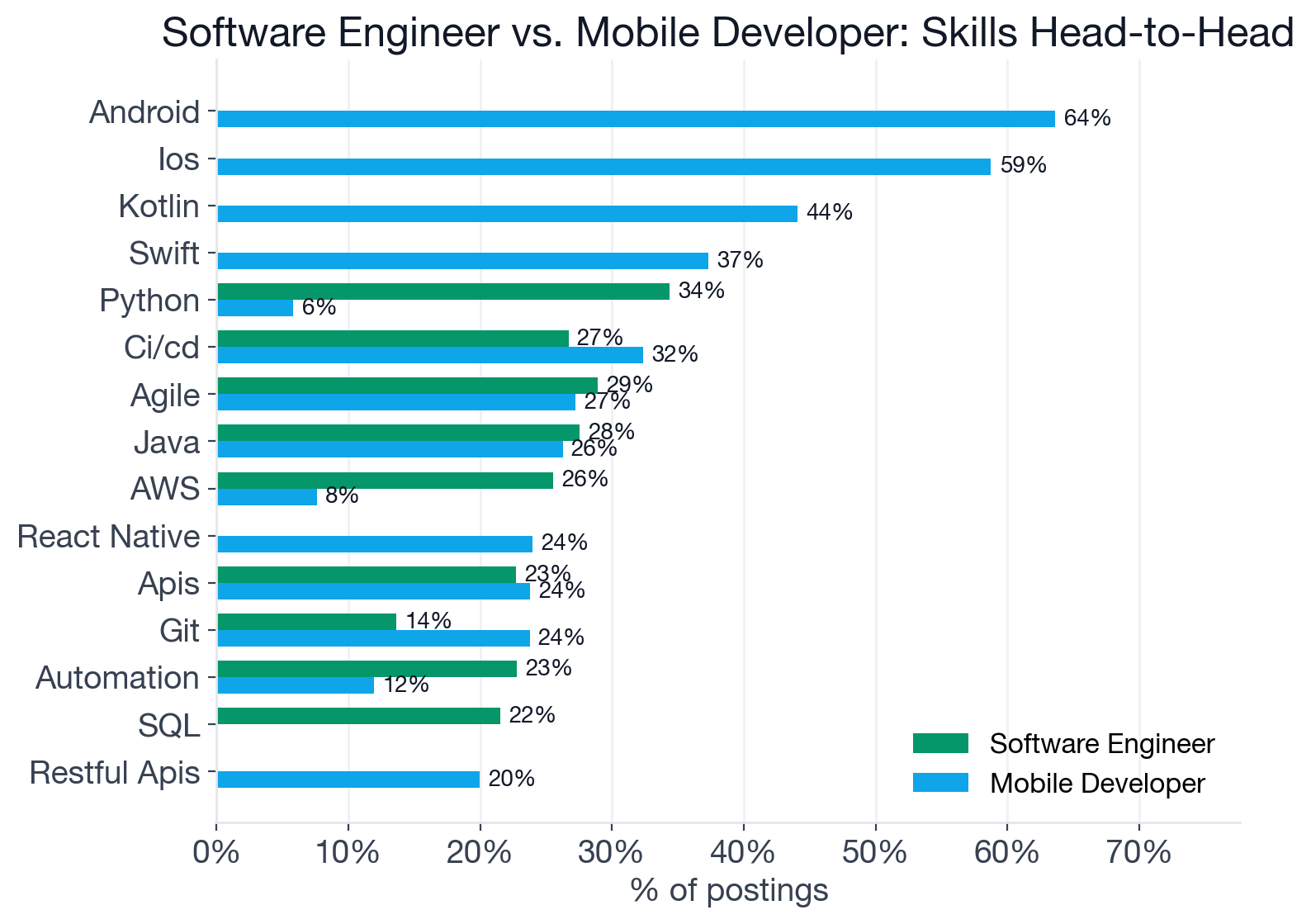
Top skills for Software Engineer (emerald) and Mobile Developer (blue) by share of active postings. Skills present in both roles appear at different heights; role-specific skills appear only on one side.
CI/CD shows up in 27% of Software Engineer openings and 32% of Mobile Developer openings. Agile sits at 29% and 27% respectively. Java appears in 28% of SE postings and 26% of Mobile Developer postings, but for different reasons: Spring-based backends on the SE side, Android development on the mobile side. APIs sit at roughly 23-24% in both.
The overlap coefficient of 33% means a candidate switching between the two paths brings roughly one-third of their toolkit with them. That is enough to start but far short of enough to skip re-skilling entirely.
Where Do the Roles Diverge?
The divergence is deep enough that switching mid-career requires deliberate investment in new tools, not just minor resume adjustments.
Skills exclusive to Software Engineer (in the SE top 30 but not the Mobile Developer top 30):
SQL (21%), Docker (17%), Kubernetes (17%), Azure (15%), C# (14%), Linux (13%), C++ (12%), Microservices (12%), Google Cloud (11%), Distributed Systems (11%).
The pattern is unmistakably backend, cloud, and infrastructure. SWE hiring expects containerized services, relational databases, and at least one major cloud. The C++ signal (12%) points to a significant embedded, gaming, and systems programming segment that runs parallel to the web and backend mainstream.
Skills exclusive to Mobile Developer (in the Mobile top 30 but not the SE top 30):
Android (64%), iOS (59%), Kotlin (44%), Swift (37%), React Native (24%), RESTful APIs (20%), SwiftUI (14%), Flutter (13%), Jetpack Compose (10%).
Every exclusive skill is a mobile-platform tool: the platforms themselves, the primary languages, the cross-platform frameworks (React Native and Flutter), and the modern declarative UI systems replacing the older imperative approaches (SwiftUI for iOS, Jetpack Compose for Android).
On AI tools: what postings say vs. what developers actually do
Neither role's top 30 skills lists GitHub Copilot, Cursor, or Claude Code. That gap is structural, not behavioral. According to the JetBrains State of Developer Ecosystem 2025, 85% of developers across all roles use AI tools regularly , a share that has grown steadily year over year. Employers now assume AI-assisted development the way they assumed Stack Overflow in 2012: it goes unstated.
Where the roles diverge is the explicit "build AI" tier. Machine Learning (median $154.7K, n=1,090), Generative AI ($148K, n=565), and LLMs ($152K, n=631) all appear in Software Engineer salary data with meaningful sample sizes, signaling a real subset of SWE roles dedicated to building AI systems. The equivalent signal is absent from Mobile Developer's top skills. Both roles sit on the same ambient usage baseline. Only a subset of Software Engineers are also hired to build AI.
Which Pays More?
The headline is a tie. Among US postings (where wage-transparency laws produce consistent salary disclosure), the median base salary is $140,000 for both Software Engineer (n=11,093) and Mobile Developer (n=362). Equity, bonuses, RSUs, and sign-on are not captured in posting salary data, so total compensation at top employers is meaningfully higher for both roles. The smaller Mobile Developer sample (362 vs. 11,093) is worth noting: the figure is directionally sound but less stable than the SE median.
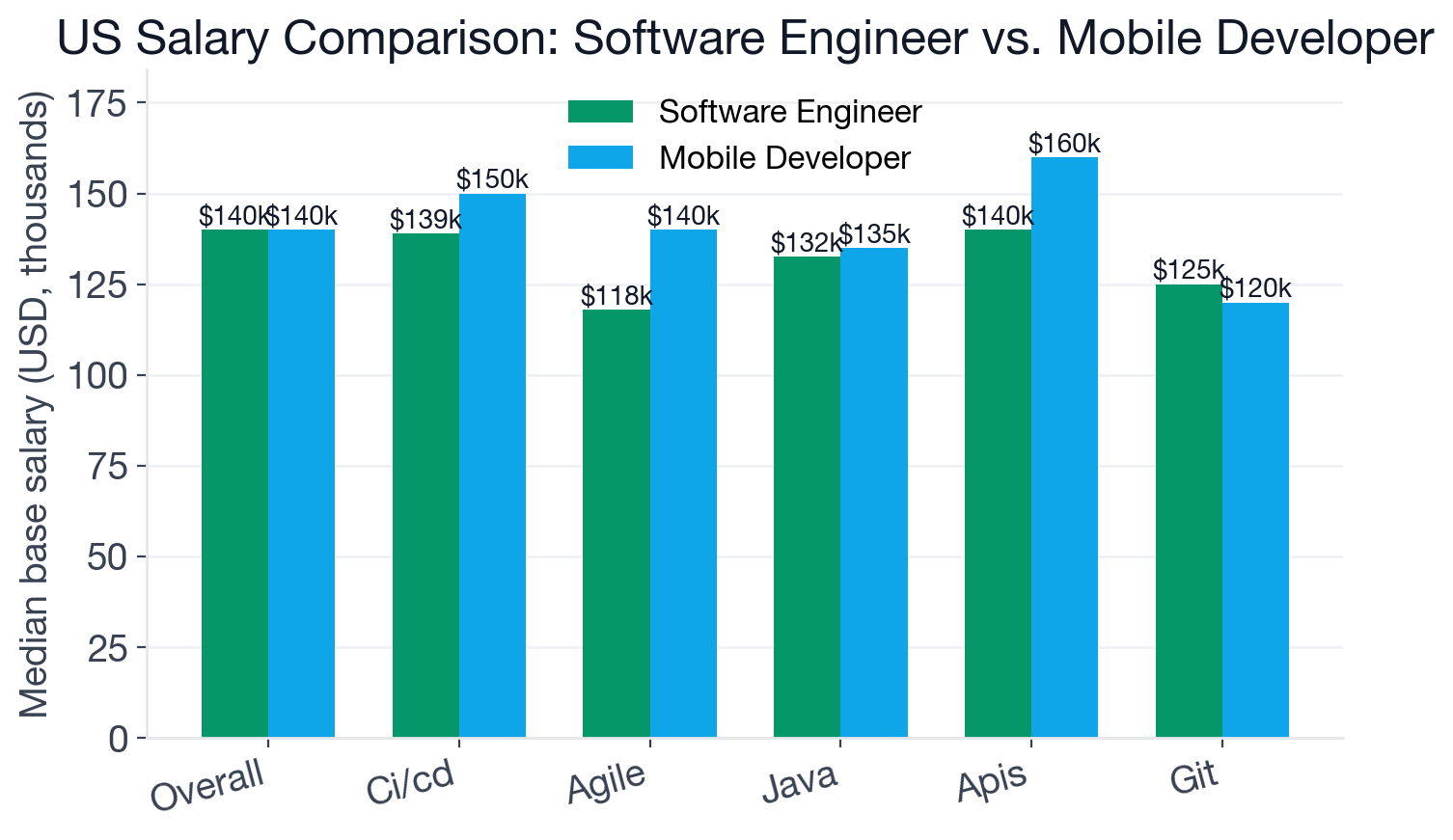
Median US base salary (USD) for Software Engineer and Mobile Developer overall and for selected shared skills. US postings only; base salary only.
What moves the needle above the $140,000 floor is different for each path:
Software Engineer salary premiums (US base, above $140K baseline): Distributed Systems ($160K, +$20K, n=1,777), Rust ($160K, +$20K, n=588), Observability ($157K, +$17K, n=1,561), Machine Learning ($154.7K, +$14.7K, n=1,090), LLMs ($152K, +$12K, n=631), Go ($150K, +$10K, n=418).
Mobile Developer salary premiums (US base, above $140K baseline): Jetpack Compose ($166K, +$26K, n=44), Swift ($159.2K, +$19.2K, n=116), SwiftUI ($152K, +$12K, n=57), React Native ($150K, +$10K, n=38).
For Software Engineers, the highest premiums cluster around infrastructure depth and AI/ML specialization. For Mobile Developers, platform-native modern UI skills carry the biggest lifts: Jetpack Compose (Android's declarative UI system) and SwiftUI are the newest frameworks on each platform, and teams paying above median want developers who know them well.
For a deeper look at the full Software Engineer skill and salary picture, see the Software Engineer skills analysis.
Which Has More Job Openings?
Software Engineer is one of the largest roles in tech by posting volume. Its 46,486 active listings outnumber Mobile Developer's 2,601 by 17.9 to 1. The US accounts for 39% of SE postings (about 18,100) and 27% of Mobile Developer postings (about 710).
| Level | Software Engineer | Mobile Developer |
|---|---|---|
| Entry | 4% (1,752 postings) | 3% (78 postings) |
| Mid-level | 52% (24,030) | 55% (1,420) |
| Senior | 30% (14,118) | 30% (779) |
| Staff | 14% (6,586) | 12% (324) |
The seniority distributions are nearly identical: both roles are mid-level-heavy at 50-55% and have slim entry-level doors at 3-4%. The practical difference is volume: with roughly 18x more SE postings overall, there are about 22 times more entry-level SE openings in absolute terms (1,752 vs. 78). Neither role is notably more accessible at the level-by-level rate; Software Engineering just has more of every level.
Work mode is where the gap is real. Mobile Developer's 27% remote share is half again the SE figure of 18%. Onsite is still the plurality for both (48% Mobile, 51% SE), but the remote differential compounds over a career if location flexibility matters.
Which Should You Choose?
Choose Software Engineer if you:
- Want the broadest job market: roughly 18x more openings and multiple on-ramps (backend, cloud, AI/ML, embedded)
- Are drawn to backend systems, distributed infrastructure, or building the APIs that mobile apps consume
- Want an explicit path into AI/ML engineering without changing roles
- Prefer a wider language portfolio: Python, Java, Go, Rust, C++, C#, JavaScript
Choose Mobile Developer if you:
- Want to build consumer-facing products that end up in people's pockets
- Are drawn to platform-specific engineering with its performance constraints and UX feedback loop
- Value a higher remote share (27% vs. 18%) when evaluating where you work
- Are willing to commit to a narrower, more specialized skill set in exchange for a clearer professional identity
Both paths offer the same median salary floor. The question is breadth vs. depth: Software Engineering offers more doors; Mobile Development offers a cleaner lane.
Bottom Line
Software Engineer and Mobile Developer pay identically at the median ($140,000 US base), but serve very different goals. Software Engineering is one of the most abundant and varied roles in tech; Mobile Development is narrower and platform-driven, with better remote availability and an equally solid salary floor. The 33% skill overlap means the switch from one track to the other requires real investment, not just a resume refresh.
Browse Software Engineer openings or Mobile Developer openings on the InterviewStack.io job board. Use the AI mock interview tool to sharpen interview skills for either track, and the question bank to drill system design, algorithms, and platform-specific topics.
FAQ
Q. How do Software Engineer and Mobile Developer salaries compare in 2026?
Both roles share a median US base salary of $140,000. The Software Engineer figure is based on 11,093 US postings with salary disclosed; the Mobile Developer figure is based on 362. These are base salaries only: equity, bonuses, and sign-on are not captured in posting data, so total compensation at top employers is higher for both roles.
Q. How many Software Engineer jobs are there compared to Mobile Developer jobs in 2026?
Software Engineer has 46,486 active postings vs. 2,601 for Mobile Developer, roughly 17.9 times more SE openings. In absolute terms, the US alone accounts for about 18,100 SE postings and 710 Mobile Developer postings.
Q. What skills do Software Engineers and Mobile Developers share?
CI/CD (27% of SE postings, 32% of Mobile Developer postings), Agile (29% and 27%), Java (28% and 26%), and APIs (23% each) form the shared foundation. The 33% Jaccard overlap means roughly one-third of the skill profile transfers between the two roles; two-thirds is platform-specific.
Q. What programming languages do Mobile Developers need in 2026?
Kotlin (44% of Mobile Developer postings) and Swift (37%) are the native-platform essentials for Android and iOS respectively. Java (26%) remains in use, particularly on the Android side. React Native (24%) and Flutter (13%) signal cross-platform demand. Python, which dominates Software Engineer postings at 34%, appears in only 6% of Mobile Developer postings.
Q. Which role is more remote-friendly in 2026?
Mobile Developer is notably more remote-friendly: 27% of postings are tagged remote, compared to 18% for Software Engineer. Onsite is still the plurality for both (48% for Mobile, 51% for SE), but the gap in remote availability is real and consistent across the active posting dataset.
Q. Should I become a Software Engineer or Mobile Developer?
Choose Software Engineer for broader opportunity and a path into AI/ML engineering. Software Engineering has roughly 18 times more openings and a wider language and systems portfolio. Choose Mobile Developer if you want to build consumer products on Android or iOS, value higher remote-work availability (27% vs. 18%), and prefer a deeper specialization in one platform.
Final Thoughts
These two roles sit on the same salary floor but serve very different professional identities. Software Engineering is the broader bet: more openings, more paths, a clear on-ramp into AI work. Mobile Development is the specialist's choice: a narrower platform focus, better remote availability, and the same compensation floor. The shared toolkit of CI/CD, Agile, Java, and APIs means the first steps of each path look similar; after that, the platform skills diverge fast.
Topics
Ready to practice?
Put what you've learned into practice with AI mock interviews and structured preparation guides.