
The Engineering Manager Project Delivery and Execution Ownership Interview Starts Scoring Before the First Follow-Up
You're seven minutes into a mid-level Engineering Manager interview and you've already covered the deadline, the ambiguous requirements, and the platform team's API dependency. What you haven't mentioned is that a senior engineer is leaving your team midway through the project, a detail buried in the second paragraph of the prompt that no follow-up question ever asks about directly. The first phase of this interview's scoring checklist grades whether you name it anyway, unprompted, in your very first answer, and nothing forces the topic back into the conversation if you don't.
This walkthrough follows one full 30-minute simulated interview, built on the same blueprint InterviewStack's AI mock interviewer uses to run and score real Engineering Manager candidates: a one-quarter delivery commitment, five stacked constraints, and a 100-point rubric spread across four dimensions. Watch where a well-prepared mid-level candidate still gives points back, then see the complete blueprint an interviewer is actually grading against.
Key Findings
- The 30-minute interview is paced into 4 phases: 0-7 minutes to frame the goal, 7-18 minutes for the execution plan, 18-26 minutes to handle a mid-project curveball, and 26-30 minutes for launch accountability.
- Scoring splits 30/30/20/20 across Interviewer Objectives Alignment, Level-Specific Expectations, Technical Proficiency, and Communication & Problem Solving, so 60 of 100 points sit in judgment before technical accuracy is scored at all.
- The opening prompt buries 5 distinct constraints in one paragraph (the quarter deadline, undefined requirements, an external API dependency, cross-platform delivery, and a senior engineer departing mid-project), and Phase 1's checklist grades whether you name all 5 unprompted.
- Phase 2 is the interview's single biggest ask: 5 expected behaviors packed into an 11-minute window, from launch scoping to a named contingency plan for one external dependency.
- 4 skill categories are ruled out entirely for this interview: deep authentication-system design, people-management coaching, negotiation theory, and executive-level strategy.
- The closing phase runs just 4 minutes (26-30), and 2 of its 3 checklist items, naming post-launch metrics and deciding whether to iterate or broaden rollout, live weeks after the ship date, not on it.
- The interviewer is holding 6 distinct follow-up curveballs, from a 4-week platform slip to a QA failure found 2 weeks before launch, and which ones you face depends on how you open.
What Is the Interviewer Actually Listening For in This Scenario?
The interview question
You are an Engineering Manager for a product engineering team at a large consumer tech company. Your team owns the backend and client integrations for account security settings. A recent internal review found that users who enable two-factor authentication are much less likely to experience account takeover, but activation is low because the current setup flow is confusing and drop-off is high.
Your org commits to shipping an improved two-factor authentication enrollment experience in one quarter. The work will require coordination across your engineers, design, mobile, web, QA, and a dependency on a platform team that owns the authentication service API. You are expected to drive delivery for your area and hit the quarter commitment, but requirements are not fully defined yet and your team has one senior engineer leaving midway through the project.
How would you take ownership of this project and drive it from kickoff to a successful launch by the end of the quarter?
The interviewer isn't grading whether you can produce a polished project plan on a whiteboard. They're checking whether you can independently take ownership of a delivery-critical initiative under exactly the conditions real Engineering Managers get: incomplete requirements, a hard deadline, a dependency you don't control, and reduced capacity, and still define measurable success, sequence the work, and know when to escalate versus when to just decide.
Four Follow-Ups, One Instinct to Wait
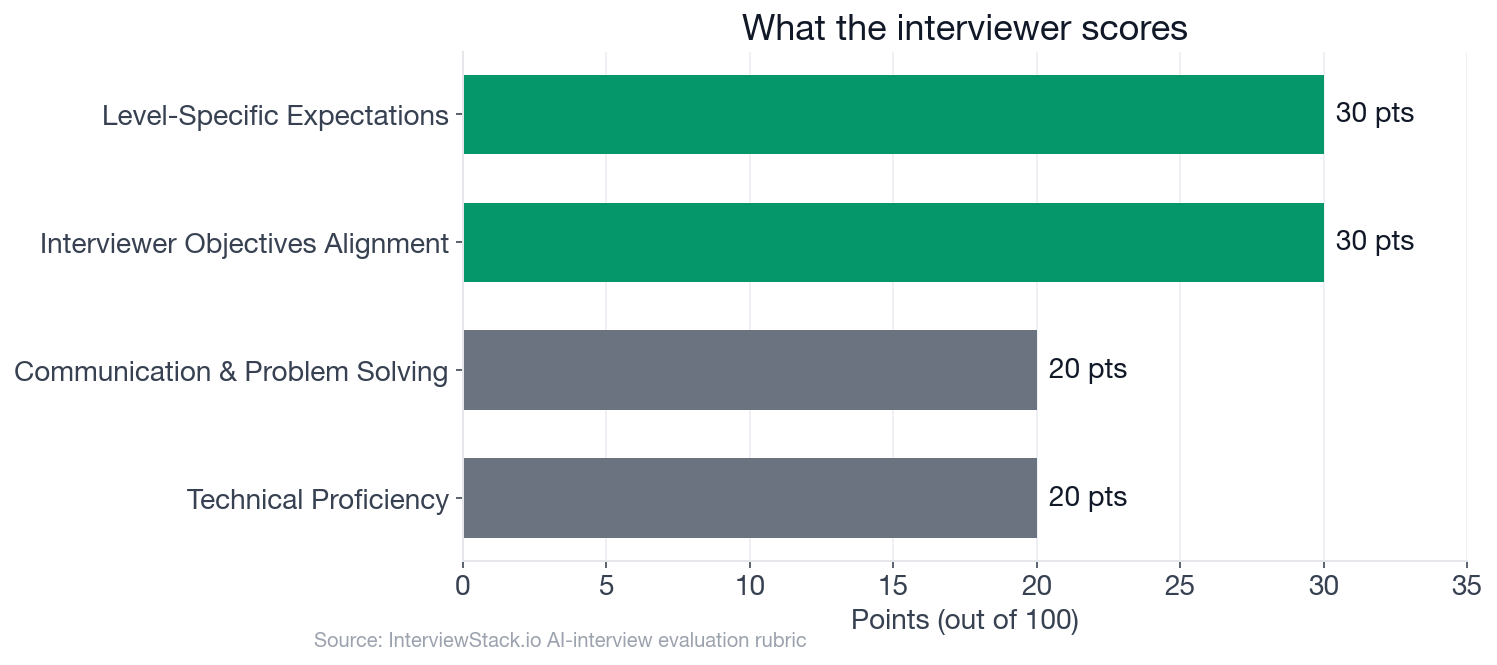
Interviewer Objectives Alignment and Level-Specific Expectations together carry 60 of the 100 points, more than Technical Proficiency and Communication & Problem Solving combined (40). A candidate can sound organized in the opening minutes and still give most of that back in the follow-ups below, which is exactly where a candidate we'll call Mira starts losing ground.
Turn 1: Defining Success Two Ways
Interviewer: "What would you define as success for this project, and how would you know early enough if delivery or impact is off track?"
Turn 2: The API Slips Four Weeks
Interviewer: "Suppose the platform team tells you halfway through planning that the API change you expected will slip by four weeks. How would you adapt the plan and still protect the quarter commitment?"
Turn 3: A Two-Week Quality Trap
Interviewer: "Two weeks before launch, QA finds that the new flow works on web but has a high failure rate on older mobile app versions. What would you do?"
Turn 4: Closing the Loop on Impact
Interviewer: "After launch, what outcomes would you review, and how would you decide whether the project was actually successful versus merely shipped on time?"
Spotting Mira's Mistakes Is the Easy Part
Every mistake above is obvious once it's sitting in a red box with a label on it. Live, with the interviewer waiting and Phase 2 alone handing you five checklist items in an eleven-minute window, noticing that your own success definition only covers delivery, or that your quality trade-off just quietly abandoned the staged-rollout option, is a different skill entirely. This post teaches you to recognize the pattern after the fact. It doesn't teach you to catch yourself doing it, out loud, while the clock is the one keeping time, not you.
That gap only closes with reps. If the interviewer had instead pushed on scope, a PM wanting backup methods and admin controls added to an already capacity-constrained launch, or on how you'd keep blockers surfacing without becoming the bottleneck yourself, those are two more ways this exact scenario can turn against you. Start a live AI mock interview on project delivery and execution ownership and find out which one you get.
What Does the Live Interview Actually Track, Phase by Phase?
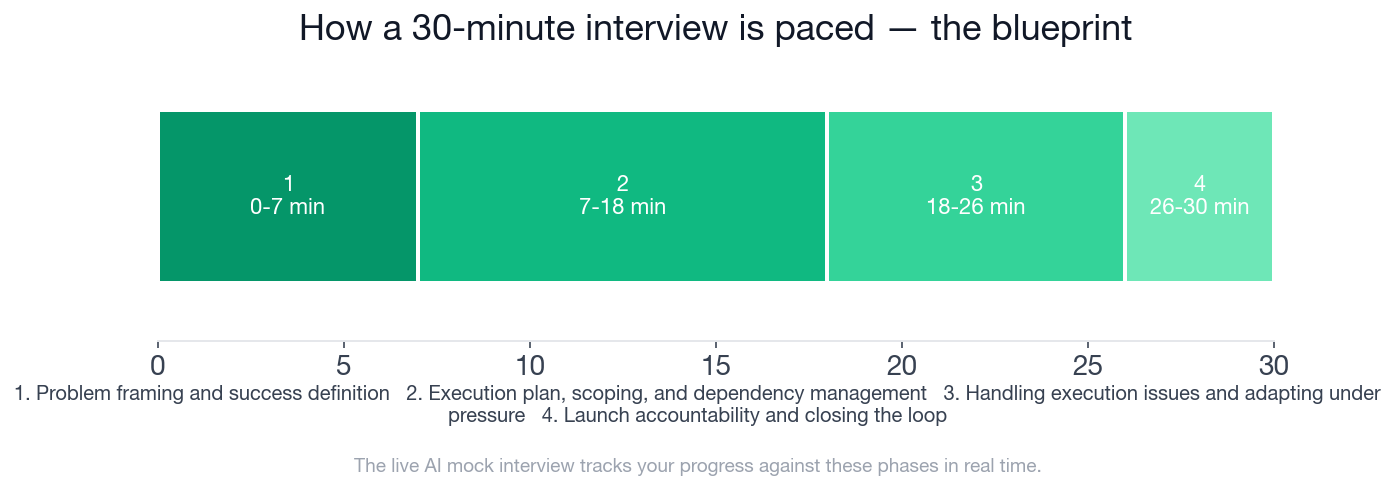
The chart paces the same 30 minutes into the four phases the interviewer is actually timing against: framing first, execution planning second, handling pressure third, closing the loop last. The card below is the exact checklist inside each phase, the same thing the AI mock interviewer tracks against in real time as you talk.
- ✓States a concrete project goal tied to shipping an improved 2FA enrollment flow within the quarter.
- ✓Defines at least one delivery metric and one product/outcome metric, such as launch date confidence, enrollment completion, drop-off reduction, support tickets, or auth failures.
- ✓Surfaces major constraints from the prompt: quarter deadline, ambiguous requirements, external API dependency, cross-platform work, and senior engineer departure.
- ✓Identifies missing inputs to resolve early, such as current funnel data, client version distribution, API limitations, legal/security review needs, or rollout constraints.
- ✓Breaks the quarter into sensible phases such as discovery/spec alignment, design/tech plan, implementation, validation, and launch.
- ✓Proposes a narrow, defensible launch scope focused on the highest-value enrollment improvements rather than absorbing all adjacent asks.
- ✓Accounts for team capacity and the loss of a senior engineer by adjusting ownership, simplifying scope, or sequencing riskier items earlier.
- ✓Creates an explicit plan for the platform dependency, including contract clarification, checkpoints, fallback paths, or temporary mitigations if the API slips.
- ✓Describes concrete operating mechanisms such as weekly milestone review, risk register, owner-by-workstream tracking, or launch readiness criteria.
- ✓Responds to slipping dependency or quality issue by re-evaluating scope, sequencing, and launch approach rather than passively waiting.
- ✓Uses escalation selectively and with a clear ask, such as prioritization trade-off, dependency support, or launch decision alignment.
- ✓Protects user quality and security by acknowledging validation, rollback, version compatibility, or staged rollout concerns.
- ✓Shows ability to keep the team moving through clear decision ownership, temporary workarounds, or splitting launch into phases if needed.
- ✓Describes launch-readiness checks such as monitoring, QA signoff, support preparedness, and rollback plan.
- ✓Names post-launch metrics and a timeline for review, not just generic statements about 'seeing how it goes.'
- ✓Explains how they would determine whether to iterate, broaden rollout, or declare success based on observed results.
Could You Name All Five Constraints in Your First Answer?
You've now seen every mistake this scenario is built to catch and the full checklist behind it. The next step is doing this live, out loud, on the clock, against follow-ups you can't preview in advance. Start the AI mock interview for project delivery and execution ownership and get scored against this exact rubric in real time.
Want to drill the individual habits first, defining measurable success, scoping under capacity constraints, escalating with a specific ask, before putting them together live? Work through the ownership and project delivery question bank, or browse company-specific prep guides if a specific interview process is next on your calendar. If ambiguity is the harder half of the job for you, our leading through ambiguity and change walkthrough covers a different corner of the same role.
FAQ
Q. What does an Engineering Manager ownership and project delivery interview actually test?
It tests whether you can independently drive a delivery-critical initiative from kickoff to a shipped, measured outcome, not whether you can recite a project-management framework. The 100-point rubric splits 30 points to Interviewer Objectives Alignment, 30 to Level-Specific Expectations, 20 to Technical Proficiency, and 20 to Communication & Problem Solving, so how you frame goals, scope trade-offs, and handle pressure counts for 60 of the 100 points before technical accuracy is even scored.
Q. How is the 30-minute interview paced?
Four phases: minutes 0 to 7 for framing the goal and success metrics, minutes 7 to 18 for the execution plan and dependency management, minutes 18 to 26 for handling a mid-project curveball like a slipping dependency or a quality issue, and minutes 26 to 30 for launch accountability and closing the loop on outcomes.
Q. Why does the senior engineer leaving matter so much in this scenario?
Because it is one of five constraints buried in the opening prompt (the quarter deadline, undefined requirements, an external platform-team dependency, cross-platform delivery, and the staffing loss), and the first scoring phase grades whether you name it, unprompted, in your very first answer. No follow-up question ever asks about it directly, so if you do not raise it yourself, nothing forces the topic back into the conversation.
Q. What happens if the platform team's API change slips by four weeks?
A strong answer resequences the team's own work to absorb the delay, front-loading anything that does not depend on the API, instead of just waiting on the platform team's revised timeline, and escalates with a specific, narrow ask rather than a vague status update. The rubric explicitly rewards re-evaluating scope and sequencing over passively waiting for someone else to fix the schedule.
Q. How is scope handled when a PM wants to add more to the launch?
By separating must-have launch scope from stretch scope and defending that line with a concrete trade-off, not by trying to fit everything in. Level-Specific Expectations for a mid-level Engineering Manager explicitly call for sound trade-offs between scope, quality, and timeline rather than absorbing every adjacent ask into one commitment.
Q. What does success mean after launch, not just shipping on time?
Naming specific post-launch metrics and a concrete review timeline, not a generic statement about seeing how it goes. The rubric's launch-accountability checklist explicitly penalizes vague monitoring language and rewards a clear plan for deciding whether to iterate, broaden rollout, or call the launch a success based on observed results.
Q. Can I practice this exact scenario?
Yes. The AI mock interview runs the same ownership and project delivery scenario and scores your live answer against this rubric, with follow-up questions you cannot see in advance.
Ownership Shows Up Before the First Question Is Asked
Every strong answer in this interview traces back to the same instinct: naming the hard part before you're asked to, whether that's a staffing loss buried in paragraph two or a quality trade-off nobody forced you to make. The scenario changes. That instinct is what the rubric is actually built to catch. The only way to know if you'd catch it yourself, live, is to run the clock.
Topics
Ready to practice?
Put what you've learned into practice with AI mock interviews and structured preparation guides.