
You walk in prepared. You can talk about tokens, Storybook and compound components. Then the interviewer says every team has its own buttons, and asks you to ship a design system that nobody breaks and everybody adopts. In a mid-level Frontend Developer design system interview, the points leak out of the follow-ups, not the opening answer. Below is a dramatized replay of that 30-minute interview, built on one InterviewStack.io blueprint.
Key Findings
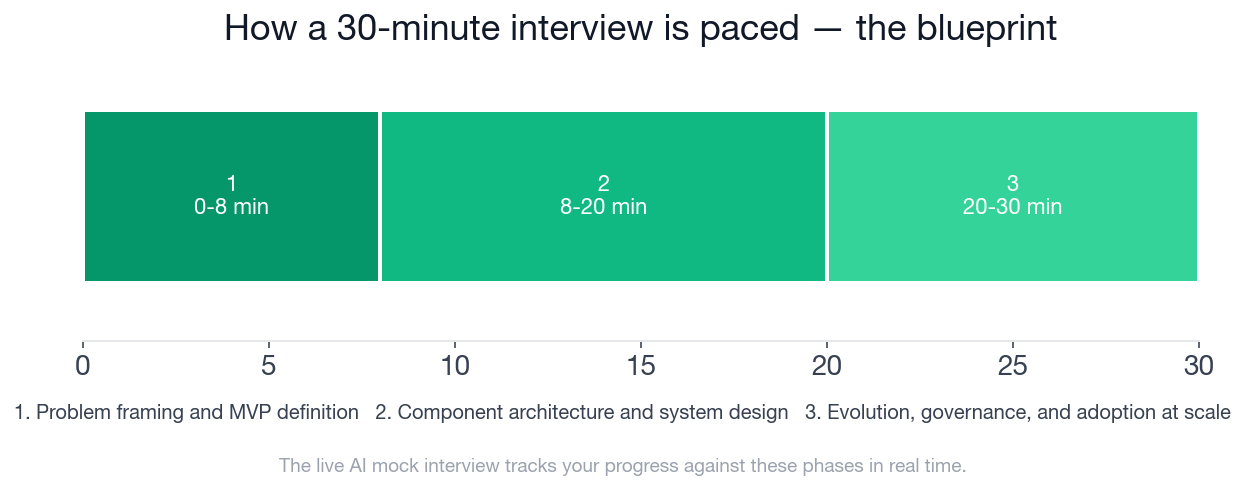
- The interview runs 30 minutes in 3 phases: framing and MVP (0-8), architecture (8-20), and governance and adoption (20-30).
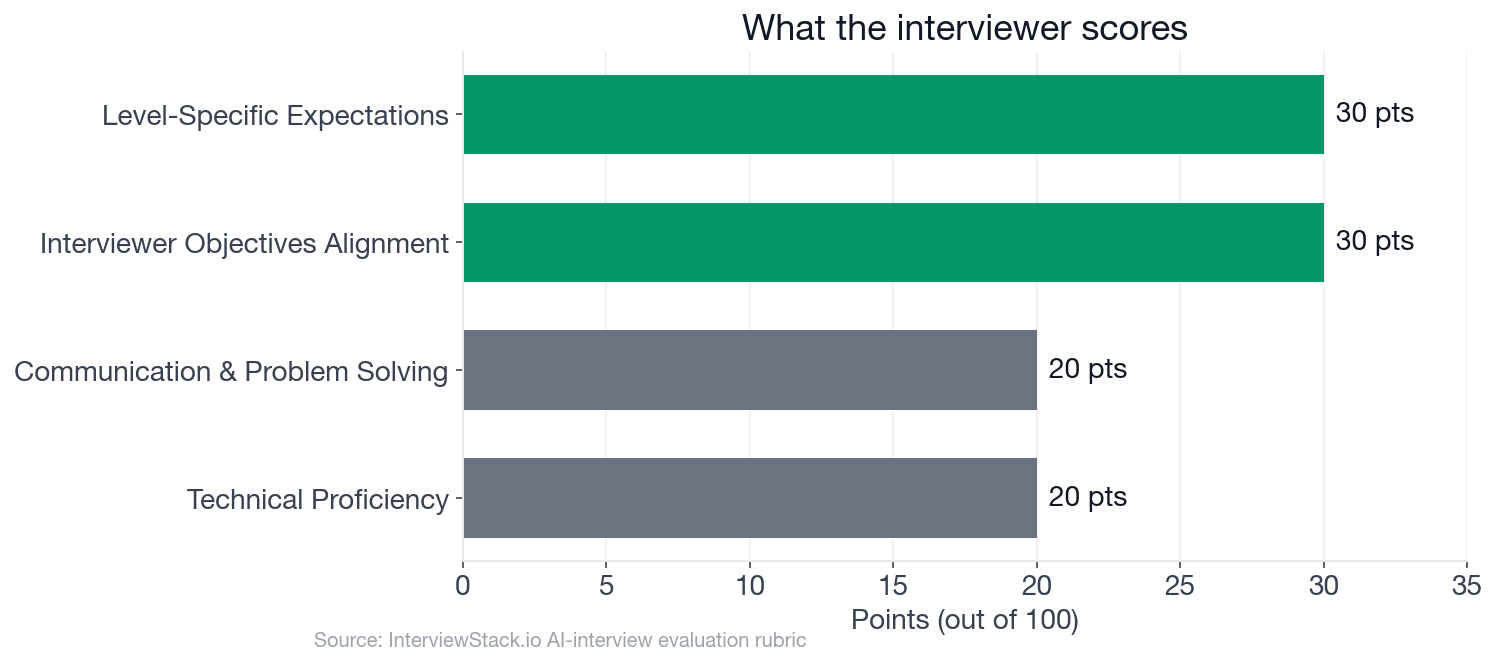
- Scoring totals 100 points across 4 dimensions, and 60 of them (30 + 30) reward objectives alignment and level-specific depth, not raw technical trivia.
- Technical Proficiency is worth only 20 points, the same as Communication & Problem Solving.
- The architecture phase carries 7 checklist items, the most of any phase, from layered tokens to visual regression tests.
- The governance phase has 6 checklist items, and 4 of them are about change policy, versioning, migration, and exceptions.
- A strong v1 is narrow: design tokens, a few core primitives, and a handful of high-usage components, rolled out through pilot teams rather than a big-bang replacement.
What Is a Frontend Developer Design System Interview Really Asking?
It is asking whether you can scope, not whether you can build. The scenario below is deliberately open-ended, and the interviewer is probing component API design, accessibility, tokens, versioning, and cross-team adoption, with pragmatic trade-offs appropriate for a mid-level engineer.
The interview question
Your company has several product surfaces built by different teams: a consumer web app, an internal admin tool, and a marketing site. Today, each team has its own buttons, form fields, modals, spacing rules, and color values, which has led to inconsistent UX and slow feature delivery.
Leadership wants a shared design system and component library for web products. You are joining the effort early, and the first milestone is to support common UI primitives and a few composed components while keeping adoption friction low for existing teams. How would you design and roll out the first version of this design system and component library so that teams can adopt it safely and it can evolve without creating product inconsistency or breaking consumers?
The Walkthrough: Four Turns Where Points Quietly Disappear
These answers are illustrative, not a transcript of any real candidate. Each shows a pattern many candidates fall into, and what the rubric would want instead.
Turn 1: Scoping the first release
Interviewer: "What would you include in the first release versus explicitly defer, and how would you decide?"
Turn 2: Tokens and component APIs
Interviewer: "How would you structure component APIs and design tokens so both the consumer app and the marketing site can share foundations but still meet their different needs?"
Turn 3: The one-off button request
Interviewer: "Suppose one team needs a button variation that is not in the system yet. How would you handle that request without letting the library fragment?"
Turn 4: Versioning and migration
Interviewer: "How would you version changes and help teams migrate when a component API or token needs to change?"
Why Is Reading This Not Enough?
Spotting these mistakes on the page is easy, because you had the answer one box below. Live, you have a ticking clock, an interviewer who changes direction, and a v1 scope you must defend from memory. Avoiding the pattern under that pressure is the real skill, and it only comes from reps. A read-through cannot give you those; a live mock interview can.
The Complete Blueprint
This is the blueprint a strong candidate hits, and exactly what the AI mock interview tracks you against in real time. The 30 minutes are paced so that you cannot spend all of it on tokens.
- ✓Clarifies target consumers such as product teams, designers, and possibly marketing engineers
- ✓Identifies current pain points like inconsistency, duplicated effort, and maintenance cost
- ✓Proposes a narrow first release such as tokens plus core primitives and a few high-usage components
- ✓Explains why some components or surfaces would be deferred from v1
- ✓Mentions adoption strategy such as pilot teams or incremental migration instead of big-bang replacement
- ✓Describes a layered approach such as tokens to primitives to composed components
- ✓Explains how design tokens would represent foundations like color, spacing, typography, and states
- ✓Proposes component APIs that are composable and constrained, avoiding excessive one-off props
- ✓Addresses accessibility expectations for common components such as keyboard support, focus states, labeling, and ARIA where appropriate
- ✓Discusses customization mechanisms such as variants, slots, composition, or theme overrides without allowing uncontrolled divergence
- ✓Mentions packaging or distribution choices at a practical level, such as a shared package, documentation site, and local development workflow
- ✓Includes quality controls like unit tests, visual regression, interaction tests, and accessibility checks
- ✓Explains a change policy for adding, modifying, or deprecating components and tokens
- ✓Mentions semantic versioning and distinguishes breaking from non-breaking changes
- ✓Suggests migration support such as codemods, deprecation warnings, examples, or office hours
- ✓Defines lightweight governance, for example review with design and frontend maintainers plus contribution guidelines
- ✓Identifies adoption and health metrics such as usage coverage, duplicate component reduction, accessibility defects, or time to ship UI changes
- ✓Shows balanced judgment on when to accept exceptions versus standardize patterns
Practice It Live in the AI Mock Interview
Run this exact scenario, with unscripted follow-ups and the same three-phase blueprint, in the AI mock interview for Frontend Developers. You will see where you drift off the checklist while there is still time to fix it. Want more reps first? Work through the design systems question bank, or read the Frontend Developer preparation guides to fill gaps before you sit down.
FAQ
What does a mid-level Frontend Developer design system interview test?
It tests whether you can scope a first release, design layered component APIs and tokens, and plan versioning and migration for multiple teams. The 30-minute blueprint splits into three phases (0-8, 8-20 and 20-30 minutes), and the rubric weights alignment with the interviewer's objectives and level-specific expectations at 30 points each.
What should go into the first release of a design system?
A narrow v1: design tokens, a few core primitives, and a handful of high-usage composed components. Strong candidates also say what they defer and why, then roll out through pilot teams instead of a big-bang replacement.
How do you handle a team that needs a component variant the system lacks?
Treat the request as a signal, not a ticket. Ask whether existing variants, composition, or slots already cover the need, then route real gaps through a lightweight contribution path reviewed by design and frontend maintainers, with exceptions logged rather than silently allowed.
How should a design system handle breaking changes?
Use semantic versioning, separate breaking from non-breaking changes, and ship deprecation warnings before removal. Back that with migration support such as codemods, examples, and office hours so consumer teams are not stranded.
How is a design system interview scored?
Out of 100 points across four dimensions: Interviewer Objectives Alignment (30), Level-Specific Expectations (30), Technical Proficiency (20), and Communication & Problem Solving (20).
How do you measure whether a design system is working?
Track usage coverage, duplicate component reduction, accessibility defects, and time to ship UI changes. Pairing a consistency metric with a velocity metric shows the system helps teams rather than only policing them.
How can I practice a design system interview before the real one?
Run the question live in an AI mock interview that tracks you against the same three-phase blueprint with unscripted follow-ups, then review where you lost points.
Your First Release Is a Negotiation
Interviewers rarely reward the biggest system. They reward the candidate who picks a small v1, defends what was left out, and keeps teams from forking the moment someone needs a new button. Practice saying that out loud until it sounds like a plan.
Topics
Ready to practice?
Put what you've learned into practice with AI mock interviews and structured preparation guides.