
The deploy notes list five changes, checkout failures climbed from 0.8% to 7%, and the interviewer wants to know how you would find the one that matters. The instinctive move for a mid-level Full-Stack Developer is to name a favorite suspect inside a minute, usually the new promo flag. That instinct may even be right, and it still scores poorly, because this round pays for the evidence that eliminates suspects, not for the guess.
What follows is a simulated mock interview built on one AI interview blueprint. The mistakes are illustrative composites with coaching, not a transcript of a real candidate or any company's actual questions.
Key Findings
- The interview is scored out of 100 points across 4 dimensions, and Technical Proficiency is only 20 of them.
- Interviewer Objectives Alignment and Level-Specific Expectations carry 30 points each, 60 of 100 combined.
- The 30 minutes run in 3 phases: initial triage and framing (minutes 0 to 8), systematic narrowing and diagnosis (8 to 20), and mitigation, verification and root-cause analysis (20 to 30).
- Narrowing gets the longest slot, 12 minutes or 40% of the interview, and 5 of the blueprint's 13 checklist items.
- Checkout failures rose nearly ninefold, from 0.8% to 7%, while API latency was only slightly elevated.
- The deploy notes list 5 changes while a checkout feature flag reached 25% of traffic; the blueprint expects you to use that rollout as a bisection tool rather than treating all 5 changes equally.
- The interviewer has 6 prepared follow-ups; this walkthrough dramatizes 4 of them.
The Rollout Split Is the Best Tool in the Prompt
Read the setup as a list of suspects plus a set of alibis. The deploy notes give you five suspects. The traffic gives you the alibis: who is on the flag, which region, which shard, which carts.
The interview question
You are on-call for a product team that owns a web application with a React frontend, a Node.js/Express API, Redis for caching sessions and some derived data, and PostgreSQL as the source of truth. The app has just finished a staged rollout of a new checkout-related feature flag to 25% of traffic.
Starting about 20 minutes ago, support reports that some users can add items to cart but fail when placing an order. Product says the issue seems concentrated in one region but not all users there are affected. The dashboard shows a sharp increase in checkout failures from 0.8% to 7%, while overall API latency is only slightly elevated. A rollback has not yet happened because another team depends on the same release train.
Recent changes in the last deploy included:
- React checkout page refactor to lazy-load payment options
- New API endpoint for order price recalculation
- Redis key format change for cart-related cached data
- PostgreSQL index added on orders(user_id, created_at)
- Feature flag added for a new promo stacking rule
You have access to logs, metrics, traces, feature-flag targeting info, and can make low-risk production changes if needed.
Walk me through how you would investigate and drive this incident to root cause.
The interviewer objectives name the layers you are expected to isolate: client, API, cache, database and deployment. They also reward judging evidence quality and blast radius, so every step you propose should say what it would prove. Designing a new checkout architecture is explicitly out of scope; minutes spent redesigning earn nothing here.
How Is a Full-Stack Developer Debugging Interview Scored?
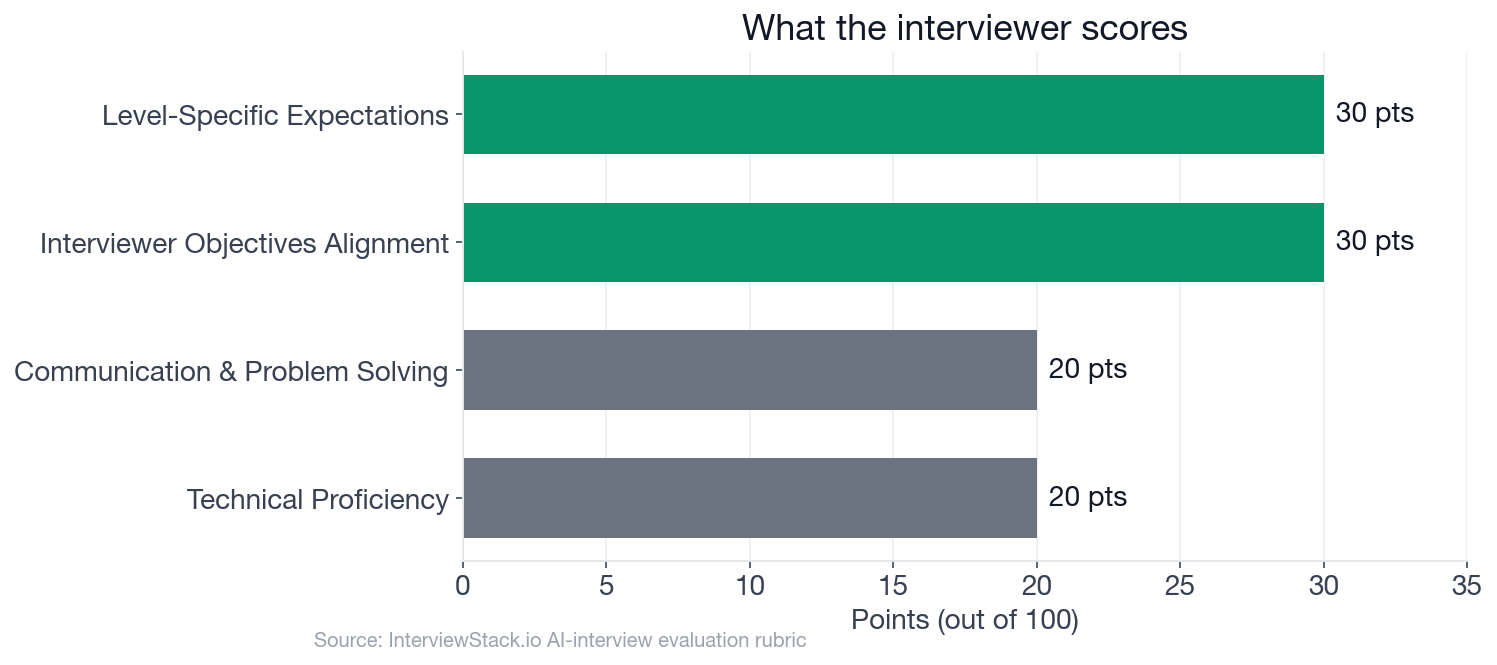
The 100-point rubric behind this interview. Interviewer Objectives Alignment and Level-Specific Expectations are 30 points each; Technical Proficiency and Communication & Problem Solving are 20 each.
Sixty of the 100 points depend on whether you hit the interviewer's objectives and the mid-level bar, not on knowing the right tool. That bar is specific: propose an end-to-end plan across at least the application, cache and database layers without heavy prompting, and say what evidence would confirm or eliminate each hypothesis. Designing a company-wide incident command structure is not expected, so skip the theatre and stay on the evidence.
Where Do Prepared Candidates Leak Points?
Turn 1: Bisecting With the Rollout
Interviewer: "How would you use the 25% feature rollout and recent changes to do bisection without making risky assumptions?"
Turn 2: Sorting 4xx From 5xx
Interviewer: "If the frontend reports a generic checkout error but the backend shows a mix of 4xx and 5xx responses, how would you separate user-input issues from system failures?"
Turn 3: The Promo-and-Shard Clue
Interviewer: "Suppose failures only happen for carts that contain a promo code and only for users routed to one API shard. How would that change your debugging path?"
Turn 4: The RCA That Sticks
Interviewer: "Once the incident is mitigated, what would you include in the root-cause analysis to prevent this class of issue from recurring?"
Why Does This Feel Obvious on the Page and Hard in the Room?
Spotting a mistake with the fix printed underneath is the easy version. Live, the shard detail arrives after you have already committed to the flag theory, you have 12 minutes to work through five suspects while narrating your reasoning, and you cannot predict which follow-up comes next. Two of the six never appeared above: when to mitigate in the first few minutes, and what to instrument when the logs are noisy. A live interviewer might open with either. The habit of eliminating before accusing only holds under that pressure if you have practiced it under that pressure.
From 7% Back to Baseline, Phase by Phase
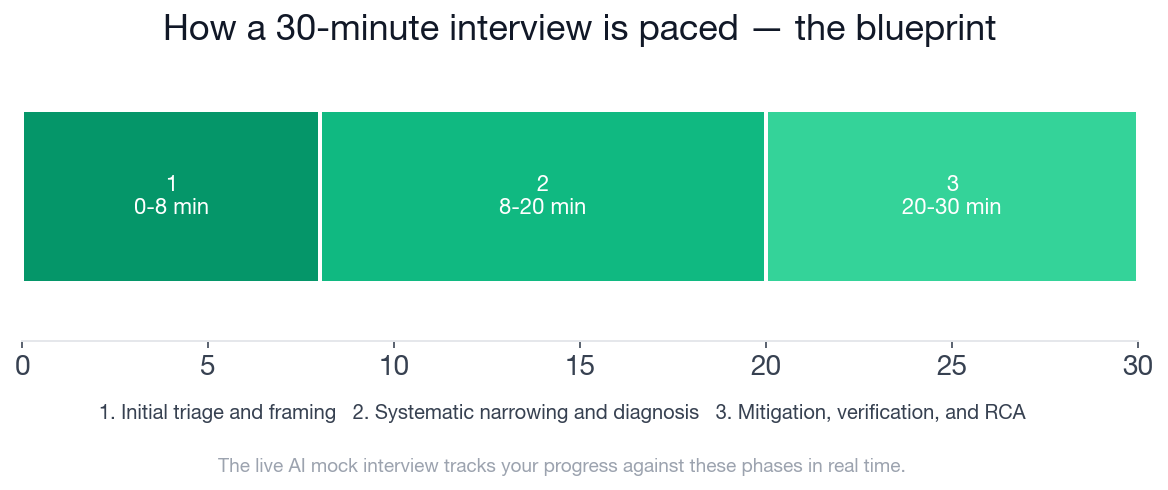
The interview's three phases: triage and framing (0 to 8 minutes), narrowing and diagnosis (8 to 20), mitigation, verification and root-cause analysis (20 to 30).
This is the blueprint a strong candidate hits, and it is the exact checklist the AI mock interview tracks you against in real time as you talk.
- ✓States a goal to quantify scope: affected users, regions, endpoints, status codes, and time correlation with deploy/flag rollout.
- ✓Identifies at least 2-3 plausible failure domains tied to the scenario, such as feature flag logic, Redis key mismatch, API contract breakage, or shard/region-specific behavior.
- ✓Proposes an initial evidence-gathering sequence with concrete signals: error rate by endpoint, trace comparison between successful and failed checkouts, logs filtered by region/flag cohort.
- ✓Mentions a mitigation path early if customer impact is significant, such as disabling the promo flag for the affected cohort or pausing rollout.
- ✓Uses recent changes and 25% rollout as a bisection tool rather than treating all changes equally.
- ✓Suggests comparing affected vs unaffected cohorts by feature-flag state, region, API shard, promo usage, and request path.
- ✓Describes at least one safe temporary diagnostic, such as structured logging of cart ID/flag state/cache hit path/error code, or trace annotations around price recalculation.
- ✓Considers cache/version mismatch risks from the Redis key format change and explains how stale or mixed-format data could produce selective failures.
- ✓Explains how to validate or rule out database/index impact using query timings, lock/wait metrics, and whether slight latency can plausibly explain the failure mode.
- ✓Chooses a mitigation that matches their leading hypothesis and minimizes blast radius, for example cohort-specific flag disablement before full rollback.
- ✓Defines how to verify recovery: checkout success rate returns to baseline, affected cohort improves, logs/traces no longer show the failing path.
- ✓Clearly separates immediate fix from true root cause, and notes what evidence is still needed before declaring incident closed.
- ✓Proposes at least two preventive actions tied to the scenario, such as cache key versioning, contract tests between frontend and API, canary alarms segmented by flag cohort/region, or stronger rollout guardrails.
Debug This Incident Live Before Your Real Round
The fastest way to find out whether you eliminate or accuse is to run this scenario against an interviewer who pushes back. Start the Full-Stack Developer debugging mock interview: 30 minutes, unscripted follow-ups, and the blueprint above filling in as you cover each item, with feedback scored against the same four dimensions.
Want a warm-up first? Work through single questions in the systematic debugging question bank, then browse the preparation guides for your target companies. If your loop also includes a build round, the Full-Stack Developer feature interview walkthrough covers that side.
FAQ
Q. What does a Full-Stack Developer debugging interview test?
It tests whether you can run a repeatable investigation across the client, API, cache, database and deployment layers, not whether you can guess the bug. In this 30-minute blueprint you frame impact and hypotheses, narrow the failure with cohort comparisons and safe diagnostics, then mitigate, verify and write the root-cause analysis. Technical Proficiency is 20 of 100 points; Interviewer Objectives Alignment and Level-Specific Expectations are worth 30 each.
Q. Should you mitigate before you know the root cause?
Often, yes. Mitigation and diagnosis are separate decisions, and the first phase of the blueprint expects you to raise a mitigation path early when customer impact is significant, such as disabling the promo flag for the affected cohort or pausing the rollout. Pick the option with the smallest blast radius that matches your leading hypothesis, and keep investigating after it lands.
Q. What temporary diagnostics are safe to add in production during an incident?
Structured logging and trace annotations scoped to the failing path. The blueprint names logging cart ID, flag state, cache hit path and error code, or annotating traces around the price recalculation call. Keep the change small, reversible and free of sensitive payment data, and remove it once the question it answers is settled.
Q. How do you use a feature flag rollout to debug?
Treat the rollout as a natural experiment. Compare the failure rate for users with the flag on against users with it off: if only the flagged cohort is elevated, the flag path is implicated; if both are, look at the changes that shipped to everyone. Check first that flag assignment is not skewed by region or shard, or the comparison can mislead you.
Q. What is a mid-level candidate expected to cover in this interview?
The blueprint lists 4 level-specific expectations: propose an end-to-end plan across at least the application, cache and database layers without heavy prompting; prioritize causes from the deploy changes and traffic segmentation; name safe mitigations with basic trade-offs; and say what evidence would confirm or eliminate each hypothesis. Designing a company-wide incident command structure is explicitly not expected.
Q. How can I practice a debugging interview like this one?
Run it live. The AI mock interview for this role, level and topic asks its own follow-ups and tracks you against the same three-phase blueprint in real time. The question bank works as a warm-up for single questions on hypothesis-driven debugging, bisection and root-cause analysis.
Eliminate Before You Accuse
The promo flag might well be the culprit. The interview is scored on whether you proved it: one cohort split, one status-code breakdown and one targeted log line at a time, then a fix you verified and an RCA that stops the next one. Practice saying that sequence out loud until it is the first thing you reach for.
Topics
Ready to practice?
Put what you've learned into practice with AI mock interviews and structured preparation guides.