
A $62K Gap Has Already Opened Inside the AI Engineer Title
The AI Engineer role is, by name, an AI job. Yet within it, there is already a $62,400 salary split based on which generation of AI you are building with. Postings that explicitly require generative AI skills, meaning LLMs, RAG pipelines, agent systems, and the orchestration frameworks that bind them, show a US median base salary of $140,000 (base salary only; equity and bonuses not reflected in posting data). Postings for the same job title that rely on traditional ML work or carry no AI requirement at all land at $77,600. Across 4,155 active AI Engineer postings analyzed on the InterviewStack.io job board as of June 2026, those two numbers tell the core story.
The gap is not primarily about seniority or company size. It is about which era of AI you are shipping. Companies building systems around large language models, retrieval pipelines, and autonomous agents are paying dramatically more than those still mapping "AI Engineer" onto classical model-training work. Both groups use the same job title. The market does not treat them the same way.
Key Findings
- 4,155 active AI Engineer postings analyzed on the InterviewStack.io job board as of June 2026.
- 83.1% of postings (3,451 of 4,155) explicitly require new-wave generative AI skills; 91.8% require any form of AI.
- AI Agents is now the #3 most demanded AI skill, appearing in 47.3% of all postings (1,967 of 4,155).
- LLMs lead the new-wave stack at 55.5%, followed by AI Agents (47.3%), Generative AI (40.6%), and RAG (39.6%).
- US postings with generative AI skills: median $140,000 (n=635). Without AI skills: $77,600 (n=77). Gap: $62,400. Base salary only; equity not included.
- Machine Learning still appears in 58.9% of all AI Engineer postings, confirming foundational ML has not been displaced.
- Senior-level roles dominate at 65.6% of postings; entry-level is just 5.1% (212 of 4,155).
- Fintech leads industry AI adoption at 95.1% of AI Engineer postings requiring AI skills (175 of 184 postings).
Before 2023, the "AI Engineer" Title Barely Existed
Three years ago, the work that today's AI Engineers do was distributed across several separate role names. ML Engineers trained models. Data Scientists built predictions. Platform Engineers kept training infrastructure running. None of those roles involved integrating a production LLM into a customer-facing product, because production-ready LLMs capable of that kind of integration did not yet exist.
The pre-2023 version of this work centered on applied machine learning: Python, TensorFlow or PyTorch, scikit-learn for classical models, and tools like Kubeflow or MLflow for serving. "Agent systems" meant rule-based bots with decision trees. "Vector database" was not in common job description vocabulary. The dominant concerns were model training efficiency, feature engineering quality, and getting a scikit-learn model into a REST API without too much pain.
Then ChatGPT launched in late 2022, and the job market began a wholesale redesign. By 2026, AI Engineer had become the fastest-growing job title in US tech, with posting volume up 143% year-over-year according to HeroHunt.ai. AI and ML jobs now represent roughly half of all tech job postings, up from about 10% in 2023, according to Index.dev. The role did not evolve incrementally. The LLM wave rebuilt the job description from the outside in.
Which AI Skills Are Explicitly Required in 2026?
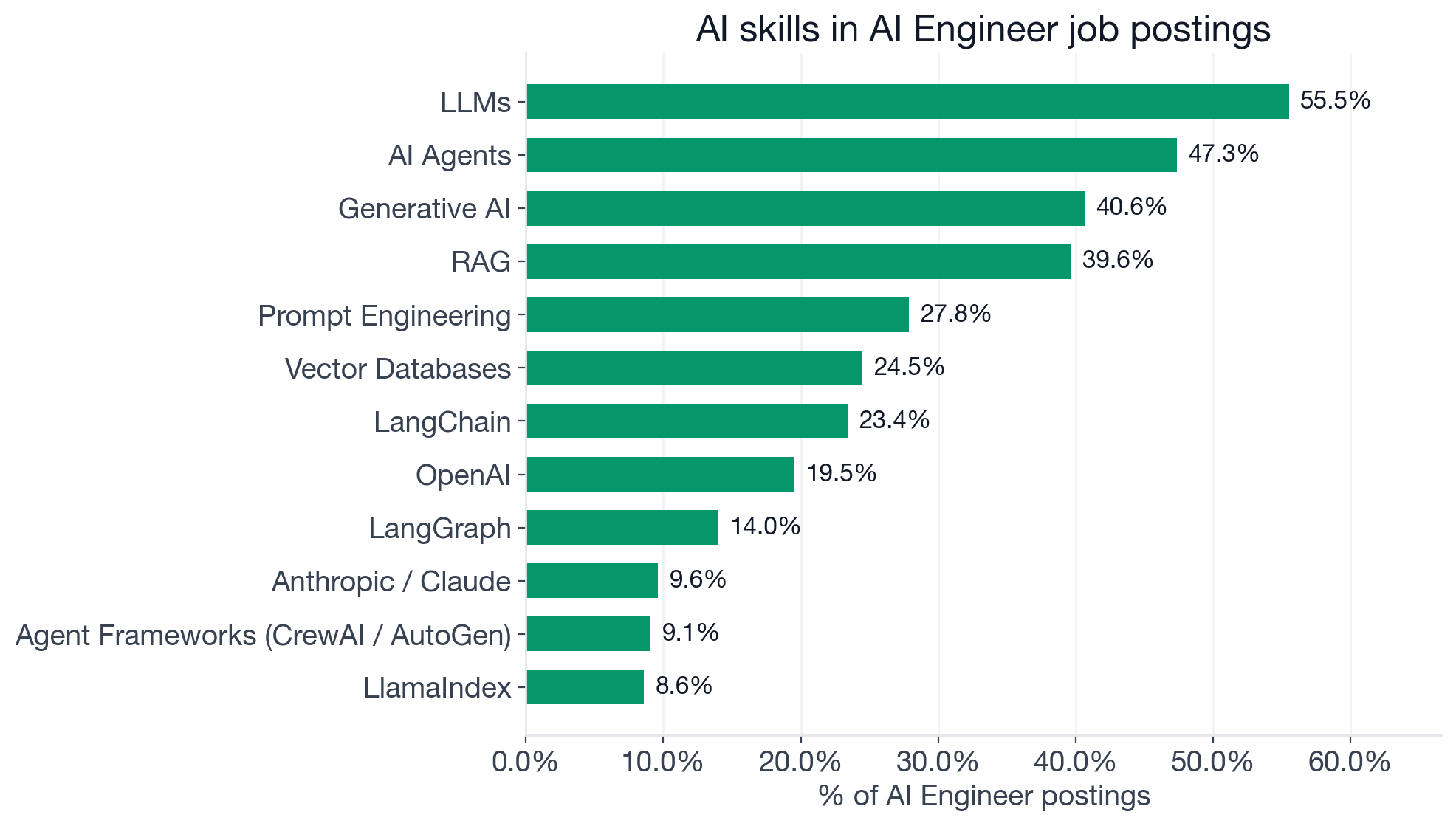
The chart above shows what "AI Engineer" means to a hiring manager in 2026, broken down by individual skill frequency.
LLMs lead the new-wave AI skills at 55.5% of postings. That number was zero three years ago. The more telling signal is AI Agents at 47.3%: nearly half of all AI Engineer postings now ask for experience building autonomous, multi-step AI systems that make tool calls, loop on their own output, and act without direct human steering at each step. This is not a niche specialization. It is approaching majority territory.
RAG (Retrieval-Augmented Generation, a technique for grounding LLMs in external knowledge bases at query time) appears in 39.6% of postings and Prompt Engineering in 27.8%. The orchestration layer is defined by LangChain at 23.4%, LangGraph (a framework for building stateful, multi-actor agent workflows) at 14.0%, and multi-agent frameworks including CrewAI and AutoGen at 9.1%. Vector databases (embedding-based stores that power RAG retrieval) appear in 24.5% of postings.
Traditional infrastructure is still present. Machine Learning itself leads all skills at 58.9% because many AI Engineer roles need engineers who can evaluate and compare models, not just call an API. Deep Learning and Neural Nets appear in 24.5%, and MLOps in 20.0%. The role is layering the generative AI stack on top of classical ML foundations, not replacing them.
| AI Skill | % of Postings | Job Count |
|---|---|---|
| Machine Learning | 58.9% | 2,451 |
| LLMs | 55.5% | 2,306 |
| AI Agents | 47.3% | 1,967 |
| Generative AI | 40.6% | 1,689 |
| RAG | 39.6% | 1,647 |
| Prompt Engineering | 27.8% | 1,157 |
| Deep Learning / Neural Nets | 24.5% | 1,019 |
| Vector Databases | 24.5% | 1,016 |
| LangChain | 23.4% | 972 |
| MLOps | 20.0% | 832 |
Of the orchestration platforms, OpenAI appears in 19.5% of postings, Anthropic / Claude in 9.6%, Hugging Face in 7.8%, and Gemini in 5.9%. The platform landscape is still contested, which is why platform-agnostic framework skills like LangChain and LangGraph matter more than proficiency in any single provider.
Beyond the 83%: The Layer of AI Fluency Job Postings Miss
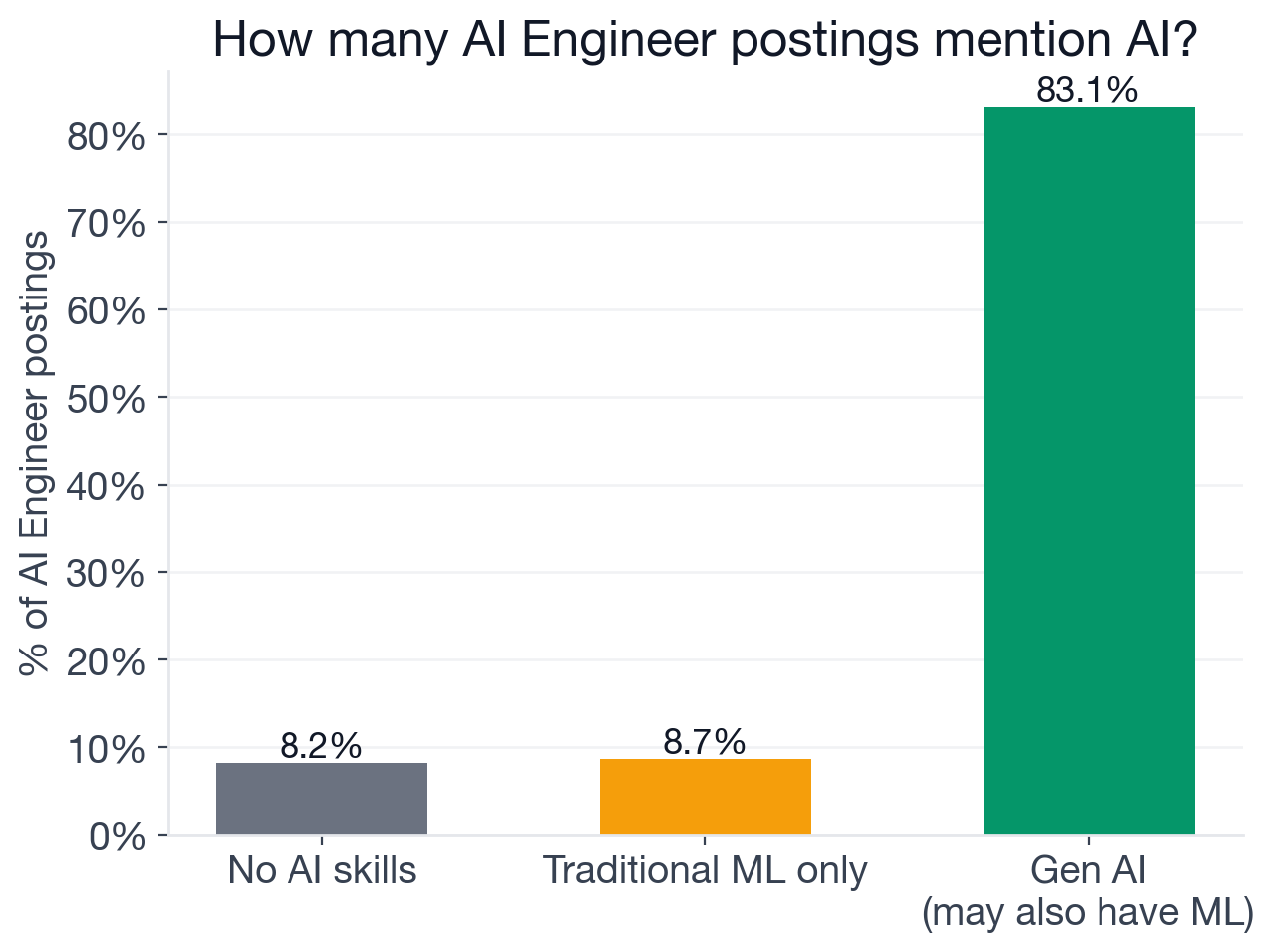
Eighty-three percent of AI Engineer postings explicitly require new-wave generative AI skills. That figure measures how many employers are hiring people to design, deploy, and maintain AI systems built on LLMs and agents. It does not capture how AI Engineers actually work on any given Tuesday.
Job postings measure what could be called Layer 1: the explicit Build AI mandate. Employers who want someone to architect a RAG system, deploy an agent framework, or fine-tune a model write those terms into the job description. They show up in the 83.1%.
Layer 2 is invisible in posting data because employers assume it: AI coding tools used as productivity multipliers in the engineer's own workflow. The JetBrains State of Developer Ecosystem 2025 survey found 85% of all developers now use AI tools regularly in their own coding workflows, with 62% relying on at least one AI coding assistant or agent IDE. The Stack Overflow Developer Survey 2025 found 51% using AI tools daily. These numbers cover the broader developer population. For AI Engineers, who sit at the center of the tooling ecosystem, ambient adoption is effectively higher still.
The practical framing for candidates: the 83.1% figure tells you how many companies are hiring people to build AI infrastructure. The remaining 17% still expects engineers who use AI tools fluently in their own workflows. The distinction the 2026 market draws is not between "uses AI" and "does not use AI." It is between "is being hired specifically to design AI systems" and "is expected to have AI fluency as a baseline, the same way internet connectivity was assumed but never listed in 2005 job ads."
What Does the $62,400 Salary Gap Actually Signal?
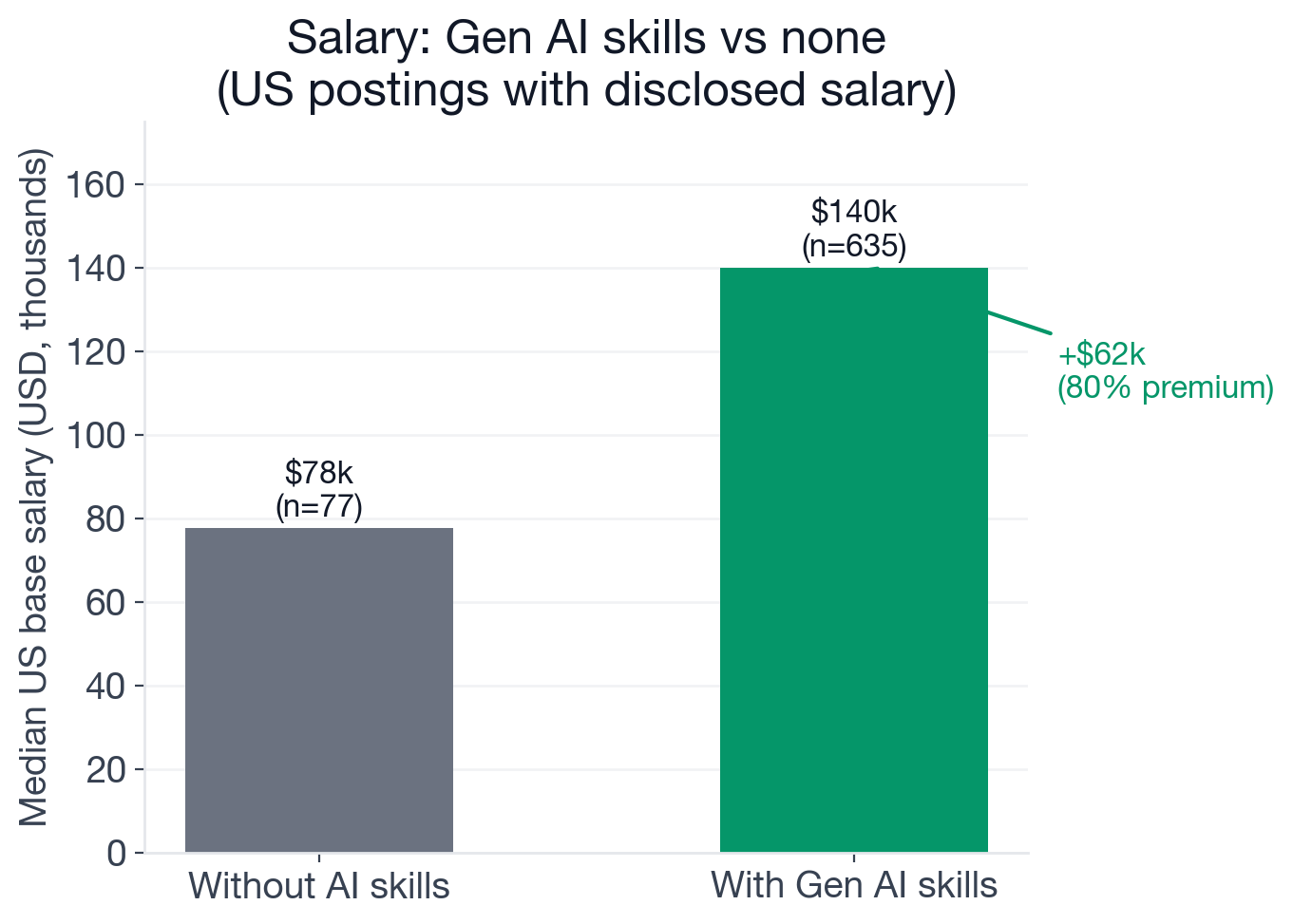
The $62,400 gap between generative-AI-requiring and non-AI AI Engineer postings is not simply "AI pays more." It reveals that a single job title now covers two economically distinct positions.
The n=77 postings without AI requirements (out of 4,155 total) likely represent traditional ML infrastructure work or analytics-adjacent roles that carry the "AI Engineer" label without the LLM-era stack. At $77,600 US median, these postings reflect a more established candidate pool with a larger supply. Note that n=77 is a small sample (roughly 1.9% of all postings), so the $77,600 figure is directionally informative rather than a statistically stable benchmark; treat the gap size as a strong signal rather than a precise number. The n=635 generative-AI postings reflect a market where demand outran supply as soon as LLMs moved to production, and compensation rose accordingly.
External data reinforces the direction. A broader industry analysis found that roles requiring AI skills now carry a 56% wage premium over comparable non-AI positions, up from 25% the prior year (Netguru). The premium is still expanding, not plateauing. Our data showing a $62,400 internal gap aligns with that trajectory: the more explicitly a role is tied to the generative AI stack, the more employers are bidding to fill it.
The average compensation for AI Engineer roles overall is also rising fast. HeroHunt.ai reports average AI Engineer compensation jumping from $156,000 in 2025 to $206,000 in 2026, a $50K year-over-year gain driven primarily by the generative AI tier. The $140,000 US base median we see in posting data, which covers base only and excludes equity, tracks the lower end of that range for production-focused roles.
The takeaway for anyone positioning for this market: which AI stack you are building with is not a specialization question. It is a compensation tier question.
Where Is This Shift Concentrated?
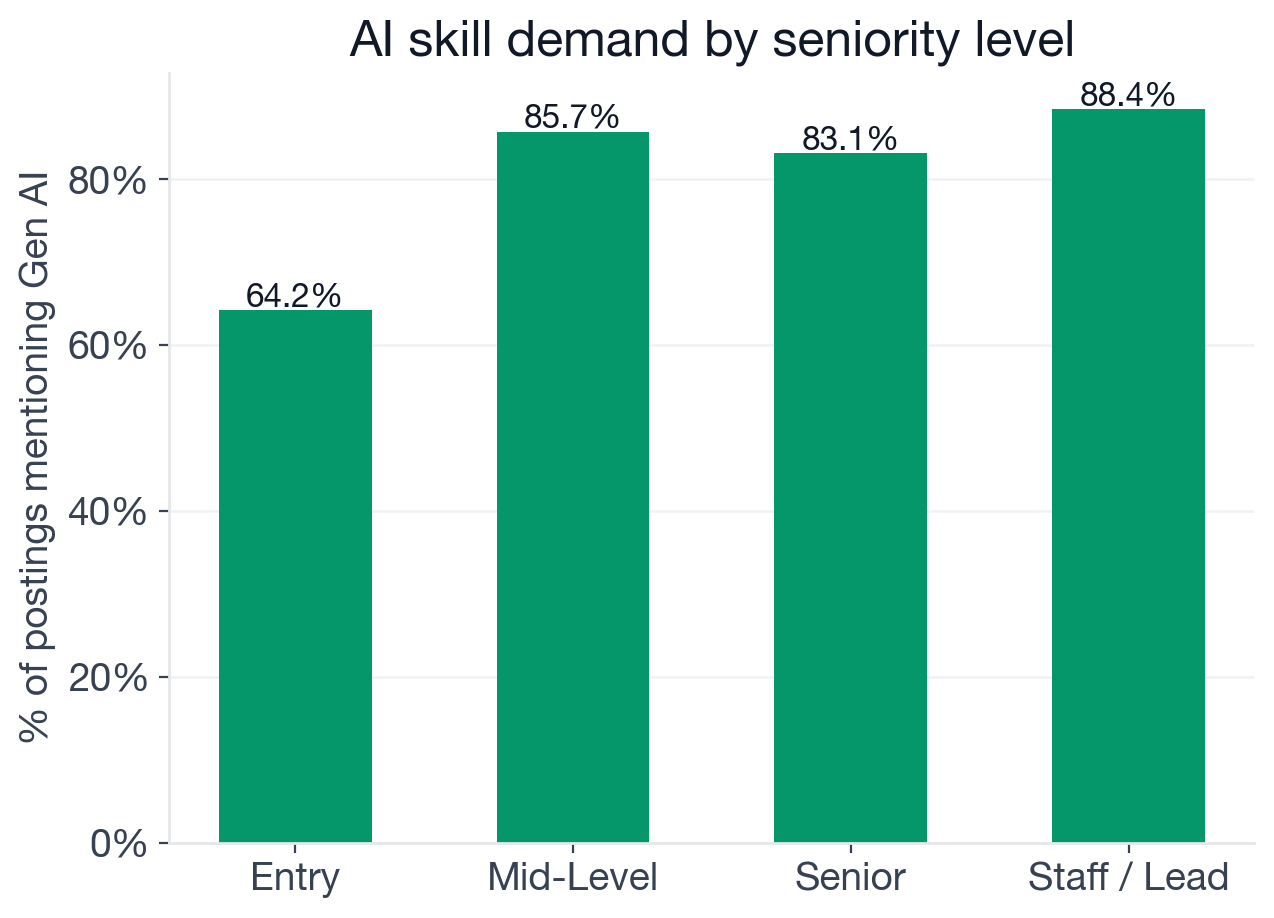
Senior engineers represent 65.6% of all AI Engineer postings, and 83.1% of those postings require generative AI skills. Mid-level is 19.9% of the market at 85.7% AI adoption. Entry-level is 5.1% (212 postings), with a 64.2% generative AI requirement rate. Even the entry-level tier is not a safe harbor from new-wave expectations: nearly two-thirds of entry-level AI Engineer roles still ask for generative AI experience.
The slight uptick at staff level (88.4% AI adoption vs. 83.1% at senior) signals what the job looks like at the top. Staff AI Engineers are not just building systems; they are evaluating which models and frameworks the organization adopts, defining how the LLM stack integrates with existing engineering infrastructure, and owning the architectural decisions that will be expensive to reverse. The AI requirement rate is higher because those decisions are inseparable from deep generative AI knowledge.
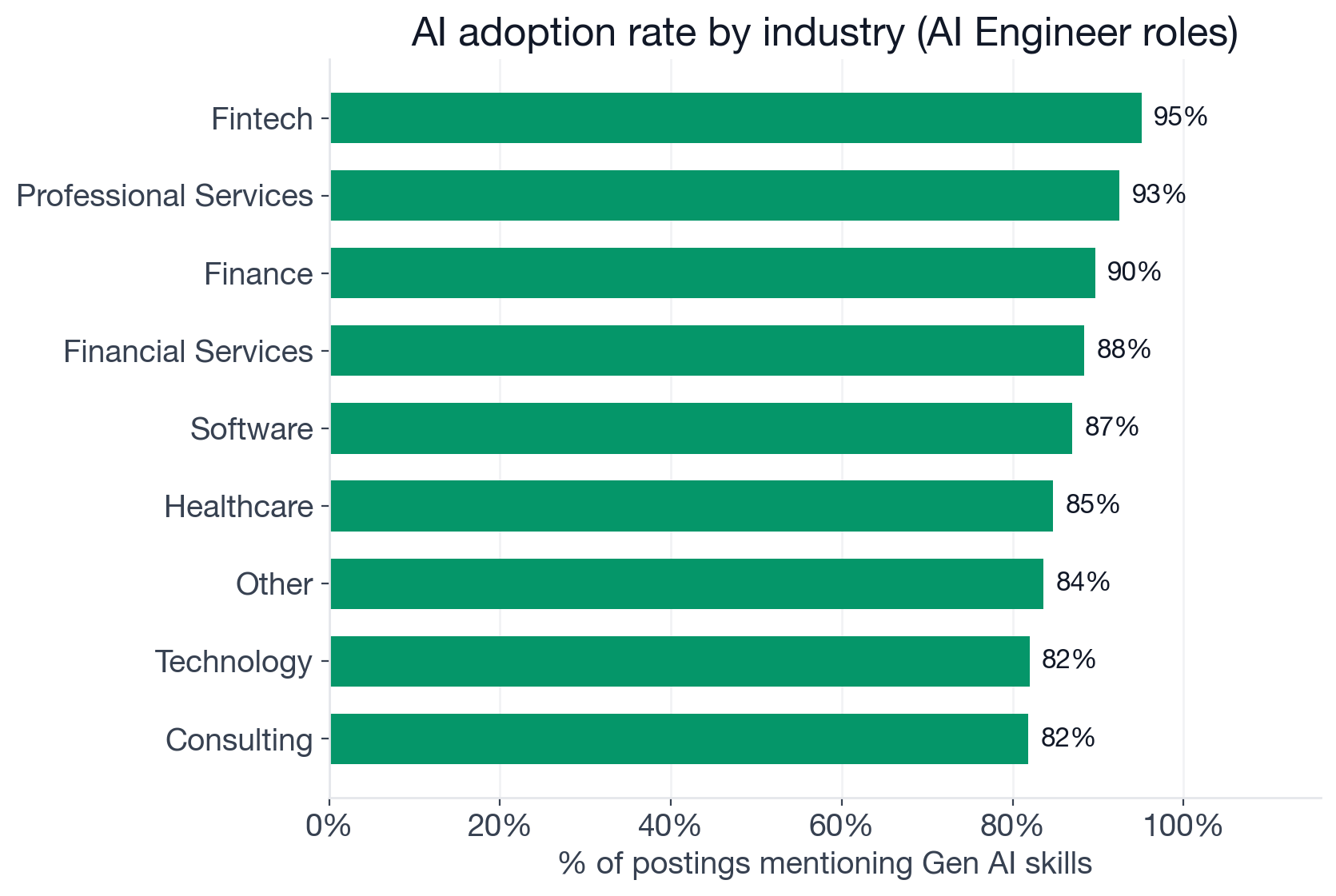
Fintech leads at 95.1% AI adoption across 184 AI Engineer postings, reflecting how much financial-technology products have been rebuilt around AI-native UX and risk systems in the past two years. Among other major sectors, Finance shows 89.7% AI adoption and software 87.0%. Healthcare at 84.7% is the most notable signal in the chart: AI adoption in healthcare used to lag on regulatory and compliance grounds, and matching or exceeding the overall average suggests those barriers have dropped substantially for the AI Engineer role specifically.
The demand is globally distributed. The US holds 33.3% of postings (1,382), India 12.8% (532), Germany 4.8%, the UK 4.6%, and Canada 4.0%. AI adoption rates are consistent across markets: 88.0% in India, 85.3% in the UK, 82.3% in the US. The wage premium in the analytics data reflects US postings; the skill requirements are shared across geographies.
If you are browsing AI Engineer openings now, you will find roles asking for LLM engineering skills, AI agent frameworks, and RAG pipeline experience spread across fintech, software, and healthcare employers in every major hiring market.
How to Use This in Your Job Search
The skill table above is a starting guide, but listing LangChain on a resume is not the same as being able to design a reliable multi-agent system in a 45-minute technical screen. Interviewers for this role ask candidates to reason about retrieval quality, agent failure modes, latency tradeoffs, and model selection under cost constraints. Practice with AI mock interviews that simulate those design conversations before going into real ones.
For targeted drilling, the question bank covers LLM fundamentals, RAG architecture, AI agents, and MLOps, which maps directly to the highest-frequency skills in the data. Focus on LLMs, AI Agents, and RAG before working outward into the framework layer. The frameworks change faster than the underlying concepts; knowing why you would choose a stateful agent graph over a simple chain will matter more in five years than knowing LangGraph's 2026 API.
Machine Learning appearing in 58.9% of AI Engineer postings is a signal worth taking seriously. Generative AI skills are the differentiator, but they need a functional ML foundation underneath. If that foundation is thin, interactive courses covering machine learning fundamentals and deep learning will close that gap faster than trying to absorb it mid-role. If you are weighing this role against its closest neighbor, the AI Engineer vs. ML Engineer comparison breaks down where the two paths diverge on skills, compensation, and day-to-day scope.
The salary data makes the targeting question concrete: generative AI experience correlates with a $62K higher US base salary median within this single title. Matching your actual skills to the right tier of posting matters more here than in most roles.
FAQ
Q. What is the median US base salary for an AI Engineer with generative AI skills in 2026?
The median US base salary for AI Engineer postings explicitly requiring new-wave generative AI skills is $140,000 (n=635 postings with disclosed US salary). Postings without any AI skills show a median of $77,600 (n=77), a gap of $62,400. These figures cover base salary only; equity and bonuses are not reflected in job posting disclosures.
Q. What percentage of AI Engineer postings require generative AI skills?
83.1% of the 4,155 active AI Engineer postings analyzed (3,451 postings) explicitly mention new-wave generative AI skills such as LLMs, RAG, AI agents, or prompt engineering. An additional 8.7% of postings require only traditional ML skills like deep learning, bringing total AI-related demand to 91.8%.
Q. Which new-wave AI skills appear most frequently in AI Engineer job postings?
LLMs appear in 55.5% of AI Engineer postings, AI Agents in 47.3%, Generative AI (general) in 40.6%, RAG (Retrieval-Augmented Generation) in 39.6%, and Prompt Engineering in 27.8%. Among frameworks, LangChain leads at 23.4%, followed by LangGraph at 14.0% and CrewAI/AutoGen at 9.1%.
Q. Is AI Engineer an entry-level-friendly role?
It is one of the more demanding roles to break into. Only 5.1% of AI Engineer postings are explicitly entry-level (212 of 4,155), and even those postings show a 64% AI-requirement rate. Senior-level roles dominate at 65.6% of all postings. Most practitioners enter through adjacent paths in software engineering, data science, or ML before transitioning to the AI Engineer title.
Q. Which industries are hiring the most AI Engineers in 2026?
Fintech leads AI adoption among AI Engineer postings at 95.1% (175 of 184 postings explicitly mention AI skills). Among other major sectors, Finance shows 89.7% AI adoption, software 87.0%, and healthcare 84.7%. No single industry holds a commanding share of total AI Engineer postings; demand is distributed broadly across software, technology, financial services, and consulting.
Q. How has the AI Engineer role changed since 2021?
The AI Engineer title barely existed as a formal job designation before 2023. In 2021 to 2022, equivalent work lived under ML Engineer, Data Scientist, or Platform Engineer roles and centered on training models, managing MLOps pipelines, and deploying scikit-learn or PyTorch models. The 2023 LLM wave redefined the role around integrating large language models, building RAG pipelines, designing agent systems, and orchestrating multi-model workflows. Job posting volume for AI Engineer has grown 143% year-over-year as of 2026.
Q. Do all AI Engineers use AI tools in their own workflows?
Job postings capture explicit AI skill requirements, not day-to-day tool usage. Developer surveys find that 85% of all developers (JetBrains 2025) now use AI coding tools regularly, with 51% using them daily (Stack Overflow 2025). For AI Engineers, who are closer to the tooling than almost any other role, ambient AI usage for coding and development tasks is essentially universal, even when job descriptions do not call it out.
What This Means for AI Engineer Candidates
The fastest-growing job title in US tech is also one of its most internally varied. "AI Engineer" in 2026 spans traditional ML infrastructure work at one end and multi-agent system design at the other, and the US base salary difference between those two ends is $62,400. The market has already priced this gap in. Entering with classical ML skills is a legitimate starting point, but the direction of demand and compensation is unmistakable: the generative AI stack (LLMs, agents, RAG, and the orchestration layer connecting them) is where the role is concentrating, where employers are bidding hardest, and where the premium is still widening.
Topics
Ready to practice?
Put what you've learned into practice with AI mock interviews and structured preparation guides.