
The Tool You Use Might Become the Evidence You're Examining
Most roles facing an AI shift split cleanly into two layers: what job postings explicitly ask for, and what practitioners quietly already do. Digital Forensic Examiners have that same split, and a second one layered on top of it. The tools examiners are starting to use to investigate cases (LLM-assisted triage, AI-drafted reports) are the same tools now showing up as evidence inside the cases themselves: a suspect's ChatGPT desktop app, a custodian's locally run LLM, a deleted prompt history. We looked at 677 active Digital Forensic Examiner postings on the InterviewStack.io job board over a trailing 90-day window, and the gap between what's written into those postings and what the field's own practitioner surveys report is one of the widest we've measured in this series.
Only 7.1% of postings explicitly require a new-wave AI skill, one of the lowest adoption rates we've tracked across any role. But a 2025 industry survey of DFIR (digital forensics and incident response) professionals found that 68% are already using AI in their day-to-day workflow, summarizing evidence, triaging large datasets, drafting reports, regardless of whether a job posting ever mentioned it. That's not a generic "developers like Copilot" statistic borrowed from software engineering; it's a survey of the exact population this post is about.
A note on scope: A manual read of a random title sample from this dataset shows most postings carry titles like "Incident Response Analyst," "Information Security Manager," or "SOC Associate" rather than "Digital Forensic Examiner" itself. In practice, digital forensics and incident response are usually run as one combined discipline (DFIR), and the job-board classifier for this role reflects that wider DFIR/cybersecurity-incident-response hiring pool rather than the narrow job title alone. Read the figures below as describing that broader DFIR-adjacent market, not a market where every posting is literally titled "Digital Forensic Examiner."
Key Findings
- Only 7.1% of Digital Forensic Examiner postings explicitly require a new-wave AI skill (48 of 677 analyzed).
- 9.3% mention any AI, new-wave generative AI plus traditional ML combined (63 of 677); traditional ML/deep learning alone appears in 3.7% (25 of 677).
- 68% of DFIR professionals report they already use AI in their investigative workflows, per a 2025 industry survey, nearly 10x the explicit posting rate.
- AI Agents (3.2%, 22 postings) and LLMs (2.8%, 19 postings) each outrank Generative AI as a named skill (1.6%, 11 postings).
- Staff-level postings show the highest AI adoption rate at 10.5% (4 of 38), more than double the 4.1% rate at mid-level (6 of 147).
- Senior-level postings make up 65.3% of the entire dataset (442 of 677), making this one of the more experience-gated roles we track.
- The non-AI US salary baseline is $127,920 (n=158); the AI-tagged US sample (n=17) is too small to responsibly compute a premium this cycle.
- 82% of DFIR practitioners agree AI can automate repetitive investigative tasks like data acquisition, hashing, keyword search, and report generation.
What the Digital Forensic Examiner Job Looked Like Before Generative AI
Three or four years ago, a Digital Forensic Examiner's toolkit was built around acquisition and analysis suites like Cellebrite, Magnet AXIOM, and EnCase, plus manual keyword search, hash matching, and timeline reconstruction across phones, disks, and logs. Where "AI" showed up at all before 2023, it was narrow and supervised: classifiers flagging known contraband imagery, clustering models grouping malware samples, occasionally a recommender surfacing likely-relevant files. None of it involved a chat interface or a prompt. The bottleneck was volume: a single phone extraction could produce hundreds of thousands of messages, and the job was mostly manual triage against that pile.
Generative AI changed what's plausible to automate in that pile, not by replacing judgment, but by compressing the first pass. Practitioner literature from 2025-2026 documents concrete use cases that didn't exist a few years ago: summarizing large message collections, clustering conversations by topic, extracting entities across datasets, and reconstructing timelines, tasks that used to be fully manual. That shift shows up faintly in job postings (7.1% explicit) but loudly in how practitioners describe their week: Cellebrite's 2025 Industry Trends Survey found 61% already view AI as a valuable investigative tool, and 51% of agencies plan to formally implement it within two years. The practice is running ahead of the paperwork.
Why So Few Postings Say "AI" Out Loud
The 7.1% figure measures something specific: postings that explicitly ask candidates to build, integrate, or evaluate AI-based forensic tooling, a specialized subset even within a specialized role. It is not a measure of whether AI matters to the job. Think of it the way internet access was handled in a 2005 posting: assumed, not listed. Nobody wrote "must know how to use email" into a forensic examiner req in 2010, and increasingly nobody writes "must be comfortable using AI to triage evidence" either, even though the survey data says most examiners already are.
The same Cellebrite survey puts a number on that ambient layer: 68% of DFIR professionals report already using AI in their investigative workflows, and 86% agree AI can "quickly analyze vast amounts of data to surface relevant evidence faster," directly relevant to examiners triaging phones, disks, and logs. The same survey also found that 82% agree AI can automate repetitive investigative tasks like data acquisition, hashing, keyword search, and report generation, the exact grunt work that used to eat most of an examiner's week before generative tools existed. That tracks with broader developer-population surveys: 84% of developers are using or planning to use AI tools (Stack Overflow 2025), and 85% regularly use an AI coding assistant (JetBrains 2025). The DFIR-specific number lands higher than the general-technology baseline, not lower, arguing against the idea that this is a slow-moving field. The explicit hiring language just hasn't caught up to daily practice yet. If you're deciding whether to build AI fluency for this role, don't wait for the job posting to ask.
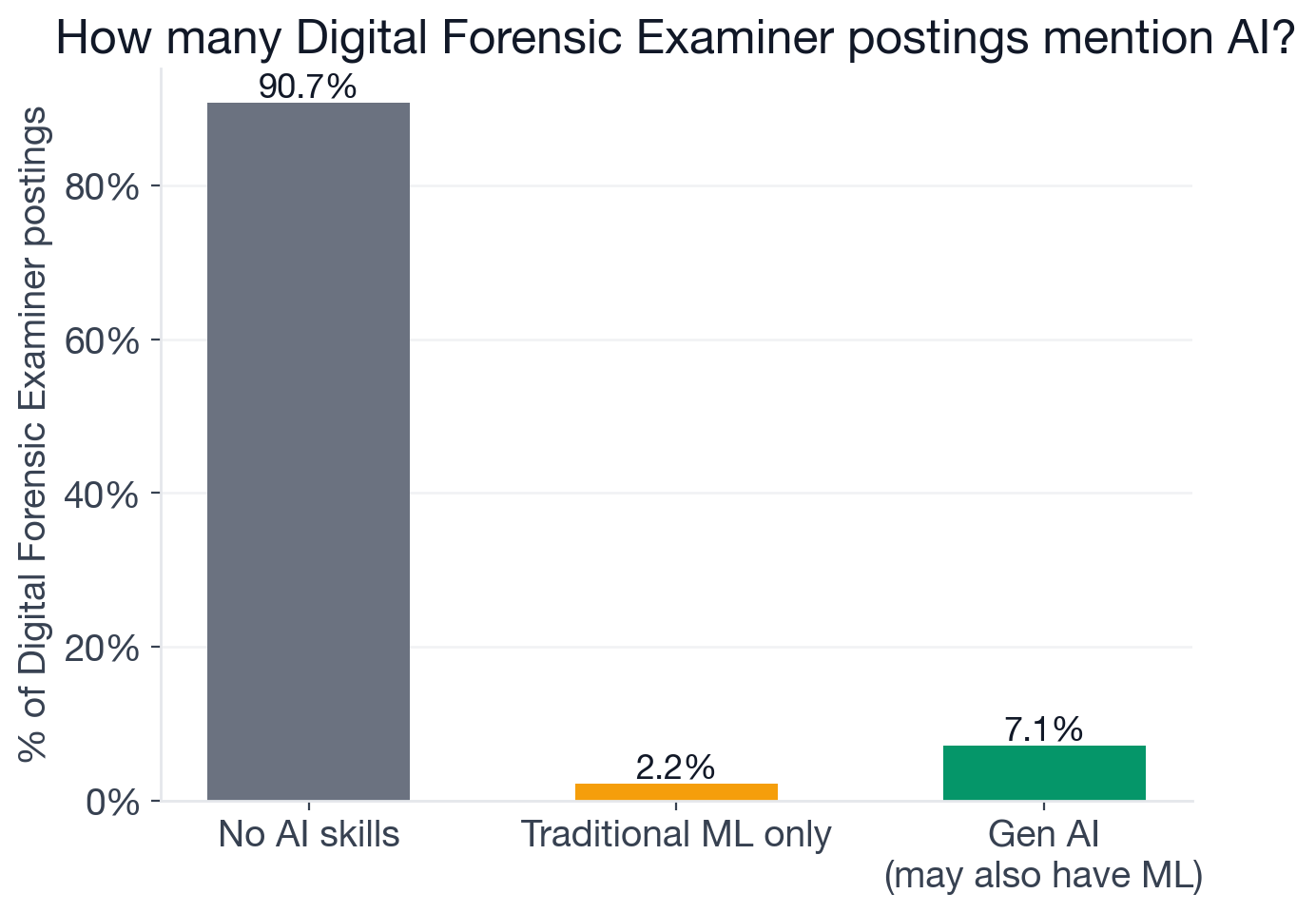 9.3% of postings mention any AI skill; the remaining 90.7% show no explicit AI or ML requirement at all, a gap the ambient-use survey data closes almost entirely.
Which AI Skills Are Employers Actually Naming?
When postings do name an AI skill, the ranking itself tells a story. Machine Learning, the older, pre-generative term, still edges out every new-wave concept individually at 3.7% of postings (25 of 677). Right behind it, AI Agents (3.2%, 22 postings) and LLMs (2.8%, 19 postings) outrank Generative AI as a standalone term (1.6%, 11 postings), suggesting that where employers do write AI into a forensic-role req, they're describing a system (an agent doing triage, a model summarizing evidence) rather than a category.
| AI skill | Postings | % of all postings |
|---|---|---|
| Machine Learning | 25 | 3.7% |
| AI Agents | 22 | 3.2% |
| LLMs | 19 | 2.8% |
| Generative AI | 11 | 1.6% |
| Anthropic / Claude | 3 | 0.4% |
| Gemini | 2 | 0.3% |
| RAG | 2 | 0.3% |
| LLM Fine-Tuning | 2 | 0.3% |
The most telling row isn't in that table: AI-Assisted Development, the closest proxy for "uses Copilot or ChatGPT as a productivity tool," appears in exactly 1 of 677 postings. That's the clearest evidence for the two-layer thesis in this entire dataset. Employers are willing to name AI Agents or LLMs when they mean a forensic tool, but they almost never bother naming the consumer AI tools examiners already use daily. If browsing current openings leaves you thinking the field barely touches AI, that's the posting language talking, not the actual workflow.
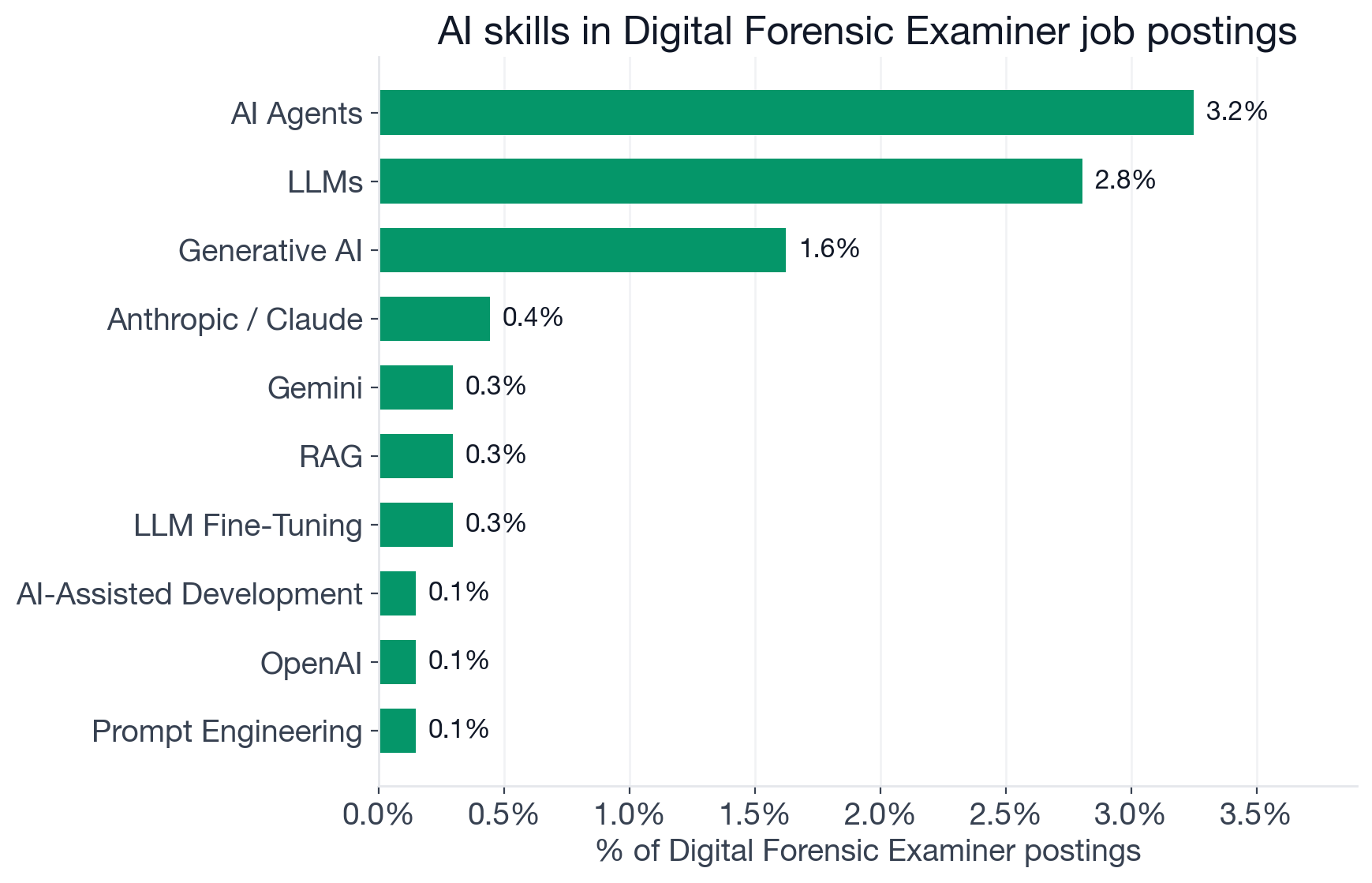 AI Agents and LLMs already outrank Generative AI as a named term, evidence that where AI shows up explicitly, it's framed as a system to operate, not a buzzword to check off.
AI Is Also Becoming the Subject of the Investigation, Not Just the Tool
This is where Digital Forensic Examiner diverges from every other role we've analyzed in this series. For most jobs, the AI shift is a one-way question: how much do you need to use AI to do the work? For this role, there's a second, distinct requirement building alongside it: examiners increasingly have to investigate AI tools as evidence sources in their own right. Recent research documents forensic methodologies for recovering artifacts from the ChatGPT desktop application and from locally run LLM tools like Ollama or LM Studio, tools that leave chat logs, cached prompts, and model files on a device the same way a browser leaves history. As more suspects and custodians run AI tools locally, "can you forensically examine an AI application" becomes as relevant a question as "can you use one."
That double requirement carries a governance wrinkle. Practitioner literature flags a real risk: feeding case data into a public, web-based AI tool for triage can itself create a confidentiality breach, since the provider may log or retain what was submitted, a chain-of-custody problem unique to this field. An examiner who is fluent using AI for triage but undisciplined about which tool touches case data is trading one risk for another. Expect the next wave of hiring language, once it catches up, to reflect both halves: use it carefully, and know how to find it when someone else did.
What Salary Data Can (and Can't) Tell Us Yet
A quick disclosure before the numbers: all salary figures below are US base salary only. Equity, bonuses, and other compensation are not disclosed in job postings, so total compensation at employers offering those extras will run higher than what's reported here.
The honest finding in this section is a data gap, not a premium. Among US postings with disclosed salary and no AI requirement, the median is $127,920 (n=158), a solid, well-supported baseline. The AI-tagged US sample sits at just 17 postings, below the 25-posting floor we require for a reliable median, so we can't responsibly report a premium this cycle. That's not a suppressed number; it's a direct reflection of how early explicit AI hiring still is for this role. Given the scope note above, this baseline is also blended with the broader DFIR/incident-response postings in the dataset, some of which (senior information-security management roles, for instance) tend to pay above what a narrowly-titled forensic examiner role earns, so treat $127,920 as directional for the wider DFIR hiring pool rather than a precise figure for the forensic-examiner title alone. The more useful takeaway is that $127,920 is what this broader pool pays regardless of AI, and building AI fluency ahead of the hiring language is a bet on where the role is heading, not one with a quantified payoff yet.
Which Seniority Level Is Leading This Shift?
AI adoption in this role doesn't climb steadily with seniority, it dips in the middle before spiking at the top. Junior-level postings show a 6.98% AI rate (3 of 43), mid-level drops to 4.08% (6 of 147, the largest sample of the two, so the dip is not just noise), then senior climbs back to 7.92% (35 of 442) and staff peaks at 10.53% (4 of 38). Entry-level postings, a small slice at just 7 listings, show zero AI mentions, though that sample is too thin to treat as a trend on its own.
The bigger structural fact is that senior-level postings make up 65.3% of this entire market (442 of 677). Digital Forensic Examiner is already one of the more experience-gated roles we track, and the data suggests that whatever AI requirement does exist concentrates further at the top of that ladder rather than easing the path in at the bottom. If you're early in your DFIR career, the practical read is: build core forensic competence first, since that's what nearly two-thirds of the market is hiring for, and layer in AI fluency as a differentiator for the senior and staff roles you're aiming at next.
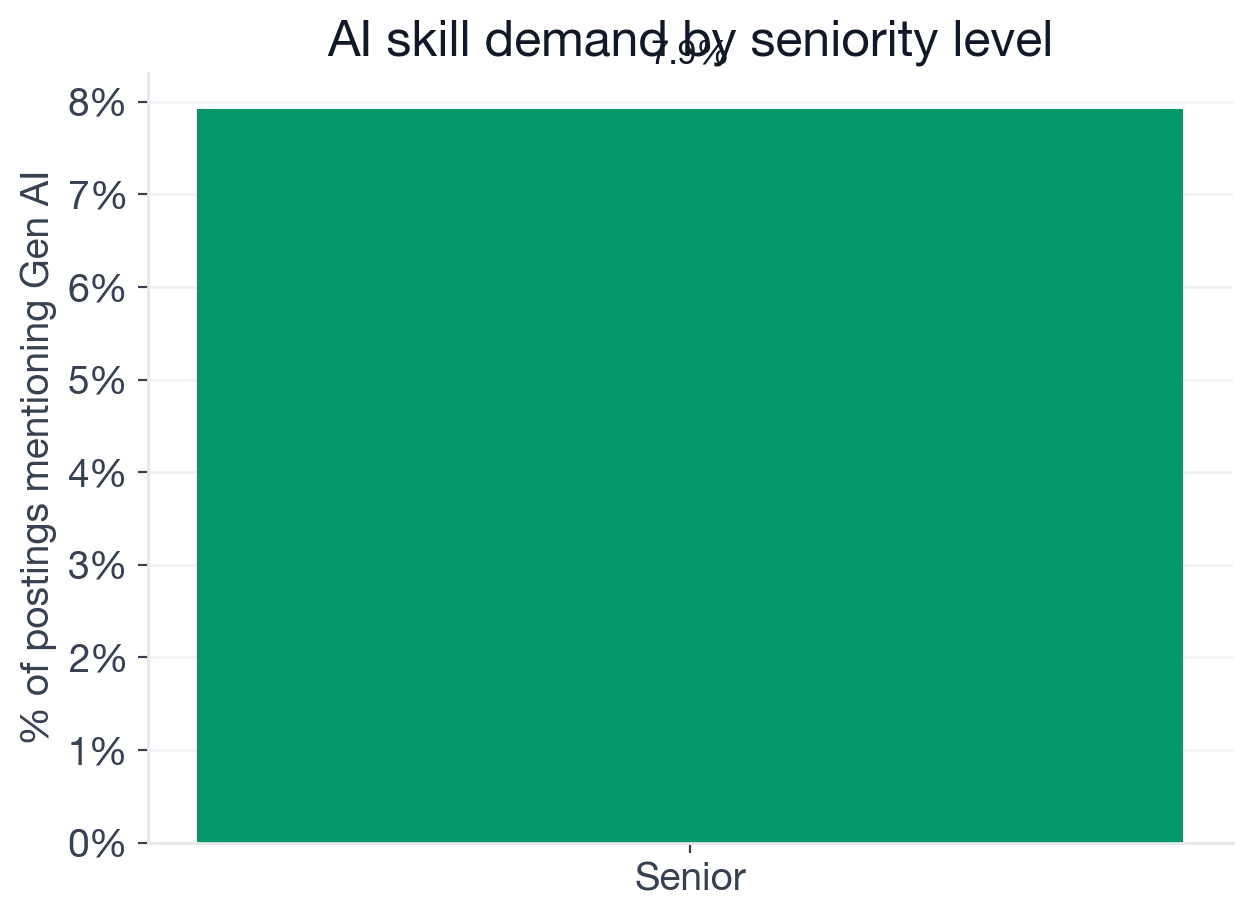 AI adoption dips at mid-level (4.1%) before climbing to its highest point at staff (10.5%), a U-shape rather than a straight line.
How to Use This in Your Job Search
If you're building toward a Digital Forensic Examiner role in 2026, treat the explicit 7.1% figure as a floor, not a ceiling. Get comfortable with the practical use cases the survey data confirms examiners are already running, AI-assisted summarization of large evidence sets, report drafting, timeline reconstruction, while staying disciplined about which tools touch case data. On the flip side, build familiarity with how AI applications themselves leave forensic artifacts; that skill is undervalued in postings today but shows up consistently in the research literature as a growing part of the caseload.
To close the gap between using AI and explaining how you use it in an interview, run a few AI mock interview sessions built around investigative scenarios, walking through an evidence-triage workflow is a different exercise than naming a tool. The Question Bank is a good place to drill DFIR-specific technical questions alongside the newer AI-adjacent ones. When you're ready, browse current Digital Forensic Examiner postings or filter for roles naming AI Agents or Machine Learning as a requirement, or read the sibling Digital Forensic Examiner skills breakdown for the full non-AI skill picture.
FAQ
Q. Do Digital Forensic Examiners need AI skills in 2026?
Only 7.1% of active Digital Forensic Examiner postings explicitly require an AI skill (48 of 677 analyzed on the InterviewStack.io job board). But a 2025 industry survey of DFIR practitioners found 68% are already using AI in their daily investigative work, whether or not their job posting mentioned it. The honest answer is: explicit requirements are rare, but practical fluency is already close to universal.
Q. What percentage of Digital Forensic Examiner jobs require AI skills?
9.3% of postings mention any AI skill, new-wave generative AI or traditional machine learning (63 of 677). New-wave generative AI specifically (LLMs, AI agents, generative AI tools) appears in 7.1% of postings (48 of 677), while traditional ML and deep learning appear in 3.7% (25 of 677), with some overlap between the two groups.
Q. What AI skills do Digital Forensic Examiner postings ask for most?
Machine Learning leads at 3.7% of postings (25 of 677), followed by AI Agents at 3.2% (22 of 677) and LLMs at 2.8% (19 of 677). Generative AI as a named skill sits at 1.6% (11 of 677). Consumer AI tools like ChatGPT or Copilot are almost never named directly; the closest proxy, AI-Assisted Development, appears in just 1 posting.
Q. Why do forensic examiners need to investigate AI tools themselves?
As AI applications like ChatGPT desktop clients and locally run LLMs (via tools like Ollama or LM Studio) spread onto suspect and custodian devices, they leave forensic artifacts, chat logs, cached prompts, model files, that examiners must now know how to recover and interpret. Recent 2025-2026 research documents concrete methodologies for this. It means AI literacy is becoming relevant to the subject matter of investigations, not only the tooling used to conduct them.
Q. Do AI skills increase Digital Forensic Examiner salaries?
We can't say yet with confidence. The US postings with disclosed salary and no AI requirement show a median of $127,920 (n=158). The AI-tagged US sample is only 17 postings, below the 25-posting floor needed for a reliable median, so no premium can be responsibly reported this cycle.
Q. Are entry-level Digital Forensic Examiner roles affected by AI requirements?
Entry-level postings are a small slice of this role (7 of 677 in this dataset) and none required an AI skill. Senior-level postings dominate the market at 65.3% of all listings (442 of 677), and AI adoption is highest at staff level (10.5%) and lowest at mid-level (4.1%), so AI requirements concentrate at the top of the seniority ladder, not the bottom.
Q. What is the difference between using AI and building AI in this role?
Building AI means the posting explicitly requires you to integrate, evaluate, or operate AI-based forensic tooling, currently 7.1% of postings. Using AI means the ambient productivity layer, drafting reports, triaging large evidence sets, summarizing communications with an LLM, that most employers assume without writing it into the job description. Survey data puts that ambient layer at 68% among DFIR practitioners specifically.
The Skill Set You Actually Need Now
The gap between 7.1% and 68% is the real story here, but the more durable point is the double requirement underneath it. Digital Forensic Examiners aren't just being asked, quietly, to use AI as a tool. They're increasingly being asked to treat AI as a category of evidence, something a case subject used, and something an examiner has to know how to find. Neither half shows up much in job postings yet. Both are already part of the job.
Topics
Ready to practice?
Put what you've learned into practice with AI mock interviews and structured preparation guides.