
The QA Engineering Job Description Is Being Rewritten
The job posting for QA Engineer used to read like a checklist: write test cases, execute regression suites, log bugs in Jira, automate with Selenium or Cypress. The work was fundamentally about validating deterministic systems. Given input A, expect output B, flag anything else.
That description is becoming obsolete. The software products QA engineers test now include AI assistants, LLM-powered features, generative content pipelines, and autonomous agents. None of them produce the same output twice. Testing a system that reasons is a different job from testing a system that executes, and the job postings are starting to reflect that.
We looked at every active QA Engineer posting on the InterviewStack.io job board as of May 2026, 17,007 listings, with AI skill requirements extracted and categorized as new-wave generative AI (2023 and later) or traditional ML. Here is how fast the shift is moving, what it means for compensation, and where it is concentrated.
Key Findings
- 17,007 active QA Engineer postings analyzed on the live job board as of May 2026.
- 4.4% of postings (751) explicitly require new-wave generative AI skills such as LLMs, AI Agents, or Prompt Engineering. A further 3.0% (507) mention traditional ML.
- LLMs (1.4%), AI Agents (1.4%), and Generative AI (1.2%) are the three most-demanded new-wave skills, reflecting QA teams being pulled into testing AI-powered products.
- US median base salary with new-wave AI: $119,300 vs. $80,000 without, a $39,300 premium (n=79 vs. 3,459; US base salary, equity excluded).
- Staff-level QA engineers show the highest explicit AI adoption at 7.2%, followed by senior at 4.9%. Senior roles account for 61.7% of the entire QA posting market.
- Technology (12.6%), professional services (13.2%), and software (10.1%) have the highest share of QA postings with explicit AI requirements.
- AgileEngine, Marvell Technology Group, TripleTen, and NVIDIA are among the employers where AI requirements appear most consistently in QA hiring.
What Did QA Engineer Roles Look Like Before AI?
In 2021 and 2022, the QA Engineer was primarily a test automation specialist. The dominant tools were Selenium for web UI, Appium for mobile, Postman for APIs, and Jest or Pytest for unit coverage. The strategic conversation in QA centered on shift-left testing: embed automated suites into CI pipelines, write tests earlier, and catch regressions before they reached staging. AI did not appear in that conversation because the software under test was almost entirely deterministic. Given the same input, you got the same output, and the job was writing assertions that would flag deviations.
Two things disrupted that model. First, AI-assisted coding tools entered QA workflows directly. GitHub Copilot and ChatGPT let engineers generate test boilerplate, synthesize test data, and explore edge cases faster than any manual process. Every QA engineer now has access to these tools whether or not their job posting mentions them. This is the ambient layer: productivity-level AI usage that employers assume without stating, the same way internet access never appeared in a 2005 job description.
Second, the software QA teams are now asked to test increasingly contains AI components: chatbots, recommendation engines, generative content features, autonomous agents. These systems require a fundamentally different testing approach. You cannot write a fixed expected output for a language model. You write evaluation criteria, adversarial prompts, and behavioral contracts instead. That is the skill gap showing up in job posting data.
What Are Companies Explicitly Requiring Now?
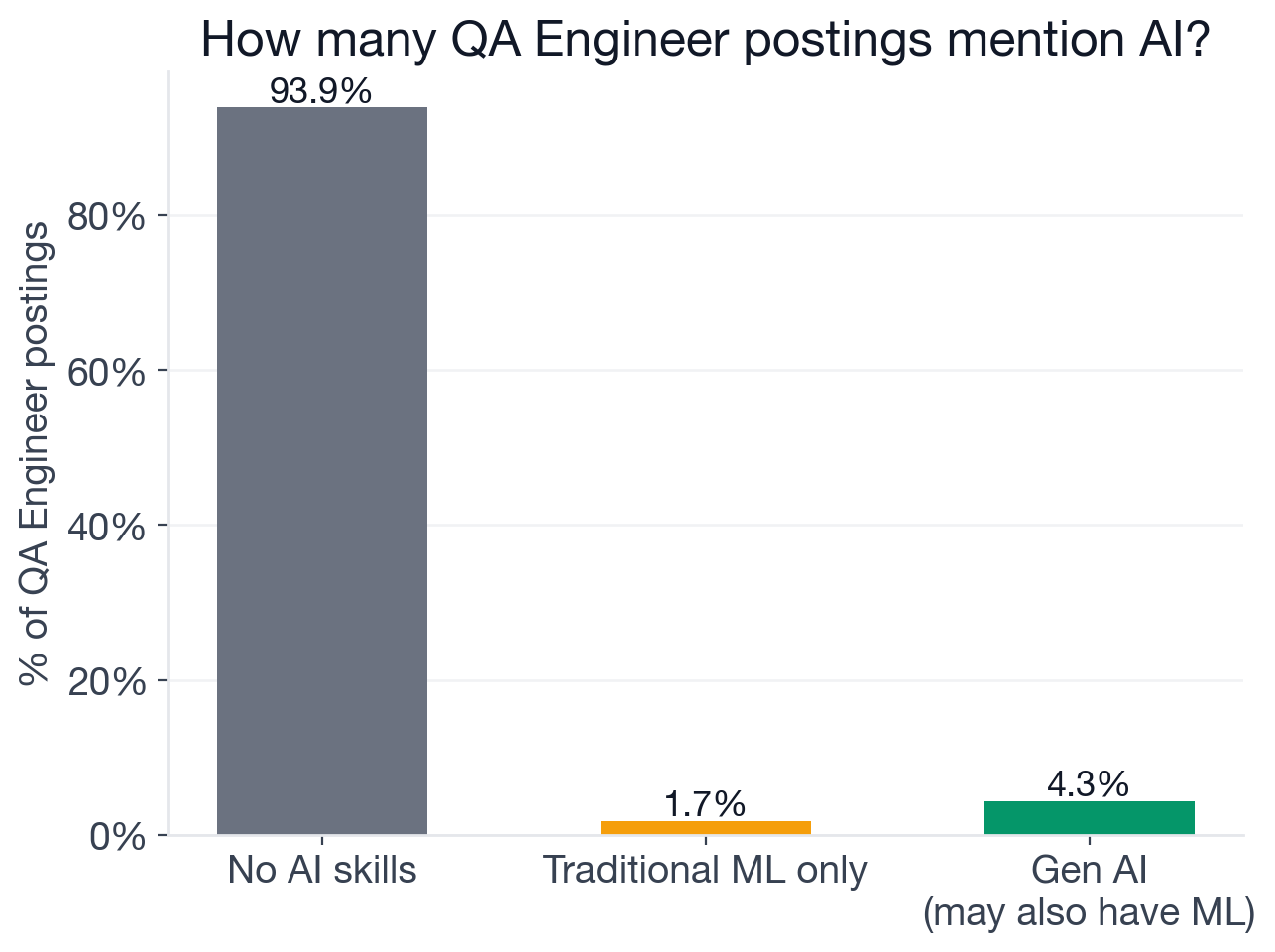
Share of QA Engineer postings by AI requirement category. "New-wave" includes LLMs, Generative AI, AI Agents, GitHub Copilot, and similar 2023-era tools. "Traditional ML" includes Machine Learning, Deep Learning, and model serving.
Of the 17,007 QA Engineer postings analyzed, 4.4% explicitly require new-wave generative AI skills and 3.0% require traditional ML. About 93% carry no explicit AI requirement.
That 93% figure needs a careful interpretation. It does not mean those jobs are unaffected by AI. It means employers filling them have not yet added an explicit AI clause to the description. The ambient layer, using Copilot to generate test code, ChatGPT to analyze failure logs, AI-powered test tools for visual regression and exploratory coverage, is now expected in most QA teams without being stated.
The right lens for reading this data: 4.4% of QA postings require you to build for AI (testing LLM pipelines, validating AI agent behavior, evaluating prompt reliability). Virtually all of them expect you to use AI as part of your testing workflow. These are different requirements, and only the first shows up in posting text. A candidate who treats AI tool usage as optional because it does not appear in the job description is misreading the market.
Which AI Skills Are Reshaping QA Work?
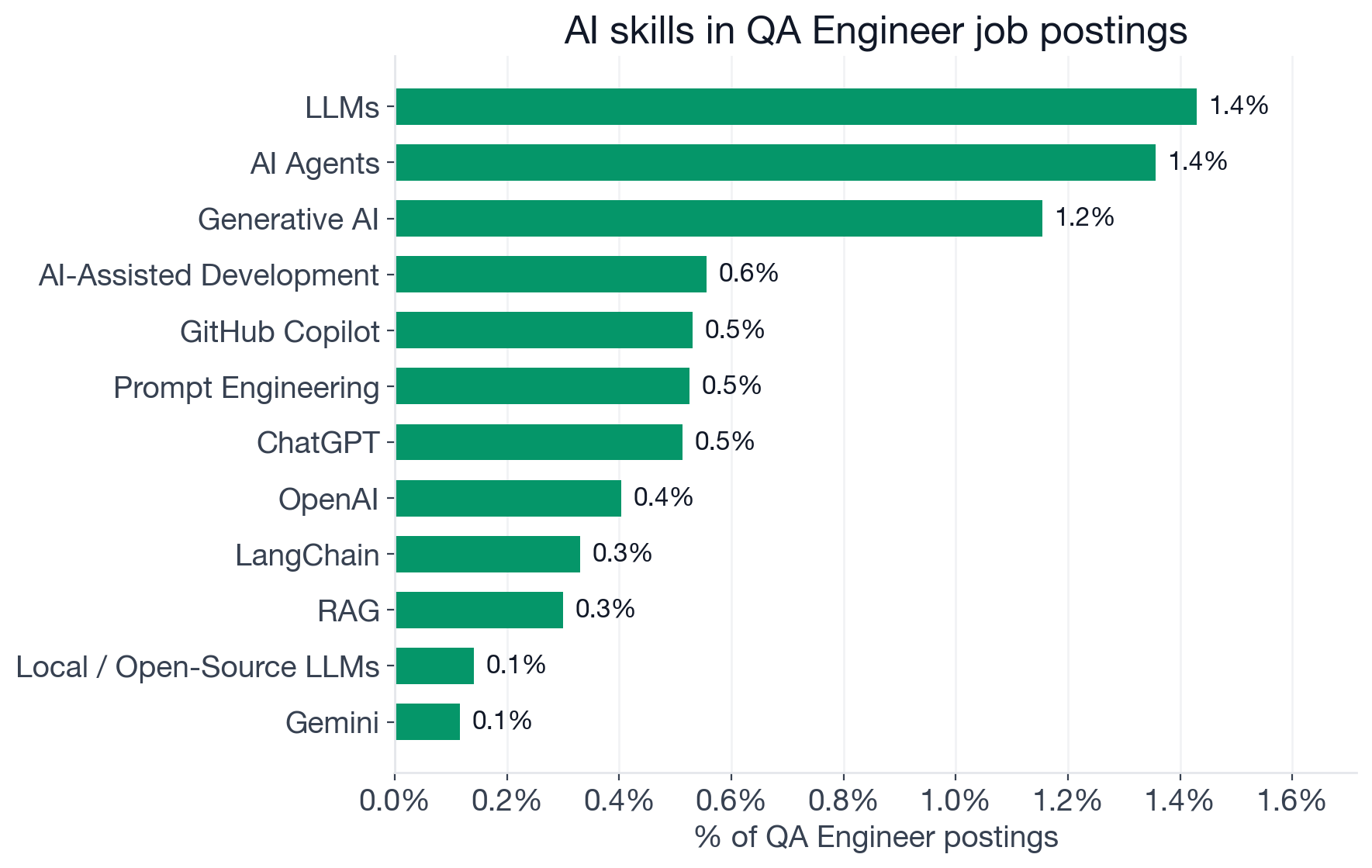
Top AI-related skills by share of QA Engineer postings that mention them. Skills are categorized as new-wave (emerged with the 2023 generative AI wave) or traditional ML.
The skill list tells two separate stories about what AI means for QA work.
Testing AI-powered products. LLMs (1.4%, 243 postings), AI Agents (1.4%, 233 postings), and Generative AI (1.2%, 207 postings) lead the new-wave list. Postings citing these skills are hiring QA engineers to evaluate systems where language models or autonomous agents are core components. Prompt Engineering (0.5%, 93 postings) appears alongside these skills for a specific reason: you need to understand how prompts work in order to construct the adversarial inputs that surface failures. RAG (retrieval-augmented generation, a pattern where AI systems retrieve from a knowledge base before generating a response, 0.3%, 51 postings) signals roles where the QA engineer must also validate that retrieval is working correctly, not just the generation.
Using AI to test. GitHub Copilot (0.6%, 94 postings), AI-Assisted Development (0.6%, 98 postings), and ChatGPT (0.5%, 87 postings) represent postings that explicitly expect engineers to incorporate AI productivity tools into their workflow. These counts are almost certainly undercounts: companies for whom AI tool use is already standard are less likely to call it out as a differentiator.
Machine Learning sits at 2.8% (477 postings), higher than any single new-wave skill. Most of those postings are not asking QA engineers to train models. They are asking for engineers who understand ML pipelines well enough to design tests for them: edge case coverage, data distribution shifts, model regression, and monitoring for silent failures.
Browse QA Engineer openings that mention LLMs or roles focused on AI Agent testing to see how employers frame these requirements in practice.
What Does the AI Premium Look Like for QA Salaries?
The figures below are US postings only, where wage-transparency laws produce consistent salary disclosure. These are base salary numbers: equity, bonuses, RSUs, and sign-on are not disclosed in postings. Total compensation at top employers runs meaningfully higher than what we report here, particularly at tech and software companies.
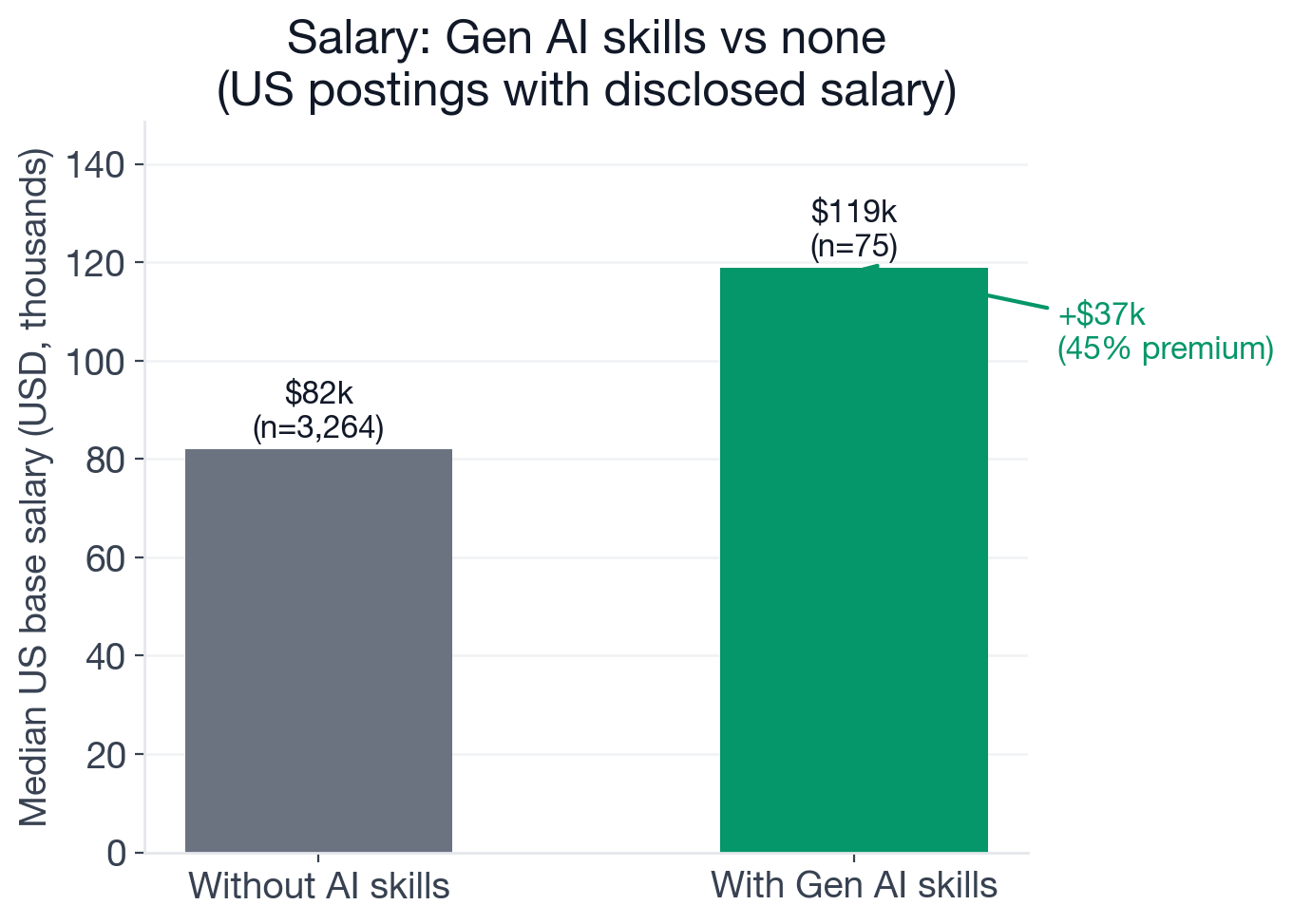
Median US base salary for QA Engineer postings with and without explicit new-wave AI skill requirements. US base salary only; equity excluded.
Among US postings with disclosed salary data, QA Engineer postings that explicitly require new-wave AI skills show a median US base of $119,300 (n=79). Postings with no AI requirements show a median of $80,000 (n=3,459). The gap: $39,300, roughly a 49% premium.
A caveat is warranted. The n=79 AI-required sample is small. That premium almost certainly reflects a talent scarcity effect: employers hiring for the explicit AI skill combination are competing in a thinner candidate pool, which bids salaries up. It is not evidence that listing "LLMs" on a resume adds $39K to any QA offer. It is evidence that engineers who can genuinely design and execute test strategies for AI-powered systems are currently in short supply, and the market is pricing that scarcity.
The practical implication: engineers who move into AI testing work early are entering a compensation tier that most conventional QA automation specialists are not yet competing in.
Who Is Leading the Shift to AI-Ready QA?
By Seniority
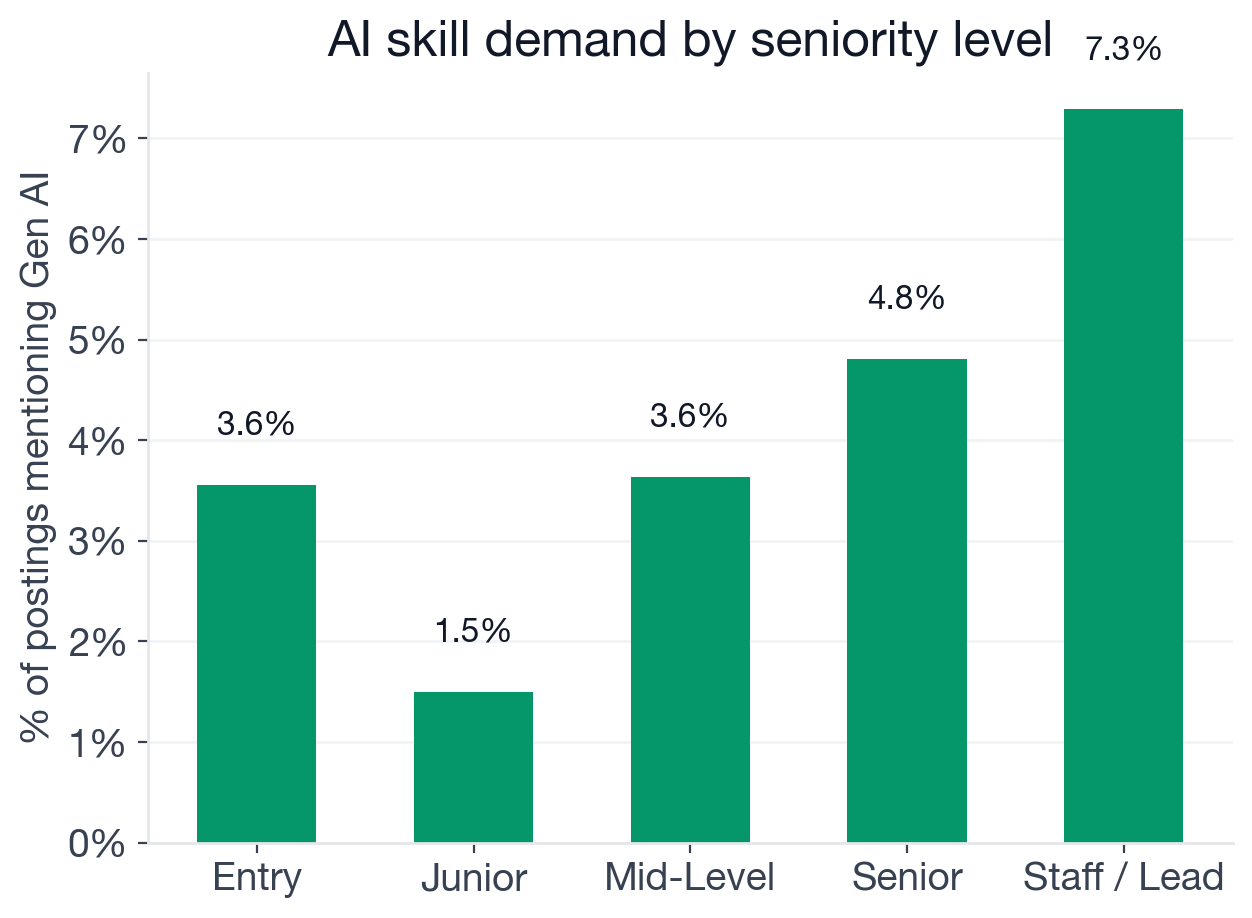
Share of QA Engineer postings at each seniority level that include explicit AI skill requirements.
Staff-level QA engineers show the highest AI adoption rate at 7.2% (40 of 556 staff postings), followed by senior at 4.9% (518 of 10,496 senior postings). Mid-level and entry both sit at 3.7%, while junior trails at 1.3%.
The pattern reflects where companies are placing their AI-testing bets: with experienced engineers who understand both the testing domain and the risk of AI failure, not with early-career staff still building core automation skills.
The seniority distribution of the broader QA market adds context. Senior roles make up 61.7% of all QA postings, mid-level accounts for 25.5%, and entry is only 3.2%. QA is one of the most senior-heavy engineering markets in the dataset, which shapes the absolute numbers even when the percentages look modest: 518 senior QA postings with explicit AI requirements is a real and growing talent segment.
By Industry
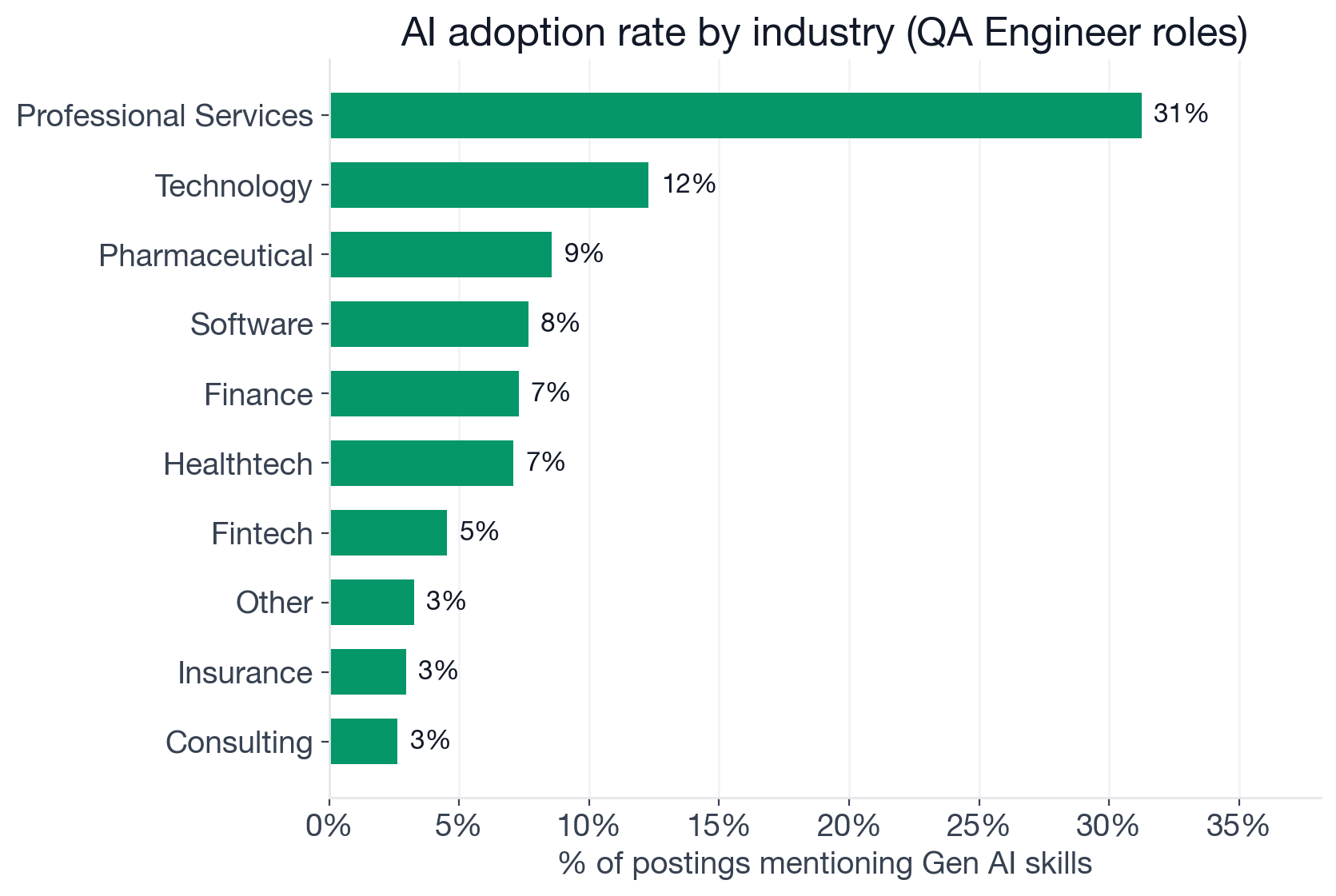
Share of QA Engineer postings in each industry sector that include explicit AI skill requirements.
Professional services (13.2%), technology (12.6%), and software companies (10.1%) are the earliest adopters. These are the industries building AI-powered products most aggressively and therefore most urgently need QA engineers who can evaluate them.
Pharmaceutical (7.4%) and healthtech (6.3%) trail closely. AI-assisted diagnostics, clinical decision tools, and drug discovery platforms all require rigorous validation, and QA engineers with AI testing experience are increasingly valuable there. Finance (6.2%) and fintech (5.4%) follow, driven by AI fraud detection, credit scoring, and algorithmic trading systems that need structured behavioral evaluation.
Consulting (3.8%) and insurance (2.7%) sit at the lower end. These industries still center their QA workloads on legacy system validation and compliance testing, where the testing challenges are well understood even if the tools are evolving.
Top Companies by AI Adoption
The employers with the most consistent AI requirements in their QA postings include AgileEngine (100% of 33 QA postings include AI skills), Marvell Technology Group (100% of 18), Hyland (100% of 8), VML (100% of 7), and TripleTen (77% of 44). Among larger-volume employers, Arctic Wolf (50% of 12 postings), Adobe (40% of 15), PricewaterhouseCoopers (31% of 35), Waymo (30% of 20), and NVIDIA (18% of 45) show substantial AI fractions alongside meaningful QA headcount. The spread across software, hardware, consulting, and autonomous vehicle companies signals that AI testing requirements are no longer confined to pure software employers.
How to Use This in Your Job Search
The data points to three distinct moves for QA engineers thinking about where to invest in 2026.
Build AI product testing competence first. The salary premium lives in the ability to test systems with LLM or AI Agent components: writing evaluation harnesses for non-deterministic outputs, constructing adversarial prompts that surface failures, and designing behavioral contracts for autonomous systems. These are skills that require understanding how AI models fail, not just how to script a test runner. Practice with AI mock interviews to rehearse articulating test strategy for probabilistic systems under interview conditions, where explaining your reasoning clearly is as important as the strategy itself.
Incorporate AI tools into your current automation work. If you work with Selenium, Pytest, or Cypress today, adding GitHub Copilot or ChatGPT to your workflow for test generation, log analysis, and edge case exploration is a low-cost upgrade with high visibility in interviews. Employers increasingly assume this baseline. The question bank covers QA and testing topics across difficulty levels, including test design questions that now regularly surface in senior QA interviews at tech companies.
Target industries and companies where AI is moving fastest. Professional services, technology, and software firms show 10 to 13% explicit AI adoption in QA hiring; consulting and insurance are at 3 to 4%. If your goal is to work on AI testing problems specifically, the highest-signal employers are in tech and software, with meaningful representation in healthtech and pharma. Use interactive courses covering test automation, system design, and AI fundamentals to fill gaps before applying. And browse current QA Engineer openings on the InterviewStack.io job board to see how employers are phrasing AI requirements in live postings, which changes faster than any blog analysis can track.
FAQ
Q. What percentage of QA Engineer jobs require AI skills in 2026?
4.4% of active QA Engineer postings (751 of 17,007 analyzed) explicitly require new-wave generative AI skills such as LLMs, AI Agents, or Prompt Engineering. A further 3.0% (507 postings) ask for traditional ML skills. These figures capture only explicit requirements: virtually all QA teams now expect engineers to use AI-assisted development tools and AI-powered test generation as ambient productivity tools, whether or not postings state it.
Q. How much of a salary premium do AI skills add for QA engineers?
QA Engineer postings in the US that explicitly require new-wave AI skills carry a median base salary of $119,300, compared with $80,000 for postings with no AI skills (n=79 and 3,459 respectively; US base salary, equity excluded). That is a $39,300 gap, roughly a 49% premium. The sample for AI-required postings is relatively small at n=79, so treat the figure as directional rather than definitive.
Q. Which AI skills are QA engineers expected to know in 2026?
LLMs (1.4%, 243 postings), AI Agents (1.4%, 233 postings), and Generative AI (1.2%, 207 postings) are the top new-wave AI skills in QA postings, reflecting demand for engineers who can test AI-powered products. AI-Assisted Development (0.6%), GitHub Copilot (0.6%), Prompt Engineering (0.5%), and ChatGPT (0.5%) round out the tools tier. Machine Learning appears in 2.8% of postings, largely for roles testing ML-powered systems.
Q. Which industries are hiring AI-ready QA engineers most aggressively?
Professional services (13.2% of QA postings with AI requirements), technology (12.6%), and software (10.1%) lead AI adoption in QA hiring. Healthcare tech (6.3%), finance (6.2%), and fintech (5.4%) follow. Consulting (3.8%) and insurance (2.7%) lag, reflecting QA workloads centered on legacy system validation rather than AI product testing.
Q. Is QA engineering at risk from AI automation, or is demand stable?
Demand is stable: 17,007 active QA Engineer postings were analyzed over the 90-day window as of May 2026. AI is changing the job, not eliminating it. Companies building AI products need QA engineers who can test non-deterministic LLM outputs, validate AI agent behavior, and evaluate prompt reliability, tasks that require human judgment alongside AI tools.
Q. Which seniority level sees the most AI-related QA demand?
Staff-level QA engineers show the highest share of postings with AI requirements at 7.2% (40 of 556 staff postings), followed by senior at 4.9% (518 of 10,496 senior postings). Senior roles dominate the QA market overall at 61.7% of all postings, making them the largest absolute group adopting AI skill requirements.
Final Thoughts
The QA Engineer role in 2026 is caught in a productive tension: AI tools are making testing faster and more automated, while AI features in production software are creating a new category of testing problems that require more expertise, not less. The explicit AI adoption rate in job postings, 4.4%, understates the actual shift, because it only captures the "build for AI" layer. The ambient layer, using AI tools as standard practice, is already everywhere. The engineers who will capture the salary premium are the ones who can move fluently across both: use AI to test faster, and understand AI well enough to test it rigorously.
We will refresh this analysis as the market evolves.
Topics
Ready to practice?
Put what you've learned into practice with AI mock interviews and structured preparation guides.