
The Reliability Job Now Extends to the AI Itself
Scan the AI skills that Site Reliability Engineer (SRE) postings actually name in 2026, and the top one isn't a coding assistant or a chatbot: it's AI Agents, cited in 6.1% of postings, ahead of LLMs (3.8%) and Generative AI (2.2%). We looked at 2,747 distinct SRE postings active on the InterviewStack.io job board over a trailing 90 days (2,772 total postings before deduplication; every percentage below uses that 2,772 figure as its denominator), tagging each for explicit AI and machine learning mentions, seniority, industry, and salary. The ordering is the story: companies aren't mostly hiring SREs to use AI tools faster, they're hiring SREs to keep autonomous AI systems from falling over in production, the same discipline SRE has always applied to databases, load balancers, and deploy pipelines.
That shift already has a name. "Agent Reliability Engineer" is starting to appear as a job title, according to the Catchpoint SRE Report 2026 (418 practicing SREs surveyed), and it treats an AI agent the way SRE has always treated a production service: something with an SLO, an on-call rotation, and a blast radius when it misbehaves. The caveat that keeps this honest: an IBM Research benchmark spanning SRE, FinOps, and CISO scenarios found that current models autonomously resolve only 13.8% of real-world incidents on their own. AI is proving out as a triage and correlation assistant, not a replacement for SRE judgment, which is exactly why the discipline is expanding to cover the AI layer instead of eliminating the humans who practice it.
Key Findings
- 11.4% of SRE postings (315 of 2,772) explicitly require new-wave AI skills; 16.8% (467) require any AI, including traditional ML.
- AI Agents is the top new-wave AI skill at 6.1% (169 postings), more than one and a half times LLMs (3.8%, 105 postings).
- SRE roles with new-wave AI skills post a $170,000 US median base salary versus $142,700 without, a $27,300 premium (n=89 vs n=540).
- AI-skill demand is nearly flat by seniority: 11.3% at mid-level, 11.7% senior, 12.6% staff, but only 6.0% of all SRE postings are entry or junior level combined.
- Finance leads industry AI adoption at 24.1% (34 of 141 postings), more than 6x aerospace's 3.5% (5 of 142).
- India's AI-skill rate (16.0%, 53 of 331) outpaces the US (12.2%, 133 of 1,093) despite the US posting more than 3x the volume.
- An IBM Research benchmark found current AI models autonomously resolve only 13.8% of real-world SRE/FinOps/CISO incident scenarios, evidence that AI augments SRE judgment rather than replacing it.
A scope note on the dataset: postings surfaced under "Site Reliability Engineer" span more than classic software SRE. A title-level check of this sample turned up data-center operations technicians, hardware and audio reliability engineers, industrial safety-and-reliability analysts, and generic IT-operations/NOC titles alongside core SRE, DevOps-SRE, and database-reliability roles. That's a real mix in how companies label reliability-adjacent work, not a skew toward or against AI in either direction, so the percentages below are best read as directional for the software-SRE-and-adjacent hiring lane rather than a laboratory-clean SRE-only sample.
What Site Reliability Looked Like Before Agents Showed Up
Three or four years ago, being an SRE meant owning the reliability of software systems built and operated by humans: writing runbooks, tuning alert thresholds, defining SLOs and error budgets, and getting paged when a service breached one. AI showed up only at the edges, mostly as anomaly-detection tooling bolted onto an observability stack, the traditional-ML niche that still accounts for 8.3% of today's postings (230 of 2,772). Generative AI, agents, and LLM-based tooling were not part of the job description at all.
What changed is what SREs are now asked to operate. Companies started shipping AI agents and LLM-powered systems into production, and someone has to keep those systems reliable the same way someone has always kept the database reliable. The AIOps market itself reflects the pace: it grew from $8.91B in 2024 to $11.16B in 2026, and is projected to reach $32.56B by 2029, a 30.7% compound annual growth rate, according to AIOps and SRE incident response trends coverage. That's investment in tooling SREs are expected to operate, not just software SREs are expected to use.
How Many SRE Postings Actually Require AI Now?
11.4% of SRE postings (315 of 2,772) explicitly require new-wave generative AI skills: agents, LLMs, RAG, prompt engineering, or a named platform like OpenAI or Anthropic. Broaden the lens to include the older traditional ML/MLOps skill set and the any-AI figure climbs to 16.8% (467 postings). The overlap between the two is thin: only 2.9% of postings ask for both together, while 8.5% ask for new-wave AI with no ML background at all, evidence that this is a newer, largely separate hiring lane rather than a simple extension of the AIOps-anomaly-detection work SRE already did.
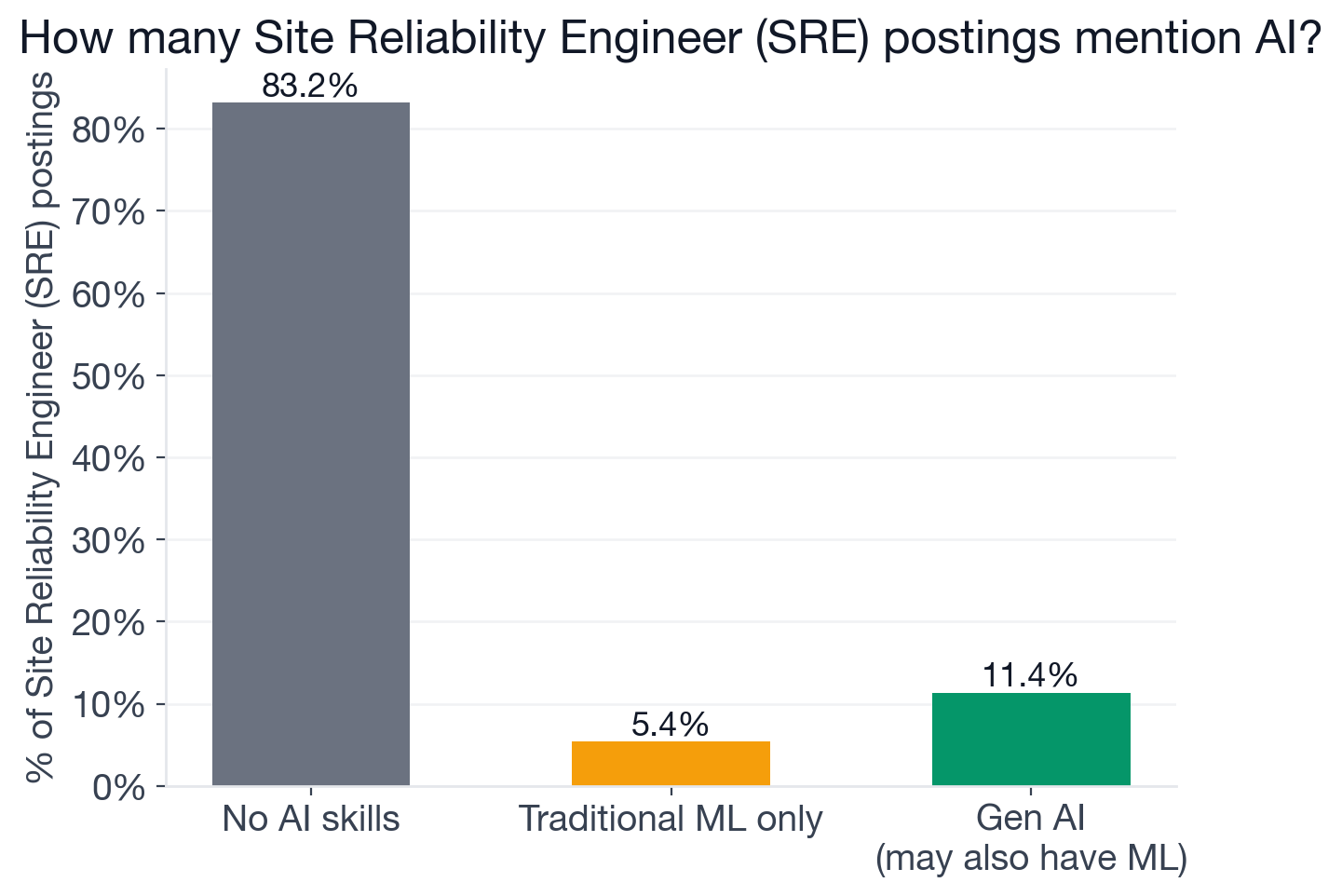 New-wave generative AI, traditional ML, and no-AI segments across 2,772 SRE postings analyzed.
That 11.4% is a floor, not a ceiling, on what SRE work actually involves. It counts only postings that name an AI skill outright, the same way a posting names Kubernetes only when a team owns the cluster. It says nothing about the ambient layer: the Stack Overflow 2025 Developer Survey puts developers using or planning to use AI tools at 84%, up from 76% in 2024, with 51% using them daily, and JetBrains' 2025 developer ecosystem survey finds 85% regularly use AI tools for coding. For SREs specifically, that ambient layer looks less like a coding copilot and more like an AIOps assistant triaging alerts: the Catchpoint SRE Report 2026 finds median SRE toil sits at 34% of working time, and roughly half of practicing SREs already say AI has measurably reduced that toil (the report doesn't quantify by how much), even when their job posting never used the word "AI."
Which AI Skills Are Companies Actually Hiring For?
Rank every AI-related skill by frequency and Machine Learning still tops the list overall, at 7.9% of postings (220 of 2,772), the pre-2023 AIOps and anomaly-detection baseline that never went away. But look only at new-wave, generative-AI-era skills, the ones that mark this specific hiring shift, and AI Agents leads clearly: 6.1% of postings (169), more than one and a half times LLMs (3.8%, 105) and nearly three times Generative AI (2.2%, 60).
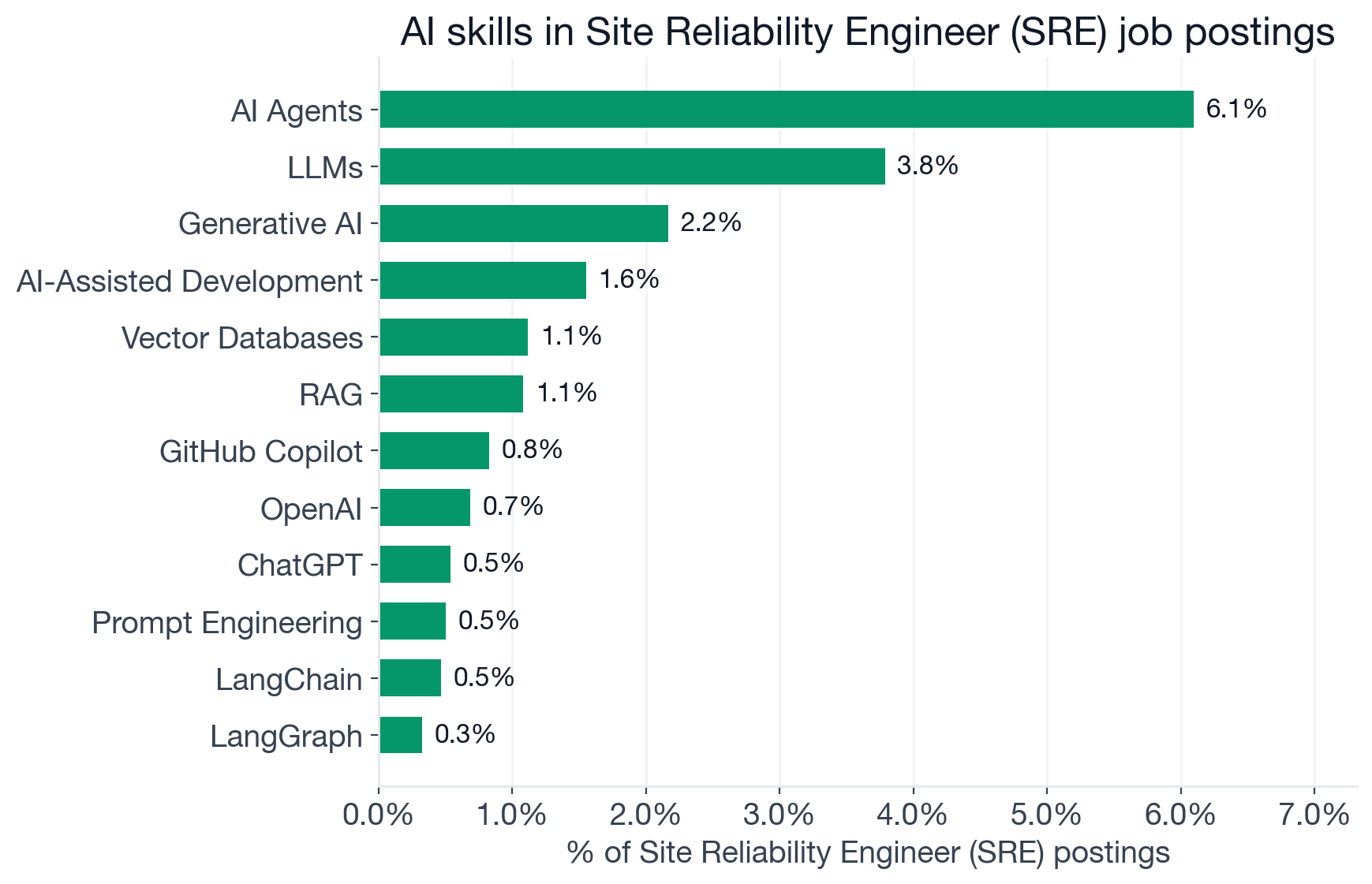 AI Agents leads every generative-AI-era skill; Machine Learning remains the highest overall as the pre-existing AIOps baseline.
| Skill | % of postings | Type | What it signals |
|---|---|---|---|
| Machine Learning | 7.9% | Traditional | AIOps/anomaly-detection baseline |
| AI Agents | 6.1% | New-wave | Build or operate autonomous ops agents |
| LLMs | 3.8% | New-wave | Integrate LLM-based tooling into workflows |
| Generative AI | 2.2% | New-wave | General genAI ops tooling |
| AI-Assisted Development | 1.6% | New-wave | AI-accelerated engineering workflow |
| MLOps | 1.2% | Traditional | Own ML infrastructure reliability |
| Vector Databases | 1.1% | New-wave | Retrieval infra for ops tooling |
| RAG | 1.1% | New-wave | Retrieval-augmented ops assistants |
| GitHub Copilot | 0.8% | New-wave | Named developer-tool requirement |
That AI Agents lead lines up with what the tooling itself already delivers: accounts using AI achieve roughly 2x higher alert-correlation rates and 27% less alert noise than non-AI accounts, per New Relic's 2026 AI Impact Report (aggregated across 6.6 million platform users). Employers are hiring for the systems that produce that gain, not just for people who can prompt a chatbot.
AI Skills Add $27,300 to the Median SRE Salary
Among US postings with disclosed base salary (equity, bonus, and other compensation aren't captured in job postings, so total pay at senior levels runs higher than these figures), SRE roles that explicitly require new-wave AI skills carry a median of $170,000 (n=89), compared with $142,700 for postings that don't (n=540). That's a $27,300 premium, a genuine jump in salary band tied to a handful of AI line items in the job description.
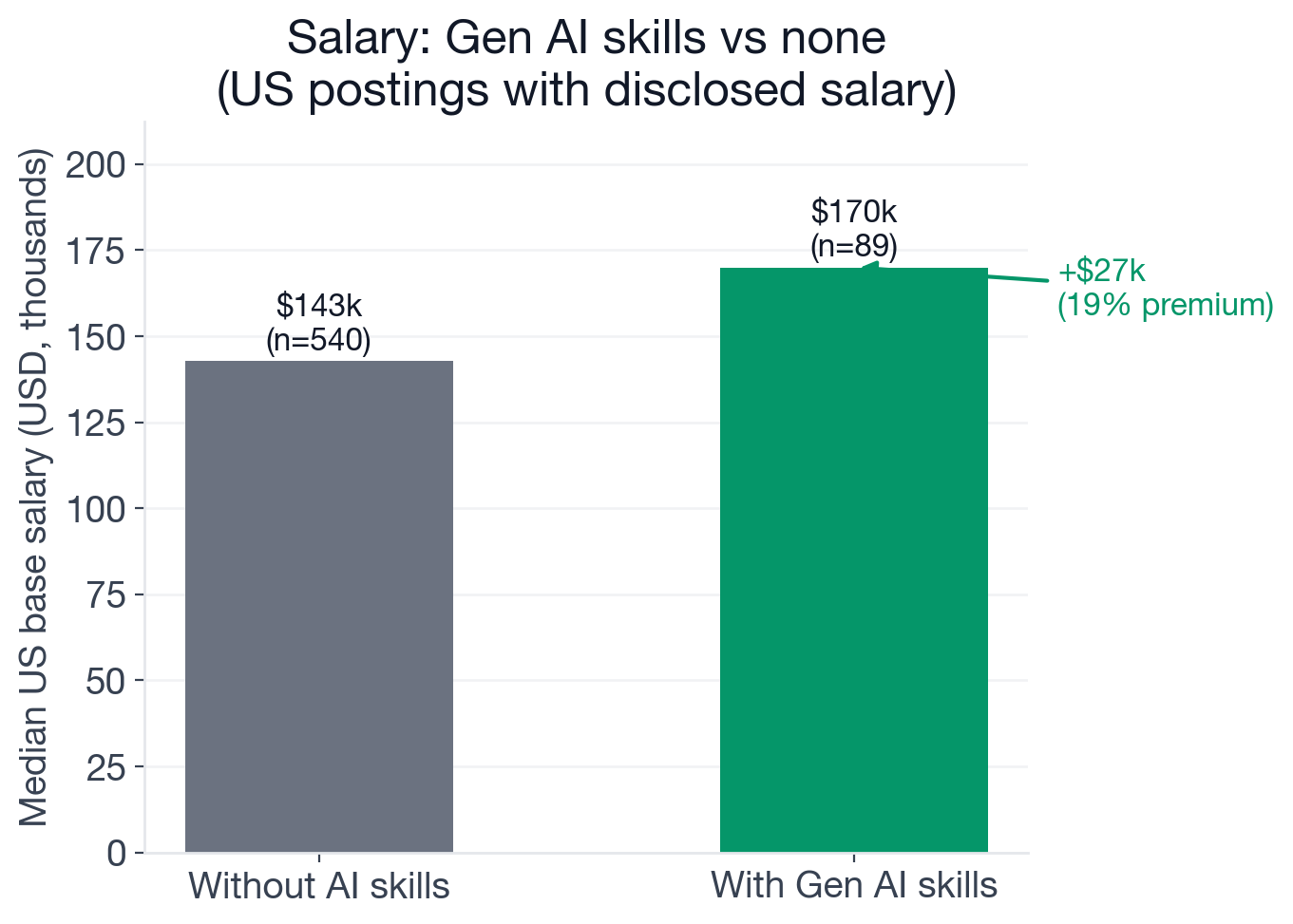 US base salary median for SRE postings with versus without explicit new-wave AI requirements.
Global figures point the same direction at a smaller magnitude: postings with any AI skill (new-wave or traditional) show a $160,000 median worldwide (n=161) against $137,500 without (n=650), a $22,500 gap that mixes currencies and cost-of-living differences, so the US-only number above is the one to anchor on.
Where Is This AI Shift Concentrated?
AI-skill demand barely moves across seniority: 11.3% at mid-level (70 of 618), 11.7% at senior (217 of 1,852), and 12.6% at staff (17 of 135), a far flatter curve than roles where AI requirements cluster sharply at one end of the career ladder. The more striking number is how little of the SRE pipeline is junior at all: just 1.3% of postings are entry-level (36 total) and 4.7% are junior (131), versus 66.8% senior. SRE was already a role you grow into rather than start in, and the AI layer isn't changing that; it's arriving on top of a ladder that already skips most of the bottom rungs.
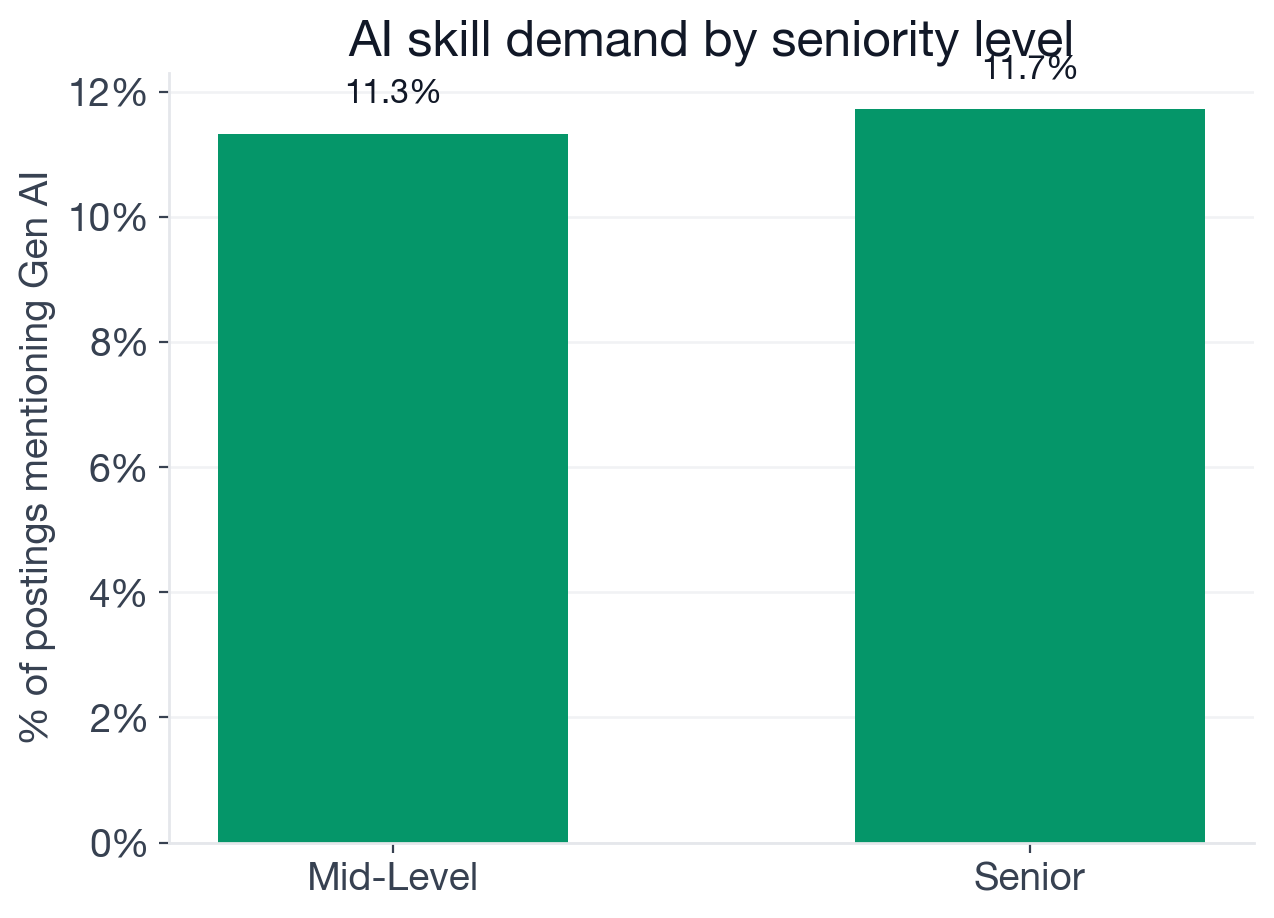 AI adoption rate climbs only modestly from mid-level to staff; SRE postings themselves skew heavily senior.
Industry tells a sharper story than seniority does. Finance leads AI adoption at 24.1% of SRE postings (34 of 141), and software companies follow at 19.7% (63 of 320), both well above the broader technology sector's 10.2% (47 of 462) and fintech's 9.5% (21 of 221). Aerospace sits lowest at 3.5% (5 of 142), consistent with a sector whose reliability culture predates, and in places resists, the generative-AI wave.
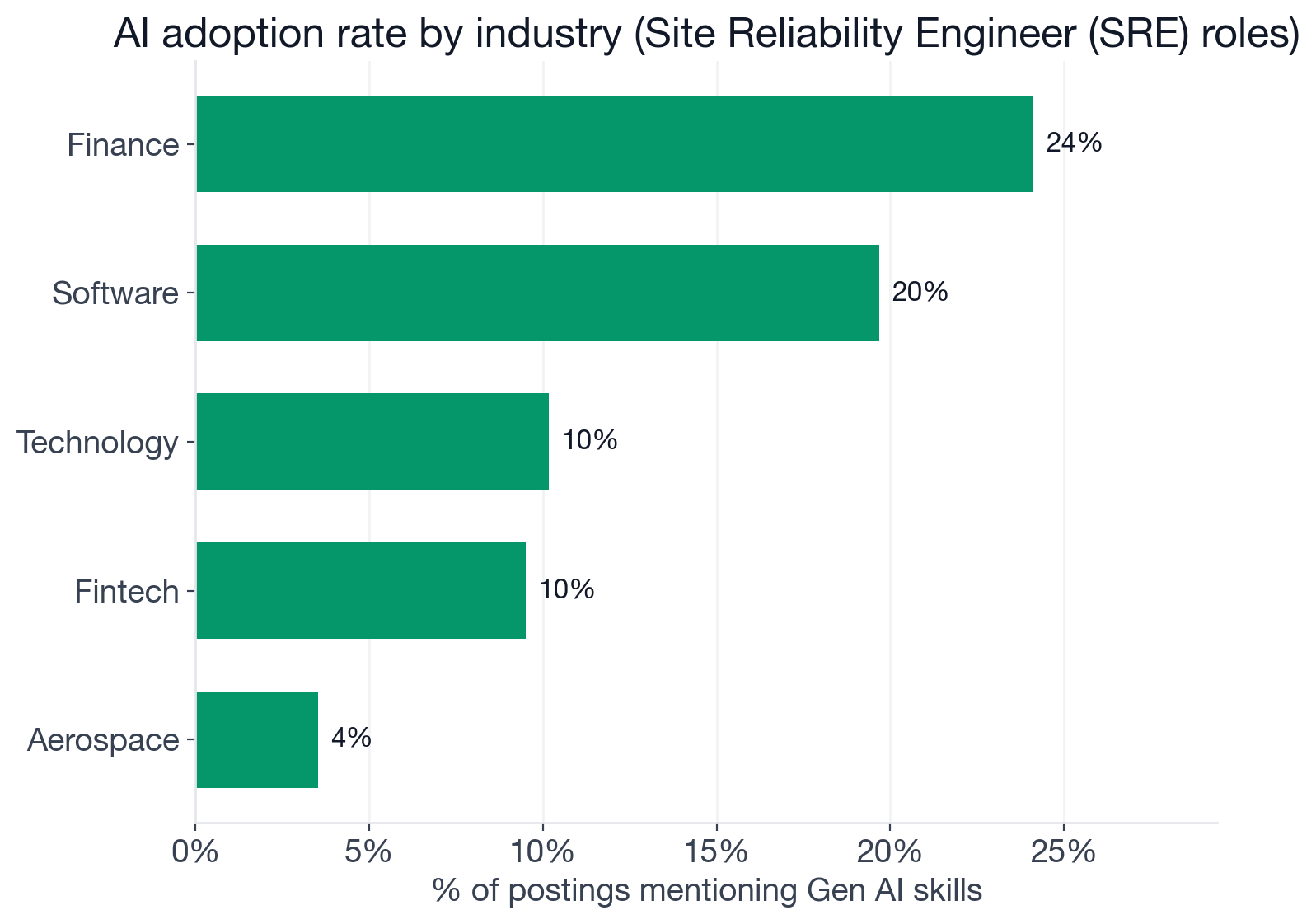 Finance and software postings show substantially higher AI adoption than technology, fintech, or aerospace.
Geography adds one more wrinkle: India's AI-skill rate (16.0%, 53 of 331) outpaces the US (12.2%, 133 of 1,093) despite the US posting more than three times the volume. Adoption rate and posting volume don't move together here, and a smaller market can move faster on requirements than the largest one.
A handful of named employers show up repeatedly with elevated AI-adoption rates, though the smaller counts among them are directional rather than definitive:
| Company | AI-tagged / total postings | AI rate |
|---|---|---|
| Booz Allen Hamilton | 6 / 13 | 46.2% |
| London Stock Exchange Group | 10 / 28 | 35.7% |
| Oracle | 6 / 45 | 13.3% |
| Royal Bank of Canada | 6 / 6 | 100% (small sample) |
| Remote | 5 / 5 | 100% (small sample) |
How to Use This in Your Job Search
If you're aiming at SRE roles in 2026, lead with AI Agents experience on your resume, since it's the clear signal at 6.1% of postings, and treat MLOps/AIOps (1.2%) as a smaller but still relevant secondary signal, both ahead of "I use ChatGPT to write my runbooks," a claim nearly every candidate can already make and almost no posting screens for. Practice narrating a real agent-reliability tradeoff (autonomy versus guardrails, what happens when the agent's own decision causes an incident) with AI-powered mock interviews built around the kind of systems questioning staff-level postings actually run.
If your AIOps or agent-reliability vocabulary is thinner than your on-call experience, the Question Bank is the fastest way to drill the specific concepts this data shows are actually screened for: SLOs for autonomous systems, anomaly-detection pipelines, and incident correlation. For the fundamentals underneath that layer, the ML and observability concepts most AI-agent tooling sits on top of, our interactive courses build that base before an interview loop tests it. For a broader look at what separates a strong SRE candidate independent of AI, our skills breakdown for the SRE role covers the table-stakes and differentiator skills across the full posting set. And when you're ready to see what's open, browse current Site Reliability Engineer postings filtered by skill and seniority.
FAQ
Q. How many Site Reliability Engineer jobs actually require AI skills in 2026?
11.4% of active SRE postings (315 of 2,772 analyzed) explicitly require new-wave generative AI skills like AI agents, LLMs, or RAG. Broaden that to include traditional ML and MLOps and the share rises to 16.8% (467 postings). That explicit figure is a floor, not a ceiling: it only counts postings that name AI skills outright, not the ambient AI tooling nearly every engineering role now assumes.
Q. What's the most in-demand AI skill for SREs right now?
AI Agents, cited in 6.1% of postings (169 of 2,772), ahead of LLMs (3.8%) and Generative AI (2.2%). The top new-wave skill isn't a coding copilot, it's the same autonomous-agent technology SREs are increasingly asked to operate and keep reliable.
Q. Does AI experience pay more for Site Reliability Engineers?
Yes. Among US postings with disclosed salary, SRE roles requiring new-wave AI skills post a median base salary of $170,000 versus $142,700 for roles that don't, a $27,300 premium (n=89 with AI vs n=540 without). Equity, bonus, and other compensation are not included in these figures.
Q. Is AI adoption higher for senior SREs than for people starting out?
Somewhat, yes. AI-skill demand is 8.3% at entry level (3 of 36 postings) and 6.1% at junior level (8 of 131), both below the 11.3%-12.6% range that spans mid-level through staff. So senior and staff SREs do see AI requirements more often than people starting out, though the gap is modest compared with many engineering roles. The bigger story at the entry end is that there's barely an entry level to begin with: just 1.3% of SRE postings are entry-level and 4.7% junior, versus 66.8% senior.
Q. Which industries are hiring SREs with AI skills fastest?
Finance leads at 24.1% of postings requiring AI (34 of 141), followed by software companies at 19.7% (63 of 320). Broader technology and fintech postings sit closer to the role average, at 10.2% and 9.5% respectively, while aerospace trails at 3.5%.
Q. Will AI replace the Site Reliability Engineer role?
Current evidence says no, it's reshaping the role rather than eliminating it. An IBM Research benchmark (ITBench, ICML 2025) found that state-of-the-art models autonomously resolved only 13.8% of real-world IT-operations scenarios spanning SRE, FinOps, and CISO domains. AI is proving effective as a correlation and triage assistant, not as an autonomous replacement for SRE judgment.
Q. What's an Agent Reliability Engineer?
An emerging job title, flagged in the Catchpoint SRE Report 2026, for SREs who apply reliability-engineering discipline (monitoring, incident response, SLOs) to AI agents themselves rather than only to traditional services. It reflects the same shift the posting data shows: AI Agents is now the single most-requested new-wave AI skill in SRE job listings.
The Skill Set Is Widening, Not Disappearing
The AI layer isn't replacing what SREs already do, it's adding a new category of system to the list of things that can page you at 2 a.m. A model that resolves 13.8% of incidents on its own isn't a threat to the job; it's a tool that still needs someone accountable for the other 86.2%, and increasingly, for the AI agent itself. That's the widening version of the SRE job description 2026 is actually hiring for.
Topics
Ready to practice?
Put what you've learned into practice with AI mock interviews and structured preparation guides.