
The AI Divide Runs Through the Employer, Not the Job Title
Two people can hold the exact same job title, Solutions Architect, at two different companies, and one of them is doing meaningfully AI-native work while the other almost never touches it. That is not a hunch. Across active Solutions Architect postings on the InterviewStack.io job board, 5,083 listings over a rolling 90-day window with AI-related terms tagged directly from the posting text, technology companies require AI skills in 37.5% of their Solutions Architect postings. IT services firms, hiring for a title that reads identically on a resume, require it in just 2.2%. That is roughly a 17x gap, and it is far larger than the gap between any two seniority levels in the same dataset.
That is the story most "AI is changing this role" posts miss: they look for a shift over time or over seniority, and Solutions Architect does show both. But the sharper cut here is horizontal, across employer type, not vertical, across career stage. If you're deciding where to point your job search, which company is hiring matters more than which level you're applying for.
A scope note before the numbers: this dataset matches on the Solutions Architect title family, and a spot-check of sample listings shows it also pulls in adjacent titles, Enterprise Architect, Business Architect, and Solutions Consultant among them, alongside the core "Solution(s) Architect" title. That widens the picture to the broader solutions/enterprise-architecture family rather than isolating the individual-contributor, AWS/Azure-style title alone, so treat the percentages below as describing that wider family. Separately, the IT services figure below is built on just 3 AI-requiring postings out of 138 total for that industry, small enough that the exact multiple should be read as directional rather than a precise measurement.
Key Findings
- 26.8% of Solutions Architect postings (1,360 of 5,083) explicitly require new-wave generative AI skills; 35.8% (1,821) require some form of AI, generative or traditional machine learning.
- Technology companies require AI in 37.5% of their Solutions Architect postings (392 of 1,046) versus 2.2% at IT services firms (3 of 138), a roughly 17x gap.
- Traditional Machine Learning is the single top AI-related skill at 19.9% (1,011 postings); among new-wave skills, AI Agents leads at 16.6% (844), ahead of Generative AI (14.6%) and LLMs (9.1%).
- AI-requiring postings carry a $14,050 US median base salary premium: $184,000 (n=406) versus $169,950 without AI (n=715).
- Seniority barely moves the AI rate: 25.9% at mid-level, 27.6% at senior, 23.4% at staff, a narrow band compared to the employer-type gap.
- Senior-level postings dominate the role at 78.5% of all listings; entry and junior combined make up just 3.2%.
- The US is the largest single market at 38.1% of postings, with a 29.5% AI rate; India follows at 9.0% share and a 22.6% AI rate.
What Solutions Architect Work Looked Like Before Generative AI
Three or four years ago, a Solutions Architect's AI-adjacent work was almost entirely translation work: taking a data science team's model output and wiring it into a customer-facing system, or evaluating a vendor's "AI-powered" analytics add-on for a client's stack. Machine learning and BI integration were already part of the job, which is exactly why traditional Machine Learning still shows up in nearly a fifth of today's postings, it's a holdover skill, not a new one. What has changed since 2023 is the object being architected. Instead of wiring a static prediction into a dashboard, architects are now asked to design systems where an LLM or an agent makes decisions, calls tools, and acts autonomously inside a customer's environment, and to do that securely, at scale, and inside existing compliance boundaries.
That shift shows up clearly in enterprise-architecture leadership research: 92% of EA leaders now name AI or agentic architecture their top trend for 2026, and 72% cite AI or data-architecture skill as the biggest capability gap on their teams (Avolution, Enterprise Architecture in 2026). Deloitte's enterprise AI research adds a second, related data point: 76% of enterprise AI use cases today are deployed via third-party, off-the-shelf products rather than custom-built models (Deloitte, State of AI in the Enterprise). That second stat matters specifically for this role: a Solutions Architect evaluating and integrating a vendor's AI product is doing AI-adjacent work even when the job posting never uses the words "generative AI," which is one reason the explicit percentages below likely undercount the real footprint of AI in this job.
How Many Solutions Architect Jobs Actually Require AI?
Job-posting language only captures one layer of AI adoption: the explicit ask to build, deploy, or govern an AI system. It misses the much larger ambient layer, using AI tools as part of daily work, that most employers now assume without writing into the requisition, the same way "internet access" never appeared as a listed skill in a 2005 job ad.
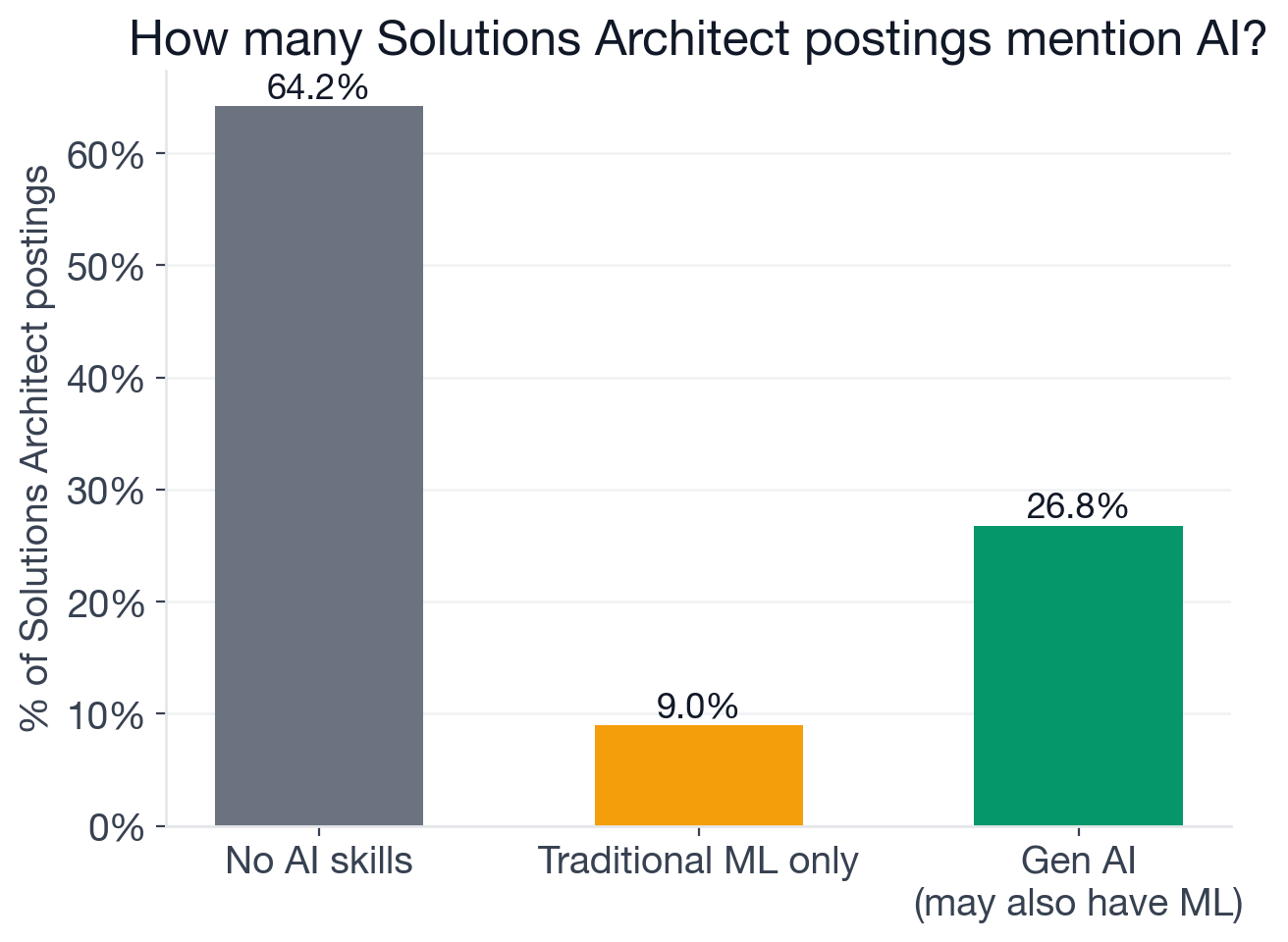
26.8% of postings explicitly require new-wave generative AI skills; 21.7% require traditional machine learning; the two overlap in 12.7% of postings, and 35.8% require some form of AI overall.
Layer one, the explicit build-AI ask, sits at 26.8% (new-wave) to 35.8% (any AI). Layer two, ambient use, is far higher. General developer-tool surveys put AI-tool usage at 84% (up from 76% the year before) and daily use at 51% among professional developers (Stack Overflow 2025 Developer Survey), with JetBrains reporting 85% of developers regularly using AI tools for coding and 62% relying on at least one AI coding assistant, agent, or editor (JetBrains State of Developer Ecosystem 2025). Architects sit a layer above hands-on coding, so those exact figures don't transfer one-to-one, but the EA-specific numbers above (92% naming AI/agentic architecture their top trend, 72% naming it their top skill gap) point the same direction: the 26.8% figure measures who is hired to explicitly build or govern AI systems, not how many architects are expected to understand and use AI as part of the job. Virtually all of them are.
The Real Fault Line Is the Employer, Not the Job Title
If explicit AI demand were mostly a function of seniority, you'd expect a steady climb from entry-level to staff. It isn't. The AI requirement rate moves in a narrow band across every level with a meaningful sample: 25.9% at mid-level (n=640), 27.6% at senior (n=3,990, the level that makes up 78.5% of all postings), and 23.4% at staff (n=290). Junior sits lower at 14.3% (n=133), and entry-level shows 20% but on a tiny sample of 30 postings, worth flagging as directional rather than reading as a trend.
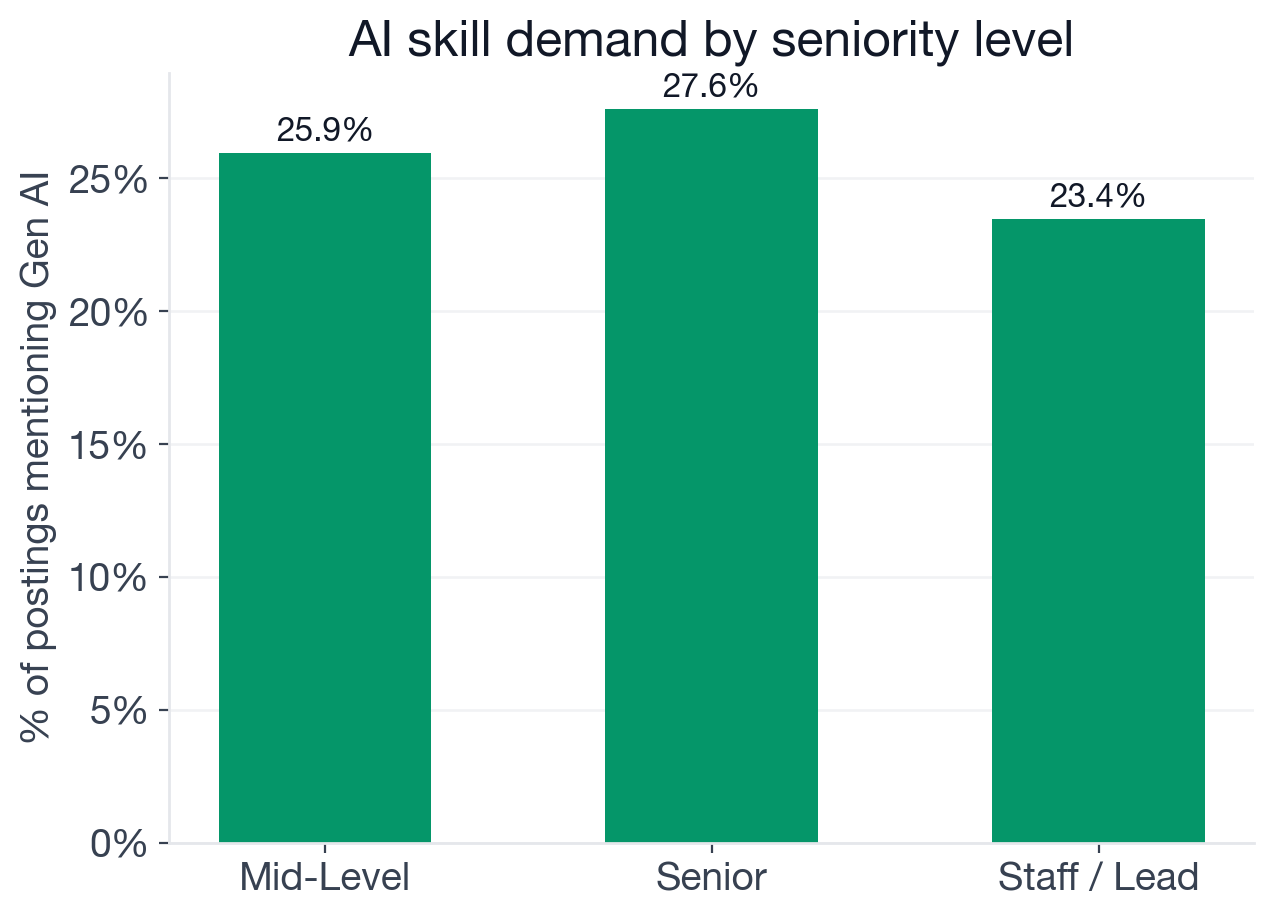
Outside the small entry-level sample, AI adoption holds between roughly 23% and 28% from mid-level through staff, a narrow band compared to the gap seen across employer types below.
Now compare that to industry. Technology companies require AI in 37.5% of Solutions Architect postings (392 of 1,046); software companies, 28.9% (200 of 692). Healthcare sits at 21.1% (n=152) and finance at 20.0% (n=110). Consulting (15.5%, n=226) and fintech (13.9%, n=137) trail further. IT services firms, the traditional systems-integration and staffing-adjacent end of the market, sit at just 2.2% (3 of 138 postings).
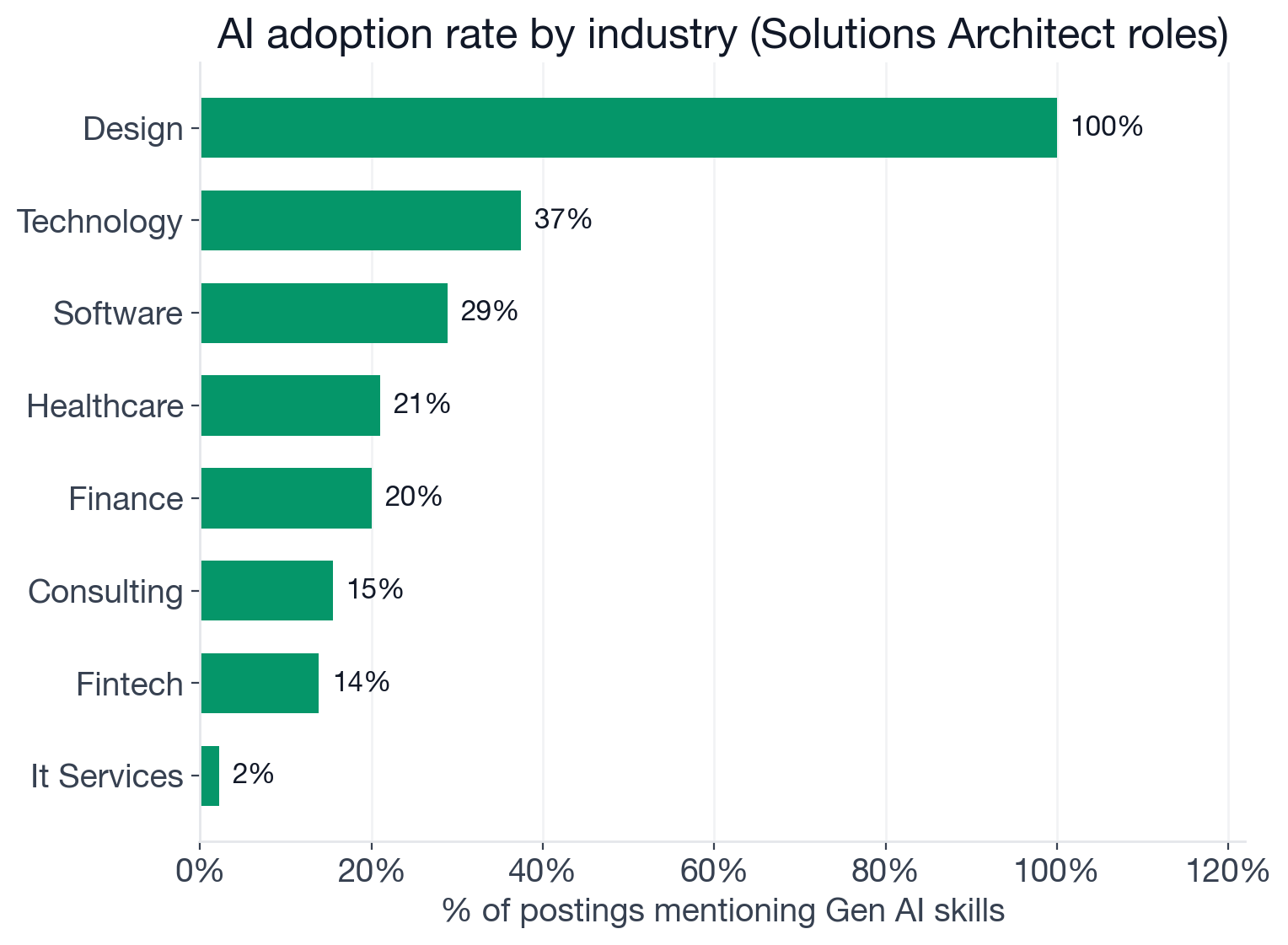
Technology and software employers require AI in Solutions Architect postings at roughly 3-17x the rate of IT services firms, a bigger swing than anything seniority produces.
Put those two charts side by side and the shape of the role becomes clear: a Solutions Architect job at a technology or software company is now substantially an AI-systems job, roughly one in three to one in four postings say so outright, while the same title at an IT services firm is still overwhelmingly a traditional integration job. Neither is "the real" Solutions Architect role; they're two different jobs sharing one title, and the company you target tells you more about which one you'll get than your years of experience does.
Which AI Skills Are Solutions Architects Actually Hired to Build?
Traditional Machine Learning is still the single most common AI-related skill in Solutions Architect postings at 19.9% (1,011 of 5,083), a legacy of years of BI and predictive-analytics integration work that predates the current wave. Among skills specific to the generative AI era, AI Agents leads at 16.6% (844), ahead of Generative AI at 14.6% (741) and LLMs at 9.1% (465).
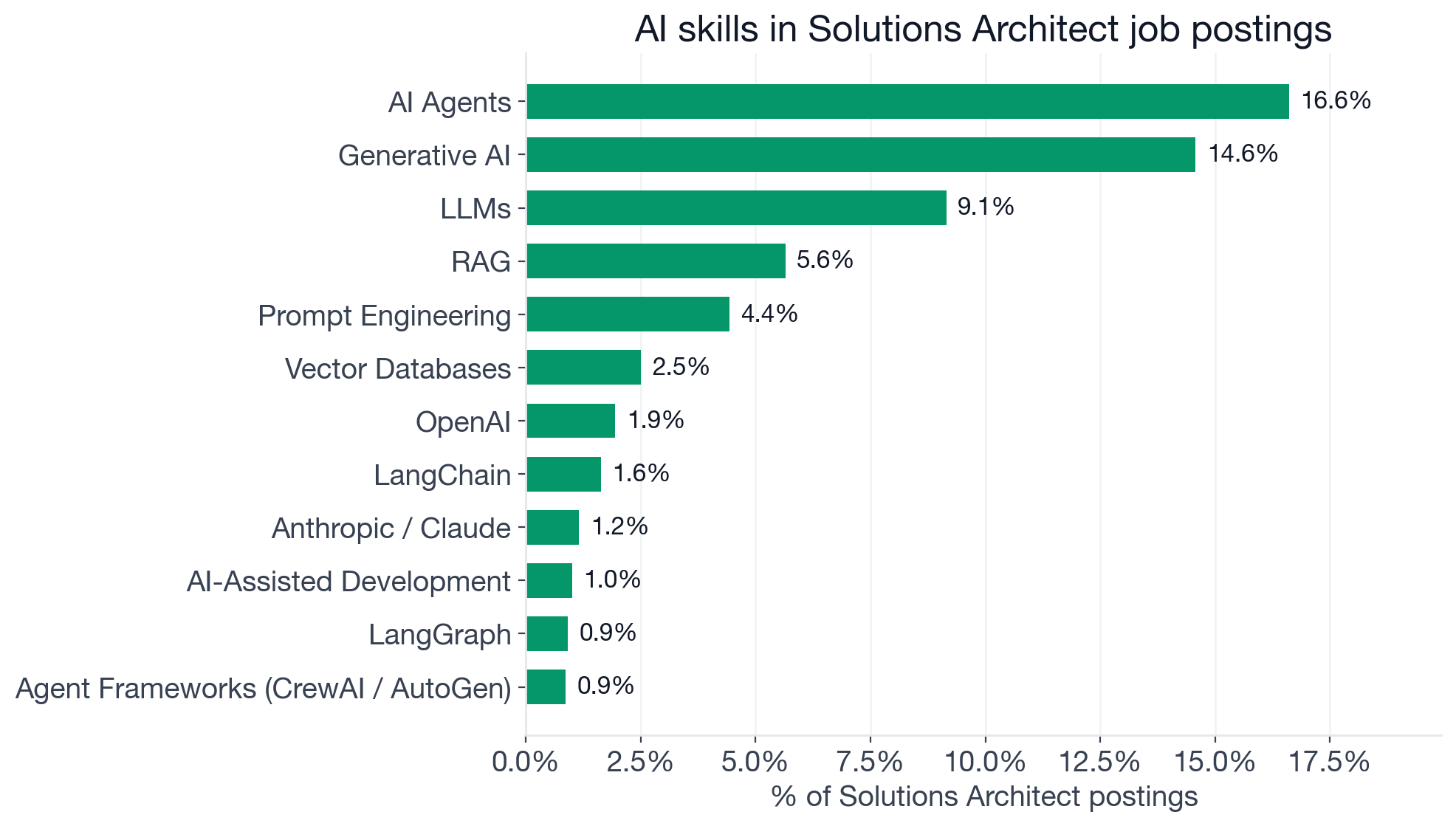
AI Agents outranking Generative AI and LLMs signals architects are increasingly hired to design autonomous, tool-calling systems, not just add a conversational feature to an existing product.
That ranking, AI Agents ahead of plain Generative AI, is the clearest signal in the skills data. Companies aren't mostly asking Solutions Architects to bolt a chatbot onto a product; they're asking them to design systems where an agent plans, calls tools, and acts with some autonomy inside a customer's environment, which is a harder and more architecturally consequential problem than adding an LLM endpoint. Further down the list, RAG (5.6%), MLOps (5.7%), and Prompt Engineering (4.4%) all sit in the single digits, supporting infrastructure around the two headline concepts rather than standalone requirements on their own.
The AI Salary Premium Is Real, but It's Not Huge
Among US postings with disclosed base salary (equity, bonus, and sign-on are not captured in job-board data and are not reflected in either figure below), Solutions Architect roles that require new-wave AI skills show a $184,000 median base, compared with $169,950 for roles that don't, a $14,050 premium. Both samples clear a comfortable size, 406 AI-requiring postings and 715 without, so this is a stable read rather than a small-sample guess.
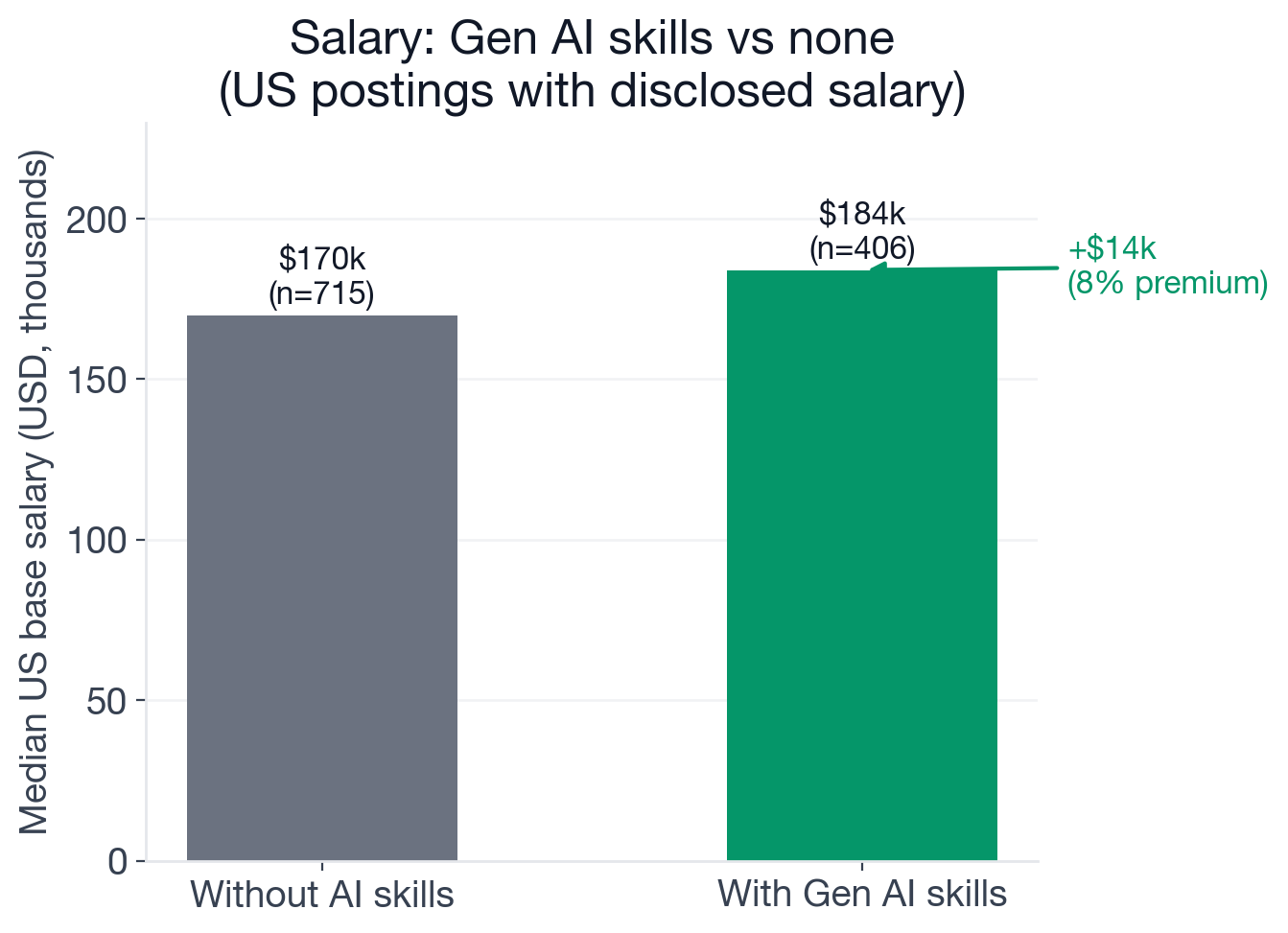
A $14,050 US base-salary premium for AI-requiring Solutions Architect postings, real but modest next to the 17x gap in who even asks for AI in the first place.
Read against the employer-type gap above, that premium is worth putting in context: $14,050 is a real number, but it's a much smaller signal than the difference between working at a company that requires AI 37.5% of the time versus one that requires it 2.2% of the time. The bigger financial decision for most architects isn't "should you learn AI for the raise," it's "which kind of employer you're applying to."
Who's Building the AI Stack
Ranked by the volume of AI-requiring Solutions Architect postings, Amazon leads by a wide margin (206 AI-requiring postings of 433 total, 47.6%), followed by NVIDIA (137 of 243 combined listings, 56.4%) and Adobe (51 of 76 combined listings, 67.1%). Databricks and MongoDB each show 23 AI-requiring postings, though MongoDB's is a far higher share of its total volume (23 of 26, 88.5%, versus Databricks' 23 of 102, 22.5%). Salesforce, Zip, SAP, Genesys, and Braze round out the top ten.
| Company | AI-requiring postings | Total postings | AI rate |
|---|---|---|---|
| Amazon | 206 | 433 | 47.6% |
| NVIDIA | 137 | 243 | 56.4% |
| Adobe | 51 | 76 | 67.1% |
| Databricks | 23 | 102 | 22.5% |
| MongoDB | 23 | 26 | 88.5% |
| Salesforce | 17 | 17 | 100% |
| Zip | 16 | 17 | 94.1% |
| SAP | 16 | 41 | 39.0% |
| Genesys | 15 | 17 | 88.2% |
| Braze | 12 | 13 | 92.3% |
Geographically, the US is the largest single market at 38.1% of postings with a 29.5% AI rate, and India follows at 9.0% of postings with a 22.6% rate. The UK's smaller share (5.8%) carries a slightly higher AI rate than the US at 31.6%, and Mexico is a notable, if small-sample, outlier at 57.6% (n=59), worth watching rather than treating as an established trend.
How to Use This in Your Job Search
If you're targeting the AI-heavy end of this role, start by mapping which companies actually ask for it: browse current Solutions Architect openings that require AI Agents or Generative AI rather than assuming every "Solutions Architect" posting is equivalent. The employer-type gap above means the title alone won't tell you which job you're applying for.
To close the gap between where you are and what these postings ask for, practice explaining agentic system design out loud with AI mock interviews, the kind of scenario question ("design a system where an agent can call three internal tools safely") that's becoming standard at technology and software employers. If your Machine Learning fundamentals are rusty or you've never worked with RAG or vector databases, the question bank is the fastest way to drill the concepts by topic, and the interactive courses are a better fit if you need to build foundational fluency in ML or generative AI systems from scratch rather than just practice interview answers. Once you've mapped the target companies and shored up the gaps, the full Solutions Architect board is where to track new postings as they go live.
FAQ
Q. What percentage of Solutions Architect jobs require AI skills in 2026?
26.8% of active Solutions Architect postings (1,360 of 5,083 analyzed) explicitly require new-wave generative AI skills. Including traditional machine learning and deep learning, the any-AI figure rises to 35.8% (1,821 postings). That is the explicit hiring ask; it does not capture how many architects already use AI tools day to day, which is much higher.
Q. Does AI adoption vary by the type of company hiring a Solutions Architect?
Yes, dramatically. Technology companies require AI in 37.5% of their Solutions Architect postings (392 of 1,046) and software companies in 28.9% (200 of 692). IT services firms sit at just 2.2% (3 of 138), roughly a 17x gap from technology. The job title is identical across all three; the AI content of the work is not. Note the IT services figure rests on only 3 AI-requiring postings, so read the exact multiple as directional.
Q. Does seniority determine whether a Solutions Architect job requires AI?
Not much, and that is itself notable. The AI requirement rate holds in a narrow band across the levels with real sample size: 25.9% at mid-level (n=640), 27.6% at senior (n=3,990), and 23.4% at staff (n=290). Compare that to the 17x swing by employer type: which company you target predicts AI exposure far better than which level you're applying for.
Q. What is the top AI skill required for Solutions Architect roles?
Traditional Machine Learning is the single most-requested AI-related skill at 19.9% of postings (1,011 of 5,083), reflecting years of BI and predictive-analytics work already baked into the role. Among new-wave generative AI skills specifically, AI Agents leads at 16.6% (844 postings), ahead of Generative AI (14.6%) and LLMs (9.1%), which signals companies are hiring architects to design agentic systems, not just add a chatbot to an existing product.
Q. Is there a salary premium for Solutions Architects with AI skills?
A real but modest one. Among US postings with disclosed salary, those requiring new-wave AI skills show a $184,000 median base (n=406), compared with $169,950 for those that don't (n=715), a $14,050 premium. Both samples are well above the reporting floor, so this is a stable read, not a directional guess. Equity, bonus, and sign-on are not included in either figure.
Q. Which companies are hiring the most AI-focused Solutions Architects?
By volume of AI-requiring postings: Amazon (206 of 433 total postings), NVIDIA (137 of 243), Adobe (51 of 76), Databricks and MongoDB (23 each), and Salesforce, Zip, SAP, Genesys, and Braze rounding out the top ten. Amazon and NVIDIA combine large volume with high AI rates; MongoDB and Salesforce show smaller but nearly saturated AI requirements.
Q. Do Solutions Architects need AI skills even if a job posting doesn't mention them?
Almost certainly, in practice. Enterprise-architecture leadership surveys show 92% of EA leaders now name AI or agentic architecture their top trend for 2026, and 72% cite AI or data-architecture skill as their biggest capability gap. Separately, general developer-tool surveys put AI-tool usage at 84-85% and daily use above 50%. The posting language lags what the job actually requires.
Read the Employer, Not Just the Title
"Solutions Architect" in 2026 isn't one job with an AI layer sprinkled on top, it's two jobs wearing the same title, and which one you get depends far more on your employer than your resume. If you want the AI-heavy version, technology and software companies are where the postings, and the skills that get you hired for them, actually line up.
Topics
Ready to practice?
Put what you've learned into practice with AI mock interviews and structured preparation guides.