
For Technical PMs, AI Means Systems Work, Not Chat Windows
Scan enough Technical Product Manager postings in 2026 and a pattern breaks the expected generative-AI script: the single most-requested AI skill is not a chatbot, an LLM, or a prompt template. It is Machine Learning, the pre-2023 term, still leading at 15.8% of postings, ahead of AI Agents (12.7%), and well ahead of Generative AI and LLMs (6.8% each). Prompt Engineering shows up in just 1.6% of listings. ChatGPT barely registers at 1.3%.
We looked at 751 distinct Technical Product Manager postings active on the InterviewStack.io job board over the trailing 90 days, tagging each one for explicit AI and machine learning skill mentions. One dataset caveat worth naming: about one in five sampled titles under this label are actually Technical Designer roles in apparel and interior design ("Sr. Technical Apparel Designer," "Technical Designer - Space Planning"), a distinct job family that shares title vocabulary with Technical Product Manager but isn't a software role. Those postings essentially never mention AI or ML skills, so the adoption percentages below are best read as a floor for software-focused Technical Product Managers, not an overstatement. The pattern holds across the software-PM majority of the dataset: companies are hiring Technical Product Managers to own AI infrastructure and agentic systems, not to prove they can operate a chat window. That distinction should shape how you position yourself for 2026.
Key Findings
- 21.5% of Technical Product Manager postings (162 of 751) explicitly require new-wave generative AI skills; 28.8% require any AI, including traditional ML.
- Machine Learning is the single most-requested AI skill at 15.8% of postings, ahead of AI Agents (12.7%), LLMs (6.8%), and Generative AI (6.8%).
- Prompt Engineering (1.6%), ChatGPT (1.3%), and GitHub Copilot (0.3%) are rarely named as explicit requirements.
- US base salary median with new-wave AI skills is $157,500 (n=42) versus $135,750 without (n=164), a $21,750 premium.
- Staff-level postings show the highest AI adoption rate at 40.6% (n=32), roughly double the mid-level rate of 18.8% (n=128).
- Germany's AI adoption rate (38.5%, n=26) outpaces the US (21.8%, n=385) and India (20.4%, n=54).
- Only 8.5% of postings ask for both traditional ML and new-wave generative AI together; 13.0% ask for new-wave AI with no ML mention at all.
What Technical Product Manager Hiring Looked Like Before Generative AI
Three or four years ago, a Technical Product Manager posting was mostly a fluency test: can you read an API contract, sit in an architecture review without glazing over, and translate between engineers and stakeholders without losing precision. Machine learning showed up in the job only if the product itself was a recommendation engine, a fraud model, or a platform team's internal tooling, and even then it was usually framed as "worked with a data science team," not "manage an AI product."
Generative AI changed what products exist, not just what skills get listed. Once companies started shipping LLM features, RAG-based search, and AI agents as core product surfaces rather than backend experiments, a Technical Product Manager became the person accountable for those systems in production: latency budgets, hallucination tolerance, evaluation pipelines, and the vendor or model-choice tradeoffs that used to belong entirely to engineering. That is a materially heavier technical bar than the pre-2023 version of the role carried.
How Many Technical Product Manager Jobs Actually Require AI in 2026?
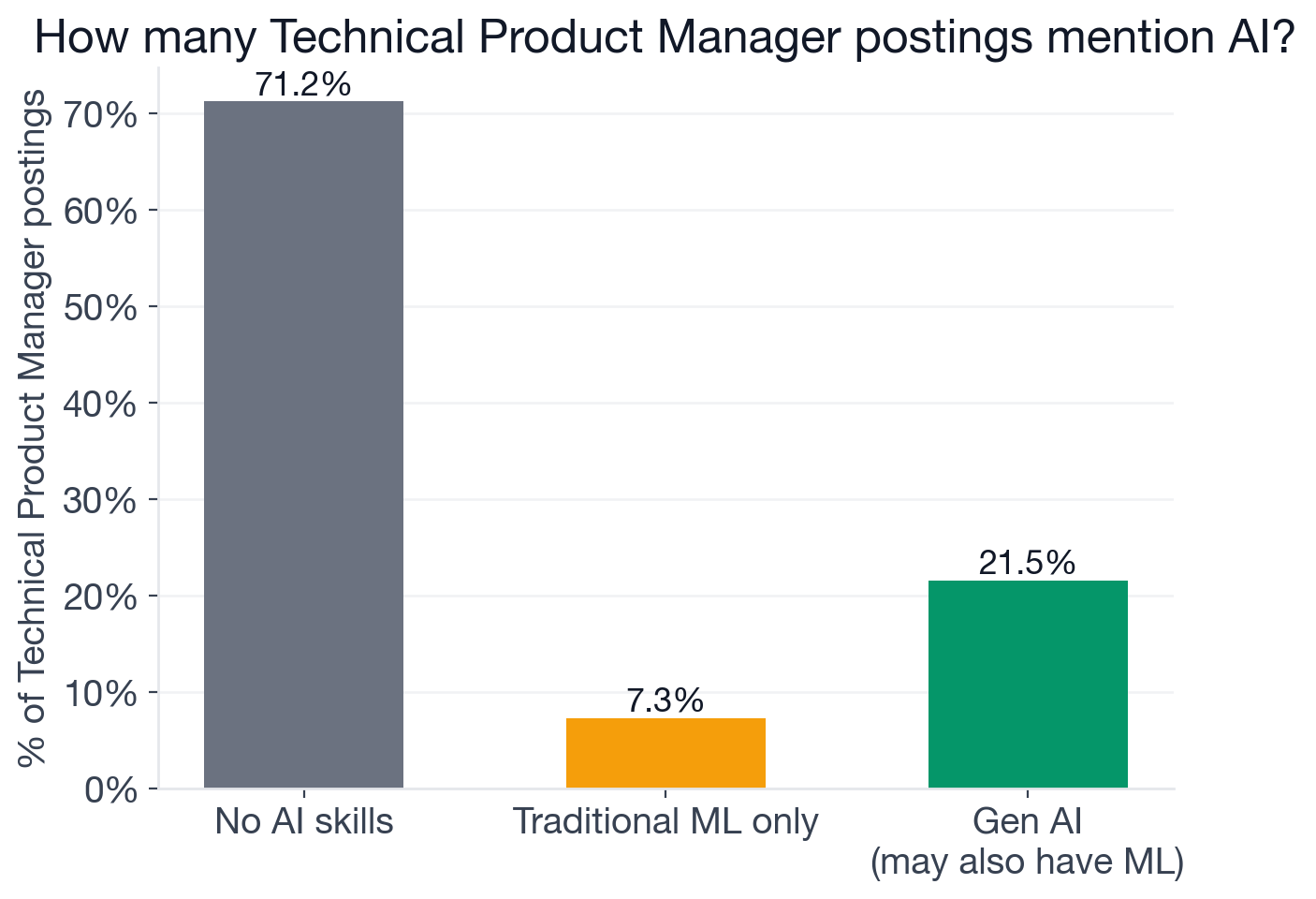 New-wave generative AI, traditional ML, and no-AI segments across 751 Technical Product Manager postings analyzed.
21.5% of postings explicitly require new-wave generative AI skills. Add traditional machine learning and the any-AI figure climbs to 28.8%. But the overlap between the two is smaller than you might expect: only 8.5% of postings ask for both, while 13.0% ask for new-wave AI with zero ML mention and 7.3% ask for ML with no generative AI mention at all. In practice, these read as two mostly separate hiring lanes: one for AI-platform ownership rooted in the older ML stack, and one for generative-AI product ownership that is newer and often doesn't overlap with it.
That 21.5% is the floor for what companies will state outright, not the ceiling for what they actually expect. It measures Technical Product Managers hired specifically to build, ship, or govern AI-powered products, the same way a posting explicitly lists Kubernetes only when the role owns the cluster. It does not measure the much larger population of Technical Product Managers who use AI tools daily to write specs, analyze usage data, or draft roadmaps, because no employer writes "must know how to use ChatGPT" into a 2026 job description any more than a 2005 posting said "must know how to use email." Industry surveys back this up directly: 84% of developers report using or planning to use AI tools in their process, per the Stack Overflow 2025 Developer Survey, and separate research on 379 product professionals found 94% use AI daily or often, with 96% using it consistently in some form and nearly half describing it as deeply embedded in their workflow, per the Productboard AI in Product Management Report 2025. Set against a 21.5% explicit-build figure, the ambient-use layer for Technical Product Managers is close to universal. The number that varies is how deep the AI ownership goes, not whether AI matters.
Which AI Skills Do Technical Product Manager Postings Actually Want?
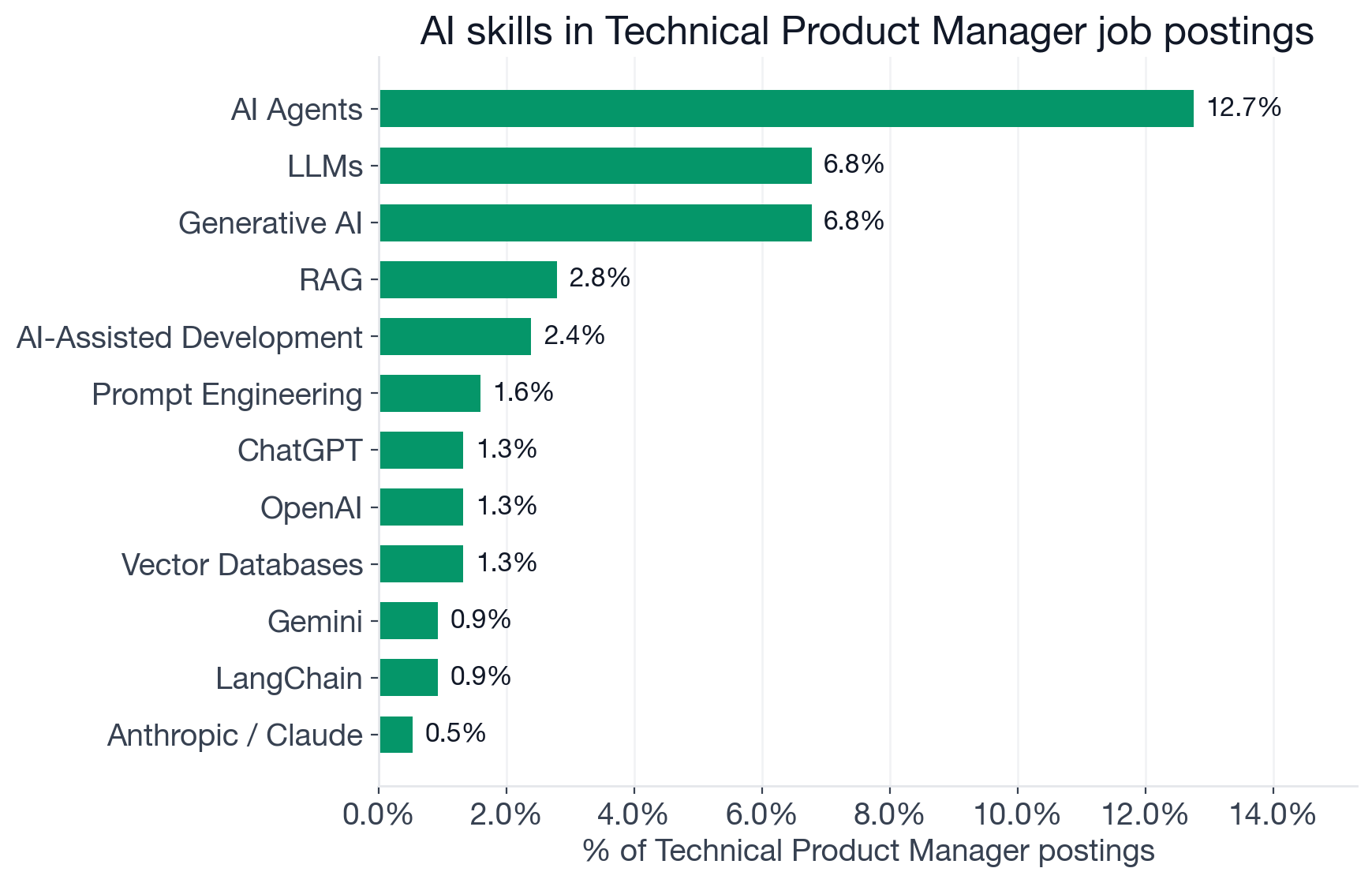 Machine Learning and AI Agents lead the ranked list; consumer-facing tools like ChatGPT and Copilot sit near the bottom.
| Skill | % of postings | What it signals |
|---|---|---|
| Machine Learning | 15.8% | Own an ML-driven product or platform |
| AI Agents | 12.7% | Ship or govern autonomous/agentic systems |
| LLMs | 6.8% | Manage a large-language-model-powered feature |
| Generative AI | 6.8% | General genAI product ownership |
| RAG | 2.8% | Retrieval-augmented search or knowledge systems |
| AI-Assisted Development | 2.4% | Coordinate AI-accelerated engineering workflows |
| Prompt Engineering | 1.6% | Direct hands-on prompt design work |
| ChatGPT / OpenAI / Vector DBs | 1.3% each | Named-vendor or infra-specific requirement |
| GitHub Copilot | 0.3% | Named developer-tool requirement |
The shape of this list is the real story: the top of it is infrastructure and systems vocabulary (Machine Learning, AI Agents, RAG, Vector Databases), and the bottom of it is tool-usage vocabulary (ChatGPT, Copilot, Prompt Engineering). AI Agents alone outranks either LLMs or Generative AI individually (12.7% versus 6.8% each), which tracks with Technical Product Managers increasingly owning the agentic-systems layer, the part of the product that makes autonomous decisions rather than just generating text on request. Machine Learning remaining the single largest line item is a reminder that the ML-platform version of this job never went away, it just stopped being the only version.
Does AI Experience Pay More for Technical Product Managers?
Among US postings with disclosed base salary (equity, bonus, and other compensation are not captured in job postings, so total pay at senior levels runs higher than these figures), Technical Product Managers with explicit new-wave AI requirements carry a median of $157,500 (n=42), compared with $135,750 for postings without AI requirements (n=164). That is a $21,750 premium, worth roughly a full salary band, tied to a single line item in the job description.
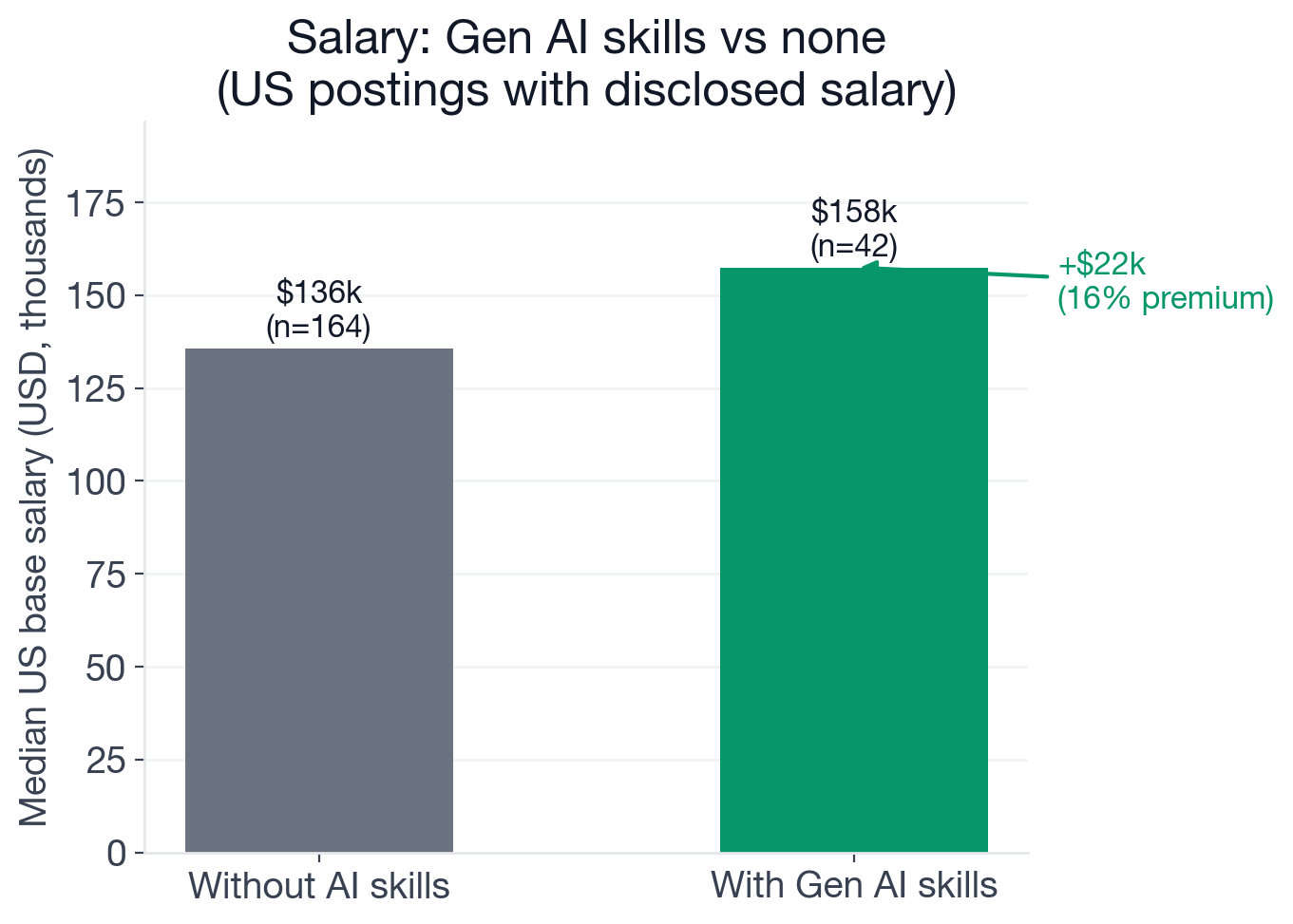 US base salary median for postings with versus without explicit new-wave AI requirements.
The sample behind the AI-skills figure (n=42) is smaller than the non-AI comparison group, so treat it as a real signal rather than a precise number, the direction and the rough magnitude are consistent with what the rest of the dataset shows: employers pay more for the systems-ownership version of this job, not for AI fluency alone.
Who's Actually Being Asked to Build AI Products
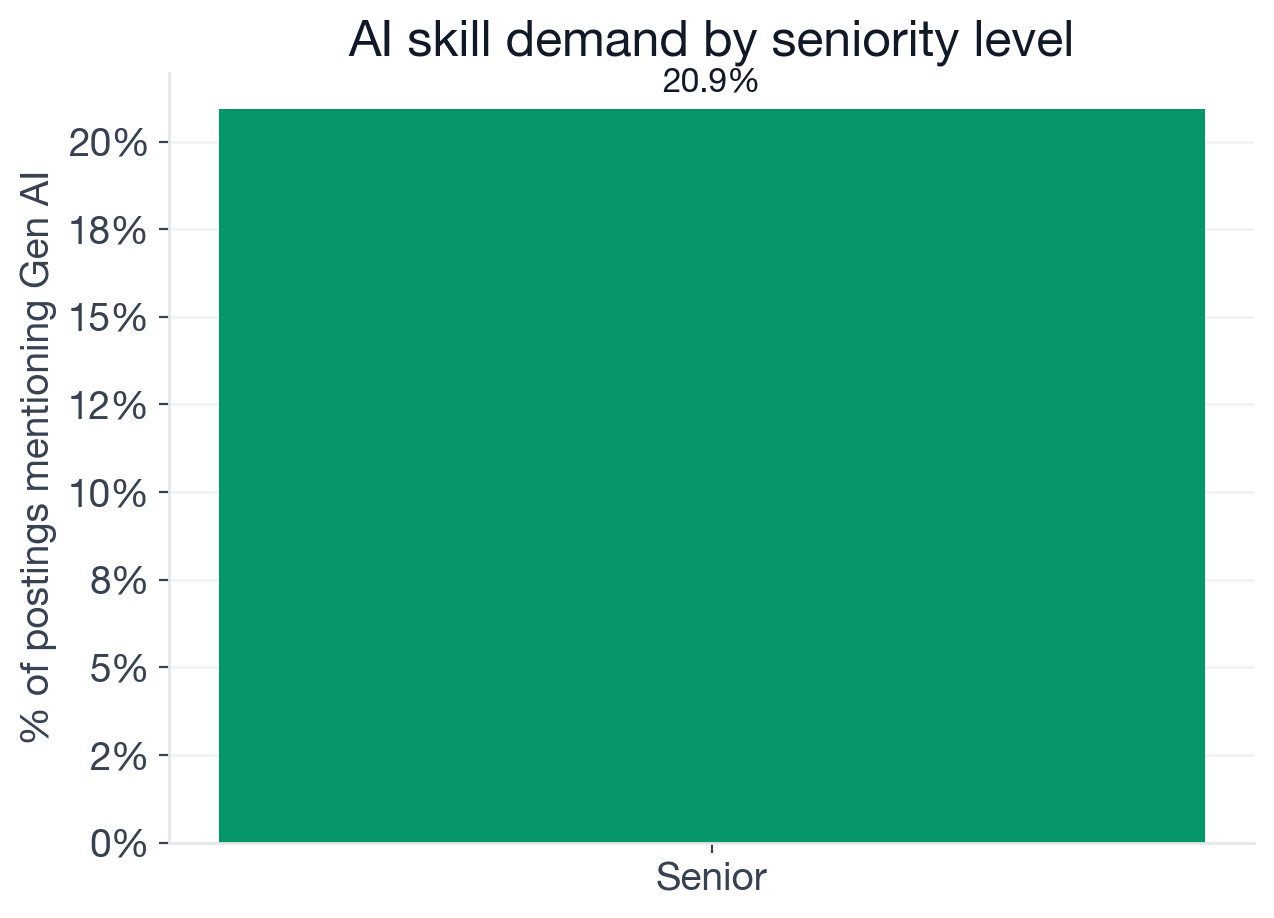 AI adoption climbs sharply at the staff level and dips in the middle of the ladder.
Staff-level Technical Product Manager postings show the highest AI adoption rate at 40.6% (n=32), more than double the mid-level rate of 18.8% (n=128). Senior postings, the largest single tier by volume at 564 of 753 (the seniority breakdown's total, a hair above the 751 distinct-postings figure used elsewhere), sit at 20.9% AI adoption, close to the overall average. Entry (22.2%, n=9) and junior (25.0%, n=20) postings show elevated rates too, but both samples are small enough that they read as noise rather than a genuine junior-level AI mandate. The clearest, best-supported signal is the staff-level spike: once a Technical Product Manager reaches staff, AI ownership becomes disproportionately part of the job.
Geography tells a similar concentration story. The US carries just over half of all postings (51.1%, n=385) at a 21.8% AI adoption rate, close to the global average. Germany stands out at 38.5% AI adoption (n=26), well above the US, though the sample is modest enough to call this a directional signal rather than a settled trend. India (20.4%, n=54) and Canada (23.5%, n=34) both track close to the US baseline. With topCompaniesAI and industry-level breakdowns too thin to support a credible "who's hiring" ranking in this window, seniority and geography are the more reliable lenses on where the AI-heavy roles concentrate right now.
How to Use This in Your Job Search
If you're targeting Technical Product Manager roles in 2026, treat "Machine Learning" and "AI Agents" experience on your resume as the higher-leverage credentials, not "I use ChatGPT," which every candidate can already claim and almost no posting bothers to ask for. Practice narrating a real AI-system tradeoff (latency versus accuracy, build versus buy a model, agent autonomy versus guardrails) with AI-powered mock interviews that simulate the kind of systems-level questioning staff-level AI postings actually run.
If your background is stronger on the process side than the technical side, the Question Bank is the fastest way to drill the specific technical vocabulary this data shows companies actually screening for: ML lifecycle, RAG architecture, and agent design, rather than generic AI trivia. For a deeper foundation, our interactive courses cover the machine learning and system design fundamentals that sit underneath most of the "systems, not chat tools" skill list above. And when you're ready to see what's currently open, the Technical Product Manager board reflects this same live dataset, filterable by skill and seniority.
FAQ
Q. What percentage of Technical Product Manager jobs require AI skills in 2026?
21.5% of Technical Product Manager postings (162 of 751 analyzed) explicitly require new-wave generative AI skills such as AI agents, LLMs, or RAG. Counting traditional machine learning too, the any-AI figure rises to 28.8% (217 postings).
Q. What is the single most in-demand AI skill for Technical Product Managers?
Machine Learning, appearing in 15.8% of postings, still outranks every individual new-wave AI concept, including AI Agents (12.7%), LLMs (6.8%), and Generative AI (6.8%).
Q. Do Technical Product Manager postings ask for ChatGPT or prompt engineering skills?
Rarely as named requirements. Prompt Engineering appears in 1.6% of postings, ChatGPT in 1.3%, and GitHub Copilot in 0.3%. That does not mean Technical Product Managers skip these tools daily, it means employers stopped listing them as requirements the same way a 2005 posting never listed email as a skill.
Q. Does AI experience pay more for Technical Product Managers?
Yes. Among US postings with disclosed base salary, Technical Product Managers with new-wave AI requirements have a median of $157,500 (n=42) versus $135,750 (n=164) without, a $21,750 premium.
Q. Which seniority level shows the highest AI adoption for Technical Product Managers?
Staff-level postings lead at 40.6% AI adoption (n=32), more than double the mid-level rate of 18.8% (n=128) and above the senior rate of 20.9% (n=564, the largest tier by volume).
Q. Are AI requirements for Technical Product Managers the same in every country?
No. Germany shows a notably higher AI adoption rate (38.5%, n=26) than the US (21.8%, n=385) or India (20.4%, n=54), though the German sample is smaller and should be read as directional rather than definitive.
Q. Should Technical Product Managers learn AI tools even if their job posting does not mention AI?
Yes. The Stack Overflow 2025 Developer Survey and the Productboard AI in Product Management Report 2025 show 84% to 94% of professionals already use AI tools like ChatGPT and Copilot daily or often, with a further 96% using AI consistently in some form, regardless of what the job posting states. The 21.5% figure measures who is hired to build AI systems, not who is expected to use AI tools. That expectation is now close to universal.
Build the Systems, Not Just the Prompts
The Technical Product Manager postings in this dataset are not asking for AI fluency, they are asking for AI ownership: models, agents, retrieval pipelines, and the production tradeoffs that come with running them. If your résumé leads with tool usage, it's answering a question almost nobody asked. If it leads with a system you shipped or governed, it's answering the one that pays the $21,750 premium. For a closer look at how this role compares to the generalist Product Manager track, see our companion post on how AI is changing the Product Manager role and the broader Technical Product Manager skills breakdown.
Topics
Ready to practice?
Put what you've learned into practice with AI mock interviews and structured preparation guides.