
The Schema Isn't Where the Risk Hides
A mid-level Information Security Analyst walks into a 30-minute interview about data classification and sensitivity handling. The scenario looks like a schema problem at first: profiles, tickets, payment events, analytics tables. Then one detail changes everything. Support agents can paste anything into a free-text box, a government ID, a health complaint, a note about financial hardship, and no column header will ever flag that it's there.
This walkthrough follows one real interview blueprint from InterviewStack.io's AI mock interview system, the same 30-minute, three-phase scenario a live candidate faces for this role and topic. Sketching a classification scheme is the opening move, not the finish line. What decides the interview is whether that scheme survives contact with a free-text field, an impatient engineering team, and a platform that spans two continents.
Key Findings
- The rubric totals 100 points: Interviewer Objectives Alignment and Level-Specific Expectations each carry 30 points, 60 of 100 combined, versus 20 for Technical Proficiency and 20 for Communication and Problem Solving.
- The interview runs 30 minutes across 3 phases: problem framing (0-8 min), control mapping and lifecycle handling (8-20 min), and trade-offs and edge cases (20-30 min).
- Phase 2 (control mapping and lifecycle handling) alone carries 5 checklist items, more than either other phase.
- Phase 1's checklist requires 2-3 clarifying questions or explicit stated assumptions before a classification model is proposed.
- The scenario packs at least 6 distinct high-risk data domains into one prompt: identifiers, behavioral data, payment events, free-text tickets, minors data, and multi-region records.
- Engineering's opening proposal is a single 7-year retention period for all data, the exact blanket-policy anti-pattern Phase 3 grades candidates on pushing back against.
- 4 skill areas sit explicitly outside this interview's scope: exploit development, deep jurisdiction-specific legal interpretation, active-breach incident response, and low-level cryptographic design.
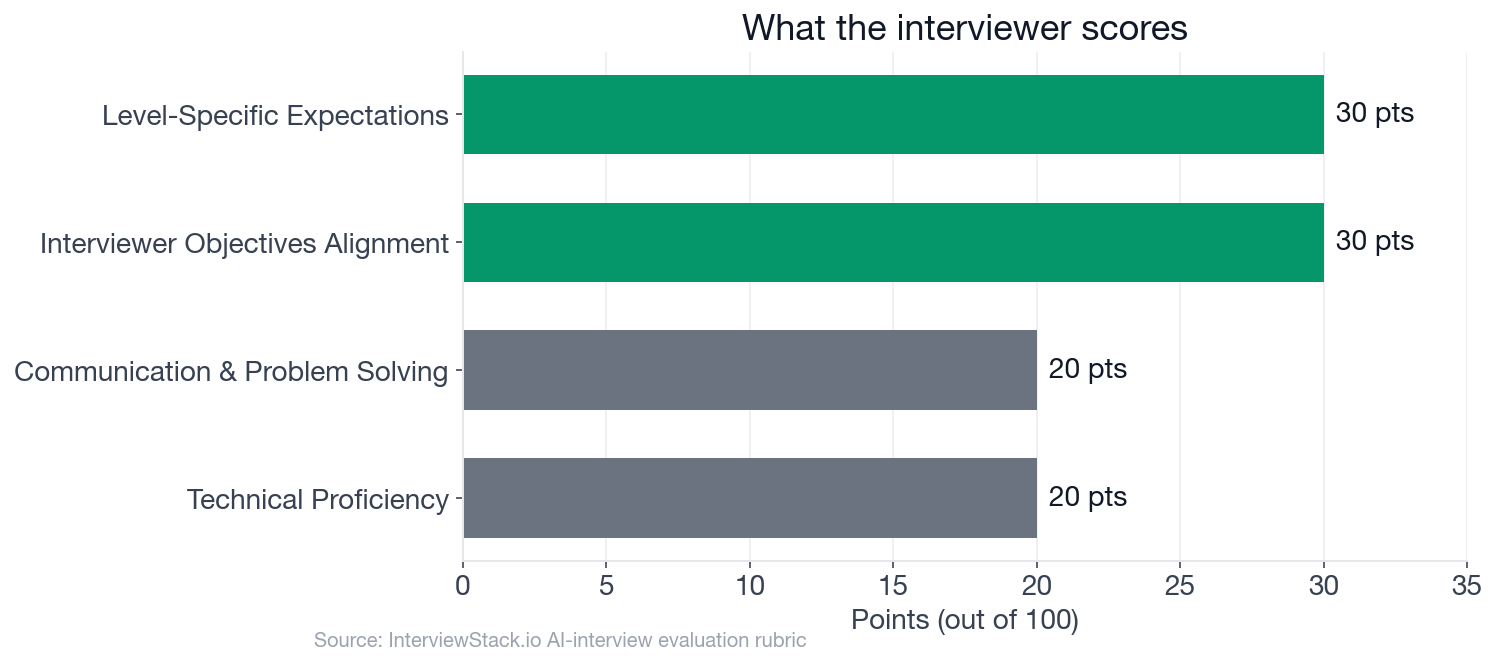 Judgment dimensions (Interviewer Objectives Alignment and Level-Specific Expectations) outweigh Technical Proficiency and Communication combined, 60 points to 40.
What Is an Information Security Analyst Data Classification and Sensitivity Handling Interview Designed to Surface?
The interview question
A consumer technology company is building a unified customer operations platform that merges profile data, support tickets, account activity, payment events, and product analytics into one system. Support agents want a single view of each customer. Fraud analysts want device, IP, geolocation, and login history. Marketing wants segmentation and campaign measurement. Data science wants years of history for churn and abuse modeling. A third-party vendor will handle after-hours support tickets.
Some users are minors. Some support tickets contain health details, financial-hardship notes, or government IDs typed straight into a free-text box. The platform stores data from the US and the EU. Engineering has proposed one default: keep everything for 7 years to keep the build simple. Today the company only has informal labels like internal and confidential, with no real classification standard behind them.
How would you design a data classification and sensitivity handling approach for this platform so the company can safely use the data for operations and analytics while reducing privacy and security risk?
The interviewer isn't grading whether you can recite a classification framework from a textbook. What's actually being scored: a workable model tied to real handling decisions (access, encryption, retention, monitoring), correct identification of the scenario's highest-risk data (the free-text tickets, the minors, the vendor, the cross-border data), and a rollout a mid-level analyst could realistically run with engineering and legal, not a governance program built from scratch.
Building the Model Is the Easy Half
A first-pass classification scheme is quick to sketch. The interview doesn't reward the sketch; it rewards what happens when that model meets a free-text field, four different internal teams, an engineering team asking for one retention number, and a legal wrinkle involving minors. Four follow-up questions from this scenario show where a workable model breaks, and what a stronger answer, from a candidate we'll call Amir, looks like instead.
Turn 1: The Free-Text Wildcard
Interviewer: "How would you classify free-text support tickets that may unpredictably contain government IDs, health details, or payment-related information, and what controls would you attach to that classification?"
Turn 2: Who Actually Gets Access
Interviewer: "How would your classification scheme affect access for support agents, fraud analysts, marketers, and the third-party support vendor?"
Turn 3: The 7-Year Shortcut
Interviewer: "If engineering pushes back on multiple retention periods and wants one default policy for everything, how would you respond and what compromise, if any, would you propose?"
Turn 4: One Model, Many Flags
Interviewer: "How would you handle regional differences or minors' data without creating an unmaintainable classification model?"
What Happens When the Interviewer Asks About the Data Warehouse Next?
Spotting Amir's four mistakes on the page is the easy part; you had time to reread the question. A live interviewer doesn't stop at four follow-ups either. This scenario still has two more curveballs in reserve: how your classification labels survive once data moves into logs, warehouses, and exports, and how you'd de-identify years of historical data for churn and abuse modeling without leaving the residual risk unmentioned. Neither is hard in isolation. Both are hard in the interview's final ten minutes, after you've already spent your retention argument and your access matrix, with the clock still running. That's the skill this format is actually built to test, and it only shows up under real time pressure, which is exactly what the AI mock interview is built to apply.
The Three Phases Behind a Defensible Classification Model
Everything above maps to one blueprint. This is the phase-by-phase structure a strong candidate hits, and what the AI mock interview tracks against in real time as you talk.
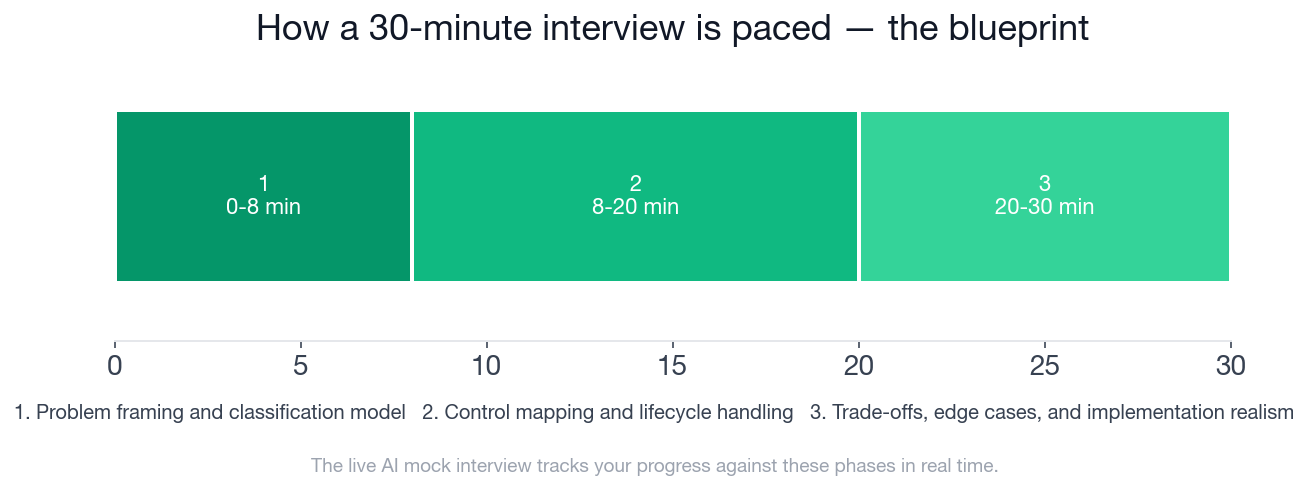 The 30-minute interview paced into its three phases: framing (0-8 min), control mapping (8-20 min), and trade-offs and edge cases (20-30 min).
- ✓Asks at least 2-3 relevant clarifying questions or states explicit assumptions about data uses, users, and systems
- ✓Identifies major data classes present in the scenario, including direct identifiers, behavioral/account data, payment-related events, free-text support content, minors’ data, and regional data
- ✓Proposes a compact classification model that is understandable and operationally usable
- ✓Begins linking classes to handling differences instead of only naming labels
- ✓Maps classification to specific controls such as role-based access, need-to-know restrictions, field masking or redaction, encryption, logging, and approval requirements
- ✓Addresses how free-text fields should be handled differently due to unpredictable sensitive content
- ✓Recommends differentiated retention rather than blanket retention, with rationale tied to purpose and risk
- ✓Covers downstream propagation of labels or metadata into warehouses, exports, logs, and third-party processing
- ✓Includes at least one practical control for vendor access and one for analytics or modeling use cases
- ✓Responds sensibly to pushback on retention or access friction without abandoning core risk controls
- ✓Explains how to handle minors’ data, regional considerations, or special-category data without making the model overly complex
- ✓Acknowledges residual risk and proposes compensating measures such as monitoring, DLP, review workflows, or restricted environments
- ✓Outlines a realistic rollout approach such as defining standards, tagging critical datasets first, partnering with data owners, and auditing adoption
What Do You Say When Engineering Pushes Back, Live?
Reading Amir's answers is not the same as producing them cold, in your own words, while an interviewer waits with a follow-up you didn't prepare for. Start the AI mock interview on this exact data classification and sensitivity handling scenario and find out where your own answer breaks, then use the question bank to drill the individual checklist items before you go back in. Our preparation guides cover company-specific process notes if you're prepping for a particular employer, and the compliance frameworks walkthrough covers the adjacent scenario of defending a framework choice under similar pushback.
FAQ
Q. What makes data classification and sensitivity handling hard to interview for?
The scenario spreads risk across at least six data domains at once: direct identifiers, behavioral and account data, payment events, free-text support tickets, minors data, and multi-region records. Free-text fields can carry a government ID, a health detail, or a financial-hardship note that no schema field ever labels. A strong answer has to build one compact classification model that covers all of it without turning into an unusable label taxonomy.
Q. How is a mid-level Information Security Analyst data classification interview scored?
The rubric totals 100 points across four dimensions. Interviewer Objectives Alignment (30 points) and Level-Specific Expectations (30 points) carry 60 of the 100 points between them, with Technical Proficiency (20 points) and Communication and Problem Solving (20 points) making up the rest. Most of the score rewards judgment and implementable trade-offs, not reciting policy language.
Q. Do I need to cite specific privacy laws like GDPR or CCPA to pass?
No. Deep jurisdiction-specific legal interpretation is explicitly out of scope for this interview, and the level-specific bar only expects sound retention and access reasoning with clear rationale, even without citing statute language from memory. Naming the risk, minors data, cross-border transfer, special-category content, matters more than the legal citation.
Q. How should free-text fields like support tickets be classified?
Treat free text as variable-sensitivity by default rather than giving it one fixed label, since a support agent can paste a government ID, a health detail, or a payment number into the same box at any time. The checklist rewards candidates who pair that field with detection and review controls, restricted default access plus automated scanning and an escalation path, instead of trusting one static label to cover it.
Q. What is the right response when engineering pushes back on one retention policy for everything?
Phase 3 of the interview (20-30 minutes) specifically grades whether a candidate responds to retention or access pushback without abandoning core risk controls. The stronger move is not to hold a hard line on per-field policies; it is to compromise down to a small number of retention tiers tied to data purpose, for example fraud signals, support content, and marketing engagement, rather than agreeing to one blanket period for every data type.
Q. How long does the interview run and how is the time split?
The full interview runs 30 minutes across three phases: problem framing and classification model (0-8 minutes), control mapping and lifecycle handling (8-20 minutes, the longest phase at 12 minutes and 5 checklist items), and trade-offs, edge cases, and implementation realism (20-30 minutes).
Q. Can I practice this exact scenario?
Yes. The InterviewStack.io AI mock interview runs this data classification and sensitivity handling scenario live, asks the same follow-up questions in real time, and scores your answer against the same rubric and checklist covered in this walkthrough.
The Text Box Was the Real Test
The classification model in this scenario was never the hard part to sketch. What separates a passing answer from a strong one is whether that model survives a free-text field nobody controls, a vendor who shouldn't see everything, and an engineering team asking for the easy way out. Data classification and sensitivity handling interviews score judgment under exactly those conditions, and judgment only sharpens against a live follow-up, not another read-through.
Topics
Ready to practice?
Put what you've learned into practice with AI mock interviews and structured preparation guides.