
Two 'Shared' Skills Run in Opposite Directions
Machine Learning Engineer and Business Intelligence Analyst technically share two skills at meaningful frequency: SQL and Machine Learning. Neither behaves like a shared skill. SQL shows up in 66.0% of Business Intelligence Analyst postings and just 15.1% of Machine Learning Engineer postings, a 4.4x skew toward BI. Machine Learning runs the opposite way, and harder: 70.3% of Machine Learning Engineer postings name it, versus 8.5% of Business Intelligence Analyst postings, an 8.2x skew toward ML. We looked at every active posting for both roles on the InterviewStack.io job board, 5,542 for Machine Learning Engineer and 2,720 for Business Intelligence Analyst, and their top-30 skill lists overlap by just 20% (Jaccard similarity).
The two "shared" skills aren't a bridge between these roles. They're each role's own core skill, wearing a shared-skill label because a minority of postings on the other side still ask for it.
| Machine Learning Engineer | Business Intelligence Analyst | |
|---|---|---|
| Median US base salary | $193,000 | $129,500 |
| Active postings | 5,542 | 2,720 |
| Top skill | Machine Learning (70.3%) | Data Visualization (67.2%) |
| Remote share | 20.7% | 14.2% |
| Entry-level share | 4.9% | 5.2% |
| Skill overlap (Jaccard) | 20% shared (pairwise) | 20% shared (pairwise) |
Key Findings
- Machine Learning Engineer postings carry a median $193,000 US base salary, a $63,500 (49%) premium over Business Intelligence Analyst's $129,500.
- Skill overlap (Jaccard similarity) between the two roles' top-30 skill lists is 20%.
- Machine Learning appears in 70.3% of Machine Learning Engineer postings but just 8.5% of Business Intelligence Analyst postings, an 8.2x skew.
- SQL runs the opposite direction: 66.0% of Business Intelligence Analyst postings ask for it, versus 15.1% of Machine Learning Engineer postings, a 4.4x skew.
- Machine Learning Engineer posts 2.04x the volume: 5,542 active listings versus 2,720 for Business Intelligence Analyst.
- Entry-level access is nearly identical: 4.9% for Machine Learning Engineer versus 5.2% for Business Intelligence Analyst.
- Within Machine Learning Engineer's own postings, the title-defining skills (PyTorch, TensorFlow, Generative AI, LLMs) pay within about $9,000 of the role's baseline; RLHF and A/B Testing pay roughly $29,000 above it.
- Business Intelligence Analyst postings that explicitly require Machine Learning pay $23,900 above the role's own baseline, evidence it remains a scarce, valued add rather than a default expectation.
A note on data scope: these role classifications are title-and-skill matched, not manually vetted, so each sample includes some postings outside a strict reading of the role. In this run's Business Intelligence Analyst sample, roughly a quarter of a spot-checked title batch were adjacent or off-target: government and defense "intelligence analyst" roles (a different sense of the word "intelligence"), training and portfolio-management analysts, and executive-level titles (Chief Analytics Officer, BI Director) rather than individual-contributor BI work. Machine Learning Engineer carries a smaller version of the same effect, a handful of Director- or Head-level AI strategy titles and contract AI-training/data-labeling postings alongside the hands-on engineering roles. Neither role's skill list changes because of this (both top skill sets check out cleanly against real hiring practice), but the Business Intelligence Analyst salary and seniority figures below should be read as directional for the role family, not an exact individual-contributor baseline.
The Work Looks Nothing Alike Day to Day
A Machine Learning Engineer spends the week training, evaluating, and deploying models, moving something from a notebook prototype to a production service other systems depend on. Increasingly, that means building and operating LLM-based systems (Generative AI, MLOps, retrieval pipelines) stacked on top of, not replacing, classic supervised learning. A Business Intelligence Analyst spends the week closer to the business itself: querying and modeling warehouse data, building the dashboard that makes it legible, and vouching for its accuracy before a director acts on it. One role ships a system. The other ships a number someone can trust.
Which Skills Do Both Roles Actually Share?
Python is the one skill that's genuinely mutual between these roles, appearing in 62.3% of Machine Learning Engineer postings and 38.9% of Business Intelligence Analyst postings. Everything else in the shared-skill list is thinner or more lopsided than "shared" implies.
| Skill | Machine Learning Engineer | Business Intelligence Analyst |
|---|---|---|
| Python | 62.3% | 38.9% |
| SQL | 15.1% | 66.0% |
| Machine Learning | 70.3% | 8.5% |
| Data Pipelines | 20.3% | 30.1% |
| AWS | 30.4% | 11.2% |
| Data Science | 24.4% | 16.8% |
| Monitoring | 28.0% | 11.5% |
| Statistics | 13.1% | 17.9% |
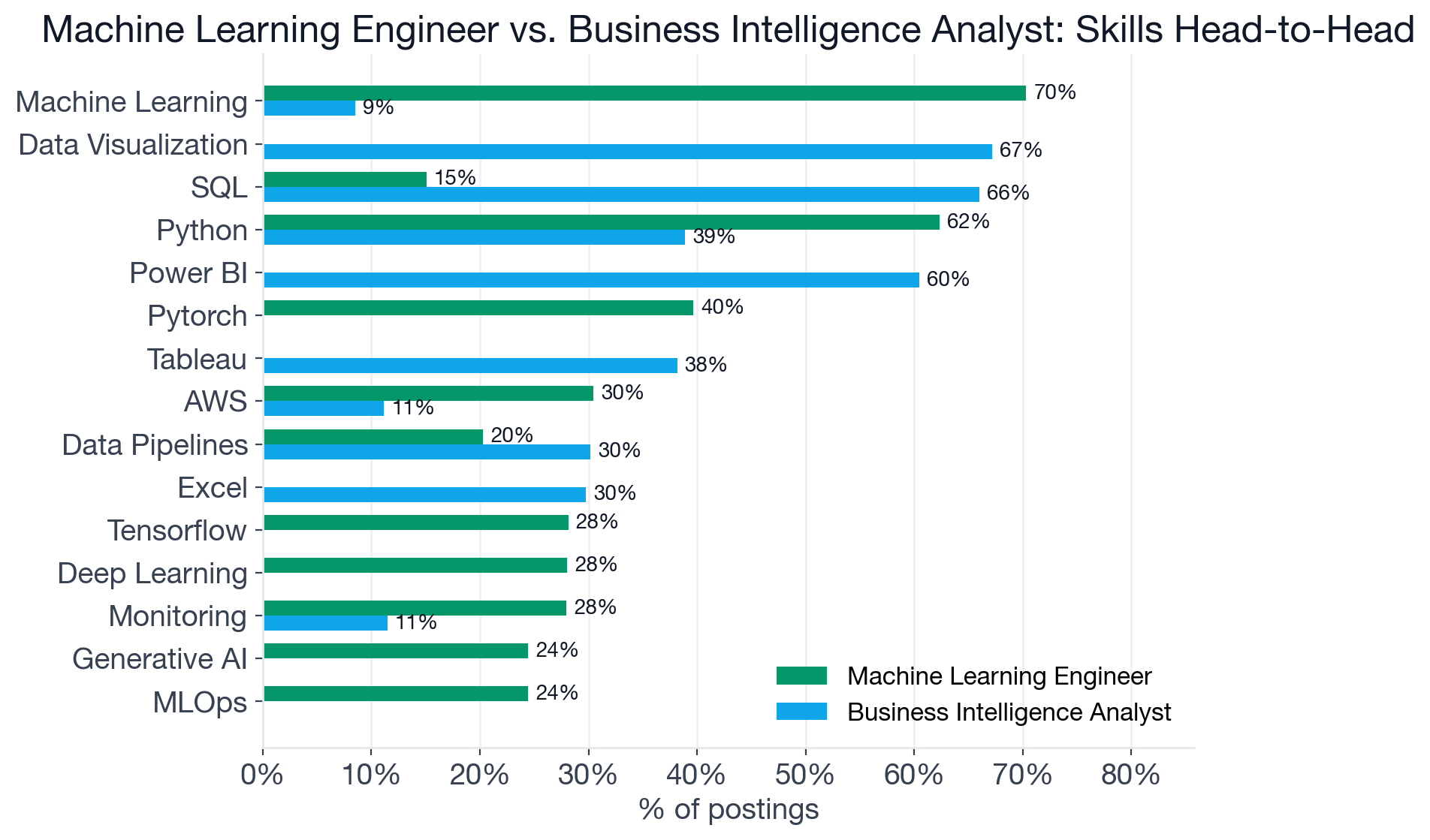 Python is the one skill that's genuinely mutual; SQL and Machine Learning both clear the shared-skill bar but run in opposite directions.
If you already write production SQL, that skill transfers almost unchanged into Business Intelligence Analyst work; on the Machine Learning Engineer side, a query is more often something you call through a feature store than something you hand-tune. The reverse holds for Machine Learning: knowing how to train and evaluate a model is the job description, not a Business Intelligence Analyst add-on.
The AI Skills Live on One Side Only
Machine Learning Engineer's exclusive cluster is entirely about building and operating AI systems: PyTorch (39.7%), TensorFlow (28.1%), Deep Learning (28.1%), Generative AI (24.4%), and MLOps (24.4%), none of which crack Business Intelligence Analyst's top-30 list. Business Intelligence Analyst's exclusive cluster runs the opposite direction, toward presenting and governing data that's already been collected: Data Visualization (67.2%), Power BI (60.5%), Tableau (38.2%), Excel (29.7%), and Data Quality (21.3%). For the full skill breakdown behind each role, see Machine Learning Engineer Skills Companies Want in 2026 and Business Intelligence Analyst Skills Companies Want in 2026.
That split is real, but it doesn't mean Business Intelligence Analysts are AI-illiterate. Job postings only list a skill when it's an explicit requirement, and that 8.5% measures who's hired to build machine learning systems, not who uses AI tools to do the job faster. The Stack Overflow 2025 Developer Survey puts general AI-tool usage at 84% or higher across technical roles, and Microsoft has since built Copilot directly into Power BI, the single most-named tool in Business Intelligence Analyst postings. Postings that do explicitly ask for Machine Learning or Generative AI back this up with pay: both clear a real premium over baseline (more below), evidence these remain scarce skills, not the ambient layer both roles already use.
Which Role Pays More in 2026?
Machine Learning Engineer earns a median $193,000 US base salary versus $129,500 for Business Intelligence Analyst, a $63,500 (49%) premium. Both figures are base salary only, drawn from US postings where wage-transparency laws produce consistent disclosure; equity, bonus, and sign-on aren't reported in job postings, so total compensation at top employers runs higher than either number.
The surprise: within Machine Learning Engineer's own postings, the skills that define the job title barely move the number. PyTorch (+$5,000, n=654), TensorFlow (-$5,500, n=427), Generative AI (+$4,500, n=353), and LLMs (+$7,000, n=407) all sit within about $9,000 of the $193,000 baseline. Business Intelligence Analyst shows the identical pattern from its own side: Power BI (-$5,900, n=256) and Excel (-$15,700, n=118), the two tools most associated with the job, pay at or below the role's own baseline.
| Skill | Role | Premium vs. role baseline | Sample size |
|---|---|---|---|
| A/B Testing | Machine Learning Engineer | +$29,400 | 224 |
| RLHF (Reinforcement Learning from Human Feedback) | Machine Learning Engineer | +$29,000 | 46 |
| JAX (a numerical computing library used for large-scale model training) | Machine Learning Engineer | +$20,000 | 132 |
| Distributed Training | Machine Learning Engineer | +$19,500 | 113 |
| Machine Learning | Business Intelligence Analyst | +$23,900 | 61 |
| Data Science | Business Intelligence Analyst | +$22,300 | 127 |
| dbt (a SQL-based transformation tool that runs inside the warehouse) | Business Intelligence Analyst | +$20,500 | 65 |
| Looker | Business Intelligence Analyst | +$16,700 | 57 |
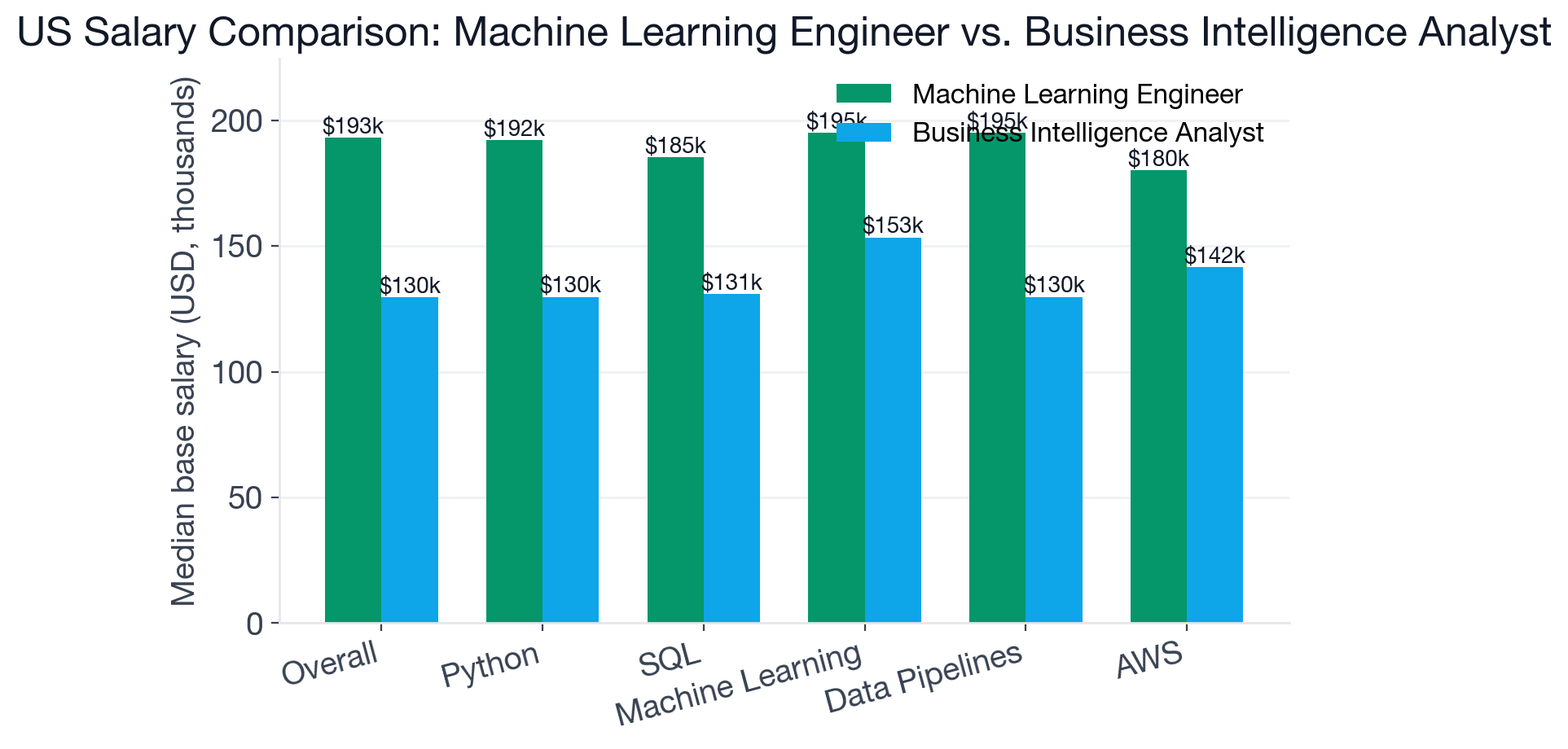 US base salary only; the skills that headline each job title pay flat or near baseline, while the real premium sits one layer down on both sides.
Knowing PyTorch is the entry ticket for Machine Learning Engineer; production-scale training work (Distributed Training, JAX) and evaluation rigor (A/B Testing, RLHF) are what actually move the number. For Business Intelligence Analyst, the fastest way to close the gap isn't the dashboard tools in the job title, it's the data-engineering layer underneath it: dbt, Looker, and Data Science all clear a $16K-plus premium over baseline, and the rare posting that explicitly asks for Machine Learning pays close to $24,000 more.
Who Has More Room to Break In?
Machine Learning Engineer posts 2.04x the volume of Business Intelligence Analyst, 5,542 active listings versus 2,720, but entry-level access is nearly identical between them: 4.9% of Machine Learning Engineer postings versus 5.2% of Business Intelligence Analyst postings. Neither role is a friendly first job; both sit mostly in the mid-level band (53.5% and 65.4%). Where they diverge is further up the ladder: Machine Learning Engineer skews meaningfully more senior overall, 41.6% senior-or-staff versus 29.4% for Business Intelligence Analyst.
The flexibility gap lives almost entirely in one column. Onsite share is within half a point of each other (57.3% vs. 57.7%), and hybrid within a third of a point (28.2% vs. 27.9%). Only remote separates them: 20.7% for Machine Learning Engineer versus 14.2% for Business Intelligence Analyst.
Which Role Fits Your Next Move?
Choose Machine Learning Engineer if you:
- Want to build and ship the model, not just interpret its output, and you're comfortable that PyTorch and TensorFlow are the entry ticket, not the pay lift.
- Want more remote flexibility (20.7% vs. 14.2%) in a market with roughly double the open roles.
- Are fine with a role that skews more senior overall (41.6% senior-or-staff), since the market pays for production and evaluation depth, not the modeling vocabulary alone.
Choose Business Intelligence Analyst if you:
- Want to work close to business stakeholders, turning data that's already collected into a recommendation, rather than building the systems that produce it.
- Already have strong SQL and dashboard skills (Power BI, Tableau, Excel) and would rather deepen the data-engineering layer underneath (Snowflake, dbt, Looker) than pivot into ML engineering.
- Aren't choosing based on an easier entry bar: at 5.2% entry-level share, it's statistically the same door as Machine Learning Engineer, not a lower one.
Turning This Data Into Interview Prep
Either path rewards realistic practice before the interview itself. InterviewStack's AI mock interviews cover both tracks, from model-design questions to dashboard-to-decision reasoning, and its Question Bank has focused drills for SQL, model evaluation, and the production-ML concepts this data shows actually pay a premium. Anyone building the Machine Learning Engineer stack from scratch can start with InterviewStack's interactive courses. If Business Intelligence Analyst is the closer fit, AI Engineer vs Business Intelligence Analyst covers the same build-vs-use AI framing from a different Role A.
FAQ
Q. How much more does a Machine Learning Engineer earn than a Business Intelligence Analyst in 2026?
Machine Learning Engineer postings show a median US base salary of $193,000, versus $129,500 for Business Intelligence Analyst, a $63,500 (49%) premium. Both figures are base salary only; equity and bonus are not disclosed in job postings.
Q. Do Machine Learning Engineer and Business Intelligence Analyst share any skills?
Some, but the overlap is thin. Skill overlap (Jaccard similarity) between the two roles' top-30 skill lists is 20%. Python is the closest thing to a genuine bridge, appearing in 62.3% of Machine Learning Engineer postings and 38.9% of Business Intelligence Analyst postings.
Q. Does SQL matter for Machine Learning Engineer roles?
Less than the title suggests. SQL appears in just 15.1% of Machine Learning Engineer postings, compared to 66.0% of Business Intelligence Analyst postings, where it is close to table stakes. SQL clears the threshold to count as a shared skill by frequency, but it skews about 4.4x toward Business Intelligence Analyst.
Q. Do Business Intelligence Analysts need to know machine learning?
Explicitly, rarely: Machine Learning appears in just 8.5% of Business Intelligence Analyst postings, versus 70.3% for Machine Learning Engineer. That measures who's hired to build machine learning systems, not who uses AI tools day to day. The Stack Overflow 2025 Developer Survey puts general AI-tool usage at 84% or higher across technical roles, and Microsoft has built Copilot directly into Power BI, the single most-named tool in Business Intelligence Analyst postings (60.5%). The postings that do explicitly ask for Machine Learning or Generative AI pay a real premium ($23,900 and $14,100 above baseline), evidence these remain scarce, valued skills rather than the ambient layer everyone already uses.
Q. Which role has more open positions in 2026?
Machine Learning Engineer, by roughly 2 to 1. This dataset shows 5,542 active Machine Learning Engineer postings versus 2,720 for Business Intelligence Analyst, a 2.04x volume ratio.
Q. Which skills actually pay a premium within Machine Learning Engineer postings?
Not the ones in the job title. PyTorch, TensorFlow, Generative AI, and LLMs, the skills that define the role, all sit within about $9,000 of the role's $193,000 baseline. The larger premiums show up one layer down, in skills like RLHF (Reinforcement Learning from Human Feedback, a technique for aligning LLM outputs with human preferences; plus $29,000) and A/B Testing (plus $29,400).
Q. Is Business Intelligence Analyst easier to break into than Machine Learning Engineer?
No, not meaningfully. Entry-level share is nearly identical for both roles: 5.2% for Business Intelligence Analyst versus 4.9% for Machine Learning Engineer. Neither role is an easy first job; both sit mostly in the mid-level band.
Same Two Skills, Opposite Meanings
Machine Learning Engineer and Business Intelligence Analyst both count as "data" work at most companies, and both list SQL and Machine Learning as shared skills, but each of those two skills belongs almost entirely to one side. Add a $63,500 pay gap, a 2.04x volume gap, and a genuine entry bar on both sides, and the honest read is that these are two different jobs that happen to overlap on the word "data," not two versions of the same career. Browse current Machine Learning Engineer or Business Intelligence Analyst openings and see which vocabulary you already speak.
Topics
Ready to practice?
Put what you've learned into practice with AI mock interviews and structured preparation guides.