
Confirming the Vulnerability Is the Easy Part of This Interview
A mid-level Penetration Tester finds a vulnerability chain during an approved assessment that appears to expose a small amount of real customer data in production, and the written scope never says whether pulling that data counts as validating impact or crossing a line. Confirming the chain is real is not actually the hard part of this interview. Technical Proficiency is worth only 20 of the interview's 100 points, and deep exploit development and production-grade exploit code are explicitly off the table, so a candidate who spends the next 30 minutes proving the bug harder is already losing ground somewhere else.
This walkthrough runs the real 30-minute blueprint the InterviewStack.io AI mock interview uses for Penetration Tester interviews on security ethics and responsible disclosure: the same opening scenario, the same follow-up prompts, and the same 100-point rubric. You'll watch a dramatized candidate, Petra, answer four of the interview's six follow-ups, see exactly which checklist item each answer costs, and see the stronger version. Browse the Penetration Tester question bank on security ethics and responsible disclosure if you want to drill individual judgment calls before running the full simulation.
Key Findings
- The rubric totals 100 points across four dimensions: Interviewer Objectives Alignment (30), Level-Specific Expectations (30), Technical Proficiency (20), and Communication & Problem Solving (20).
- The interview runs 30 minutes across 3 phases: initial boundary setting (0-8 min), validation and escalation (8-20 min, the longest phase at 12 minutes), and third-party and disclosure judgment (20-30 min).
- 13 checklist items are scored across the three phases: 4 in boundary setting, 5 in validation and escalation, and 4 in third-party and disclosure judgment.
- Candidates face 6 scripted interviewer follow-ups covering validation limits, third-party boundaries, launch-timing pressure, documentation, incident classification, and external researcher handling; this walkthrough dramatizes 4 of them.
- 4 categories of work are explicitly out of scope for this interview, including deep exploit development, malware or persistence techniques, and cryptographic implementation details.
- Level-Specific Expectations lists 5 distinct bars for a mid-level candidate, including knowing when to escalate to legal, privacy, and incident response without owning the final call.
- Phase 2, validation and escalation, alone carries 12 of the interview's 30 minutes and 5 of its 13 checklist items, more than either of the other two phases.
What Does a Penetration Tester Security Ethics and Responsible Disclosure Interview Actually Probe?
Here is the exact scenario the AI interviewer opens with.
The interview question
You are on an internal penetration testing team at a large consumer technology company. During an approved assessment of a newly launched internet-facing service, you discover a vulnerability chain that appears to allow access to a small amount of real customer data in production. The written scope authorizes testing against the service, but it does not explicitly say whether production data may be accessed to validate impact.
A similar issue may also affect a third-party integration used by the service, and the product team is pushing for a quick answer before a major launch event tomorrow. Walk me through how you would handle this situation from the moment you discover it.
The interviewer isn't grading whether the vulnerability chain is real. Confirming that takes minutes. What actually gets scored is judgment: whether the candidate recognizes the difference between being authorized to test a system and being authorized to access or retain real customer data inside it, applies coordinated disclosure principles under a real deadline, and communicates risk to both technical and non-technical stakeholders without overreaching. Balancing user safety, customer trust, bug-bounty norms, and company policy is the actual test; the vulnerability chain is just the vehicle for it.
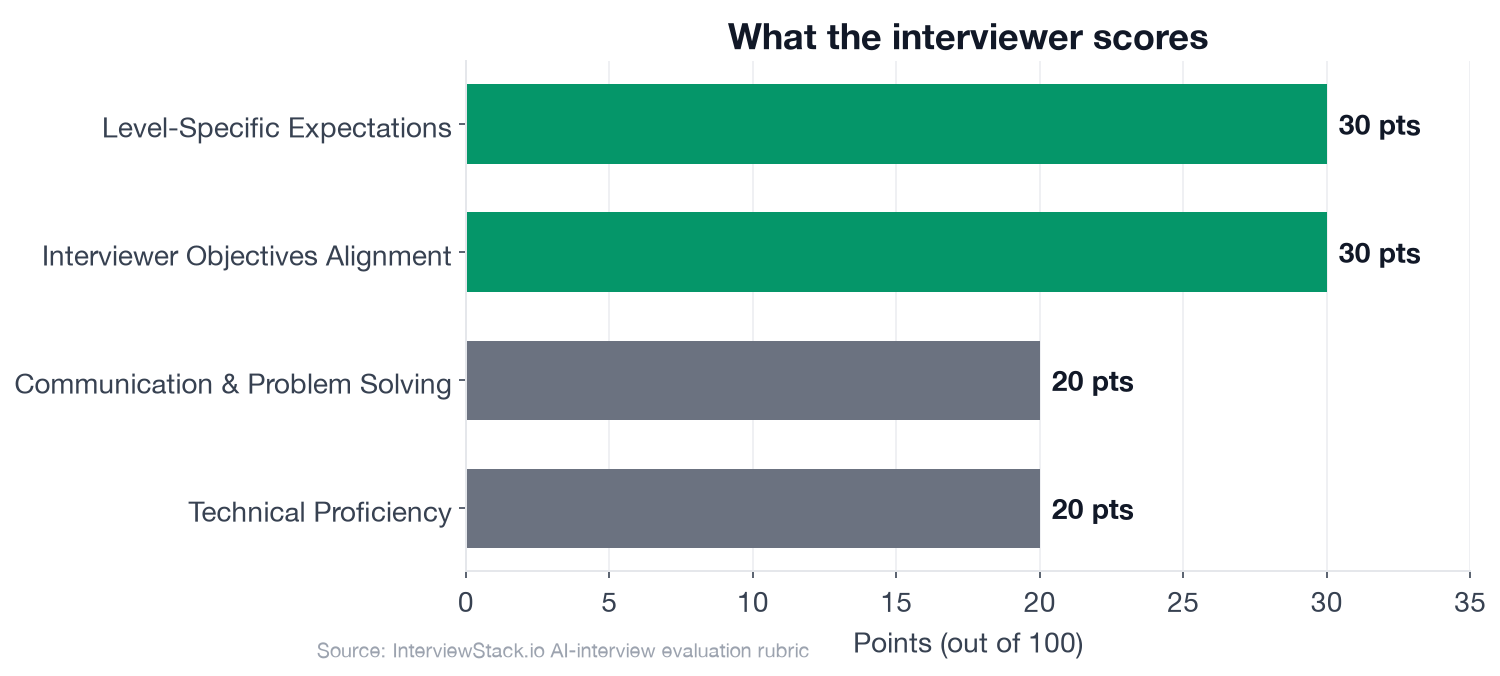 Technical Proficiency is worth only 20 of the interview's 100 points; the other 80 score judgment, escalation, and communication under pressure.
Four Follow-Ups Test the Same Discipline From Different Angles
Petra, the candidate in this walkthrough, answers four of the interview's six follow-ups. Every mistake below is the same failure wearing a different scenario: not knowing exactly where the line sits. Sometimes that means testing further than the scope allows. Sometimes it means not escalating far enough.
Turn 1: Validating Without Becoming the Breach
Interviewer: "What would you do to validate the finding while staying within ethical and legal boundaries if you are not sure whether viewing production data is permitted?"
Turn 2: Someone Else's System, Same Rule
Interviewer: "How would your approach change if you suspected the same issue affected the third-party integration, but you had no direct authorization to test that provider?"
Turn 3: When the Pressure Points Sideways
Interviewer: "If the product manager asked you to hold the report until after the launch event, how would you respond?"
Turn 4: Naming It Decides Who Gets Called
Interviewer: "How would you decide whether this should be handled as a standard vulnerability report, a potential security incident, or both?"
Would You Still Say Stop With a Launch Event Tomorrow?
Every stronger move above reads as obvious once it is printed on a page with a coach's note next to it. None of them are obvious in the room, with a product manager waiting on a Slack thread and a launch event less than 24 hours out. Knowing the correct call in the abstract and holding it under a real clock, with a real person pushing back on the other end, are different skills, and only reps under time pressure build the second one.
What Does the Blueprint Check Once You've Decided to Stop?
Deciding to pause is not the end of the interview, it is the start of the part that actually gets scored. Below is the complete phase-by-phase blueprint the AI mock interview tracks a candidate against in real time.
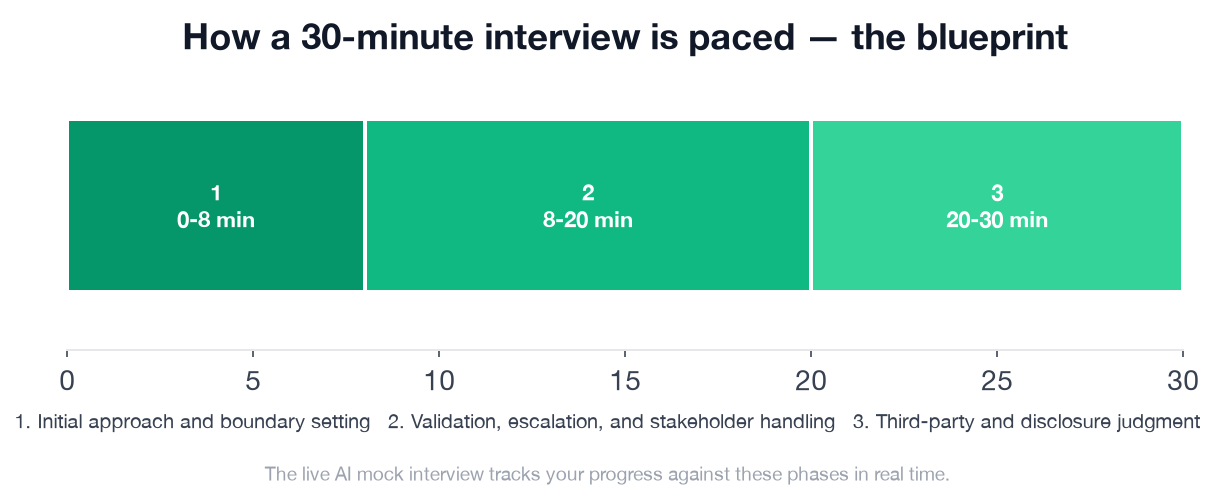 The 30-minute interview paced into its three phases: boundary setting (0-8 min), validation and escalation (8-20 min), and third-party and disclosure judgment (20-30 min).
- ✓States they would pause broad exploitation and avoid unnecessary access to customer data
- ✓Identifies ambiguity in authorization and calls out need for explicit confirmation before further validation
- ✓Mentions preserving evidence safely through minimal reproduction details, logs, timestamps, and affected assets
- ✓Distinguishes technical confirmation from over-collection of sensitive data
- ✓Proposes a minimal-impact validation plan such as controlled proof using test accounts, metadata-only confirmation, or redacted evidence where possible
- ✓Escalates to appropriate parties such as security leadership, incident response, legal/privacy, and service owners
- ✓Explains that credible exposure of real customer data may require dual handling as both vulnerability and potential incident
- ✓Pushes back appropriately on delaying action for launch timing if user risk is material
- ✓Communicates severity, confidence level, blast radius, and immediate containment recommendations in concrete terms
- ✓States they would not test the third-party provider beyond authorization and would route concerns through approved vendor/security disclosure channels
- ✓Describes documentation that is complete and auditable: reproduction steps, exact scope assumptions, approvals sought, data exposure observed, and who was notified when
- ✓Explains fair handling of an external researcher report, including acknowledgement, deconfliction with internal findings, and coordinated disclosure timing
- ✓Shows awareness that disclosure should balance remediation readiness, user protection, and legal/privacy obligations
Every green checkmark above is a specific behavior the interviewer is listening for while the candidate is still talking, not a generic rubric applied after the fact. That is what the AI mock interview actually trains: producing those behaviors on demand, in order, under the same clock.
Run This Disclosure Call Yourself
Reading the stronger moves above is not the same as producing them out loud, unscripted, while someone is waiting on an answer. Run this exact scenario in the AI mock interview and get turn-by-turn feedback against the same 100-point rubric. If you want to drill the underlying judgment calls first, work through the Penetration Tester question bank on security ethics and responsible disclosure. For the technical side of an engagement, the penetration testing lifecycle and execution walkthrough runs a different scenario against the same blueprint format, and you can browse open Penetration Tester roles to see what these judgment calls look like on the job.
FAQ
Q. What does a Penetration Tester interview on security ethics and responsible disclosure actually test?
It tests whether a mid-level Penetration Tester recognizes authorization boundaries, applies coordinated disclosure principles, communicates risk clearly under pressure, and knows when to escalate rather than resolve issues alone. The 100-point rubric splits 30 points to Interviewer Objectives Alignment, 30 to Level-Specific Expectations, 20 to Technical Proficiency, and 20 to Communication & Problem Solving, across three phases run over 30 minutes.
Q. Should a penetration tester ever access real production customer data to confirm a finding?
Only the minimum needed, and only after flagging the ambiguity to someone with authority to resolve it. The interview's validation-phase checklist rewards a minimal-impact plan, such as test accounts, metadata-only confirmation like record counts or field names rather than field values, or redacted evidence, over pulling additional real records to make a stronger case.
Q. What should a penetration tester document while an incident like this is still unfolding?
Reproduction steps, the exact scope assumptions made, what approvals were sought and from whom, what data exposure was actually observed, and who was notified and when. The interview's third-party and disclosure phase treats this documentation as auditable evidence for later review, not just a closing summary.
Q. How should a company handle an external researcher who reports the same bug through its bug-bounty program?
Fairly, and on the program's normal terms: acknowledge the report, deconflict it against the internal finding so the researcher is not penalized for a duplicate, and follow coordinated disclosure timing that balances remediation readiness against the researcher's own timeline expectations.
Q. Is writing exploit code part of this interview?
No. Deep exploit development and production-grade exploit code are explicitly out of scope, along with malware or persistence techniques, cloud infrastructure design unrelated to the scenario, and cryptographic implementation details. Technical Proficiency is worth only 20 of the interview's 100 points; the other 80 score judgment, escalation, and communication.
Q. How long does this interview run and how is the time split?
30 minutes across three phases: initial boundary setting (minutes 0-8), validation and escalation (minutes 8-20, the longest phase at 12 minutes), and third-party and disclosure judgment (minutes 20-30).
Q. How can I practice this Penetration Tester responsible disclosure interview before the real thing?
Run the InterviewStack.io AI mock interview for Penetration Tester on security ethics and responsible disclosure, which uses this same phase-by-phase blueprint, follows up based on what you actually say, and scores you across all four rubric dimensions in real time.
Knowing When to Stop Is the Skill
A Penetration Tester who can chain a vulnerability together is doing the job description. A Penetration Tester who can stop at the right moment, escalate the right situation, and say no to the wrong request under real pressure is doing the part of the job that actually protects users. Eighty of this interview's 100 points are built to find exactly that.
Topics
Ready to practice?
Put what you've learned into practice with AI mock interviews and structured preparation guides.