
Picture a 30-minute handoff interview where you are asked to drive the handoff of a checkout redesign and keep engineers faithful to it. Most prepared Product Designers walk in ready to talk about specs and polish. Then the interviewer asks what happens when an engineer says your interaction is too expensive to build, and the score quietly moves. This is a mock mid-level Product Designer interview on design handoff, built from a real InterviewStack.io blueprint, with a coach narrating what costs points and what to do instead.
Key Findings
- The interview runs 30 minutes across 3 phases: handoff strategy (minutes 0-8), spec depth and edge cases (8-20), and tradeoffs, QA, and release judgment (20-30).
- The rubric totals 100 points; 60 of them (30 + 30) reward objectives alignment and level-specific judgment rather than raw spec detail.
- Technical Proficiency and Communication & Problem Solving are worth 20 points each.
- The longest phase, 12 of 30 minutes, is spec depth: states, breakpoints, and edge cases.
- The strongest answers cover 4 or 5 checklist items per phase, and the interview expects collaboration with engineers before, during, and after the build, not just artifacts.
- Phase 3 gets 10 minutes, and its checklist has 4 items on pushback, QA, blocking versus polish, and documenting decisions.
The Handoff Isn't the Artifact, It's the Conversation
Handoff interviews reward the candidate who treats Figma as one input to a working relationship. The scenario below sets the stage; the follow-ups are where the points move. You can also browse current Product Designer openings to see what real postings ask for.
The interview question
You are working on a mature mobile app for a large-scale food delivery product. The team is shipping a redesign of the checkout screen to reduce drop-off before order placement. One part of the redesign introduces a new reusable section for delivery instructions, where users can add an optional note for the courier, see validation and character limits, edit an existing note, and encounter different behavior across small mobile screens and tablet layouts. The component will be implemented by two iOS/Android engineers and one web engineer using an existing component library, but some interaction details are new and not yet represented in Storybook.
How would you drive the handoff and developer collaboration for this feature so that the built experience stays faithful to the design while still being practical for the team to implement?
The interviewer is probing three things: whether you can define the right level of spec detail for a moderately complex feature, whether you collaborate before and during the build instead of dropping files and leaving, and whether your QA is pragmatic rather than rigid.
How Does the Rubric Score a Design Handoff Interview?
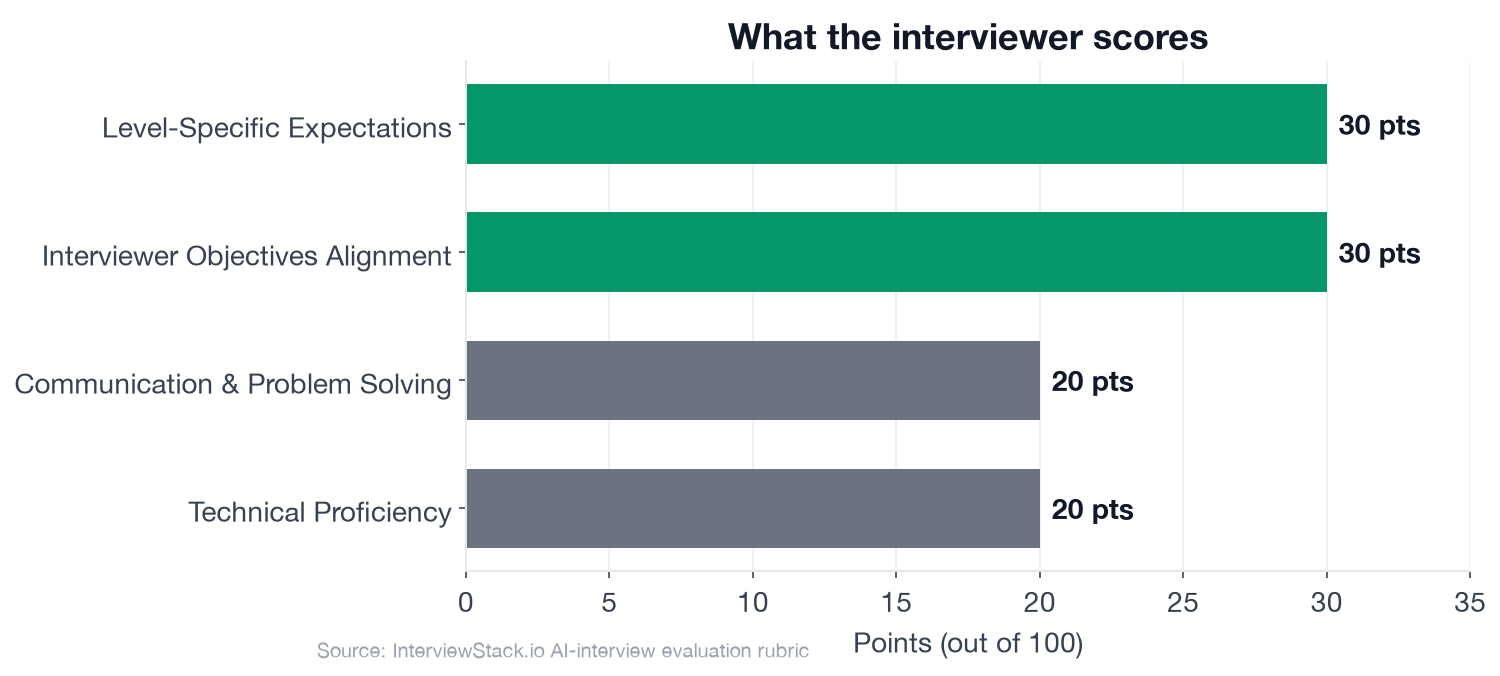
Notice what the weights say: 60 points are about judgment, not annotation. A flawless redline with no story about pushback still leaves most of the score on the table.
Four Turns, Four Ways to Lose Points
Mira is our illustrative mid-level candidate. The answers below are dramatized composites, not a real transcript; they show mistakes many candidates make.
Turn 1: Spec versus conversation
Interviewer: "What would you include in the developer-facing spec versus what you would leave to conversation or existing component documentation?"
Turn 2: Documenting the unhappy paths
Interviewer: "How would you document responsive behavior, empty states, validation, and error handling so there is less room for interpretation during implementation?"
Turn 3: Engineering pushback
Interviewer: "If an engineer tells you the proposed interaction for editing the note is expensive to build consistently across platforms, how would you work through that without losing the intent of the design?"
Turn 4: Design QA and release calls
Interviewer: "Once the first build is ready, how would you run design QA and decide what issues must block release versus what can be triaged later?"
Why Isn't Reading This Enough?
You just spotted four mistakes in a few minutes, calmly, with the rubric in view. Live, you will have a ticking clock, an interviewer who changes the follow-up based on your last sentence, and no list of edge cases in front of you. Recognizing a good answer and producing one at minute 14 are different skills, and only reps close that gap.
The Complete Blueprint: What a Strong Candidate Hits
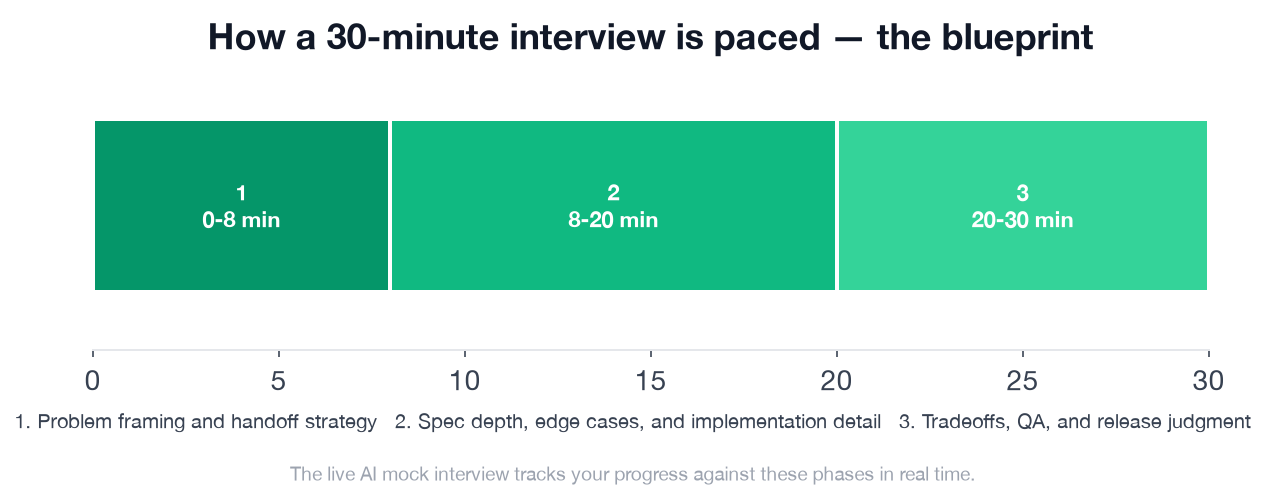
This is the blueprint a strong candidate covers, and exactly what the AI mock interview tracks you against in real time.
- ✓Asks or states key assumptions about platforms, existing component library, and implementation ownership
- ✓Outlines a handoff plan that includes both artifacts and synchronous collaboration points
- ✓Describes what success looks like for a faithful implementation in a checkout context
- ✓Keeps the answer focused on this feature rather than drifting into broad design system governance
- ✓Covers core states such as empty, focused, filled, editing, validation, disabled if applicable, error, and success or saved behavior if applicable
- ✓Specifies key interaction details such as tap targets, character count behavior, keyboard/focus handling, save behavior, and motion/transition expectations where relevant
- ✓Addresses responsive behavior across small mobile and tablet or web layouts in concrete terms
- ✓Includes edge cases such as long text, unsupported characters if relevant, network or save failure, pre-existing notes, and localization or text expansion concerns
- ✓Explains how design variants could map to component properties or states engineers can implement
- ✓Responds constructively to engineering pushback by revisiting intent, constraints, and alternative solutions
- ✓Describes a practical QA process using builds, tickets, comments, and if mentioned, visual regression support without over-relying on tooling
- ✓Differentiates blocking issues from non-blocking polish issues using user impact and checkout risk
- ✓Closes the loop by describing how decisions and deviations are documented so future contributors are not confused
Practice It Live Before It Counts
Start the AI mock interview for this exact scenario and get scored against the same blueprint, with follow-ups that react to what you actually say. If you want to drill the underlying concepts first, work through the Product Designer handoff question bank, then run the full 30 minutes. Preparing for adjacent rounds? Read our responsive and multi-platform design walkthrough or browse company-specific preparation guides.
FAQ
Q. What does a Product Designer design handoff interview test?
It tests whether you can turn design intent into an engineer-ready build plan and keep the shipped result faithful. The mock blueprint spans 30 minutes in 3 phases: handoff strategy (0-8), spec depth and edge cases (8-20), and tradeoffs, QA, and release judgment (20-30).
Q. How is a design handoff interview scored?
The rubric totals 100 points: Interviewer Objectives Alignment 30, Level-Specific Expectations 30, Technical Proficiency 20, and Communication & Problem Solving 20. 60 of the 100 points reward judgment and seniority signals, not just spec detail.
Q. What should a developer-facing spec include?
It should pin down component states (empty, focused, filled, editing, error, saved), interaction detail such as tap targets and keyboard behavior, responsive behavior across phone and tablet, and edge cases like long text and save failure. Everything else can live in conversation or existing component documentation.
Q. What do mid-level designers get wrong most often?
They treat handoff as a one-time artifact drop. The mid-level bar expects a solid handoff for a scoped feature plus direct collaboration with engineers before, during, and after the build.
Q. How do you decide which design QA issues block a release?
Rank each issue by user impact and checkout risk. Anything that can stop or confuse a user completing the order blocks the release; spacing and polish drift goes to a triaged backlog with the decision documented.
Q. How long should I practice for a handoff interview?
Run the full 30 minutes at least a few times out loud. The common failures (skipping states, defending the design under pushback, vague QA) only show up under live follow-up questions, which is what the AI mock interview simulates.
Where Your Next Rep Goes
A faithful build is the product of conversations, not files. Run the scenario out loud, hit every checklist item in each phase, and let the follow-ups find the gaps before a real interviewer does.
Topics
Ready to practice?
Put what you've learned into practice with AI mock interviews and structured preparation guides.