
Design Researcher Names AI Skills Explicitly in a Way Product Designer's Postings Don't
Generative AI shows up in 17.5% of Design Researcher postings, its 7th most common skill. It doesn't appear anywhere in Product Designer's top 30. That inverts what the rest of the data predicts: Product Designer is the far bigger role (3,600 active postings on the InterviewStack.io job board versus 474) and the better-paid one ($166,600 median US base salary versus $117,500; base salary only, no equity or bonus in either figure). Usually the larger, higher-paying role also reads as the more technically current one. Here, the smaller, lower-paid role names the frontier skill.
Browse current Product Designer openings or current Design Researcher openings to see the postings behind these numbers directly.
| Product Designer | Design Researcher | |
|---|---|---|
| Median US base salary | $166,600 | $117,500 |
| Active postings | 3,600 | 474 |
| Top skill | Figma (45.3%) | Instructional Design (40.9%) |
| Remote share | 29.6% | 32.5% |
| Entry-level share | 4.4% | 2.1% |
| Skill overlap (Jaccard) | 33% | 33%* |
*Jaccard overlap is one symmetric metric describing the pair, not two independent per-role numbers.
Key Findings
- Product Designer's median US base salary is $166,600 (n=910) versus $117,500 for Design Researcher (n=131), a $49,100 gap (41.8%).
- Product Designer postings (3,600 active) outnumber Design Researcher postings (474) by 7.6 to 1.
- The two roles share only 33% skill overlap (Jaccard on their top-30 skill sets); Figma and Product Design anchor Product Designer's stack at 45% each, while Instructional Design anchors Design Researcher's at 41%.
- Generative AI appears explicitly in 17.5% of Design Researcher postings but doesn't crack Product Designer's top 30 skill list at all.
- When Product Designer postings do ask for AI skills, they pay for it: Generative AI, Machine Learning, and LLMs each price $11,400 to $14,200 above the role's own baseline.
- Entry-level share is thin on both sides: 4.4% for Product Designer, just 2.1% for Design Researcher.
- Onsite work still leads for both roles (43.2% Product Designer, 44.3% Design Researcher), with remote a clear second (29.6% and 32.5%).
What Does Each Job Actually Look Like?
A Product Designer spends most of the day in Figma, moving between wireframes, prototypes, and a shared design system to ship one feature end to end with a PM and an engineer. (The "Product Designer" posting title also picks up some adjacent physical-product disciplines, packaging, industrial, and hardware design among them, but the skill data confirms digital product work is the dominant cohort: Figma, Design Systems, and Prototyping each clear a third or more of postings.) "Design Researcher" is really two jobs under one title: one track runs usability studies and turns user behavior into product recommendations; the other, larger by posting volume, builds training curricula and eLearning modules for a company's own workforce, with little overlap with product design at all.
Which Skills Do Both Roles Actually Share?
Both roles lean on the same small cluster of user-facing skills, but at very different intensities. Figma, Product Design, and Prototyping are core to Product Designer (45.3%, 45.2%, 34.8%) and only occasional for Design Researcher (9.7%, 7.2%, 7.2%). Storytelling and Accessibility flip the other way, more common on the research side (28.9% and 28.5% versus 16.0% and 19.0%). User Experience is the closest bridge skill: 26.2% versus 18.1%, an 8-point gap rather than the 2-3x swings everywhere else.
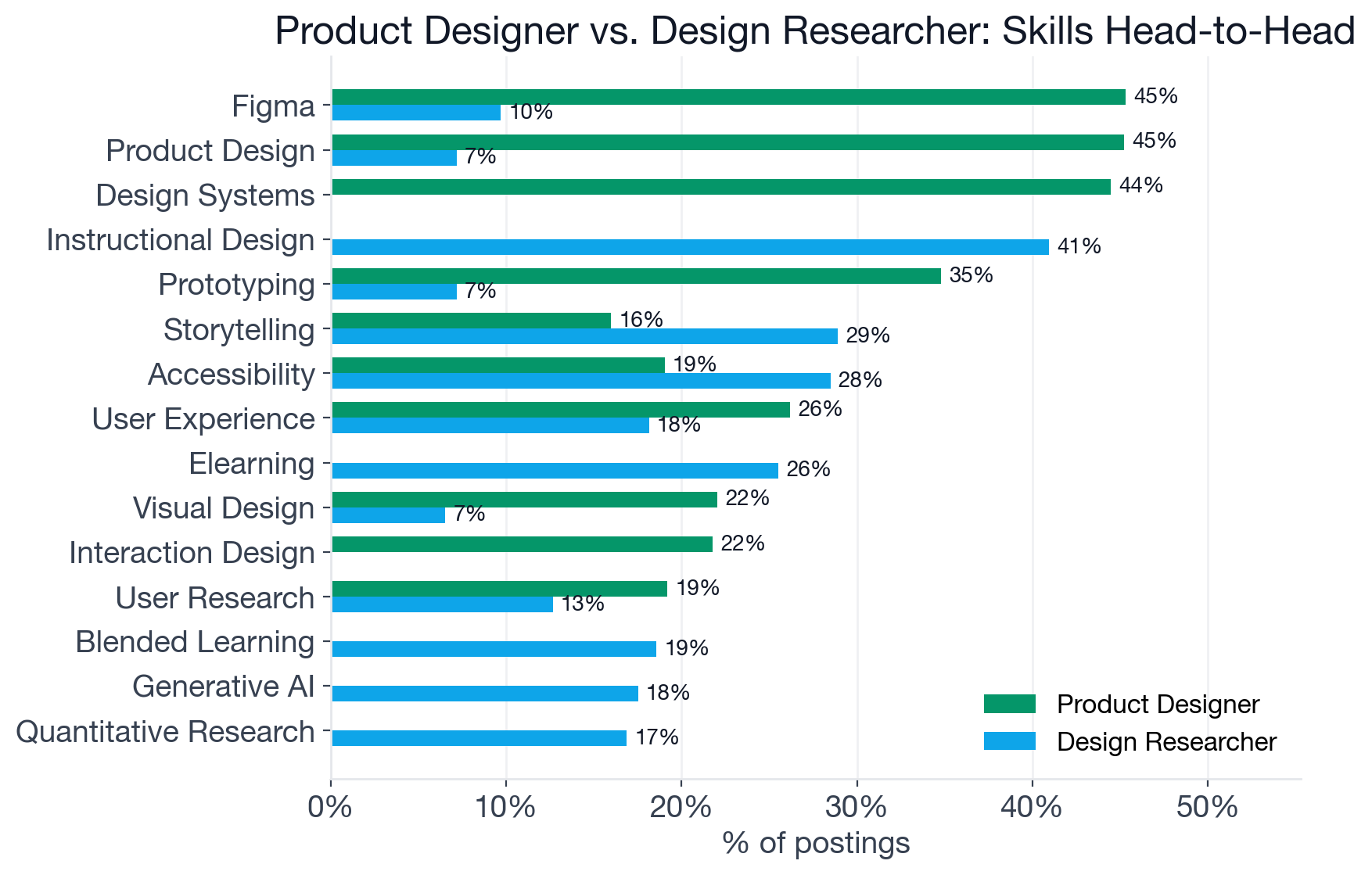 Figma and Product Design anchor Product Designer's stack at 45% each; Instructional Design anchors Design Researcher's at 41%, already a sign the two roles aren't built from the same material.
Where the Two Roles Pull Apart
Product Designer's exclusive skills read as one coherent production toolkit: Design Systems (44.4%), Interaction Design (21.8%), Typography (16.0%), Wireframes (15.5%), Adobe Creative Suite (11.3%), User Flows (10.4%), Information Architecture (9.1%), and Design Thinking (8.9%). Every one is a craft or production skill; nothing research-related or business-function mixes in.
Design Researcher's exclusive list doesn't hold together the same way. Instructional Design (40.9%) and eLearning (25.5%) top it, both corporate learning-design skills, not research methods. InterviewStack's Design Researcher deep-dive documents why: the title spans two different jobs on the board, a UX/product-research track and a learning-design track, pooled together. The rest of the exclusive list, Blended Learning (18.6%), Quantitative Research (16.9%), Machine Learning (14.6%), Andragogy, Data Privacy, and Virtual Training (12.9% each), and LLMs (12.7%), splits along that same line, so Generative AI, Machine Learning, and LLMs sit inside the split rather than proving a uniformly AI-native role.
Is Design Researcher Really the More AI-Native Role?
Not once you look past the job description. Design Researcher does name AI skills more often in postings: Generative AI (17.5%), Machine Learning (14.6%), and LLMs (12.7%) all crack its top 30; none do for Product Designer. Within Product Designer's 910 US postings with disclosed salary, Generative AI shows up in just 54 (5.9%), Machine Learning in 48 (5.3%), and LLMs in 32 (3.5%), all comfortably below the roughly 6% rank-30 cutoff measured across the full 3,600-posting population (the two samples aren't identical, but the direction holds on either one).
But scarcity cuts the other way in the salary data. Because so few Product Designer postings ask for AI skills, the ones that do pay a real premium: Generative AI, Machine Learning, and LLMs each price $11,400 to $14,200 above its $166,600 baseline. Design Researcher's AI skills can't be priced the same way; none clear the 25-posting sample-size floor for salary data, so its higher mention rate hasn't translated into pricing evidence yet.
Neither number is the whole picture. Job postings only name an AI skill when it's an explicit build-or-architect requirement; they don't capture ambient tool use, and by 2026 that's most of the story on both sides. Independent 2026 surveys put AI tool usage at 72-75% for product designers (72% now use generative AI per Figma's State of the Designer 2026; 75% use it daily per Designer Fund's AI in Design Report) and 69% of design researchers using AI in at least some of their work (Maze's Future of User Research Report 2026), with AI-assisted synthesis the fastest-growing part of the research workflow. Read the posting-level gap as which role currently screens for AI-native language in writing, not which role actually uses AI more.
The $49,100 Gap Traces to Specific Skills, Not Just the Baseline
Product Designer, clearly: $166,600 versus $117,500 at the median US base salary, a $49,100 gap (41.8%). Both are base salary only; postings don't disclose equity, bonus, or sign-on, so total comp at top employers runs higher than either figure alone.
The gap isn't just a baseline difference; it traces back to specific skills on each side, and it complicates a simple "Design Researcher is behind" reading. User Experience, a skill both share, prices at $175,000 for Product Designer (+$8,400 over baseline) but $179,100 for Design Researcher (+$61,600 over baseline, n=31), the widest swing in this comparison. Design Researcher's own defining skills tell the opposite story: Instructional Design prices $31,300 below baseline and eLearning $31,400 below it (both n>25). The learning-design track that dominates its posting volume is the same one dragging its median down.
| Skill | Product Designer premium | Design Researcher premium |
|---|---|---|
| User Experience | +$8,400 (n=276) | +$61,600 (n=31) |
| Accessibility | +$4,900 (n=211) | +$1,900 (n=25) |
| Interaction Design | +$12,800 (n=243) | not enough salary data |
| Design Systems | +$4,900 (n=437) | not enough salary data |
| Instructional Design | not enough salary data | -$31,300 (n=53) |
| eLearning | not enough salary data | -$31,400 (n=26) |
| Generative AI | +$11,400 (n=54) | not enough salary data |
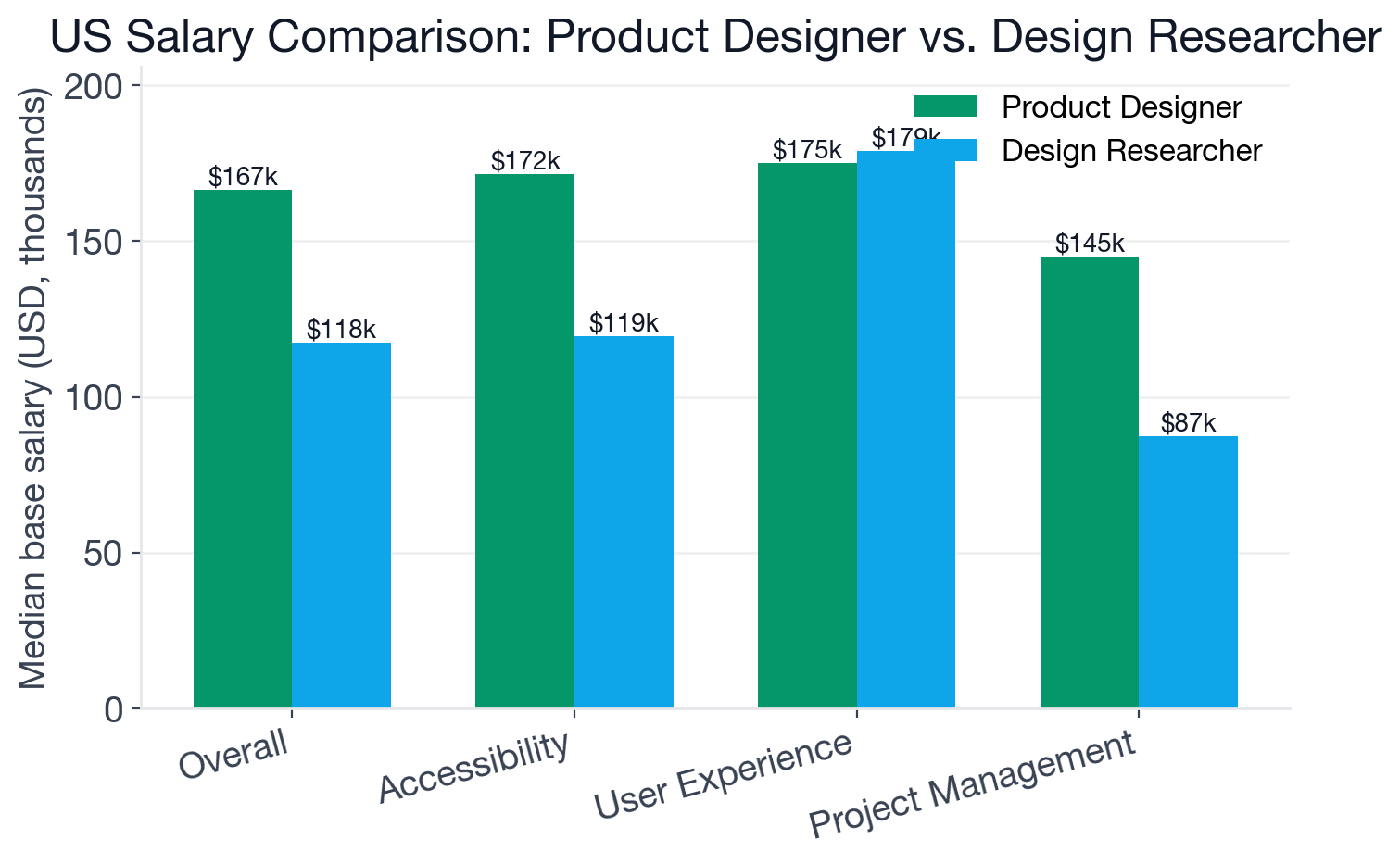 Product Designer's $166,600 median clears Design Researcher's $117,500 by $49,100; the widest individual-skill swing sits in User Experience, which prices $61,600 above Design Researcher's own baseline.
Which Role Has More Openings, and Is Either Easier to Break Into?
Product Designer, on both counts. It has 7.6 times the active postings (3,600 versus 474), and its entry-level share is more than double Design Researcher's (4.4% versus 2.1%). The two gaps compound: that's 158 genuinely entry-level Product Designer openings on the board right now, versus just 10 for Design Researcher. Most people land the Design Researcher title after a stint in an adjacent role, not as a first job.
Both roles are US-concentrated and mostly onsite: the US accounts for 44.9% of Product Designer postings and 43.2% of Design Researcher postings, and both lean onsite (43.2%, 44.3%) over remote (29.6%, 32.5%). One caveat for Design Researcher: one employer accounts for about 12% of its smaller 474-posting sample, so treat single-point differences in its distribution as directional, not exact.
The Bigger Market or the Rarer Specialty
Choose Product Designer if you:
- Want the larger, more liquid job market: 7.6 times the active postings and a lower bar to find your first genuinely entry-level opening
- Already work in craft and production tools (Figma, prototyping, design systems) rather than research methodology or curriculum design
- Want the higher pay ceiling: a $49,100 baseline premium, plus a real (if modest) bonus for AI-adjacent skills
Choose Design Researcher if you:
- Actually want to do research or applied learning-design work, not shipped visual design, and you're prepared to check which of the role's two tracks a given posting belongs to before applying
- Are targeting the UX/product-research track specifically, where User Experience alone prices $61,600 above the role's own median
- Can accept a much smaller, more concentrated job pool and a base salary that trails Product Designer's by about 29.5%
How to Use This in Your Job Search
Before applying, browse current openings filtered by the specific skills a posting leans on, like Product Designer + Design Systems or Design Researcher + Instructional Design, so you know which version of the job you're interviewing for. AI mock interviews let you rehearse explaining your track out loud under realistic conditions. If usability testing, research synthesis, or design-systems thinking is thin in your background, the question bank has focused drilling for both, and our interactive courses build the underlying foundations rather than just testing what you already know.
FAQ
Q. Does Product Designer or Design Researcher pay more in 2026?
Product Designer, by a wide margin. The median US base salary is $166,600 (n=910) versus $117,500 for Design Researcher (n=131), a $49,100 gap (41.8%). Both figures are base salary only; equity, bonus, and sign-on aren't disclosed in postings, so total comp at top employers runs higher on both sides.
Q. How much skill overlap do Product Designer and Design Researcher share?
About 33% (Jaccard similarity on each role's top-30 skill set). The skills that do overlap meaningfully are Figma, Product Design, Accessibility, Storytelling, and User Experience, but even these appear at very different rates on each side: Figma shows up in 45.3% of Product Designer postings but only 9.7% of Design Researcher postings.
Q. Do Design Researcher postings really require AI skills more than Product Designer postings?
In writing, yes. Generative AI appears in 17.5% of Design Researcher postings (its 7th most common skill); Machine Learning and LLMs also crack that role's top 16. None of the three make Product Designer's top 30 at all. That doesn't mean Product Designer work skips AI: independent 2026 surveys put AI tool usage at 72-75% for product designers, so the posting language and the actual workflow are telling two different stories.
Q. Which skills are exclusive to Product Designer?
Design Systems (44.4%), Interaction Design (21.8%), Typography (16.0%), Wireframes (15.5%), Adobe Creative Suite (11.3%), User Flows (10.4%), Information Architecture (9.1%), and Design Thinking (8.9%) all clear the exclusivity threshold for Product Designer and stay below it for Design Researcher.
Q. Which skills are exclusive to Design Researcher?
Instructional Design (40.9%), eLearning (25.5%), Blended Learning (18.6%), Generative AI (17.5%), Quantitative Research (16.9%), Machine Learning (14.6%), Andragogy (12.9%), Data Privacy (12.9%), Virtual Training (12.9%), and LLMs (12.7%). The top of that list, Instructional Design and eLearning, points to corporate learning-design work rather than product research; InterviewStack's deep-dive on Design Researcher documents a full two-track split inside this one job title.
Q. Is Product Designer or Design Researcher easier to break into?
Neither is easy, but Product Designer offers more attempts. Entry-level share is 4.4% for Product Designer versus 2.1% for Design Researcher, and Product Designer has 7.6 times the active posting volume (3,600 versus 474), so the same low entry-level rate produces far more actual openings to apply to.
Q. Are Product Designer and Design Researcher remote-friendly roles?
Both lean onsite more than remote, and they're close to each other on the split: Product Designer is 29.6% remote, 24.1% hybrid, 43.2% onsite; Design Researcher is 32.5% remote, 21.5% hybrid, 44.3% onsite. Neither role has tilted meaningfully toward remote-first hiring.
The AI Mention Is a Clue, Not the Whole Picture
Design Researcher names AI skills more often, but it's also the smaller, lower-paid, harder-to-enter role, and its biggest single-skill salary numbers come from the research track, not the AI-tagged skills. Product Designer is the safer bet by volume, pay, and entry rate; Design Researcher only makes sense if you specifically want research or learning-design work and you've confirmed which of its two tracks a given posting actually is. Whichever you pick, read the skill list on the individual posting, not just the headline AI mention or the title.
Topics
Ready to practice?
Put what you've learned into practice with AI mock interviews and structured preparation guides.