
The Feature Name Already Contains the Mistake
The scenario asks a Product Manager to lead "a new feature that lets users save and share trip itineraries" inside a large Maps app. Say that sentence back slowly and the trap is already visible: save and share are two different products wearing one feature name, and most mid-level candidates ship both before either one has proven it works.
This walkthrough follows the real blueprint InterviewStack.io's AI mock interview runs for a mid-level Product Manager on product management fundamentals: a 30-minute, three-phase session scored against a 100-point rubric. Zoe, a mid-level PM (2-5 years' experience), works through it live. Watch for the moment the plan treats "save and share" as one MVP instead of two separate bets.
Key Findings
- Interviewer Objectives Alignment and Level-Specific Expectations each carry 30 of the interview's 100 points, 60% of the score, before Technical Proficiency (20 points) or Communication and Problem Solving (20 points) even factor in.
- The interview runs 30 minutes across 3 phases: 8 minutes on problem framing, 12 minutes (40% of the time) on approach, scope, and trade-offs, and 10 minutes on success metrics and execution readiness.
- 14 checklist items span the 3 phases: 4 in framing, 5 in scope and trade-offs, 5 in metrics and execution; scope and trade-offs ties metrics and execution for the most checklist items.
- The scenario names two actions in one feature, save and share, but only one checklist item rewards calling out meaningful out-of-scope items, and it sits in the highest-weighted phase.
- Phase 1 requires naming at least 2 plausible user segments and narrowing to 1 primary audience in the first 8 minutes, before any feature discussion starts.
- 4 skill areas are explicitly off-limits: writing code or algorithm design, deep SQL query construction, machine learning model architecture, and detailed financial valuation or long-range corporate strategy.
- The interview's last follow-up hands the candidate one ambiguous result (high adoption, low sharing) with no hint about which of several plausible causes is correct.
What Does a Product Manager Product Management Fundamentals Interview Actually Score?
Zoe joins the call. The interviewer shares this scenario:
The interview question
You are joining the consumer product team for a large-scale Maps app. The team is considering a new feature that lets users save and share trip itineraries across places, routes, and notes inside the app. Engineering, design, data science, legal, and partnerships would all be involved if the feature moves forward. Assume this would be a net-new product area for your team, but adjacent to existing Maps usage.
You are the PM asked to lead this effort from early definition through launch planning: how would you approach it?
Beneath that prompt sits the interviewer's real objective: can Zoe frame the problem before naming a single feature, identify who this is actually for, define a defensible MVP with real trade-offs, and connect the whole plan to metrics and risk, all within a 30-minute conversation appropriate for a mid-level PM. That is what the checklist behind the scenario scores, not how many capabilities make it into the first version.
Turn by Turn: Where Zoe's Plan Starts to Split
Four follow-ups decide whether Zoe's plan holds together end to end. Here is where the scope call gets made, and unmade.
Turn 1: Naming the First User
Interviewer: "Who do you think the primary user should be for a first version of this feature, and how would you justify that choice?"
Turn 2: The Feature Name Is Not the Scope
Interviewer: "What would you say is in scope for MVP versus intentionally out of scope at launch?"
Turn 3: A Trade-Off, Not a Compromise
Interviewer: "How would you work with engineering, design, and legal if they had different concerns about complexity, user experience, and privacy?"
Turn 4: The Number That Doesn't Explain Itself
Interviewer: "If adoption is high but sharing usage is low, how would you interpret that and decide what to do next?"
What Happens When Every Follow-Up Tries to Widen the Scope Back Out?
Every mistake above is easy to catch on the page: the fix sits one line below the problem. Under the actual interview, the interviewer keeps handing Zoe a reason to widen scope back out, a shared link, a stakeholder disagreement, a confusing metric, right when the plan feels settled. Reading the "split the verbs" lesson once does not make it automatic when a follow-up lands and the whiteboard already has both features drawn as one box.
That gap between recognizing a scope creep on the page and refusing it live, in real time, with an interviewer watching, only closes with reps. A real session runs the same three-phase, 100-point rubric described above, with unscripted follow-ups timed the way this one was.
What Does the AI Interviewer Track From Framing to Launch Plan?
The chart below paces the same 30 minutes Zoe just sat through.
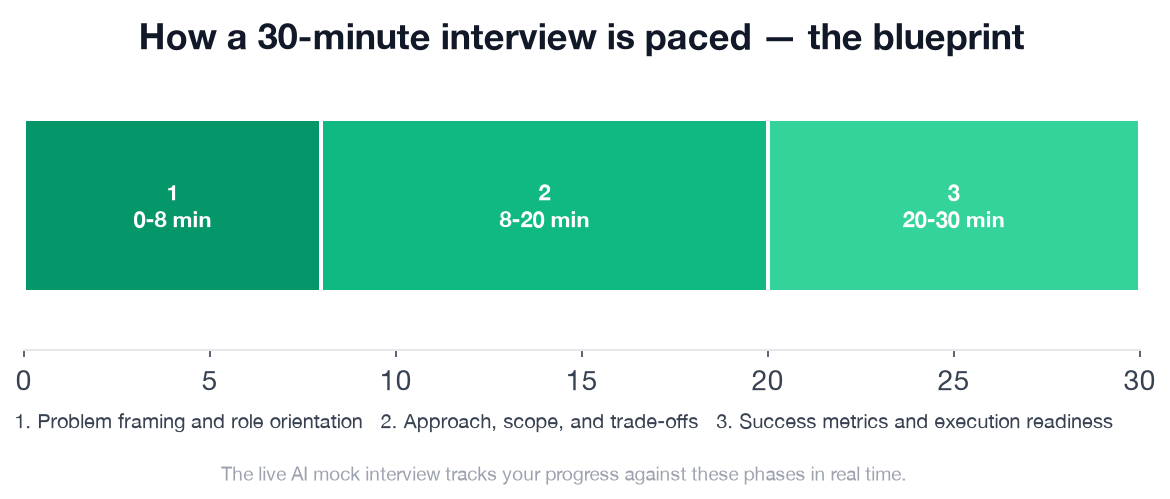
Twelve of the thirty minutes, 40% of the interview, go to approach, scope, and trade-offs, the phase that decides whether save and share ship as one MVP or two.
- ✓States or seeks to clarify the product goal and target user before discussing roadmap details.
- ✓Identifies at least 2 plausible user segments and narrows to one primary audience for initial focus.
- ✓Explains PM responsibilities in this situation as aligning functions, making trade-offs, and driving clarity.
- ✓Acknowledges this is adjacent to an existing Maps behavior and uses that to reason about fit.
- ✓Proposes a coherent MVP with a small number of core user actions such as save, organize, and share.
- ✓Explicitly calls out meaningful out-of-scope items to control complexity.
- ✓Discusses trade-offs across user value, engineering effort, privacy/legal concerns, and partner dependencies.
- ✓Describes how they would work with design, engineering, data science, legal, and partnerships during planning.
- ✓Shows awareness of edge cases like bad sharing experience, low content creation, privacy concerns, or low repeat usage.
- ✓Defines a north-star or primary success metric tied to user value, not just feature shipment.
- ✓Includes supporting metrics across acquisition, activation, engagement, retention, and quality/guardrail dimensions.
- ✓Mentions how to interpret ambiguous outcomes and what follow-up decisions or experiments would come next.
- ✓Identifies at least one launch risk and a concrete mitigation approach.
- ✓Closes with a practical phased rollout or learning plan rather than assuming full launch immediately.
This is the exact blueprint InterviewStack.io's AI mock interview tracks you against in real time, phase by phase, checklist item by checklist item, whether or not you ever say the word MVP out loud.
The scoring weights explain why framing and judgment outweigh feature-list length.
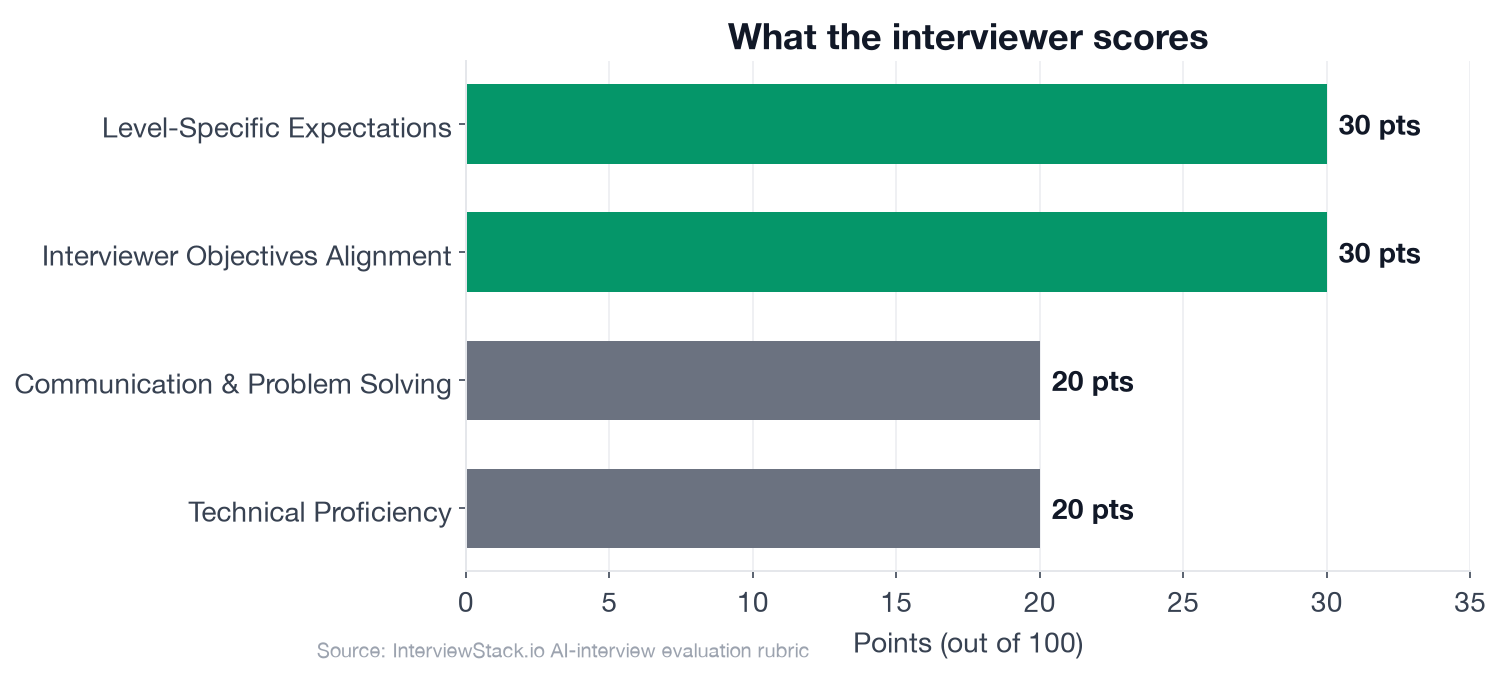
Interviewer Objectives Alignment and Level-Specific Expectations together hold 60% of the score. The other 40% is technical accuracy and how clearly the trade-offs get communicated, not how many features made the cut.
Practice This Exact Scope Decision Live
Reading Zoe's session is not the same as running it. Start the AI mock interview for product management fundamentals and work through the same Maps itinerary scenario, scored live against all four rubric dimensions above.
Before going live, drilling individual questions in the Product Manager product management fundamentals question bank builds the vocabulary to name a scope cut and a trade-off confidently under pressure. For a structured preparation plan, the Product Manager preparation guides cover additional practice paths. If you are also prepping the round that follows this one, the prioritization and stakeholder alignment walkthrough covers what happens once the structure from this interview is already assumed.
FAQ
Q. What does a Product Manager Product Management Fundamentals interview actually evaluate?
InterviewStack.io's AI mock interview scores this scenario on four dimensions worth 100 points total: Interviewer Objectives Alignment and Level-Specific Expectations at 30 points each, and Technical Proficiency and Communication and Problem Solving at 20 points each. The interviewer is checking whether you can frame the problem, narrow to one primary user, make real scope trade-offs, and define success metrics, not whether you can list every possible feature.
Q. Should save and share ship as one MVP or two separate releases?
The blueprint's Phase 2 checklist rewards a coherent MVP built around a small number of core actions (save, organize, share) plus explicit out-of-scope calls. Treating save and share as inseparable, because the prompt names both, usually produces an MVP with too much surface area: real-time collaboration, granular permissions, and cross-user notifications all creep in before you've proven anyone wants to save an itinerary at all. A stronger MVP ships save and organize first and treats sharing as a separate, more constrained release.
Q. How should I define success metrics for a net-new feature like this?
Phase 3's checklist wants a north-star metric tied to user value, not just feature shipment, plus supporting metrics across acquisition, activation, engagement, retention, and a quality or guardrail dimension. For a save-and-share feature, that typically means an activation metric (itineraries saved with 2+ items), an engagement metric (itineraries reopened before a trip), and a guardrail metric (no regression in core Maps navigation usage), not a single vanity number like total feature launches.
Q. What risks should I flag before committing engineering resources?
The interview rewards naming at least one concrete launch risk with a mitigation, not a general disclaimer. For this scenario, credible risks include low content creation (users save places but never add notes or routes, so itineraries feel empty), privacy exposure in shared links, and low repeat usage if the feature never ties back into everyday Maps navigation. Naming one of these with a specific mitigation, like a private-by-default sharing setting, scores higher than listing five risks with no plan.
Q. How long is this interview and how is the time split across phases?
It runs 30 minutes across three phases: 8 minutes on problem framing and role orientation, 12 minutes (40% of the interview) on approach, scope, and trade-offs, and 10 minutes on success metrics and execution readiness. The scope and trade-offs phase carries 5 of the interview's 14 total checklist items, tying success metrics and execution readiness for the most (also 5); problem framing has 4.
Q. Is this interview about technical execution or PM judgment?
PM judgment. The blueprint explicitly excludes writing code or algorithm design, deep SQL query construction, machine learning model architecture, and detailed financial valuation or long-range corporate strategy. Every point is scored on product framing, scope discipline, cross-functional trade-offs, and metrics judgment appropriate for a 30-minute conversation, not technical depth.
Q. How is this different from a Product Manager prioritization interview?
This fundamentals round tests whether you can independently structure an ambiguous, net-new opportunity end to end (define, scope, launch) without heavy prompting. A prioritization interview assumes that structure already exists and tests how you choose between competing initiatives under constraints. The Product Manager prioritization and stakeholder alignment walkthrough covers that later-stage round.
The Cut Is the Product Sense
A mid-level Product Manager does not earn points in this interview for imagining the richest possible version of the feature. Zoe's plan gets stronger the moment save and share stop being one word and start being two decisions, each with its own user, its own scope line, and its own way to fail. That is the entire 30 minutes, phase by phase, and the only way to know if a scope call actually holds is to defend it live.
Topics
Ready to practice?
Put what you've learned into practice with AI mock interviews and structured preparation guides.