
You open the dashboard in a mid-level Product Manager retention interview and the numbers look alarming: D7 retention down five points, D30 down three, DAU/MAU sliding from 0.31 to 0.28. The instinct is to sprint toward fixes. The checklist, however, rewards spotting an early clue in a line that looks boring: D1 is flat at roughly 41%. This post walks that interview turn by turn with an illustrative candidate, Dana, so you can see where points are won and lost. Everything below is drawn from one AI mock interview blueprint, not a real company's question or a real transcript.
Key Findings
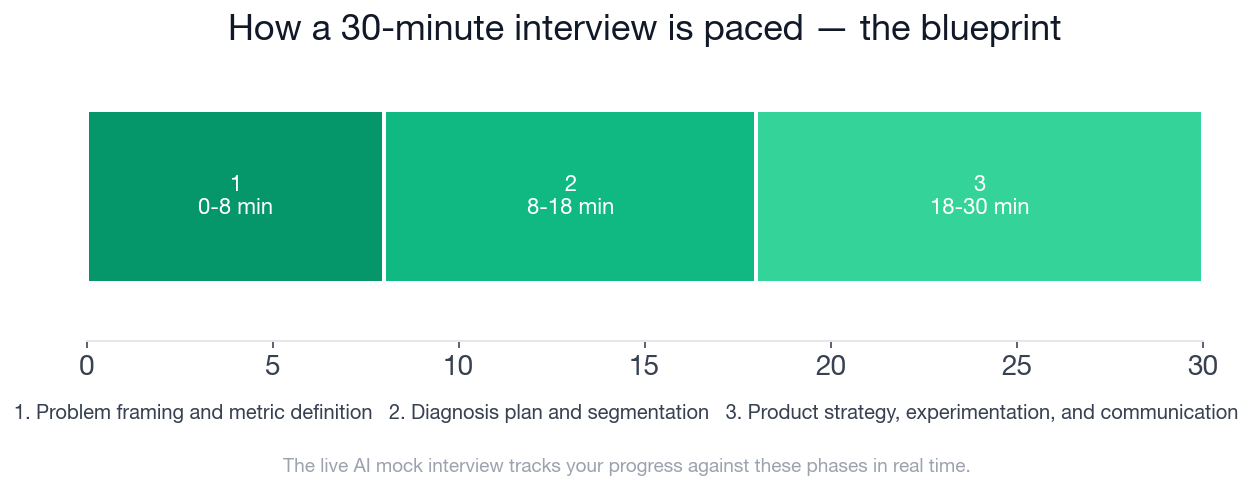
- The blueprint runs 30 minutes in 3 phases: framing (0-8), diagnosis (8-18) and strategy plus communication (18-30).
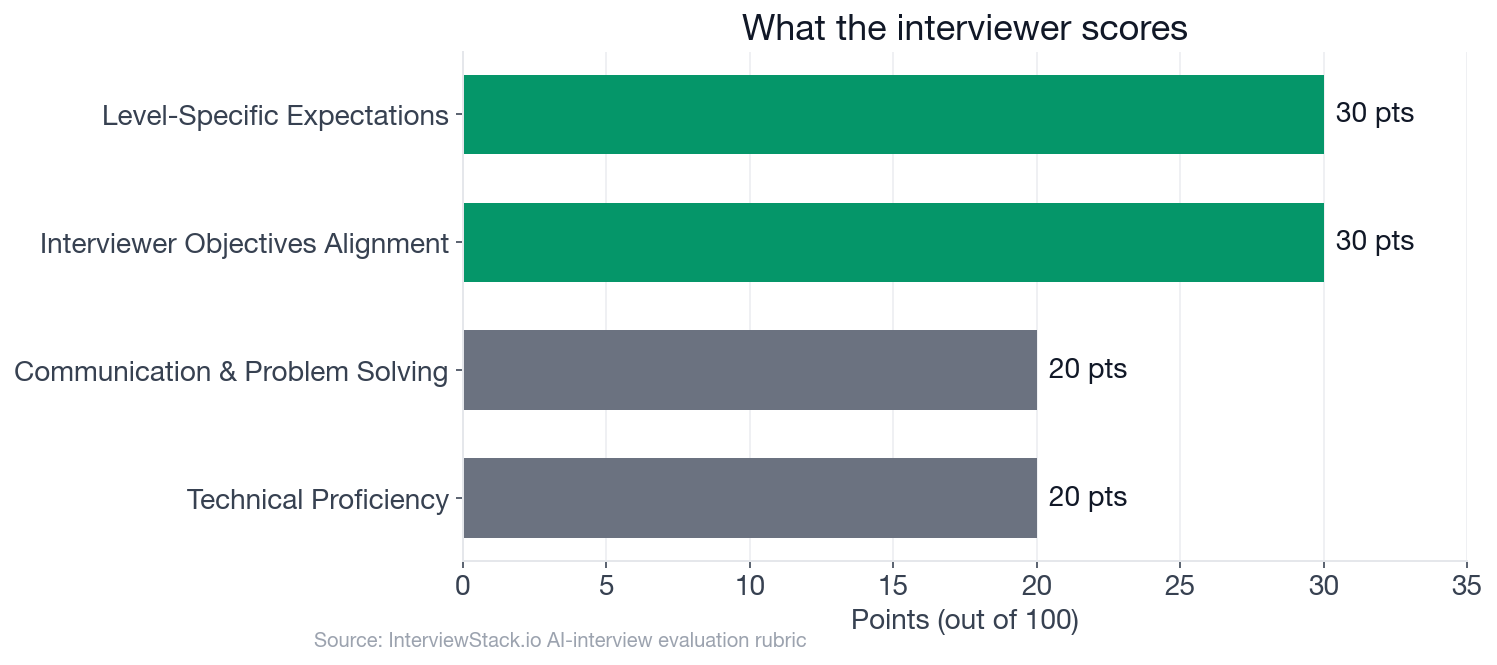
- Scoring is out of 100 points: Interviewer Objectives Alignment and Level-Specific Expectations are 30 each; Technical Proficiency and Communication are 20 each.
- The scenario shows D1 near 41% while D7 falls from 24% to 19% and D30 from 13% to 10%: the break is after day one.
- DAU/MAU slid from 0.31 to 0.28 over 2 quarters, a stickiness signal that should sit beside cohort retention.
- The package lists 3 launch countries and an iOS permission-flow change as the first segmentation cuts.
- Phase 3 expects 1-2 prioritized interventions, not a long wish list.
The Flat D1 Is an Early Hint the Checklist Rewards
Retention is a post-acquisition problem, and the interviewer wants that framing in the first minutes. A flat D1 means the first session still works. The decline sits in what happens during the first week, so the candidate who spots that has already narrowed the search.
The interview question
You are the PM for a short-form video product at a leading tech company. Over the last two quarters, new-user acquisition has stayed strong, but leadership is worried that too few new sign-ups become repeat weekly users. Your team owns onboarding, notifications, lightweight social features and creator-viewer engagement loops. It does not own ads ranking or top-of-funnel acquisition. Here are the dashboard snapshots:
New user cohorts (global): - Weekly signups: roughly flat for 12 weeks - D1 retention: 41% -> 40% -> 41% - D7 retention: 24% -> 21% -> 19% - D30 retention: 13% -> 11% -> 10% - DAU/MAU: 0.31 -> 0.28 over 2 quartersNotable product facts:
- 70% of new users watch at least 1 video in their first session
- 38% follow at least 1 creator in their first 7 days
- Push notification opt-in on iOS has declined after a recent permission-flow change
- A new "friends activity" surface launched 6 weeks ago in 3 countries
- Usage is typically higher on weekends than weekdays
How would you approach diagnosing and improving retention for this product?
The interviewer is probing how you define the problem, choose cohort and engagement metrics, form grounded hypotheses, prioritize interventions and design a measurement plan with guardrails. Acquisition and ads ranking are out of your team's hands, and good answers respect that.
Walkthrough: Four Follow-Ups, Four Habits to Show Under Pressure
Turn 1: Name the break
Interviewer: "What retention and engagement metrics would you use to determine whether this is primarily an onboarding problem, a habit-formation problem, or a cohort-mix issue?"
Turn 2: Segment before concluding
Interviewer: "How would you segment the analysis to avoid drawing the wrong conclusion from the global D7 and D30 declines?"
Turn 3: Question the push
Interviewer: "Suppose the team proposes increasing push volume to recover weekly active usage. How would you evaluate that idea and its risks?"
Turn 4: Commit to one bet
Interviewer: "What product changes would you prioritize in the next quarter, and how would you decide between onboarding improvements, follow/creator loop improvements, and social re-engagement features?"
Why Is Spotting These Mistakes on the Page Not Enough?
Each mistake above is easy to see once it is labeled. Live, you have a ticking clock, a dashboard you have never seen and an interviewer who changes direction mid-answer. Dana's answers fail because under pressure the instinct is to be helpful fast, not to be structured. That habit only changes through repetition with unscripted follow-ups. Practicing in a real mock interview shows you how you actually answer when nobody tells you which of the four turns is coming.
What Does a Strong Product Manager Retention Interview Blueprint Look Like?
This is the blueprint a strong candidate hits, phase by phase. It is also what the AI mock interview tracks you against in real time, checking each item as your answer covers it.
- ✓Clarifies the objective as improving repeat usage among newly signed-up users
- ✓References cohort retention rather than relying only on aggregate DAU or MAU
- ✓Calls out that D1 is relatively stable while D7/D30 are deteriorating, suggesting a downstream habit or re-engagement issue more than a first-session failure
- ✓Mentions at least one stickiness or engagement-depth metric such as WAU, DAU/MAU, sessions per retained user, days active per week, or follow-rate
- ✓Forms 2-4 grounded hypotheses tied to the scenario, such as weaker notification recovery, insufficient follow/interest graph formation, country-specific launch effects, or cohort/seasonality mix
- ✓Proposes segmenting by signup cohort week, country, platform, acquisition source if available, and notification opt-in status
- ✓Checks whether the decline is concentrated in the 3 launch countries or among iOS users after the permission-flow change
- ✓Looks at milestone behaviors linked to retention, such as first-session watch depth, first follow, return within first 3 days, creator interactions, or friend connections
- ✓Differentiates correlation from causation and suggests comparing similar cohorts before/after changes
- ✓Recognizes weekend/weekday usage seasonality and avoids over-reading raw calendar trends
- ✓Prioritizes one or two interventions with a clear rationale, such as improving follow/interest graph setup in week 1 or fixing the iOS push permission flow before increasing notification volume
- ✓Defines success metrics for the proposed changes, including a primary retention metric like D7 retained users or WAU per new-user cohort and guardrails such as unsubscribe rate, notification opt-out, watch satisfaction, or creator spam
- ✓Outlines an experiment or phased rollout approach appropriate for the product surface and ownership constraints
- ✓Discusses trade-offs, for example short-term DAU gains from notifications versus long-term fatigue or low-quality engagement
- ✓Communicates a concise recommendation narrative: what is likely happening, what to test next, and what decision would follow from each outcome
Run This Retention Case Yourself
Start with the AI mock interview for this exact scenario and answer the dashboard question out loud against the clock. Then browse the User Retention & Engagement question bank for more cohort and engagement prompts, or see how a neighboring topic plays out in our competitive analysis walkthrough. If you are also tracking openings, filter the Product Manager job board.
Where Your Next Rep Goes
You now know the clue sits in D1, the segmentation has layers, push volume is a risk and a plan needs one or two ranked bets. Take those four habits into a live session and let the follow-ups show you which one slips first.
FAQ
What does a Product Manager retention interview test?
It tests whether you can turn a messy dashboard into a diagnosis. Interviewer Objectives Alignment and Level-Specific Expectations are 30 points each, so structure, hypotheses and prioritization outweigh Technical Proficiency at 20 points.
Which retention metrics should I define first?
Start with cohort retention at D1, D7 and D30, then add one stickiness metric such as DAU/MAU or days active per week. Aggregate DAU or MAU alone hides which cohorts are slipping.
Why does a flat D1 matter in this scenario?
D1 holding near 41% while D7 slides from 24% to 19% points past the first session toward habit formation or re-engagement. Naming that split in the first 8 minutes is a checklist item.
Should I recommend sending more push notifications?
Not as a first move. Evaluate it against the iOS permission-flow change and pair it with guardrails such as opt-out and unsubscribe rate, because short-term DAU gains can mask long-term fatigue.
How should I segment retention data in an interview?
Cut by signup cohort week, country, platform and notification opt-in status. Then check the 3 launch countries and iOS users separately, and allow for weekend versus weekday swings.
Do I need advanced statistics or LTV forecasting at mid-level?
No. The mid-level bar is a practical plan with measurable outcomes, sound experiment design and guardrails. Long-horizon LTV modeling and large-scale SQL internals are outside this blueprint.
How long is the interview, and how is it scored?
The blueprint runs 30 minutes in three phases (0-8, 8-18 and 18-30) and is scored out of 100 across four weighted dimensions.
Topics
Ready to practice?
Put what you've learned into practice with AI mock interviews and structured preparation guides.