
More Jobs, Smaller Paycheck
The conventional assumption places Product Managers above Product Designers in the org chart and, implicitly, in compensation. The 2026 data does not cooperate. Product Designers earn a higher median US base salary than Product Managers: $146,000 vs. $140,000, a $6,000 gap that runs opposite to what most people expect from the org-chart relationship between the two roles.
The comparison gets more interesting from there. Across 15,520 active PM postings and 3,497 Product Designer postings on the InterviewStack.io job board as of June 2026, the two roles share just 40% of their top-30 skill sets. They are genuinely different careers that happen to collaborate daily, and the job market treats them very differently in volume, seniority, and remote access.
| Product Manager | Product Designer | |
|---|---|---|
| Median US base salary | $140,000 | $146,000 |
| Active postings | 15,520 | 3,497 |
| Top skill | Agile (27%) | Figma (45%) |
| Remote share | 23% | 32% |
| Entry-level share | 4.4% | 5.1% |
| Senior + staff share | 35.7% | 49.1% |
| Skill overlap (Jaccard) | 40% between roles | n/a |
Key Findings
- Product Designers earn a $6,000 higher median US base salary than Product Managers: $146,000 vs. $140,000 (n=795 and n=3,751 US postings with disclosed salary data).
- Product Manager postings outnumber Product Designer postings by 4.4x: 15,520 vs. 3,497 active listings.
- Skill overlap is 40% (Jaccard coefficient): only 4 skills reach meaningful adoption (5%+) in both roles, Agile, Automation, Scalability, and Data Visualization.
- The PM skill stack is led by Agile (27%); key PM-exclusive markers include APIs (10%), Scrum (10%), Monitoring (9%), Jira (9%), SQL (8%), and Excel (8%).
- Product Designer exclusive skills are dominated by craft tools: Figma (45%), Design Systems (44%), and Prototyping (33%).
- Product Designer roles skew significantly more senior: 49% of PD postings are senior or staff vs. 36% for PM.
- Remote access favors Product Designers: 32% of PD postings are remote vs. 23% for PMs.
What Does Each Role Actually Do?
Product Managers own the direction of what gets built. Their week runs on communication: aligning engineering and design on priorities, writing requirements, running sprint rituals, and translating business goals into a roadmap they can defend to stakeholders at multiple levels. The skill profile reflects this: process tools (Agile, Scrum, Jira) dominate the stack, and data tools (SQL, Excel) appear because PMs need to ground tradeoff decisions in what users are actually doing. AI tool adoption in the PM role is exceptionally high at the ambient level. A Productboard survey of 379 enterprise PM teams found 94% rely on AI tools daily or often, primarily for research synthesis, PRD drafting, and competitive analysis. The 9% of postings that explicitly list Generative AI or LLMs measure PMs hired specifically to define AI product strategy, not general ambient usage.
Product Designers own how what gets built feels and works. They move between user research, interaction design, and Figma, and increasingly between individual screens and the design system that governs them. The Design Systems signal (44%) tells you the role has matured beyond screen-level work: designers are expected to build reusable component infrastructure that keeps a product coherent at scale. AI is entering the design process from the research side first: Figma's 2025 AI Report found 78% of product builders say AI improves their work efficiency, though only 31% are using it for core design execution tasks like asset generation or interface drafting today.
How Do Product Manager and Product Designer Skills Compare?
With a Jaccard coefficient of 0.40, only 40% of the top-30 skill sets overlap. The four skills shared at meaningful frequency are Agile (PM 27%, PD 10%), Automation (PM 14%, PD 9%), Scalability (PM 6.5%, PD 6.8%), and Data Visualization (PM 6.9%, PD 5.8%). Switching between these roles is a genuine retrain, not a lateral step.
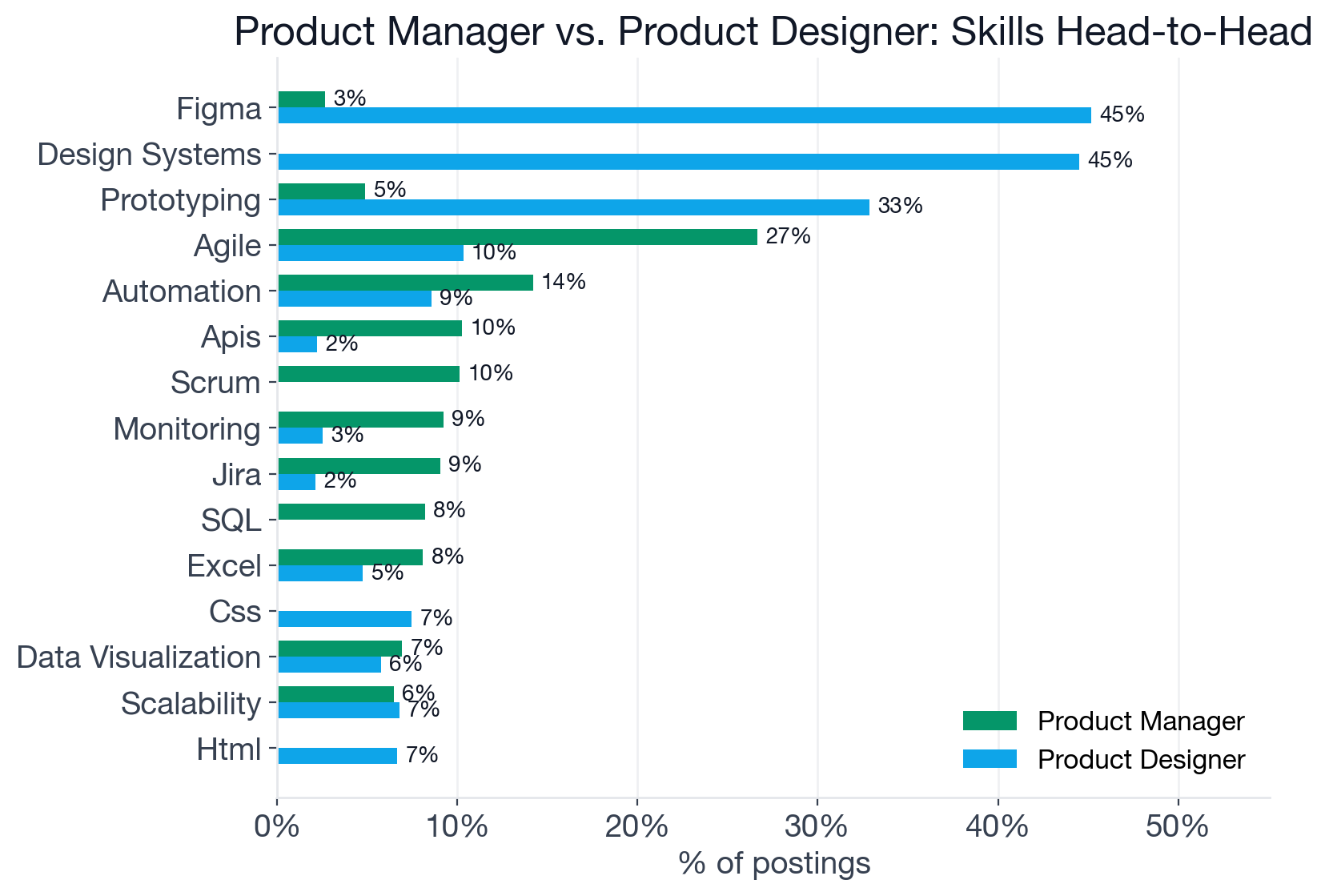
Share of postings that mention each skill, across the combined top-30 skill profiles of both roles.
On the PM side, the exclusive skills cluster around process and data:
- APIs (10.3% of PM postings): signals technical depth, particularly for PMs building products that integrate third-party services or expose their own.
- Scrum (10.1%), Monitoring (9.2%), and Jira (9.0%): Scrum and Jira are the operational infrastructure of agile teams; Monitoring flags platform-adjacent PM work where operational health metrics are part of the role scope.
- SQL (8.2%) and Excel (8.1%): analytical tools that separate evidence-based PMs from intuition-driven ones.
On the PD side, the exclusive skills are craft tools at unusually high rates:
- Figma (45.2%): present in nearly half of all PD postings, it functions as a required credential rather than an optional tool.
- Design Systems (44.5%): signals that the role is about systematic, scalable design work, not individual screen delivery.
- Prototyping (32.9%): interactive prototypes are how designers communicate intent to engineering before a line of code is written.
Browse Product Manager openings requiring APIs or Product Designer openings requiring Figma to see each cluster in practice.
Which Pays More?
Product Designers earn a $6,000 salary premium over Product Managers: $146,000 vs. $140,000 US median base salary. These figures are base only; equity, bonuses, and sign-on are not disclosed in postings and are not in this data, so total compensation at top employers runs meaningfully higher for both roles. A scope note on the PM figure: the "Product Manager" title spans tech, healthcare, hardware, and retail industries; this dataset reflects the full PM market, not exclusively software or tech PMs. Technical PM roles at product companies typically benchmark higher than the $140,000 median shown here, so the $6,000 gap is most accurate as a mid-market comparison rather than a signal that software PM lags software PD in every segment.
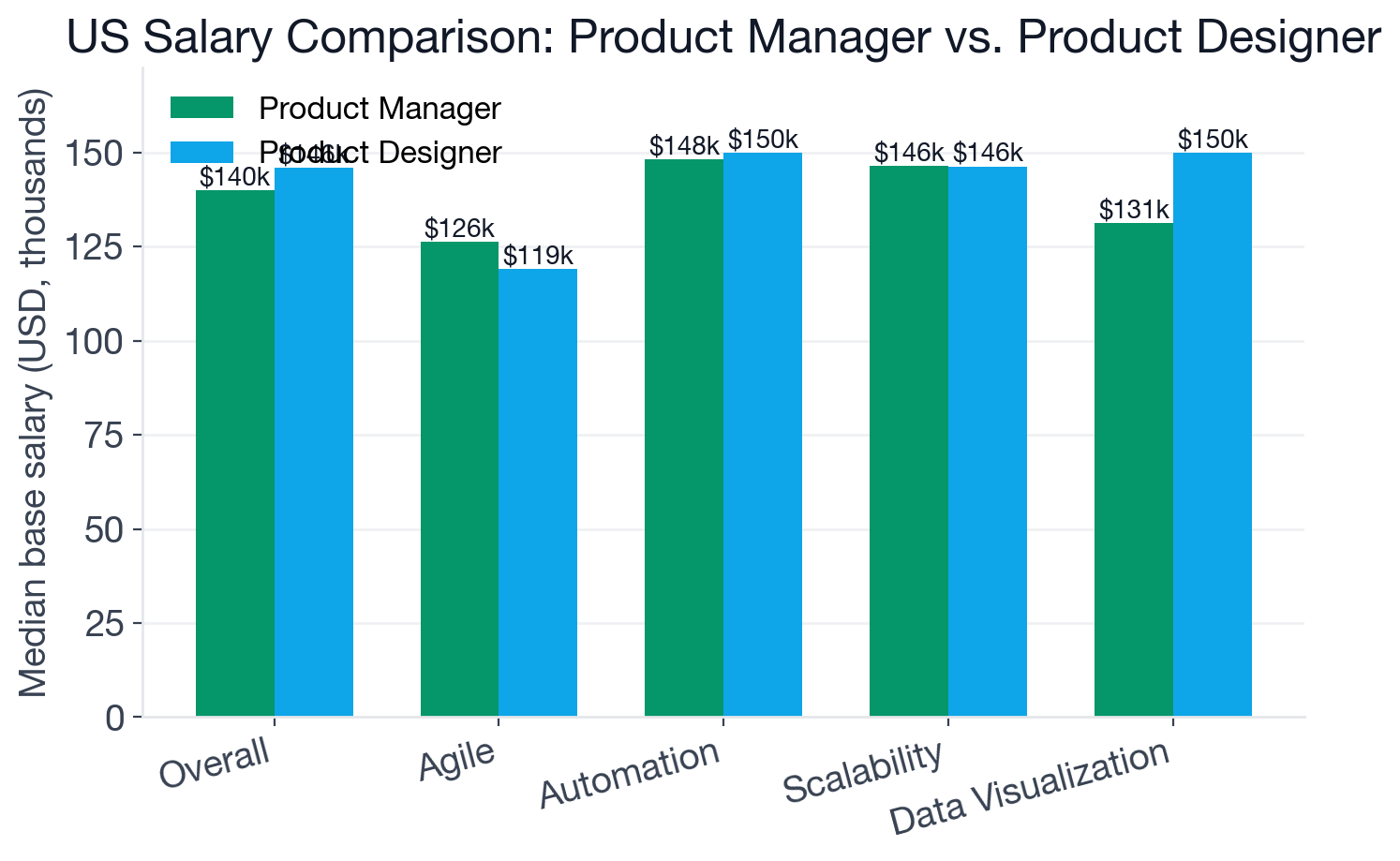
Median US base salary (base only, equity and bonus excluded) for postings with disclosed salary data.
The seniority composition explains part of the gap: 49% of PD postings are senior or staff vs. 36% for PM, and a more senior-skewing market naturally carries a higher median. But the within-role salary dynamics are the more useful signal.
For Product Managers, the process-heavy skills that dominate the market drag salary below the $140,000 baseline. Agile-mentioned roles median at $126,300 (nearly $14K below baseline) and Scrum-mentioned roles at $118,800 (more than $21K below). The skills that push PM salary upward are technical and strategic: LLMs carry roughly a $19K premium (median $159,300, n=200), Machine Learning $20K ($160,000, n=252), and Observability nearly $29K ($168,800, n=162). The technical PM earns meaningfully more than the process PM, and the salary spread between those two profiles is larger than the PM vs. PD gap.
For Product Designers, core craft skills are salary-neutral: Figma-mentioned postings median exactly at the $146,000 baseline. Design Systems adds a modest $4K premium ($150,000, n=373). The bigger moves come from engineering-adjacent skills: Android reaches $160,000 (+$14K, n=35), iOS $157,500 (+$12K, n=40), HTML $157,700 (+$12K, n=54), and Generative AI $154,000 (+$8K, n=58). Designers who can speak to mobile platform constraints or AI-generated interfaces earn more than those working exclusively in desktop-web contexts.
Explore PM openings requiring LLMs or Product Designer openings requiring Generative AI if you're targeting the higher-paying tier of either market.
Which Has More Job Openings?
Product Manager postings outnumber Product Designer postings by 4.4x: 15,520 vs. 3,497 active listings. For someone comparing career paths, that volume difference is concrete: the PM market is simply larger, which lowers the competition-per-opening in most seniority tiers.
Entry-level access is similarly thin in both. PM roles are 4.4% entry-level (683 of 15,520 postings); PD roles are 5.1% entry-level (178 of 3,497). In absolute terms there are roughly 3.8x more entry-level PM openings than PD ones. Mid-level dominates PM hiring at 60% (seniority is inferred from job-title keywords, so unclassified postings default to mid-level). PD is more distributed: 46% mid-level, 31% senior, and 18% staff, putting nearly half the PD market in senior or above tiers.
Geography is broadly similar: roughly 43% of PM postings and 42% of PD postings originate in the US. The next-largest sources differ by role: India and the UK lead for PM after the US, while the UK and Canada lead for PD. The clearest structural difference is remote access. Product Designers have more fully remote opportunities: 32% of PD postings are tagged remote vs. 23% for PMs. Both roles see similar onsite shares (44% PD, 46% PM), with hybrid filling the remainder. Browse remote Product Designer openings if location flexibility is a priority.
Which Should You Choose?
Choose Product Management if you:
- Are energized by strategy, prioritization, and persuading stakeholders across engineering, design, and the business side.
- Want or already have technical depth: LLMs, Machine Learning, and Observability each add $19K to $29K to PM salary; APIs add roughly $10K; process certifications do not.
- Want the largest job market: 15,500+ PM openings vs. nearly 3,500 PD gives you 4x more opportunities to land, especially in your first few roles.
- Are coming from engineering, analytics, or consulting, where product ownership is a natural next step.
Choose Product Design if you:
- Are energized by visual systems, user research, and building the component infrastructure that makes a product coherent at scale.
- Want more remote flexibility: one in three PD postings is remote vs. roughly one in four for PM.
- Are ready to commit to Figma and design systems as core credentials: those two skills anchor 44-45% of all PD postings.
- Are comfortable with a smaller but more senior-skewing market: the PD pool is 4x smaller, but nearly half the postings are senior or staff roles.
For interview preparation on either path, AI mock interviews cover product sense cases, prioritization frameworks, and design critique scenarios with on-demand feedback. The question bank covers product strategy, metrics, and decision-making topics relevant to both tracks. For the technical PM skills that drive salary (SQL, ML fundamentals, API literacy), interactive courses build the foundations.
FAQ
Q. Do Product Managers or Product Designers earn more in 2026?
Product Designers earn a $6,000 higher median US base salary than Product Managers: $146,000 vs. $140,000, based on 795 and 3,751 US postings with disclosed salary data respectively. Equity and bonuses are not included in these figures.
Q. What skills do Product Managers need in 2026?
Agile (27%) and APIs (10%) are the most distinctive PM skills. Process tools like Scrum (10%) and Jira (9%) and data skills like SQL (8%) and Excel (8%) round out the profile. Tech-forward skills like LLMs, Machine Learning, and Observability command salary premiums of $19,000 to $29,000 over the $140,000 PM baseline.
Q. What skills do Product Designers need in 2026?
Figma (45%) and Design Systems (44%) are the defining tools of the role, followed by Prototyping (33%). Engineering-adjacent skills like Android ($160,000), iOS ($157,500), HTML ($157,700), and Generative AI ($154,000) add $8,000 to $14,000 in salary premium over the $146,000 PD baseline.
Q. How much skill overlap is there between Product Manager and Product Designer?
The Jaccard overlap coefficient is 0.40, meaning 40% of the top-30 skill sets intersect. Only 4 skills appear at meaningful frequency (5%+) in both roles: Agile, Automation, Scalability, and Data Visualization. The roles diverge sharply: Figma and Design Systems dominate PD hiring while APIs, Scrum, and SQL anchor PM work.
Q. Which role has more remote opportunities: Product Manager or Product Designer?
Product Designer roles offer more remote options: 32% of PD postings are remote vs. 23% for Product Manager postings. Both roles have similar onsite rates (44% for PD, 46% for PM), with hybrid making up the remainder.
Q. How hard is it to break into Product Manager vs Product Designer roles?
Both roles have thin entry-level pipelines. Product Manager roles are 4.4% entry-level (683 of 15,520 postings); Product Designer roles are 5.1% entry-level (178 of 3,497). Mid-level dominates PM hiring at 60%; PD skews more senior with 49% of postings at senior or staff level vs. 36% for PM.
Q. Are AI skills required for Product Manager and Product Designer roles in 2026?
About 9% of PM postings and 7% of PD postings explicitly list AI skills (Generative AI, LLMs), measuring roles hired specifically to build AI products. Ambient AI usage runs much higher: a Productboard survey of 379 enterprise PM teams found 94% rely on AI tools daily or often, and Figma's 2025 AI Report found 78% of product builders say AI improves their work efficiency.
The Bottom Line
Two healthy roles, one genuine fork. Product Designers earn $6K more at the median and have more remote options; Product Managers have 4x the job volume and a lower barrier to entry from technical or business backgrounds. The 40% skill overlap is low enough that moving between them requires a real retool, not just picking up a few tools. Browse live Product Manager openings and Product Designer openings on InterviewStack.io to compare the actual volume and requirements for each role right now.
Topics
Ready to practice?
Put what you've learned into practice with AI mock interviews and structured preparation guides.