
Why Does No Single Skill Define a Project Manager in 2026?
That is not a platitude. It is a data finding.
We analyzed every active Project Manager posting on the InterviewStack.io job board as of May 2026, a total of 33,399 listings, with skills extracted from job descriptions and synonyms collapsed so "Excel" and "Microsoft Excel" count once. The result: no individual skill appears in even 20% of all postings. The most requested skill, Excel, shows up in fewer than 1 in 5 listings.
For comparison, Python appears in 71% of Data Engineer postings and SQL appears in 71% (see our Data Engineer skills analysis). The entire tier structure that defines other tech roles collapses for Project Manager because the core work of a PM, aligning people, driving decisions, communicating across functions, managing risk, does not reduce to a tool. Postings only surface the overlay: the specific methodology, software, or domain knowledge required on top of those assumed foundations. What the data does reveal is which overlay matters most, where the salary ceiling lives, and why only 11.3% of PM roles are fully remote.
Key Findings
- 33,399 active Project Manager postings analyzed on the InterviewStack.io job board as of May 2026.
- No skill appears in more than 18% of postings: Excel leads at 17.7%, followed by Product Strategy (15.3%) and Monitoring (15.0%). This is structurally different from every other tech role in our dataset.
- Median US base salary is $100,000 (n=6,737 postings with salary disclosed); total comp at top employers is higher since equity and bonus are not disclosed in postings.
- Technical PM skills add $30-32K above the baseline: Computer Vision ($132,000), Azure ($131,900), DevSecOps ($131,300), and AWS ($130,700) lead the salary table; Machine Learning ($130,000) and TypeScript ($130,000) follow. Excel-mentioning postings have a median of $90,000, about $10K below the baseline.
- Only 3.6% of postings are entry-level (1,199 of 33,399); mid-level dominates at 76.4% (25,504), making this one of the narrowest entry paths of any role we have analyzed.
- The US is nearly half of all postings: 49.7% (16,613 listings). The next-largest market is Germany at 5.1%.
- This is one of the least remote roles in the data: 62.8% onsite, 22.7% hybrid, 11.3% remote, reflecting how much PM work depends on physical presence.
- The strongest skill pair is Atlassian-stack: Confluence + Jira has a co-occurrence lift of 13.14, meaning these two tools appear together 13x more often than chance would predict.
What Skill Families Define a Project Manager in 2026?
Group every individual skill into its broader family and count how many postings mention at least one skill from each family. The picture for Project Manager is notably flatter than other tech roles.
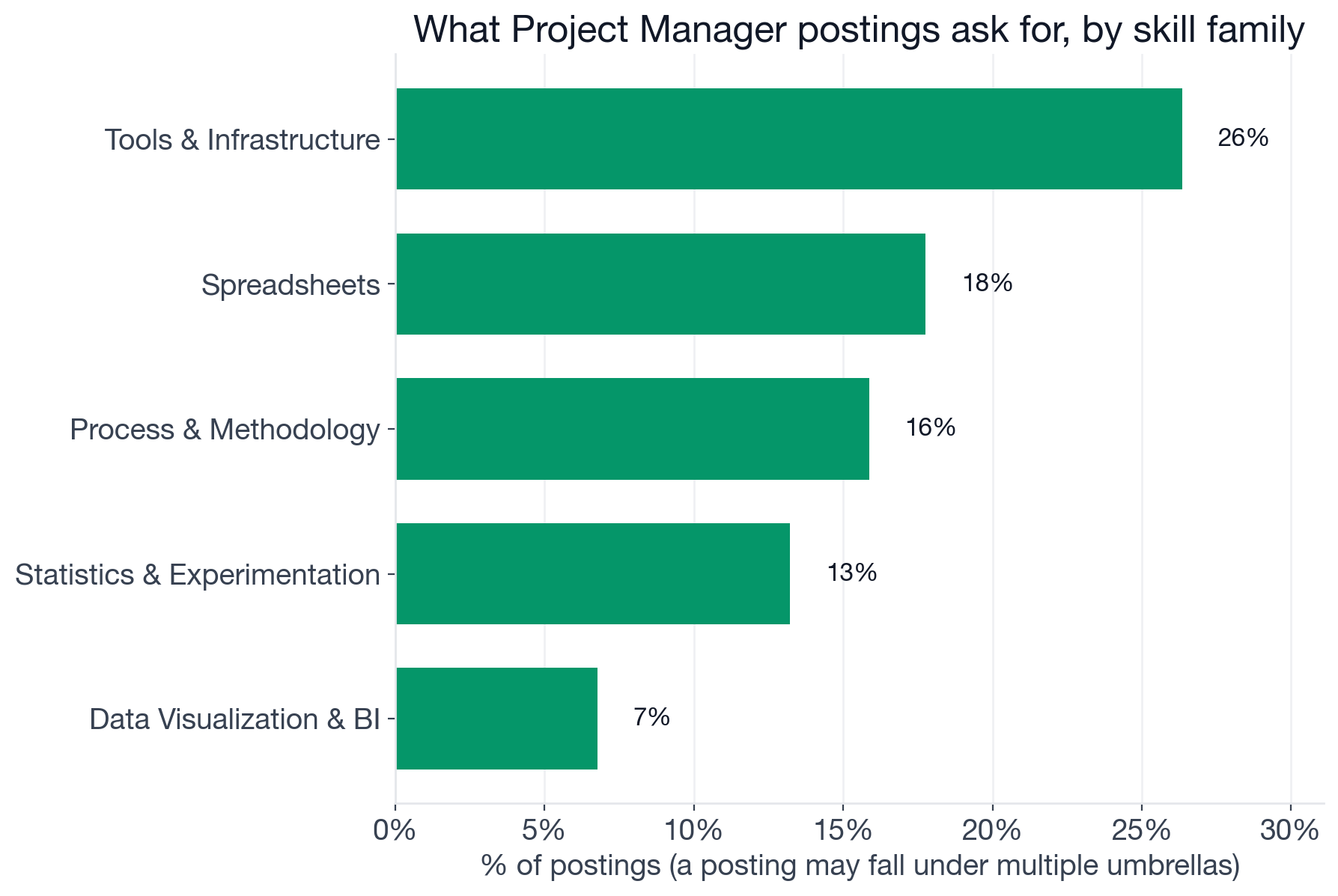
Share of Project Manager postings that ask for at least one skill in each family. A posting mentioning both Agile and Scrum counts once under "Process & Methodology."
The "Other" family at 38% is the biggest bucket, dominated by Product Strategy (15.3%): vision-setting, go-to-market planning, and cross-functional alignment work. This cluster separates product-centric PM roles, which tend to pay more and sit closer to product leadership, from pure delivery-focused roles.
Tools and Infrastructure at 26.4% covers the operational machinery most technology PMs run: Jira, Automation, Monitoring, and Confluence. Process and Methodology at 15.9% is the Agile, Scrum, and stakeholder management cluster. Statistics and Experimentation at 13.2% is driven almost entirely by Forecasting, a signal that budget and schedule planning is a concrete, measurable expectation rather than an assumed soft skill.
The small showing for Cloud Platforms (2.8%), Machine Learning and AI (2.7%), and Coding Languages (2.7%) is not evidence that PM roles are insulated from AI or technical systems. It measures something precise: only about 1 in 37 PM postings is explicitly hiring a PM to manage AI programs or lead technical infrastructure decisions. The ambient layer, the ChatGPT session for drafting a project charter, the AI-powered Jira assistant flagging schedule risks, is not captured there. According to the PMI Pulse of the Profession 2025, 22% of PM teams already have AI actively deployed in their workflows, with 39% planning deployment. The posting data captures who is being hired to lead AI. The expectation that PMs will use AI tools is becoming nearly universal, and goes largely unstated.
What Are the Three Tiers of Individual Project Manager Skills?
Looking at individual skills, the tier structure is unusual for this role. There are no table-stakes skills (50%+) and no common skills (20-50%) for Project Manager. Every skill appears in fewer than 20% of postings.
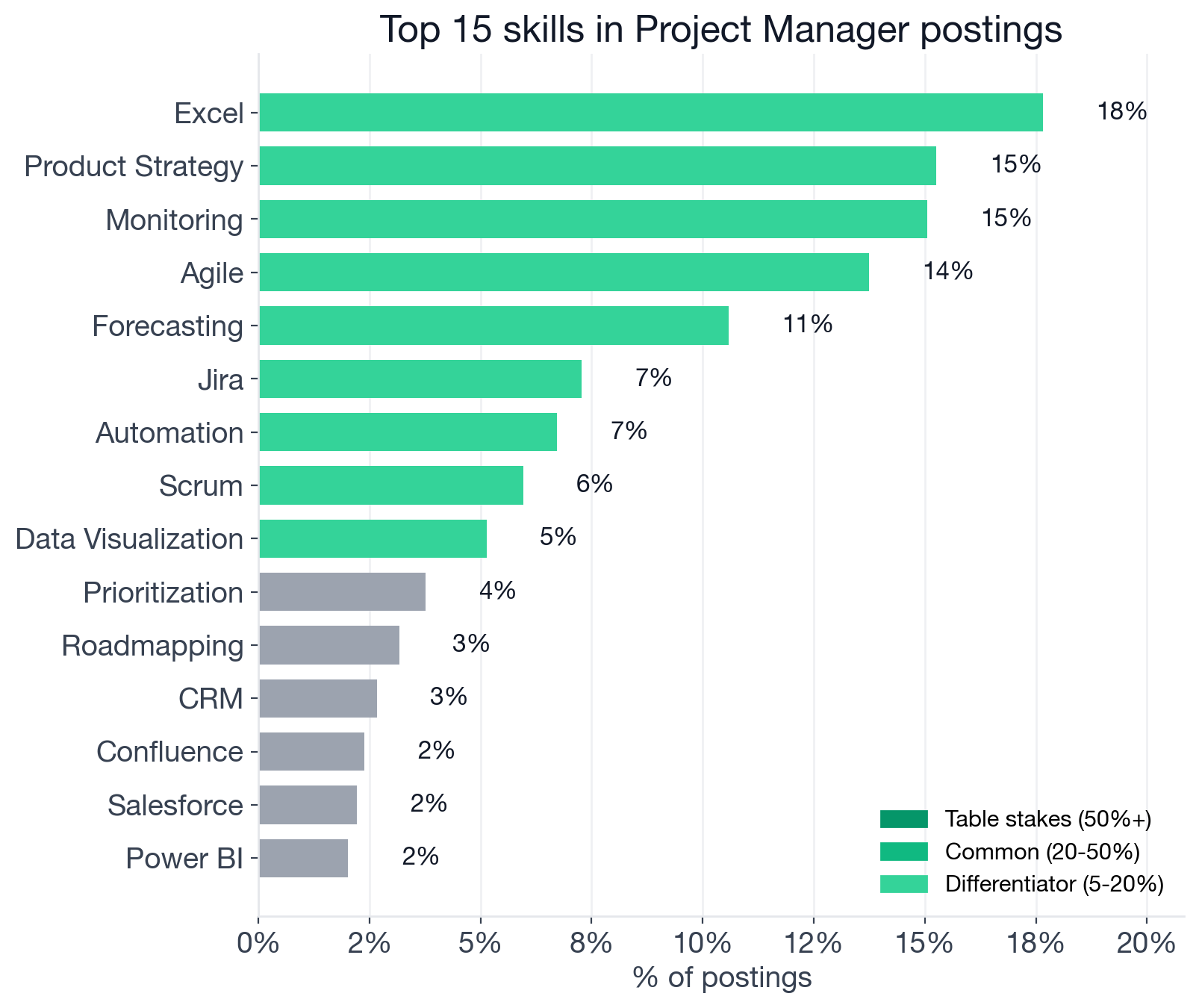
Top individual Project Manager skills by share of postings that mention them. For this role, no skill crosses the 50% table-stakes threshold or the 20% common threshold. All frequently requested skills sit in the differentiator tier (5-20%).
The Differentiator Tier (5-20% of postings)
Nine skills cluster between 5% and 18%:
- Excel: 17.7% (Excel-required PM openings)
- Product Strategy: 15.3%
- Monitoring: 15.0%
- Agile: 13.7% (Agile PM openings)
- Forecasting: 10.6%
- Jira: 7.3%
- Automation: 6.7%
- Scrum: 6.0%
- Data Visualization: 5.1%
These are all "differentiators" not because the skills themselves are rare, but because the PM role spans so many industries and sub-disciplines that no single tool or methodology is required across the board. A construction PM does not need Jira. A clinical PM does not need product roadmapping. An IT program manager needs both, plus technical depth. The industry breadth suppresses every skill's frequency, which is why the histogram looks so flat compared to any other role we have analyzed.
One data signal worth contextualizing: Product Strategy at 15.3% is higher than typically expected for pure project delivery roles and likely reflects a meaningful share of product management-adjacent PM positions in this dataset: roles where the PM has partial ownership of product direction alongside delivery execution. Candidates targeting traditional delivery PM roles in construction, clinical, or infrastructure settings may encounter this skill substantially less often than the overall 15.3% rate implies.
The Noise Tier (under 5% of postings)
Skills in this band, including Prioritization (3.8%), Roadmapping (3.2%), CRM (2.7%), Confluence (Atlassian's team wiki and documentation tool, 2.4%), and Salesforce (2.2%), appear in a meaningful minority of postings but are far from universal. They are highly indicative of PM sub-type: CRM and Salesforce signal customer-facing or revenue-operations PMs; Roadmapping signals product management-adjacent roles; Confluence signals the Atlassian tech-delivery environment. Seeing them in a posting narrows the role's identity even when the job title is simply "Project Manager."
Which Skills Pay More Than the Project Manager Baseline?
Salary numbers below come from US postings only, where wage-transparency laws produce consistent disclosure, and represent base salary only: equity, bonuses, RSUs, and sign-on are not disclosed in job postings, so total compensation at top employers runs meaningfully higher than what we report here.
The overall median US base salary for Project Manager postings is $100,000 (n=6,737 postings with disclosed salary). That is the baseline.
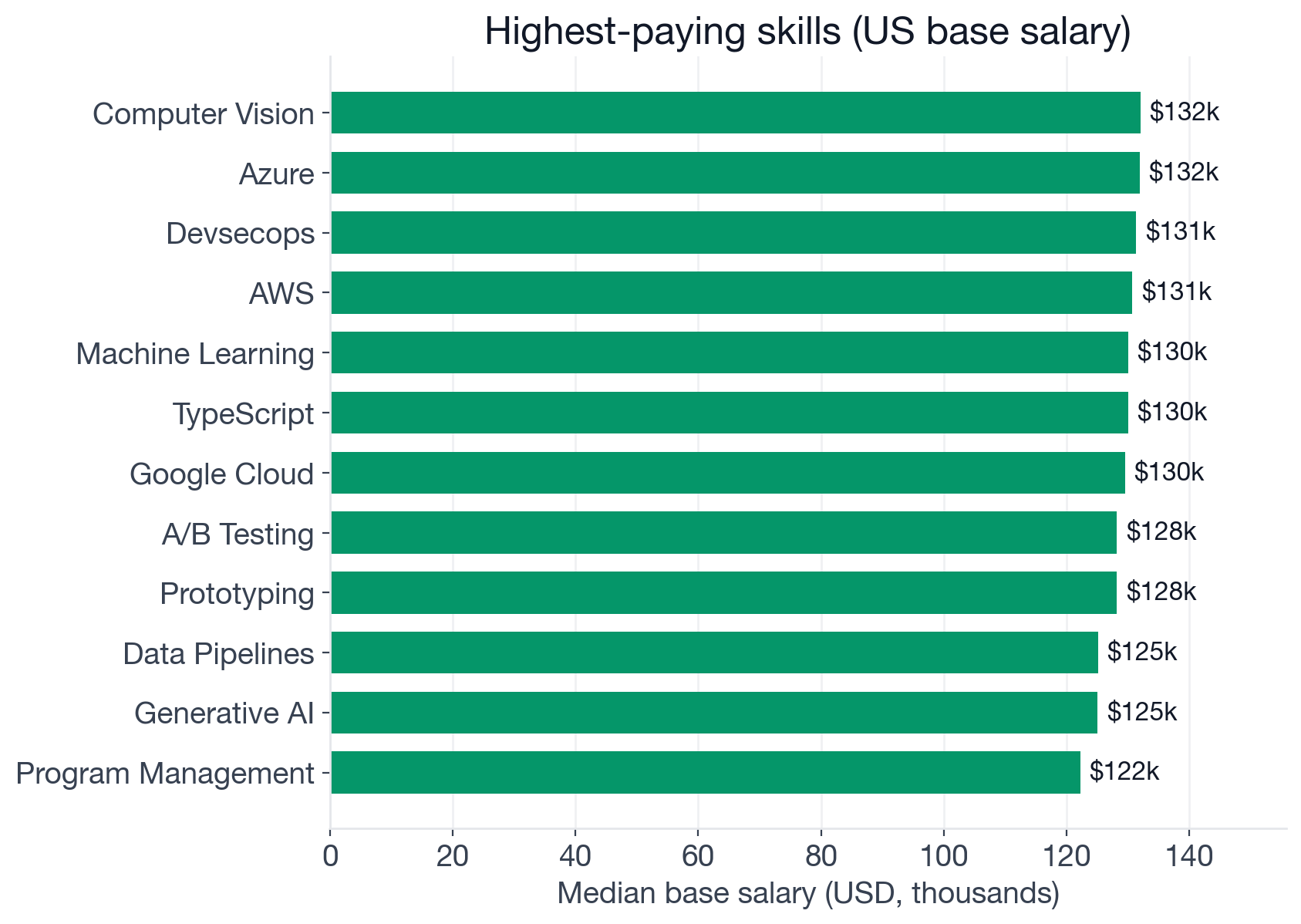
Median US base salary for Project Manager postings that mention each skill. Skills with fewer than 25 US salary data points are excluded. "US base salary" means base pay only; equity and bonus are not included.
The skills that lift salary fall into three clear groups, and the pattern is more decisive than in almost any other role.
Technical PM overlay (+$30-32K above baseline): The clearest salary signal in this dataset is technical specialization. Computer Vision (managing imaging or CV product programs) leads the salary table at $132,000 (n=69). Azure ($131,900, n=85), DevSecOps specializations ($131,300, n=39), and AWS ($130,700, n=89) follow closely. Machine Learning ($130,000, n=55) and TypeScript ($130,000, n=191) round out the top cluster, each sitting $30,000 above the $100,000 baseline. A/B Testing ($128,200, n=91) follows closely. Generative AI ($125,000, n=68) adds a $25,000 premium. These are Technical Project Manager and IT Program Manager roles: the PM is expected to understand the systems being built or operated, not just coordinate around them. If you have an engineering, data science, or product background alongside PM experience, this is the cluster that rewards it. Browse technical PM openings that require AWS to see how the job profile shifts.
Strategic PM overlay (+$15-22K above baseline): OKRs (Objectives and Key Results, a goal-setting framework common in tech organizations) reach $122,200 (n=40), a $22,200 premium. Roadmapping ($120,000, n=273) adds $20,000. Product Strategy ($115,000, n=1,300) adds $15,000. Prioritization ($111,800, n=349) and Stakeholder Management ($111,000, n=75) each add roughly $11,000. These postings are hiring for a PM whose mandate includes defining direction, not just executing against someone else's plan. The sample sizes are large enough to treat these premiums as structural rather than coincidental.
Core delivery skills (+$10K above baseline): Agile ($110,000, n=803), Forecasting ($110,000, n=814), Jira ($110,000, n=473), Scrum ($110,000, n=320), and Data Visualization ($110,000, n=425) each carry a consistent $10,000 premium over the baseline. These are the skills that appear most often in PM postings and separate a competent mid-level PM from someone who holds the title without the delivery toolkit.
Where the data cuts the other way: Excel-mentioning postings have a median US salary of $90,000 (n=1,395), $10,000 below the $100,000 baseline. Monitoring postings land at $98,000 (n=989), also below baseline. This is not because these skills are unimportant. It is because the postings that emphasize them tend to be operational or field PM roles in industries like construction, facilities management, and traditional operations, where the compensation structure differs from technology-sector PM roles. The tool in the posting is a proxy for the industry and the scope of the mandate.
What Is the Dominant Project Manager Skill Stack?
Skill pairs reveal which tools and methods are used together so consistently that seeing one in a posting reliably predicts the other.
The strongest pairs by lift (lift above 1.0 means more co-occurrence than individual frequencies would predict; lift above 5.0 is a strong signal):
| Skill pair | Postings mentioning both | % of postings | Lift |
|---|---|---|---|
| Confluence + Jira | 760 | 2.3% | 13.14 |
| Agile + Scrum | 1,757 | 5.3% | 6.43 |
| Jira + Scrum | 898 | 2.7% | 6.20 |
| Agile + Confluence | 495 | 1.5% | 4.53 |
| Agile + Jira | 1,453 | 4.4% | 4.35 |
| Agile + Roadmapping | 427 | 1.3% | 2.94 |
| Product Strategy + Roadmapping | 435 | 1.3% | 2.70 |
| Agile + Prioritization | 433 | 1.3% | 2.51 |
| Prioritization + Product Strategy | 437 | 1.3% | 2.28 |
| Automation + Product Strategy | 625 | 1.9% | 1.82 |
What each cluster signals:
The Atlassian-Agile stack (Confluence + Jira, lift 13.14): This is the highest-lift pair in the entire dataset. When a PM posting mentions Confluence, it is 13x more likely to also require Jira than the individual skill frequencies would predict. These tools are used together so reliably that seeing either one in a posting is nearly a guarantee of the other. It is a shop-choice signal: the company runs Atlassian for project tracking and documentation, and they want a PM who knows both tools fluently, not just one.
The Agile triad (Agile + Scrum lift 6.43; Jira + Scrum lift 6.20): Scrum is the most common Agile framework, and postings that name "Agile" are overwhelmingly using Scrum ceremonies specifically. Jira is the standard Scrum board. The three terms form a coherent cluster that marks software delivery PM roles: Agile methodology, Scrum ceremonies, Jira board management. This is the most common PM archetype in technology companies.
The product strategy cluster (Roadmapping + Agile lift 2.94; Product Strategy + Roadmapping lift 2.70): Postings that pair Agile with roadmapping or product strategy are typically product management-adjacent PM roles, where the PM owns the "what and why" alongside the "how and when." These roles command the $15-20K salary premium described above and require stakeholder alignment up and down the org chart.
For anyone building a PM interview preparation plan, the Agile-Scrum-Jira cluster is the base layer for technology PM roles. The question bank covers Agile ceremonies, stakeholder management, and roadmapping frameworks in structured question sets built specifically for PM interviewers.
Who's Hiring at Which Seniority Level?
Seniority tags are inferred from job-title keywords. Postings without an explicit signal default to mid-level.
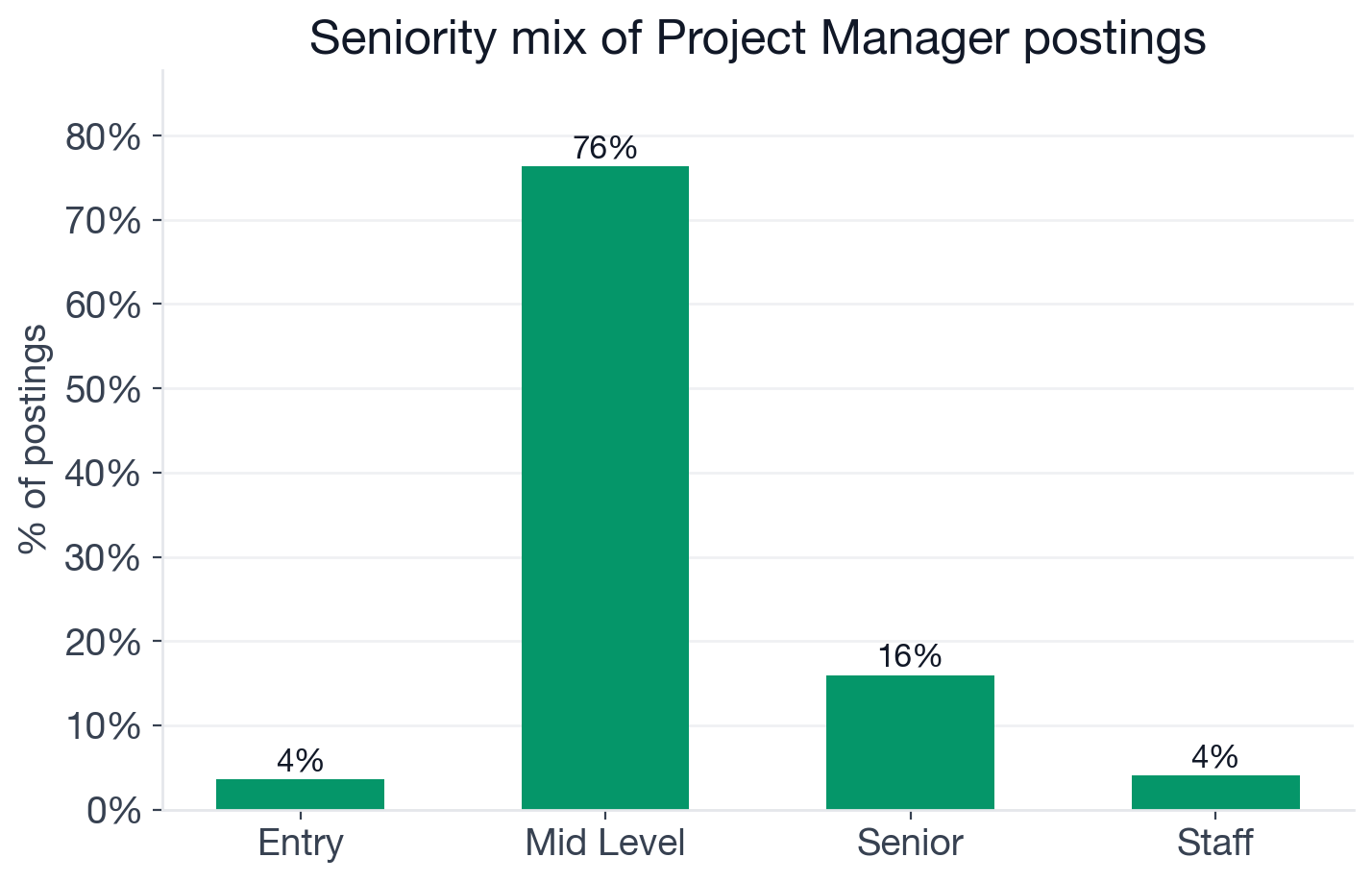
Seniority distribution of Project Manager postings based on title keywords.
- Mid-level: 76.4% (25,504 postings)
- Senior: 16.0% (5,329)
- Staff: 4.1% (1,367)
- Entry: 3.6% (1,199)
The mid-level dominance at 76.4% is one of the most concentrated of any role we have analyzed, and the entry share at 3.6%, just 1 in 28 postings, means the role is effectively gated by prior project delivery experience. Companies are not hiring Project Managers to develop into the job. They are hiring people who have already done the job in some capacity.
The practical entry path: join as a project coordinator, program analyst, or associate PM within a specific industry, deliver two or three projects in a supporting role, and then apply for the full PM title once you have verifiable delivery experience on your resume. Functional expertise in a specific domain (healthcare regulatory, construction scheduling, IT infrastructure, clinical operations) shortens the path because it gives you industry credibility that compensates for limited PM title history. Browse entry-level PM openings to see which industries and companies post the most junior-accessible roles.
The senior tier (16.0% of postings) and staff level (4.1%) together account for about 1 in 5 openings. Senior PM roles reward a combination of technical specialization and program-level leadership, and the salary data above shows they pay proportionally more. Browse senior PM openings to see how the title requirements shift from individual project delivery to portfolio or program-level ownership.
Where Are Project Manager Jobs Located, and How Remote-Friendly Are They?
The United States accounts for nearly half of all Project Manager postings globally, a much higher US concentration than most tech roles.
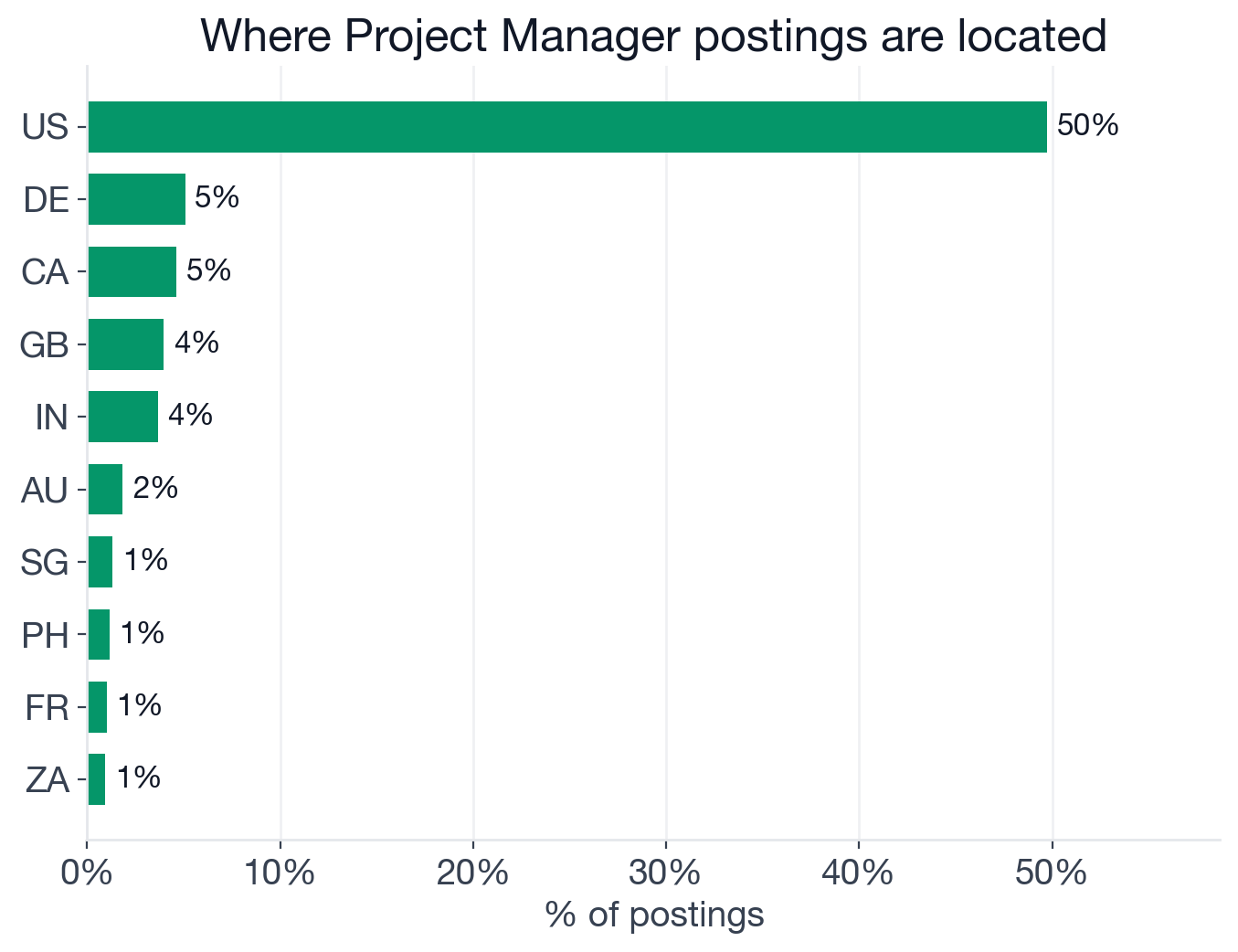
Top countries by share of Project Manager postings on the InterviewStack.io job board.
- United States: 49.7% (16,613 listings) (US-only PM openings)
- Germany: 5.1% (1,693)
- Canada: 4.6% (1,539)
- United Kingdom: 4.0% (1,322)
- India: 3.7% (1,223)
- Australia: 1.8% (617)
- Singapore: 1.3% (438)
- Philippines: 1.2% (384)
- France: 1.0% (335)
The US share at 49.7% reflects how many large-scale capital projects, federal programs, and enterprise IT initiatives are headquartered in the US, and how rarely those programs outsource PM oversight to other geographies. India's 3.7% share is notable by comparison: for Data Engineer roles, India accounts for 23% of postings (see our Data Engineer skills analysis). Project management is far less offshored than engineering delivery work.
The remote access picture is more constrained than candidates often expect.
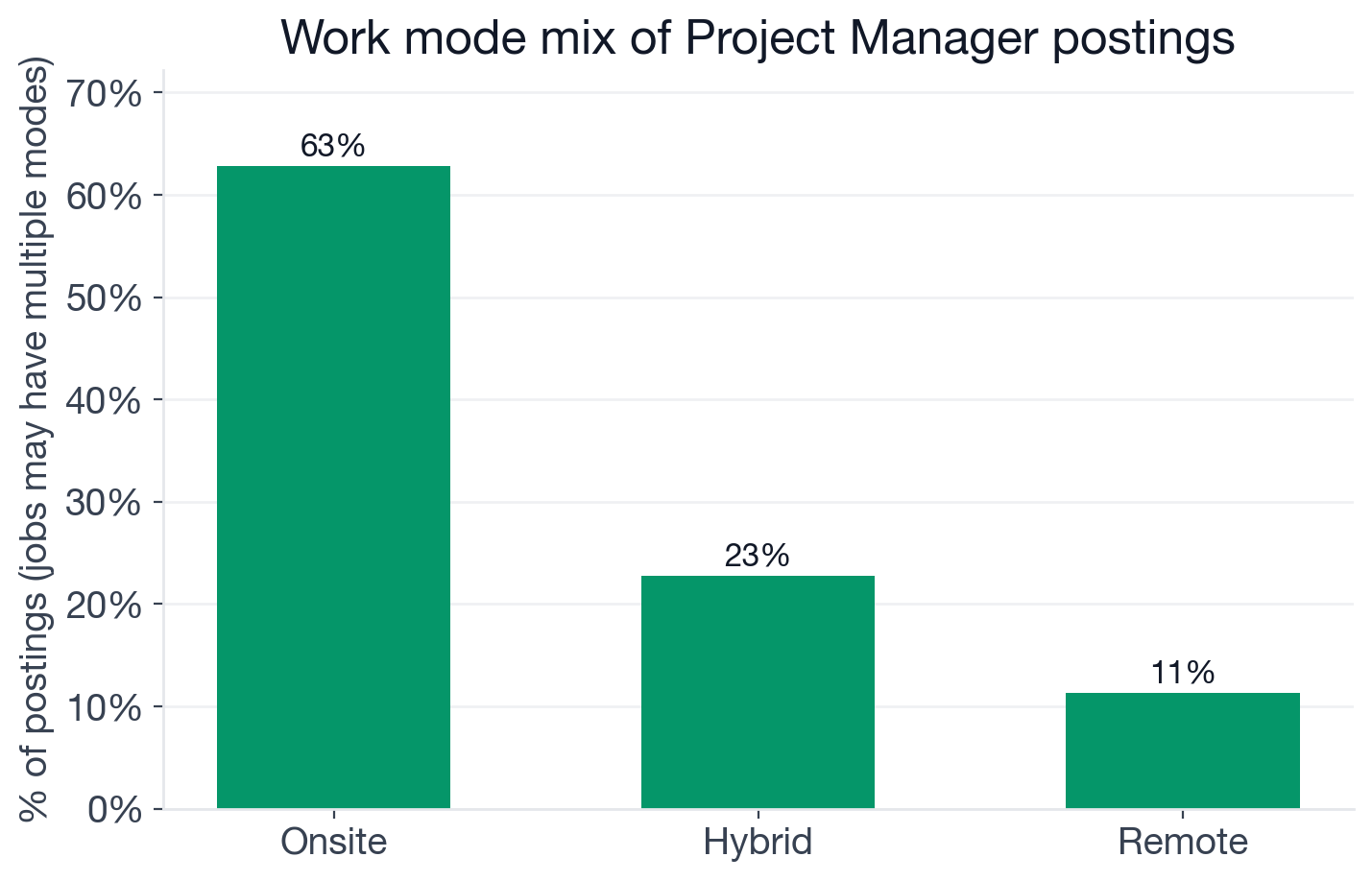
Share of Project Manager postings tagged with each work mode.
- Onsite: 62.8% (20,982 postings)
- Hybrid: 22.7% (7,597)
- Remote: 11.3% (3,784) (remote PM openings)
Project Manager skews heavily onsite, and the in-person bias is structural: PM work is built around relationships, daily standups, impromptu conversations with stakeholders, and for construction, healthcare, and engineering PMs, physical presence on site. The small remote pool concentrates in software product management, localization, and digital-first companies. If remote work is a hard requirement, expect a competitive field narrowed to a specific segment of the market.
Who's Hiring Project Managers in 2026?
The industry spread in the top-companies list is wider than any other role we have analyzed.
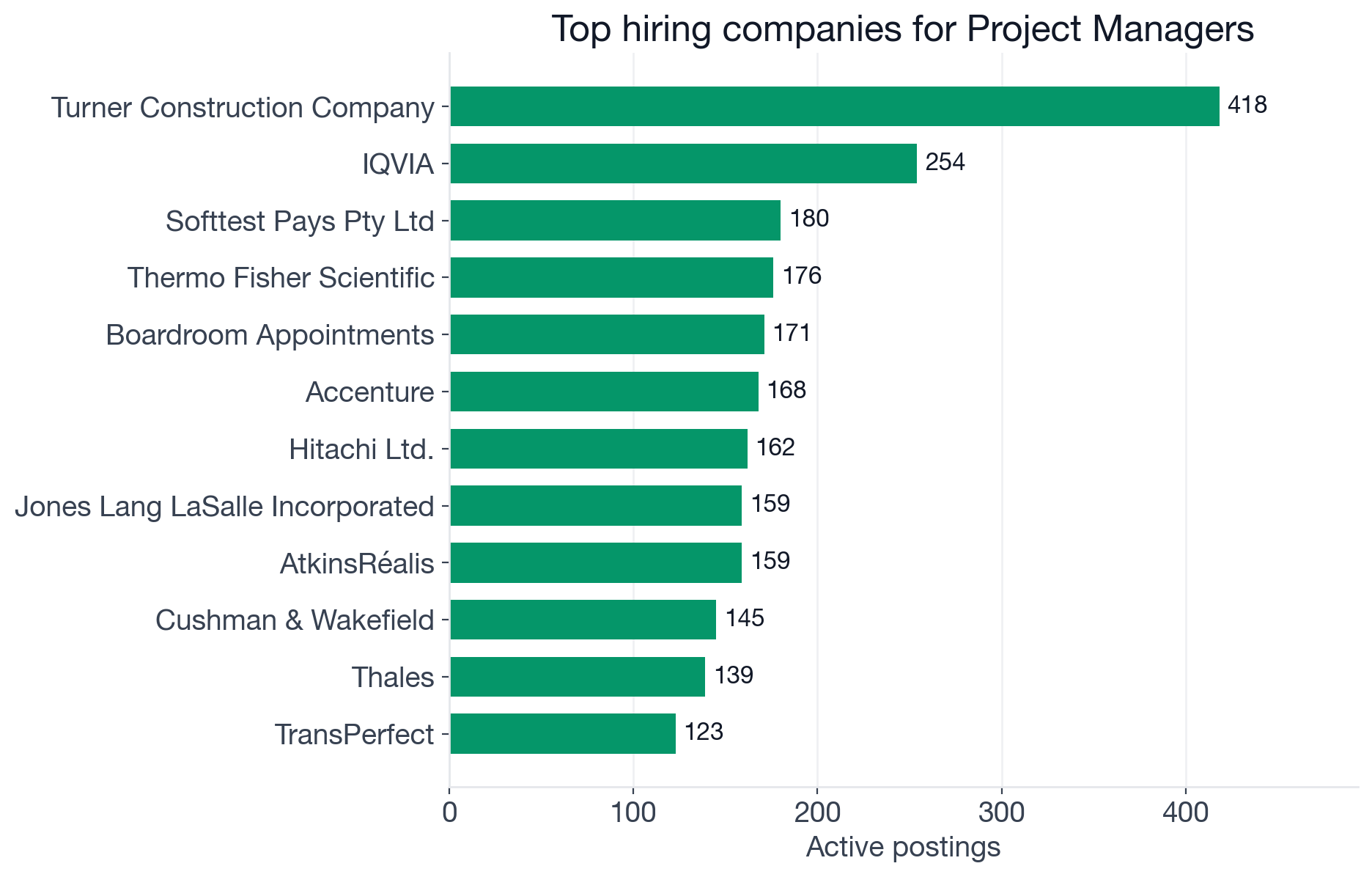
Top companies by active Project Manager postings. Counts include all locations of the same employer.
- Turner Construction Company: 418 postings (construction)
- IQVIA: 254 (healthcare data and clinical research)
- Thermo Fisher Scientific: 176 (life sciences)
- Accenture: 168 (consulting)
- Hitachi: 162 (industrial engineering and technology)
- Jones Lang LaSalle: 159 (commercial real estate)
- AtkinsRéalis: 159 (engineering and infrastructure)
- Cushman & Wakefield: 145 (commercial real estate)
- Thales: 139 (defense and aerospace)
- TransPerfect: 123 (language services and localization)
- INFUSE: 118 (B2B demand generation)
- Arcadis: 112 (design and infrastructure)
- GE Vernova: 112 (energy)
- Parsons Corporation: 108 (defense and infrastructure)
- Northrop Grumman: 108 (defense)
Note: Two staffing and recruitment agencies (Softtest Pays Pty Ltd with 180 postings and Boardroom Appointments with 171 postings) rank third and fifth by posting volume in the underlying dataset. Their listings aggregate demand across multiple client employers rather than representing a single organization's hiring. The list above reflects direct-employer postings only.
Construction, engineering, defense, life sciences, commercial real estate, and consulting each place multiple companies in the top 20. This breadth is the same structural reason no single skill is universal: a Turner Construction PM runs site schedules and contractor relationships. An IQVIA clinical PM manages regulatory submissions and trial timelines. A TransPerfect PM oversees localization workflows across language teams. The shared title is almost the only common ground; the actual work, tools, and domain knowledge differ substantially. For any company with active openings, the interview preparation guides cover how that company structures its interview process and what to prepare for.
How to Use This in Your Job Search
The absence of table-stakes skills makes PM preparation more strategic, not less rigorous. The data points to four concrete actions.
1. Match your overlay skills to the PM sub-type you are targeting. For technology PM roles at software or data companies, the Agile-Scrum-Jira cluster is the base layer, with roadmapping and product strategy as the strategic overlay. For technical or IT PM roles with salaries in the $125K-$132K range, a cloud platform credential (AWS or Azure) combined with genuine technical delivery experience provides the salary premium. For construction, healthcare, or engineering PM roles, industry-specific credentials (PMP, CAPM) often matter more than tool-specific keywords because companies in those sectors hire first for domain knowledge.
2. Prepare for the PM interview format specifically. PM interviews are distinct from other technical interviews. They center on situational judgment, stakeholder conflict resolution, scope management, and how you handle ambiguity under pressure. Practice with AI mock interviews that simulate the behavioral and situational questions PM interviewers use most. The question bank covers project management frameworks, stakeholder management, Agile ceremonies, and roadmapping topics in structured drills you can work through at your own pace. Our interview-prep courses build the structural foundations for those approaching PM interviews for the first time.
3. Take the AI fluency gap seriously. Only 2.7% of PM postings explicitly mention ML or AI skills, but the PMI Pulse of the Profession 2025 shows that 49% of project professionals currently have little to no AI experience. That gap cuts both ways: it is a warning for PMs who are treating AI tools as optional, and an opportunity for those who are not. The PMI deployment numbers (22% deployed, 39% planning) are corroborated by The Digital Project Manager's 2026 survey. Using AI for status reporting, meeting summaries, risk signal monitoring, and stakeholder communications is quickly becoming a professional baseline even when it goes unstated in job descriptions.
4. Filter the job board for your specific sub-type. Because PM demand spans so many industries, the role filter alone returns a very mixed set of postings. Browse Project Manager openings on the InterviewStack.io job board and combine role with skills, geography, and work-mode filters. Agile and Jira PM roles look very different in scope, industry, and salary from postings that list only monitoring and Excel. Filtering for your actual stack saves time and produces a more accurate signal about market demand in your target segment.
FAQ
Q. What skills do companies want for Project Manager roles in 2026?
No single skill hits even 20% of postings, which reflects how industry-diverse the role is. The most requested individual skills are Excel (17.7%), Product Strategy (15.3%), Monitoring (15.0%), Agile (13.7%), Forecasting (10.6%), Jira (7.3%), Automation (6.7%), and Scrum (6.0%). The highest-demand skill family is "Other" (38%), driven by product strategy and workflow knowledge.
Q. What is the median Project Manager salary in 2026?
The median US base salary across 6,737 Project Manager postings with disclosed salary data is $100,000. That number excludes equity, bonuses, and sign-on, so total compensation at top employers is higher. The salary range is wide: technical PMs with cloud or ML skills reach $125K-$132K, while postings emphasizing only Excel and monitoring tend to cluster below the median.
Q. Which Project Manager skills pay the most above the baseline?
Technical skills create the largest premiums. Among US postings, Computer Vision ($132,000), Azure ($131,900), DevSecOps ($131,300), AWS ($130,700), Machine Learning ($130,000), and TypeScript ($130,000) each sit $30-32K above the $100,000 baseline. Generative AI postings reach $125,000 ($25K premium). Strategic skills like OKRs ($122,200, +$22K), Roadmapping ($120,000, +$20K), and Product Strategy ($115,000, +$15K) follow. In contrast, Excel-mentioning postings have a median of $90,000, about $10K below the role baseline.
Q. Is Project Manager a good entry-level role?
Not typically. Only 3.6% of Project Manager postings are explicitly entry-level (1,199 of 33,399 analyzed). The dominant tier is mid-level at 76.4%. Companies hiring PMs overwhelmingly expect prior project delivery experience. The most practical entry path is through coordinator, analyst, or associate PM roles within a specific industry, then transitioning to a full PM title once you have delivered projects independently.
Q. Where are Project Manager jobs located, and how remote-friendly is the role?
The United States accounts for nearly half of all postings at 49.7% (16,613 listings). Germany (5.1%), Canada (4.6%), and the UK (4.0%) follow as the next largest markets. Project Manager is one of the least remote-friendly roles in the data: only 11.3% of postings are tagged remote, compared to 62.8% onsite and 22.7% hybrid. The in-person bias reflects how much PM work depends on physical presence in meetings, stakeholder relationships, and (in construction and engineering) on-site visits.
Q. Which companies hire the most Project Managers in 2026?
The top hiring companies are heavily weighted toward capital-intensive industries: Turner Construction Company (418 active postings), IQVIA (254), Thermo Fisher Scientific (176), Accenture (168), Hitachi (162), Jones Lang LaSalle (159), AtkinsRéalis (159), Cushman & Wakefield (145), and Thales (139), with TransPerfect (123), INFUSE (118), Arcadis (112), GE Vernova (112), Parsons Corporation (108), and Northrop Grumman (108) also among the top 20 direct employers. Construction, healthcare/pharma, engineering, defense, and consulting each place multiple companies in the top 20, which reflects the role's cross-industry span. Note: two staffing and recruitment agencies (Softtest Pays Pty Ltd with 180 postings and Boardroom Appointments with 171 postings) rank third and fifth by posting volume in the underlying data; they are excluded from the list above, which shows direct-employer postings only.
Q. How is AI changing what Project Managers need to know?
Only 2.7% of postings explicitly require ML or AI skills, measuring PMs hired specifically to lead AI programs. The ambient layer is larger: the PMI Pulse of the Profession 2025 reports 22% of PM teams have AI actively deployed in their workflows, with 39% planning deployment. ChatGPT for drafting project charters and status updates, AI-powered PM tools for risk monitoring and scheduling, and Copilot-assisted documentation are becoming standard parts of the PM toolkit that postings do not yet formally require. PMs who treat AI fluency as optional are taking on a growing professional risk.
Final Thoughts
Project Manager in 2026 is defined more by industry context and organizational mandate than by any specific tool or methodology. The data makes this concrete: the largest role by posting volume in our dataset has the flattest skill histogram, because the PM role's value lies in judgment and execution, not in which software tracks the tickets. The salary ceiling is set by technical depth and strategic ownership, not by years spent managing a Gantt chart in Excel. The entry bar is real and high: mid-level is the operating assumption, and the path in runs through junior delivery experience in a specific domain first. Build the Agile-Jira foundation, develop domain expertise in the industry you want to work in, then specialize toward technical PM or product-strategic PM depending on where you want the ceiling to be.
Topics
Ready to practice?
Put what you've learned into practice with AI mock interviews and structured preparation guides.