
The Scarier Bug Is the One Fewer Users See
Two bugs sit in one checkout. A promo discount vanishes after a shipping address change, and a smaller set of orders shows one total but charges another. Engineering cannot reproduce either, product wants the date held, and support already has complaints from the last release. It is tempting to open by defending the bug report. The interview is scoring something else: whether you spot, in the first seven minutes, which symptom is the real emergency.
This post walks one 30-minute QA Engineer defect management interview turn by turn, built from a real AI mock interview blueprint for a mid-level role. The candidate answers are dramatized and illustrative, not a transcript of any real person or company's questions.
Key Findings
- The interview is scored out of 100 points; Interviewer Objectives Alignment and Level-Specific Expectations are worth 30 points each, so 60 points reward judgment and seniority over tooling.
- Technical Proficiency is only 20 of the 100 points, and Communication and Problem Solving is the other 20.
- The blueprint runs 30 minutes in 3 phases: 7 minutes of risk framing, 11 minutes of triage and repro strategy, and 12 minutes of release decision, closure, and prevention.
- The scenario contains 2 symptoms, and the checklist expects you to rank the charged-amount mismatch above the promo display issue.
- Each of the 3 phases carries 5 checklist items, 15 in all, and the first one asks you to treat the 2 symptoms as possibly distinct defects.
- 4 forbidden skills keep the interview on defect handling, including writing checkout code and load testing strategy.
What Is the QA Engineer Defect Management Interview Actually Asking?
It asks you to own a messy defect from discovery to closure while engineering and product pull in different directions.
The interview question
You are the QA owner for a consumer-facing checkout experience at a large tech company. During final regression for a high-traffic release, your team finds that some users applying a promo code on mobile web see the discount disappear after changing the shipping address, and in a smaller set of cases the order total shown before payment does not match the final charged amount. Engineering says they cannot reproduce it consistently, product wants to launch on schedule, and support has already reported a few similar complaints from production in the previous release.
Your team uses a standard workflow with bug filing, triage, release go/no-go review, and post-release defect tracking.
Walk me through how you would handle this defect from the moment it is discovered through closure, including how you would communicate and drive decisions with engineering and product in this release context.
Under the surface, the interviewer is probing whether you can assess severity from user and business impact, make a bug report actionable, drive triage across engineering, product, and support, and use defect trends to prevent a repeat. The mid-level bar is doing this without heavy prompting.
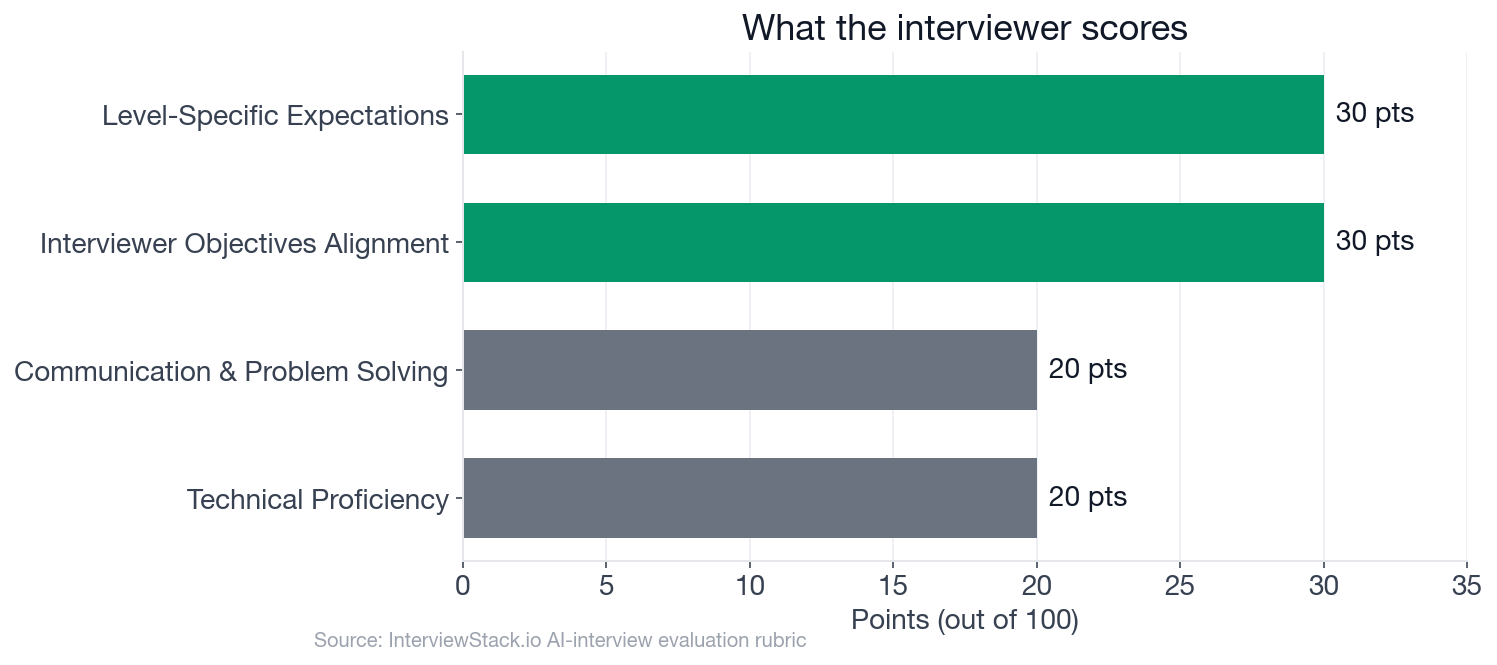
Judgment and level signals account for 60 of the 100 points, so a perfectly formatted bug report alone cannot carry the score.
Four Follow-Ups, Four Places Points Leak
Turn 1: Rating Two Symptoms
Interviewer: "How would you decide the severity and priority of the two symptoms here, and could those differ from each other?"
Turn 2: Stuck Without a Repro
Interviewer: "If engineering still cannot reproduce the issue reliably, what would you do next to move the investigation forward?"
Turn 3: Ship With a Workaround?
Interviewer: "How would you approach the release recommendation if there is a workaround for the promo display issue but not yet for the final charged amount mismatch?"
Turn 4: What Does Closed Mean?
Interviewer: "What states or transitions would you expect in the defect lifecycle for this bug, and what exit criteria would you use before marking it closed?"
Why Isn't Reading This Enough?
Spotting these four mistakes on the page is easy. Avoiding them live is the real skill: the clock is running, the follow-up is unscripted, and "it depends" is not an answer. Candidates who know the severity-versus-priority distinction still collapse it under pressure, because the habit of separating symptoms only forms through reps. Saying your release recommendation out loud, with a trade-off attached, feels different from nodding at it here.
The Blueprint a Strong Candidate Hits
This is the blueprint a strong candidate covers across the 30 minutes, and exactly what the AI mock interview tracks you against in real time. Each phase has a time range, and the checklist items turn green as you hit them.
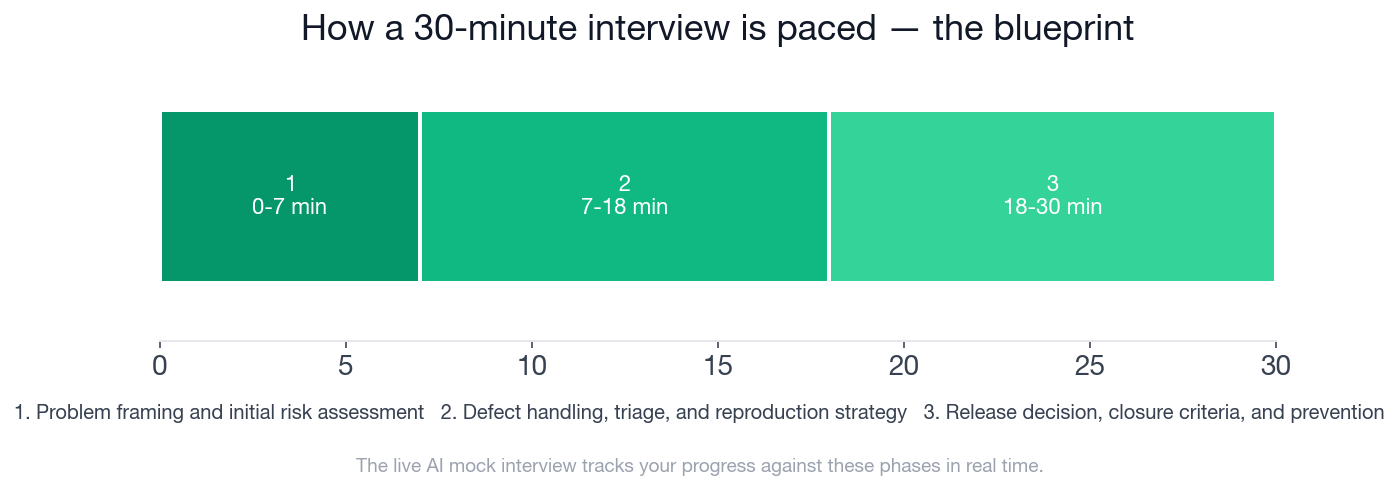
The 12-minute final phase is the longest, and it is where the release call is graded, so a candidate who runs long on bug report formatting in the 11-minute middle phase has to leave enough time to make that call.
- ✓Clarifies the two symptoms as potentially distinct defects or one defect with multiple manifestations
- ✓Identifies payment/charged amount mismatch as higher-risk than promo display inconsistency
- ✓Considers customer trust, financial impact, compliance/escalation implications, and production history
- ✓Avoids assuming root cause before enough evidence exists
- ✓Outlines an initial plan that includes triage, repro attempts, and release decision input
- ✓Mentions concrete bug report fields such as environment, device/browser, account state, promo details, address change sequence, expected vs actual, frequency, logs/screenshots/video, build/version, and impact
- ✓Proposes narrowing repro conditions with a matrix across device/browser, user state, promo type, shipping region, cached session/state, and payment flow transitions
- ✓Uses available signals from support or production complaints to correlate patterns rather than dismissing low reproducibility
- ✓Describes sensible lifecycle states such as New, Triaged, Assigned, In Progress, Fixed, Ready for QA, Verified, Reopened, Deferred, or Duplicate where appropriate
- ✓Explains how they would keep product and engineering aligned on status, blockers, and risk
- ✓Makes a defensible release recommendation that distinguishes between workaround-acceptable and release-blocking conditions
- ✓Defines closure criteria including fix validation in affected environments, targeted regression of related pricing/checkout flows, and confirmation that charged amount calculations are correct
- ✓Includes post-release monitoring or support readiness if any residual risk is accepted
- ✓Suggests preventive actions such as adding coverage for pricing state transitions, improving test data scenarios, adding observability around total calculation changes, or reviewing triage patterns from prior complaints
- ✓Communicates tradeoffs clearly instead of defaulting to either always block or always ship
Run This Interview Live
The fastest way to find out whether you would block or ship is to be asked, out loud, with a follow-up you have not seen.
Start the AI mock interview for this exact scenario and get scored against the same four dimensions, with turn-by-turn coaching afterward. If you want to warm up first, drill QA Engineer defect management questions in the question bank, skim the preparation guides, or see how a sibling topic plays out in our test reporting walkthrough. When you are ready to see who is hiring, browse current QA Engineer openings.
FAQ
Q. How long is the QA Engineer defect management mock interview?
The blueprint runs 30 minutes in three phases: problem framing and risk assessment (minutes 0-7), defect handling, triage, and reproduction strategy (7-18), and release decision, closure criteria, and prevention (18-30).
Q. How is a QA Engineer defect management interview scored?
Out of 100 points: 30 for Interviewer Objectives Alignment, 30 for Level-Specific Expectations, 20 for Technical Proficiency, and 20 for Communication and Problem Solving. Judgment and seniority signals carry 60 of the 100 points.
Q. What is the difference between severity and priority in a bug triage answer?
Severity is how much damage the defect does (a wrong charged amount is financial and trust damage). Priority is how soon it gets fixed given release timing, scope, and workarounds. The two can differ, so strong answers rate each symptom separately instead of assigning one label to the whole bug.
Q. What should a QA Engineer do when engineering cannot reproduce a bug?
Narrow the conditions instead of waiting. Build a repro matrix across device, browser, account state, promo type, shipping region, and cached session, correlate production support complaints, and attach logs, build version, and session details so engineering can test a specific hypothesis.
Q. Should a QA Engineer always block a release when a defect is open?
No. A defect with an acceptable workaround can ship with a known-issue note and support readiness. A defect with no workaround that touches money, like a charged-amount mismatch, is a release-blocking condition. The interview rewards stating that distinction and its trade-offs.
Q. What separates a mid-level answer from a junior one on defect management?
A mid-level candidate writes and drives the bug report and triage discussion without heavy prompting, makes evidence-based trade-offs, and escalates when business risk is high. They also separate a cosmetic inconsistency from a revenue-impacting defect.
Where Your Next Rep Goes
Defect management interviews reward the candidate who ranks the risk first and negotiates the release second. Pick the symptom that touches money, say why, and let the rest of your answer follow from it.
Topics
Ready to practice?
Put what you've learned into practice with AI mock interviews and structured preparation guides.