
'QA Engineer' Covers a Dozen Industries. 'SDET' Mostly Covers One.
Two testing titles, one common assumption: that "QA Engineer" and "SDET" (Software Development Engineer in Test) describe roughly the same job, with one just sounding fancier than the other. The postings don't back that up. We looked at every active listing on the InterviewStack.io job board as of July 2026, 15,897 QA Engineer postings against 1,003 SDET postings, and the gap between them isn't really about seniority or pay grade. It's about what kind of company is hiring and what "quality" even means on the job.
QA Engineer is the far bigger market, 15.85 times more active postings, but it's also a far more scattered one: no single skill shows up in even 40% of QA Engineer postings. SDET is the opposite. It's a fraction of the volume, but 86% of its postings ask for the same thing, automation, and it pays $25,000 more at the median.
| QA Engineer | SDET | |
|---|---|---|
| Median US base salary | $105,000 | $130,000 |
| Active postings analyzed | 15,897 | 1,003 |
| Top skill | Quality Assurance (35.2%) | Automation (86.0%) |
| Remote + hybrid share | 24.4% | 40.6% |
| Entry-level share | 3.9% | 2.5% |
| Skill overlap (Jaccard) | 50% shared (pairwise) | 50% shared (pairwise) |
Key Findings
- QA Engineer postings outnumber SDET postings 15.85 to 1 (15,897 vs 1,003 active listings analyzed).
- SDET pays a $25,000 (19.2%) premium at the median US base salary: $130,000 vs $105,000 (n=177 and n=3,304).
- Automation is the closest thing to a shared skill, but the split is stark: 86.0% of SDET postings mention it versus 27.3% of QA Engineer postings.
- No single skill dominates QA Engineer postings; even its own defining skill, Quality Assurance, appears in just 35.2%, versus SDET's automation at 86.0%.
- QA Engineer's top employers include manufacturing and pharma names (Jabil, Abbott Laboratories, Thermo Fisher Scientific), and QA-exclusive skills like Six Sigma (8.1%) and Quality Management (17.4%) point to physical-product quality work well outside software testing.
- SDET postings offer more flexibility: 40.6% are hybrid or remote, versus 24.4% for QA Engineer.
- The two roles share half their top-30 skill sets (Jaccard 0.50), but SDET's exclusive skills (Jenkins 23.1%, AWS 16.6%, Docker 15.5%) mark it as a software-engineering role in a way QA Engineer's exclusives do not.
What Does Each Role Actually Do?
A QA Engineer inside a software company owns test plans, writes manual and automated test cases, and tracks defects back to root cause. But "QA Engineer" is also the title plenty of non-software companies use for physical product quality work, and the postings data shows it: top employers include Jabil, Abbott Laboratories, Flex, and Thermo Fisher Scientific, manufacturing and pharmaceutical companies where a QA Engineer inspects hardware, runs calibration checks, and applies Six Sigma process discipline rather than filing GitHub issues. Our QA Engineer skills breakdown goes deeper on that broader footprint.
An SDET writes code. The job is building and maintaining the automation frameworks, CI/CD pipelines, and test infrastructure other engineers depend on to ship safely, closer to a software engineer who specializes in testability than to a QA analyst. The SDET title stays closer to software organizations than QA Engineer does, but the match isn't perfect: a share of the postings under this title, ones like "Senior Manufacturing Engineer (Welding & Automation)" or "Automation & Controls Specialist," are industrial and manufacturing automation roles that share the word "automation" with software test automation but aren't software engineering at all. Treat SDET's numbers here as cleaner than QA Engineer's by degree, not as contamination-free.
Which Skills Do Both Roles Actually Share?
Half, by one measure: the two roles' top-30 skill sets overlap at a Jaccard coefficient of 0.50. Averaging hides the real story, though, because the same skill name carries very different weight on each side. Automation is the clearest case: it's close to a universal SDET requirement at 86.0% of postings, while it's just one skill among many for QA Engineer, at 27.3%. Python (39.1% SDET vs 15.2% QA Engineer), CI/CD (41.6% vs 11.5%), and Test Automation (39.2% vs 13.6%) follow the same pattern, present on both lists, but roughly 2.5 to 3.6 times more common on the SDET side. That 86.0% automation figure for SDET likely runs a little hot, though: because the title-matching keys partly off the word "automation," a portion of the underlying postings are industrial or manufacturing automation roles ("Automation Eng Technician," "Process & Automation Equipment Engineer") rather than software test automation. The skill still anchors SDET far more consistently than anything anchors QA Engineer, but the number itself shouldn't be read as a precise 86%. Only Quality Assurance itself flips the other way (35.2% QA Engineer vs 16.0% SDET), and even that isn't dominant for QA Engineer: it's the role's own defining skill, and it still shows up in barely a third of its postings.
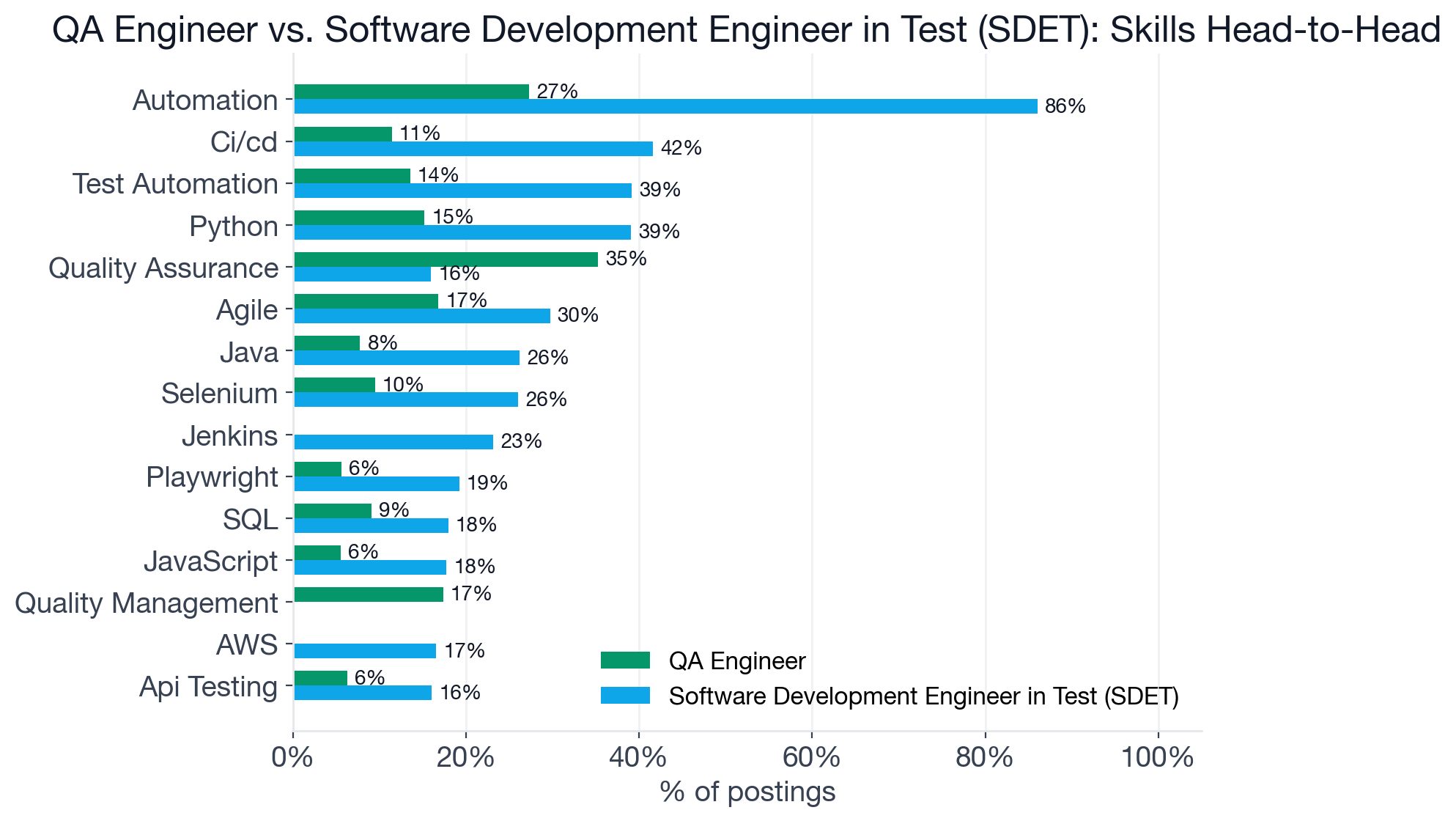 Automation anchors SDET almost universally; QA Engineer's skill footprint is far more spread out, with no single skill above 36%.
Where the Two Roles Split
QA Engineer's exclusive skills, the ones that clear 8% of postings on that side while staying under 5% for SDET, read like a manufacturing quality department: Quality Management (17.4%), Quality Control (13.2%), Excel (12.5%), Process Improvement (10.5%), and Six Sigma (8.1%). None of those are software-testing concepts; they're the vocabulary of a plant floor or a pharma quality department, which lines up with the employer list above.
SDET's exclusive skills point the opposite direction, straight at a software-engineering toolchain: Jenkins (23.1%), AWS (16.6%), Docker (15.5%), Git (15.0%), and TypeScript (13.8%). These are the tools of someone who ships code, not someone who inspects it after the fact.
Neither role's top-30 skill list contains an explicit AI or machine-learning skill, but that silence means something different for each side. Our deep dive on AI's effect on QA Engineer work covers this gap in more detail. SDET sits inside the general software-engineering population, where an AI coding assistant is close to a given: Stack Overflow's 2025 Developer Survey puts AI-tool adoption at 84% of developers, and GitHub Octoverse 2025 found 80% of new developers use Copilot in their first week. An SDET writing Python or TypeScript automation code is very likely already working alongside one of these tools, whether or not the posting mentions it. QA Engineer is harder to generalize about in the same way: Capgemini's World Quality Report 2025-26 found 89% of quality-engineering organizations piloting or deploying generative AI, mostly for self-healing test automation, but only 15% at real enterprise scale, and only about a third of testers say they trust AI-generated output at all. That adoption also has to average across a population that, per the company and skill data above, includes plenty of manufacturing and hardware quality roles where a coding assistant has no obvious job to do.
Which Role Pays More?
SDET, by $25,000. These are US-only base salaries: equity, bonus, and sign-on aren't disclosed in postings and aren't reflected here, so total compensation at senior levels runs higher than either number. SDET's median is $130,000 (n=177); QA Engineer's is $105,000 (n=3,304), a $25,000 gap, 19.2% below SDET's baseline. Worth flagging: SDET's US salary sample is comparatively thin at 177 postings against QA Engineer's 3,304, so treat the SDET figure as directionally solid rather than exact.
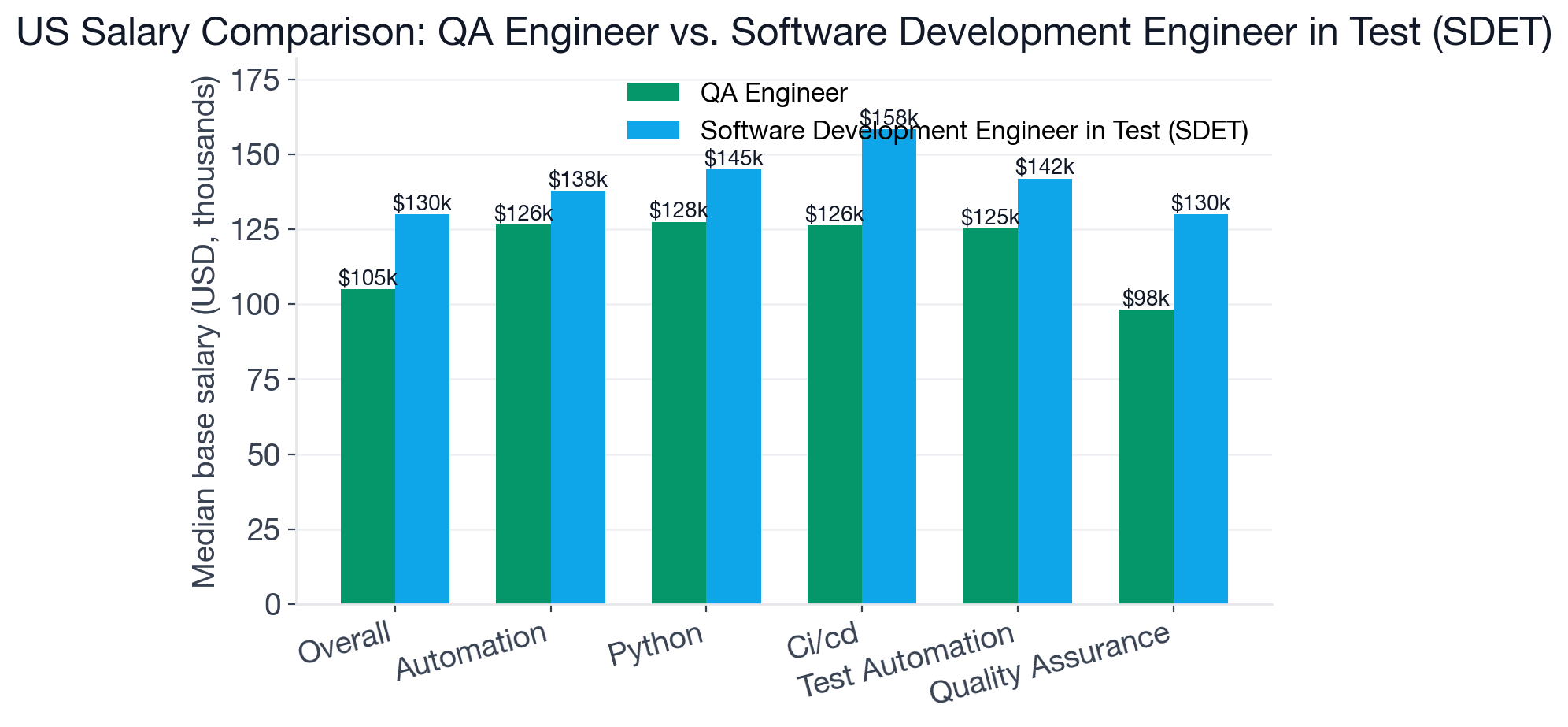 SDET's baseline sits well above QA Engineer's, and both roles pay their biggest premiums for cloud and CI/CD fluency rather than for the skills that define the title.
The premium skills tell a consistent story on both sides. For SDET, AWS carries the single largest lift, $171,000, $41,000 over the SDET median (n=27), followed by CI/CD and Jenkins at $158,300 each (roughly +$28,300, n=70 and n=47) and Docker at $155,000 (+$25,000, n=40). Notably, the skill "quality assurance" itself pays exactly at the SDET median ($130,000, n=43): the premium comes from infrastructure fluency, not testing vocabulary.
QA Engineer's premiums land somewhere else entirely: Machine Learning ($157,500, +$52,500 over the $105,000 baseline, n=54), Computer Vision ($146,500, +$41,500, n=93), Data Quality ($146,400, +$41,400, n=70), and Jenkins ($142,500, +$37,500, n=100). None of these are the manufacturing-QA skills that define most of the role; they're the software- and data-adjacent postings inside the QA Engineer bucket, and they pay close to, or above, SDET's own baseline. The real divide isn't the job title, it's how close a given posting sits to software engineering, whichever title it happens to be filed under.
Which Has More Job Openings, and How Hard Is It to Break In?
QA Engineer, by a wide margin. 15,897 active QA Engineer postings against 1,003 for SDET works out to a 15.85x volume advantage, meaning a QA Engineer search draws from a pool nearly 16 times the size.
Neither role offers much of an explicit entry-level path. Entry-level postings are 3.9% of QA Engineer listings and 2.5% of SDET listings, and both are dominated by mid-level hiring (71.7% QA Engineer, 62.2% SDET); worth noting that seniority here is inferred from title keywords, and postings without a clear signal default to mid-level, which likely inflates both mid-level shares somewhat. Where they diverge is at the senior end: SDET skews noticeably more experienced, with 22.3% senior and 13.0% staff (35.3% combined) versus QA Engineer's 16.3% senior and 8.1% staff (24.4% combined). The smaller, better-paid role is also the one asking for more seniority.
Work mode tells a similar story. SDET postings are 40.6% hybrid or remote, versus 24.4% for QA Engineer, which tracks with SDET's software-engineering profile: fully remote software teams are simply more common than fully remote manufacturing-quality teams. Geographically, both roles are US-anchored (43.1% QA Engineer, 35.0% SDET), with India the clear second market for each (8.3% and 21.8% respectively).
Which Should You Choose?
Choose QA Engineer if you:
- Want the largest, most accessible pool of openings (15.85 times more active postings than SDET), and are comfortable with the title meaning different things at different companies
- Have a background in quality processes, Six Sigma, or manufacturing quality control rather than pure software engineering
- Are aiming to move toward the software-adjacent end of the role (automation, data quality, machine-learning-flavored testing) to close the pay gap over time
Choose SDET if you:
- Want to write code daily and own the CI/CD pipelines and test infrastructure other engineers depend on
- Want the higher pay ceiling ($130,000 median, a $25,000 premium) and meaningfully more hybrid or remote flexibility (40.6% vs 24.4%)
- Are comfortable competing in a narrower market (1,003 active postings) that skews more senior (35.3% senior plus staff, versus 24.4% for QA Engineer)
How to Use This in Your Job Search
If QA Engineer's larger market fits where you are today, start with current QA Engineer openings, or narrow to a premium skill with QA Engineer + Machine Learning. If you're weighing a move toward SDET, browse active SDET postings or filter to SDET + AWS to see what that jump actually asks for.
Either direction, practice with AI mock interviews built around the specific role you're targeting rather than a generic template. If your gap is foundational, CI/CD and cloud tooling for the SDET track, automation scripting for the QA track, our interactive courses build that base first. If the fundamentals are already solid, the Question Bank lets you drill test-automation and system-design topics directly instead of studying everything at once.
FAQ
Q. What's the salary difference between QA Engineer and SDET in 2026?
SDET postings show a median US base salary of $130,000 versus $105,000 for QA Engineer, a $25,000 (19.2%) premium. The SDET figure is based on a smaller sample (n=177) than QA Engineer's (n=3,304), so treat it as directionally solid rather than exact. Equity, bonus, and sign-on are not disclosed in postings and are not reflected in either number.
Q. Are QA Engineer and SDET the same job?
No. QA Engineer postings span manufacturing, pharmaceutical, and hardware quality assurance alongside software testing (top employers include Jabil, Abbott Laboratories, and Thermo Fisher Scientific), while SDET skews far more heavily toward software-engineering roles that build test automation and CI/CD infrastructure, though the title still catches some industrial and manufacturing automation postings that share the word 'automation.' Automation appears in 86.0% of SDET postings versus 27.3% of QA Engineer postings, though that 86.0% figure is likely inflated somewhat by that same industrial-automation overlap.
Q. Which role has more job openings?
QA Engineer, by a wide margin: 15,897 active postings versus 1,003 for SDET, a 15.85x volume difference.
Q. Do QA Engineer and SDET roles require the same skills?
They overlap on about half their top-30 skill sets (Jaccard similarity of 0.50). Both mention automation, Python, CI/CD, and test automation, but at very different frequencies. QA Engineer postings uniquely emphasize Quality Management, Six Sigma, and Excel, while SDET postings uniquely emphasize Jenkins, AWS, Docker, and TypeScript.
Q. Is AI a required skill for QA Engineer or SDET roles in 2026?
Not explicitly; neither role's top-30 skill list includes an AI or machine-learning skill as a named requirement. That doesn't mean AI is absent from the work. SDET sits inside the general software-engineering population, where surveys report 84% of developers use AI tools and 51% use them daily. QA teams specifically report 72% to 85% now using at least one AI tool, most often for automated test generation and self-healing test scripts, though only about a third of testers say they fully trust AI-generated output.
Q. Which role pays more for cloud and automation skills?
SDET rewards cloud fluency most: AWS carries the largest premium at $171,000 (+$41,000 over the $130,000 baseline, n=27), followed by CI/CD and Jenkins at $158,300 each. QA Engineer's biggest premiums show up in Machine Learning ($157,500, +$52,500) and Computer Vision ($146,500, +$41,500), skills that mark the software- and data-adjacent postings inside a much broader QA Engineer population.
Q. Which role is easier to break into?
Neither offers much of an explicit entry-level path: 3.9% of QA Engineer postings and 2.5% of SDET postings are entry-level, with both roles dominated by mid-level hiring (71.7% and 62.2%, respectively). QA Engineer's much larger volume of openings makes it the more accessible market overall, even without a large entry-level slice.
Read the Posting, Not Just the Title
"QA Engineer" and "SDET" aren't two rungs of the same ladder. One is a title a plant, a pharma company, and a software team all use for genuinely different jobs; the other is used almost exclusively inside software engineering, and pays accordingly. If you're deciding between them, the skills listed in the specific posting, not the job title, are the more reliable signal for what you'd actually be doing, and what it would pay.
Topics
Ready to practice?
Put what you've learned into practice with AI mock interviews and structured preparation guides.