
React is a frontend and full-stack skill, not a general one: it is named in 11,049 of 156,131 active postings (7.1%) on the InterviewStack.io job board over the 90 days to 24 November 2026, and in about half of Full-Stack Developer and Frontend Developer postings. Compared inside the same role and seniority, postings that name React advertise about the same US base pay as those that do not (-0.5% weighted across 20 cells), and the share of postings naming it has been flat.
So the useful question is not whether React is "in demand" but which job you want. Full-Stack and Frontend ads treat it as close to standard. Software Engineer ads, which supply the most React postings simply because there are so many of them, name it in about 1 in 8. Everything below is what employers write in ads on one job board, not what the wider market does.
Key Findings
- React is named in 11,049 of 156,131 postings (7.1%), across 37 of 39 roles.
- It is named in 50.5% of Full-Stack Developer postings, 48.0% of Frontend Developer postings and 12.2% of Software Engineer postings.
- Those three roles make up 76.5% of all React postings.
- The share naming React moved from 7.6% to 7.1% to 6.9% across three 30-day windows, which we read as flat.
- Of the 2,772 mentions with required or preferred wording nearby, 80.1% say preferred and 19.9% say required.
- Within the same role and seniority, the weighted US base pay gap is -0.5%: higher in 10 of 20 cells, lower in 6.
- TypeScript appears in 54.0% of React postings (6.9 times the corpus rate), Node.js in 25.3% (6.8 times).
React Demand Sits in Three Roles, and Only Two of Them Treat It as Standard
React shows up in 37 of the 39 roles we track, but the volume is concentrated. Software Engineer postings supply the most because the role is the largest on the board, yet only about 1 in 8 of them names React. Full-Stack and Frontend postings are far smaller groups where React is named in roughly every second ad.
| Role | Postings naming React | Share of all React postings | Share of that role's postings |
|---|---|---|---|
| Software Engineer | 4,739 | 42.9% | 12.2% |
| Full-Stack Developer | 2,709 | 24.5% | 50.5% |
| Frontend Developer | 1,007 | 9.1% | 48.0% |
| Engineering Manager | 585 | 5.3% | 8.3% |
| AI Engineer | 363 | 3.3% | 8.0% |
| Backend Developer | 279 | 2.5% | 9.7% |
| DevOps Engineer | 216 | 2.0% | 4.1% |
| Product Designer | 111 | 1.0% | 6.6% |
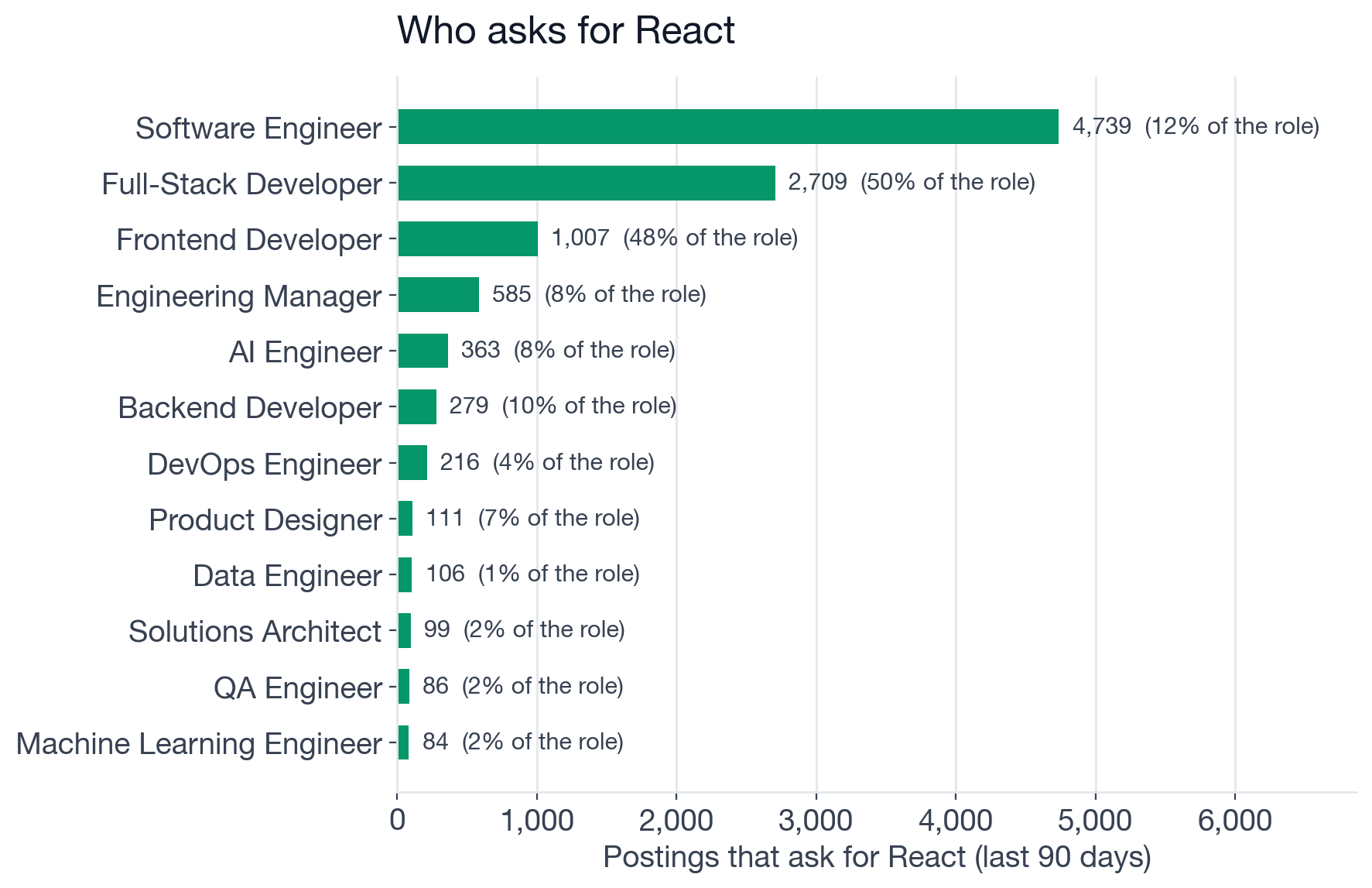
The chart counts postings that name React, by role, within the last 90 days on our board.
About half of Frontend and Full-Stack ads name React, so a candidate in those roles without it will not match a large share of the ads. A Software Engineer candidate without it is in line with most of that role's ads, and a Data Engineer or Product Manager candidate barely meets it at all (1.4% and 0.5% of those roles' postings). The Software Engineer role covers many stacks; React is one of several, so a share of 12.2% says the title is broad, not that the skill is niche. For the wider skill picture in those roles, see our Software Engineer and Frontend Developer skills posts, and the Full-Stack vs Frontend comparison.
Seniority points the same way as the rest of the board rather than toward juniors. Titles that name React carry a senior or staff level word in 48.5% of cases, against 38.5% for postings that do not, and an entry-level word in 3.9% against 4.9%. Level is read from title words and titles with no level word default to mid-level, so treat the mid-level share as inflated and the entry share as a floor.
Is React Required or a Nice-to-Have?
Where the wording can be read, React is far more often preferred than required: 80.1% preferred against 19.9% required, among the 2,772 mentions (of 11,049) with required or preferred wording within about 160 characters. Three in four mentions carry no such wording, so this is a read of a subset, not of all React postings.
In these ads React is more often written as a plus than as a hard requirement. We cannot tell from the data how flexible employers are in practice, or whether ads that also name Angular or Vue (see the pairing section below) treat the frameworks as alternatives or as a combined stack.
Does React Come With Higher Pay? Not Consistently
Pay figures here are US advertised base salary only, from postings that disclose it. Equity, bonus and sign-on are not in the data, so total compensation at larger employers is higher than anything shown. The comparison is postings that name React against postings that do not, inside the same role and seniority, using only cells with at least 15 disclosed salaries on each side. The 20 cells used cover 87.0% of React postings. The raw gap across the whole corpus points the opposite way from the matched result because of job mix, so we leave it out.
The weighted gap across cells is -0.5%: effectively nothing. Underneath, cells go both ways: higher in 10, lower in 6 and within about 2% either way in the other 4. This is a correlation between advertisements, not a statement of what React earns anyone, and the data does not say why any cell differs.
| Role and level | With React (US base) | Without React | Gap | Postings with pay (with / without) |
|---|---|---|---|---|
| Software Engineer, entry | $98,800 | $92,500 | +6.8% | 85 / 515 |
| Software Engineer, mid-level | $150,000 | $169,050 | -11.3% | 648 / 4,848 |
| Software Engineer, senior | $182,000 | $184,000 | -1.1% | 520 / 3,274 |
| Software Engineer, staff | $210,000 | $214,500 | -2.1% | 371 / 2,332 |
| Full-Stack Developer, mid-level | $145,000 | $146,300 | -0.9% | 237 / 218 |
| Full-Stack Developer, senior | $173,750 | $160,500 | +8.3% | 197 / 138 |
| Full-Stack Developer, staff | $192,500 | $201,250 | -4.3% | 101 / 74 |
| Frontend Developer, mid-level | $169,050 | $133,850 | +26.3% | 112 / 162 |
| Frontend Developer, senior | $160,000 | $165,000 | -3.0% | 71 / 59 |
| Frontend Developer, staff | $193,743 | $176,700 | +9.6% | 30 / 47 |
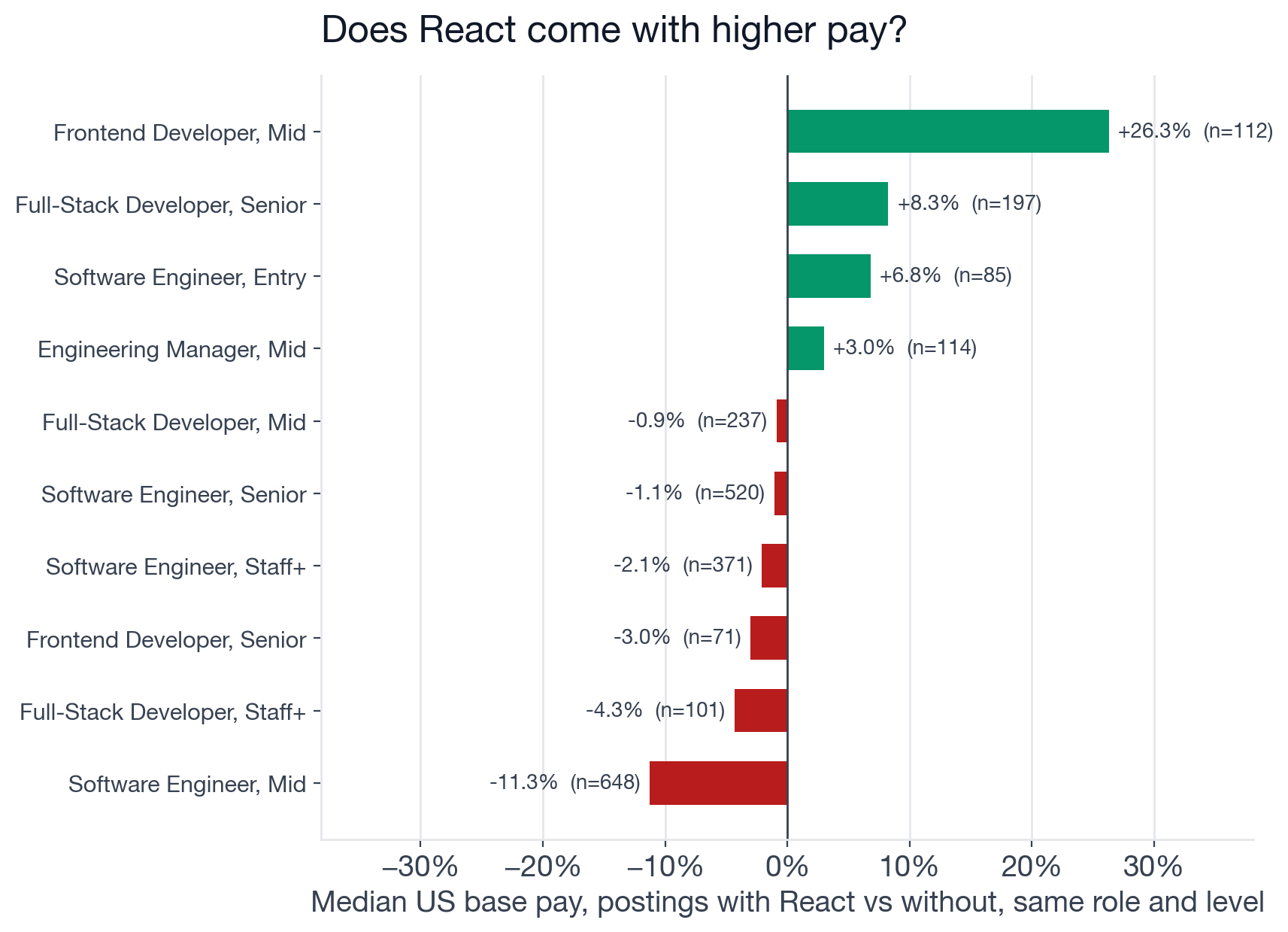
The chart shows the gap in median US base salary between postings that name React and those that do not, within each role and level; it is not what React adds to a salary.
A single sentence like "React comes with higher pay" would be false for the largest group of readers. Software Engineer ads naming React advertise lower medians at mid-level (-11.3%, the biggest cell by sample), senior and staff, and higher only at entry level on 85 disclosed salaries. The Frontend mid-level gap of +26.3% is the largest positive one, but it rests on 112 and 162 disclosed salaries, and the senior Frontend cell goes the other way (-3.0%). All three AI Engineer cells were higher, on small samples (15 to 47 postings with pay), and Engineering Manager cells split (+3.0% mid-level, +2.9% senior, -8.1% staff). The practical use of this is modest: ask what your own level and role advertise, rather than expecting a framework to move the number.
What Pairs With React: TypeScript First, Then Node.js
React is rarely named alone. The tools to learn next are the ones with the highest lift, meaning the ones that appear with React far more often than they appear in postings in general. Ranking by raw share would put AWS and Python near the top, but they are named across the board and carry little information about React work.
| Tool | Share of React postings | Lift vs the whole corpus |
|---|---|---|
| Vue | 13.7% | 9.4 |
| Angular | 23.4% | 7.3 |
| TypeScript | 54.0% | 6.9 |
| Node.js | 25.3% | 6.8 |
| JavaScript | 41.5% | 4.9 |
| PostgreSQL | 22.5% | 4.2 |
| Docker | 26.6% | 2.7 |
| C# | 14.8% | 2.6 |
| Java | 33.1% | 2.3 |
| Kubernetes | 25.2% | 2.0 |
| AWS | 40.6% | 1.8 |
| Python | 40.5% | 1.2 |
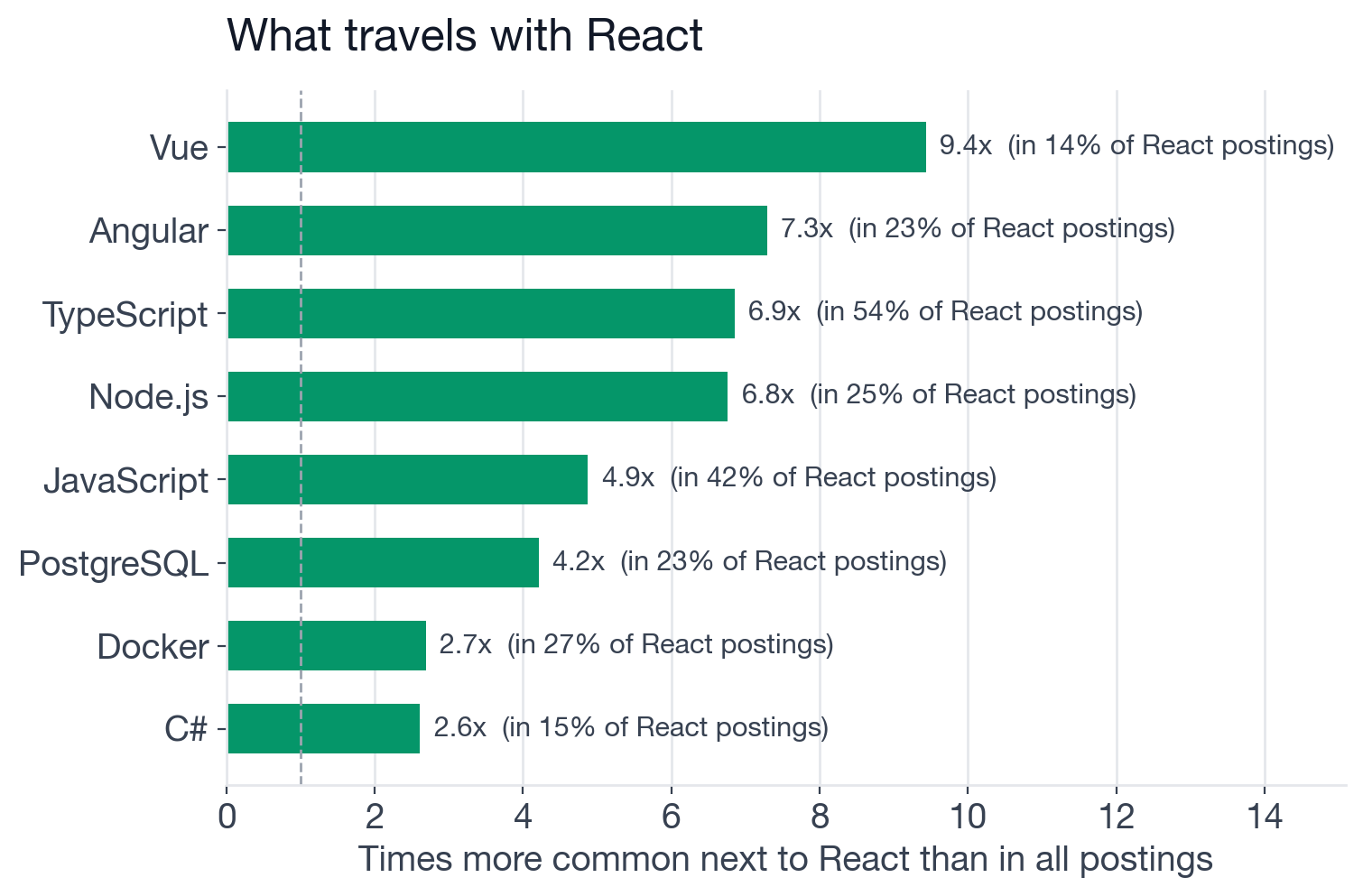
The chart ranks tools by how much more often they appear in React postings than in all postings.
TypeScript is the pairing that matters: more than half of React postings name it, at nearly seven times the corpus rate. Node.js and PostgreSQL pair with React well above their corpus rate, which fits the full-stack share of the demand. Vue and Angular have the highest lift, which means ads that name React often name another frontend framework too; the data does not show whether that is a combined stack or a list of acceptable alternatives, so it is not by itself a reason to learn three frameworks. On the practices side, CI/CD (44.7% of React postings), APIs (40.0%) and code review (37.5%) are the most common non-tool skills named alongside it, and LLMs appear in 20.5%, a mention rate that shows how often these ads describe AI work, not how many React roles build it.
Which Employers Name React Most Often?
By distinct openings, Amazon leads with 138, then Citi (117), Accenture (90), Cognizant (61), Booz Allen Hamilton (60), UnitedHealth Group (57), Google (54), PricewaterhouseCoopers (50), SpaceX (49) and Anduril (46). Counts are distinct openings, not repeated location rows.
There is no single industry story, but there is a pattern worth knowing: six of the top 15 employers (Accenture, Cognizant, Booz Allen Hamilton, PricewaterhouseCoopers, Leidos and CACI International) are IT-services, consulting or government-contractor firms, alongside banks, large technology companies and defense technology firms. React work is spread across very different kinds of employer, and no one of them accounts for a large slice of demand.
What to Do With This
- Decide by role first. If you are targeting Frontend or Full-Stack, treat React as a baseline and spend the extra learning time on TypeScript. If you are targeting Software Engineer roles in general, React is one reasonable stack among several; match it to the postings you actually want and browse current openings on the job board to check.
- Learn TypeScript with it, then Node.js or PostgreSQL if you lean full-stack. These are the high-lift pairings, not just the popular ones.
- Do not count on a pay lift from the framework. The matched data shows higher medians in some role-and-level cells and lower in others, and it cannot say what React itself earns anyone. Check what your own role and level advertise.
- Be ready to show React, not just list it. Practise explaining component design, state and rendering trade-offs aloud with AI mock interviews, and drill topics where you are weakest in the Question Bank.
- Fill gaps in fundamentals with the interactive courses, since most React ads also name APIs, CI/CD and code review.
FAQ
Q. How many job postings ask for React in 2026?
React is named in 11,049 of 156,131 active postings (7.1%) on the InterviewStack.io job board over the 90 days to 24 November 2026, across 37 of the 39 roles we track. It is named in about half of Full-Stack Developer (50.5%) and Frontend Developer (48.0%) postings and in 12.2% of Software Engineer postings.
Q. Is React demand growing or shrinking?
Flat on our board. The share of postings naming React was 7.6% for postings first seen 61 to 90 days ago, 7.1% for 31 to 60 days ago and 6.9% in the last 30 days, a movement of under 1 point that we treat as flat. Older windows only contain postings still active, so this is a rough read.
Q. Is React usually required or preferred?
Where the wording near the mention can be read (2,772 of 11,049 postings), 80.1% frame React as preferred and 19.9% as required. The remaining three quarters of mentions carry no required or preferred wording nearby, so this describes a subset.
Q. Do postings that ask for React advertise higher pay?
Not consistently. Comparing US advertised base pay within the same role and seniority, the weighted gap across 20 role-and-level cells is -0.5%. It is higher in 10 cells and lower in 6, for example Software Engineer mid-level $150,000 with React versus $169,050 without, and Frontend Developer mid-level $169,050 versus $133,850. This is a correlation across advertisements, not what React pays.
Q. What should you learn alongside React?
TypeScript is the strongest pairing: 54.0% of React postings name it, 6.9 times the rate in the whole corpus. Node.js (25.3% of React postings, lift 6.8), JavaScript (41.5%, lift 4.9) and PostgreSQL (22.5%, lift 4.2) follow. AWS and Python are common but about as common everywhere.
Q. Which roles name React most often?
By volume, Software Engineer (4,739 postings, 42.9% of React demand), Full-Stack Developer (2,709, 24.5%) and Frontend Developer (1,007, 9.1%) account for 76.5% of React postings. By how standard it is inside the role, Full-Stack (50.5%) and Frontend (48.0%) lead.
Where React Fits in Your 2026 Plan
On this board React is named in about half of Frontend and Full-Stack ads, in a minority of Software Engineer ads, and its share has been flat; postings that name it do not advertise higher pay across the board. Learn it with TypeScript, check the postings for the role and level you want, and judge the pay by your own role and level rather than by the framework.
Topics
Ready to practice?
Put what you've learned into practice with AI mock interviews and structured preparation guides.