
The Job Title in RHCE's Name Isn't Where Most of Its Demand Lives
RHCE's full name is Red Hat Certified Engineer, and four of the six roles in this dataset carry "Engineer" in the title: Systems Engineer, Cloud Engineer, Network Engineer, and Site Reliability Engineer (SRE), alongside Cloud Architect and Systems Administrator, which don't. If the certification's own name predicted where it gets asked for, the Engineer-titled roles would lead demand. They don't, at least among the roles with enough postings to check: Systems Administrator, which isn't an Engineer title at all, mentions RHCE about as often as Systems Engineer does, and both far outpace Cloud Engineer and Network Engineer. Site Reliability Engineer contributed no postings to this window, so it isn't part of the comparison below.
That pattern holds across 13,390 active postings scanned over a 90-day window on the InterviewStack.io job board, spanning Cloud Architect, Cloud Engineer, Network Engineer, Site Reliability Engineer (SRE), Systems Administrator, and Systems Engineer.
The numbers below cover exactly where that demand splits, what RHCE actually pays, and who's hiring for it.
Key Findings
- RHCE appears in just 0.75% of active postings across six roles (100 of 13,390 analyzed over 90 days).
- Systems Administrator (43% of mentions, a 1.53% mention rate) and Systems Engineer (38% of mentions, 1.01%) together account for 81% of all RHCE demand, despite Systems Administrator not having "Engineer" in its title at all.
- Cloud Engineer and Network Engineer, both literal Engineer titles, mention RHCE at just 0.39% and 0.11% respectively, far below Systems Administrator's rate.
- Among the 62 classified mentions, 88.7% (55) call RHCE preferred rather than required (7); 38 of the 100 total mentions don't specify either way.
- RHCE-mentioning postings advertise a median US base salary of $142,400 versus $135,000 for otherwise-similar postings in scope, about 5.5% higher, though no single seniority band has enough disclosed-salary postings to confirm that gap on its own.
- RHCSA, RHCE's own prerequisite certification, is the most common paired credential, appearing in 48% of RHCE mentions; CompTIA Security+ (23%) and CCNA (15%) follow.
- NVIDIA and CACI International tie for the most-cited employer (8 mentions each), and defense and government contractors make up about 56% of the top-12 employer mentions kept in this analysis.
Systems Administrator Narrowly Edges Out Systems Engineer for RHCE
Systems Administrator's 1.53% mention rate is the highest of the five roles with data in this scope, and it carries 43.0% of every RHCE mention. Systems Engineer isn't far behind: a 1.01% mention rate and 38.0% of mentions. Neither is a landslide over the other, but together they account for 81% of all RHCE demand in this dataset, while the roles that literally share the word "Engineer" with the certification, Cloud Engineer and Network Engineer, barely register.
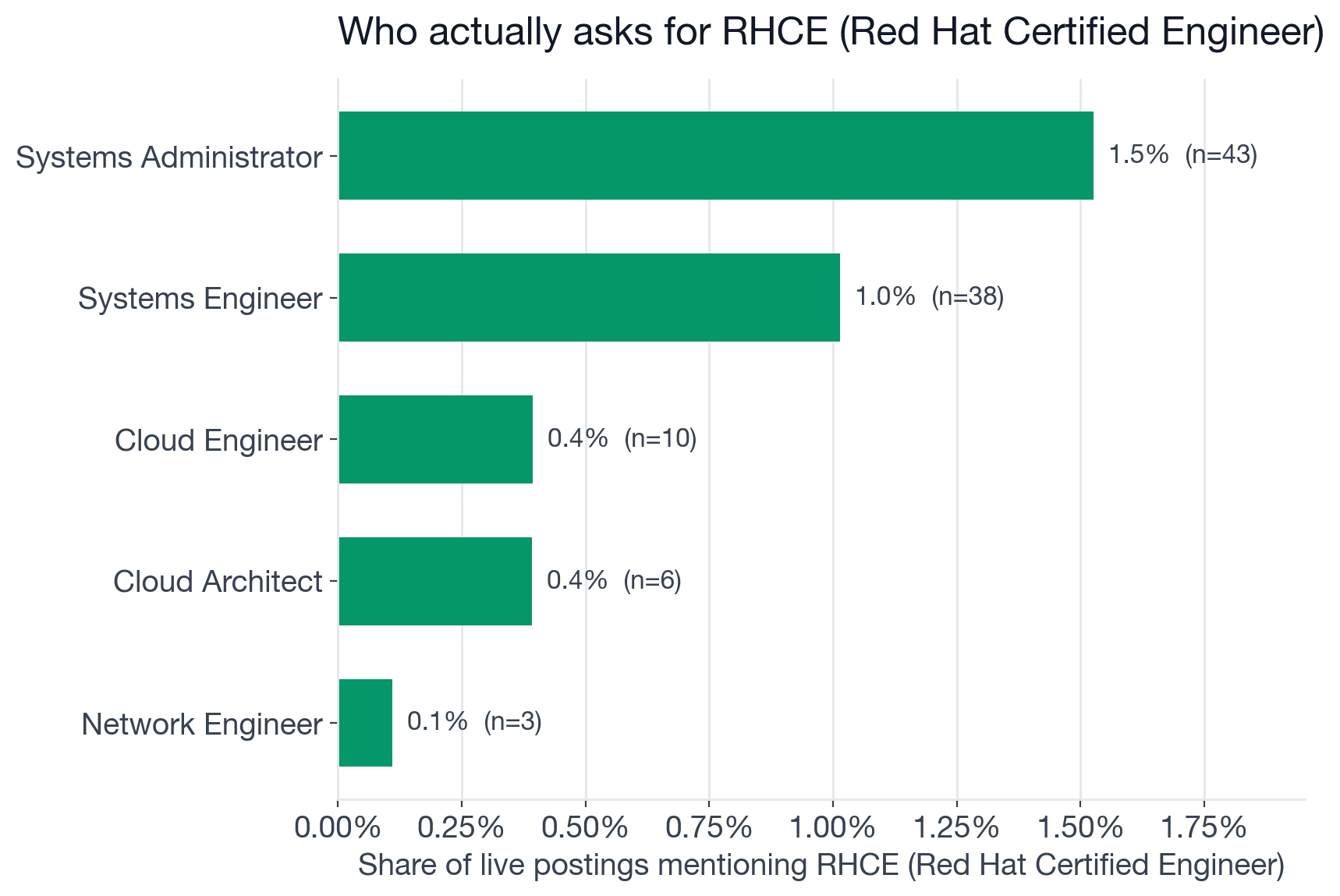 Systems Administrator and Systems Engineer cluster together near the top; Cloud Engineer and Cloud Architect sit at nearly identical, much lower rates, and Network Engineer trails the field.
| Role | Postings Scanned | RHCE Mentions | Mention Rate | Share of All RHCE Mentions |
|---|---|---|---|---|
| Systems Administrator | 2,818 | 43 | 1.53% | 43.0% |
| Systems Engineer | 3,748 | 38 | 1.01% | 38.0% |
| Cloud Engineer | 2,545 | 10 | 0.39% | 10.0% |
| Cloud Architect | 1,531 | 6 | 0.39% | 6.0% |
| Network Engineer | 2,748 | 3 | 0.11% | 3.0% |
| Site Reliability Engineer (SRE) | N/A | 0 | N/A | N/A |
Weighed against each role's share of the scanned pool rather than its raw mention count, the split is even cleaner. Systems Administrator over-indexes about 2.0x (21.0% of postings, 43.0% of mentions) and Systems Engineer over-indexes by about 1.4x (28.0% of postings, 38.0% of mentions). Cloud Engineer and Cloud Architect both run the other way, at roughly half their expected share (19.0% of postings vs 10.0% of mentions for Cloud Engineer; 11.4% of postings vs 6.0% of mentions for Cloud Architect), and Network Engineer under-indexes the most of the five: 20.5% of postings but just 3.0% of mentions, roughly one-seventh its expected share.
Pay tier doesn't explain the split either. Network Engineer is the second-cheapest role in this scope at $132,998 median base without the certification, but it has the weakest over-index score of the five. Systems Engineer, priced above both Systems Administrator and Network Engineer at $141,000, is the second-strongest over-indexer. If cert demand tracked pay level, the two cheapest roles would over-index together and the two priciest would lag together; instead the split tracks which roles actually do hands-on Linux systems work day to day, Systems Administrator and Systems Engineer, regardless of where they sit in the scope's pay ladder or whether "Engineer" appears in the title.
Do Most RHCE Postings Even Say Whether It's Required?
Most do. Of the 100 total mentions, 62 carry clear required-or-preferred wording and 38 don't specify either way. Among the 62 classified mentions, only 7 (11.3%) mark RHCE required; the other 55 (88.7%) call it preferred.
| Classification | Count | Share of Classified Mentions | Share of All Mentions |
|---|---|---|---|
| Required | 7 | 11.3% | 7.0% |
| Preferred | 55 | 88.7% | 55.0% |
| Unspecified | 38 | N/A | 38.0% |
RHCE functions overwhelmingly as a resume-strengthening credential rather than a hard gate. A posting that names it without marking it required is very likely still open to a strong candidate who doesn't hold the certification yet, provided the surrounding experience matches what the role actually needs.
RHCE's Pay Edge Can't Be Confirmed at Any Single Seniority Level
This is US base salary only, on the subset of postings that disclose it; equity, bonus, and other compensation aren't captured, and the comparison is against other postings in this same six-role scope, not the broader job market. RHCE-mentioning postings advertise a median of $142,400 (n=37) versus $135,000 for postings in scope that don't mention it (n=4,910), about 5.5% higher, roughly $7,400.
Unlike most certifications in this series, that comparison can't be checked at any single seniority level. All four bands, entry, mid-level, senior, and staff, fall short of the 25-posting floor this analysis requires for a reliable with-cert median: the largest, mid-level, has only 20 RHCE-mentioning postings with disclosed salary; entry has 1, senior 14, staff 2. The $142,400 figure is real, it is the actual median of the 37 postings that disclose both a salary and an RHCE mention, but there isn't enough data to say whether it holds within any individual level or is being shaped by which levels happen to make up that small sample.
| Seniority Level | Median US Base, With RHCE | Median US Base, Without RHCE | Sample (With / Without) |
|---|---|---|---|
| Entry | Not reportable (n=1) | $81,857 | 1 / 96 |
| Mid-level | Not reportable (n=20) | $128,300 | 20 / 3,158 |
| Senior | Not reportable (n=14) | $147,650 | 14 / 1,063 |
| Staff | Not reportable (n=2) | $174,600 | 2 / 593 |
| All levels (aggregate) | $142,400 | $135,000 | 37 / 4,910 |
Checking seniority composition doesn't resolve it either way. RHCE-mentioning postings are 2% entry, 61% mid-level, 31% senior, and 6% staff; postings that don't mention RHCE run 2.9% entry, 64.9% mid-level, 22.1% senior, and 10.2% staff. RHCE-mentioning postings skew a bit more toward senior and a bit less toward staff relative to the baseline, roughly offsetting effects, since senior pays more than mid-level but staff pays the most of the four bands. That comparison carries its own methodology limit: seniority here is inferred from title keywords, and a posting with no explicit level word, a plain "System Administrator" or "Systems Engineer," common in this dataset's title sample, defaults to mid-level, which compresses the measured spread on both sides of the comparison and means the true senior and staff shares could be undercounted in either group. The composition is close enough to the comparison group that it doesn't obviously manufacture the premium, but the sample within any one level is too thin to call this a confirmed, level-adjusted finding. Read the 5.5% figure as directional, the best comparison this dataset supports, not as a settled premium.
Which Certification Actually Pairs With RHCE Most Often?
RHCE's own prerequisite, RHCSA, is the most common pairing by a wide margin, appearing in 48% of RHCE mentions, more than twice the next-closest certification. That's the expected shape: RHCE requires an active RHCSA to sit the exam, so a posting naming RHCE is implicitly naming a candidate who already holds RHCSA too, whether or not the posting bothers to say so. RHCSA's own demand and pay pattern is covered in a companion post in this series, where RHCE itself shows up as a co-occurring credential in 40% of RHCSA mentions, behind CompTIA Security+ at 47.4%.
| Certification | Co-occurs With RHCE (% of Mentions) |
|---|---|
| RHCSA (Red Hat Certified System Administrator) | 48.0% |
| CompTIA Security+ | 23.0% |
| CCNA | 15.0% |
| CKA (Certified Kubernetes Administrator) | 14.0% |
| VMware VCP | 13.0% |
| CISSP | 10.0% |
| CCNP | 10.0% |
Security+ (23%) and CCNA (15%) round out RHCE's own top three, the same baseline security- and network-adjacent certifications that recur across most of this series' government-heavy employer rosters. On skills, Linux appears in 96% of RHCE-mentioning postings, effectively universal. Automation and Ansible both sit at 77%, no coincidence: the current RHCE exam (EX294) is built around Red Hat Ansible Automation Platform, so a posting asking for RHCE is very often asking for hands-on Ansible experience by extension. Bash (65%) and Python (64%) round out the core scripting toolkit, and Kubernetes (51%) and Docker (45%) show up often enough to signal that RHCE-certified engineers are expected to operate containerized infrastructure, not just bare-metal or VM-based Linux servers.
NVIDIA Ties Government Contractors for RHCE's Top Employer Spot
NVIDIA and CACI International, a defense and intelligence contractor, are tied for the most-cited employer in this dataset at 8 mentions each. Booz Allen Hamilton (6) is next, followed by ServerHub (4), a dedicated-server and colocation hosting company, and a merged General Dynamics Information Technology entry (4, combining a raw ATS-token listing with its named entry). Government and defense contractors, CACI International, Booz Allen Hamilton, General Dynamics IT, Leidos, Saalex, and Peraton, account for about 56% (25 of 45) of the mentions among the top-12 employers kept in this table, a pattern that recurs across most Linux- and security-adjacent certifications in this series.
What's different here is that the top spot isn't exclusively a contractor's: NVIDIA ties for first, and a secondary cluster of hosting and server-hardware companies, ServerHub, Supermicro, and Hostinger, together adds 8 more mentions outside the government-contractor group, about a fifth of the kept-12 total. NVIDIA's presence tracks a plausible industry fit: large-scale GPU and AI-infrastructure operations lean heavily on hands-on Linux administration and automation, the exact combination RHCE is built to certify. The dataset doesn't attribute specific job titles to specific companies, so that's general industry context layered on top of the raw mention count, not a dataset finding on its own.
| Employer | RHCE Mentions |
|---|---|
| NVIDIA | 8 |
| CACI International | 8 |
| Booz Allen Hamilton | 6 |
| ServerHub | 4 |
| General Dynamics Information Technology | 4 |
| Leidos | 3 |
| Saalex | 2 |
| Millennium | 2 |
| Supermicro | 2 |
| Information Management Group | 2 |
| Hostinger | 2 |
| Peraton | 2 |
Making RHCE Actually Pay Off in Your Job Search
If RHCE is already on your resume, the fastest way to see where it actually counts is filtering by the two roles that carry 81% of its demand: Systems Administrator openings and Systems Engineer openings. Cloud Engineer and Network Engineer postings mention it far less often, even though both carry "Engineer" in the title too. The full six-role scope behind this analysis is linked in the first section above.
Since the current RHCE exam is built around Ansible automation rather than freeform shell scripting, interview conversations for these roles tend to lean scenario-based: automate a multi-server configuration change, write an idempotent playbook, or troubleshoot a failed automated deployment. Practicing with AI mock interviews is a reasonable way to rehearse explaining that kind of automation-first troubleshooting out loud before a real interview.
The skills that cluster with RHCE in this dataset, Ansible, Bash, Python scripting, and Kubernetes, are also common interview topics on their own. The question bank covers each individually if the goal is drilling a specific weak spot rather than re-studying the whole exam objectives list.
If the goal is building the underlying automation and Linux administration foundation rather than just passing an exam, interactive courses covering systems administration, automation, and cloud fundamentals are a lower-stakes way to close gaps before committing exam-fee money.
FAQ
Q. What percentage of postings ask for RHCE?
RHCE appears in about 0.75% of postings (100 of 13,390) across six roles, Cloud Architect, Cloud Engineer, Network Engineer, Site Reliability Engineer (SRE), Systems Administrator, and Systems Engineer, analyzed over a 90-day window on the InterviewStack.io job board.
Q. Which role asks for RHCE the most?
Systems Administrator, narrowly. It carries 43% of every RHCE mention (43 of 100) and mentions the certification in 1.53% of its own postings, the highest rate of the five roles with data in this window. Systems Engineer is close behind at 38% of mentions and a 1.01% rate, despite RHCE's own name pointing toward an engineering title. Together the two account for 81% of all RHCE demand.
Q. Does the Engineer in RHCE's name predict where it's asked for?
Not cleanly. Systems Administrator, which isn't an Engineer title at all, mentions RHCE slightly more often than Systems Engineer does, both by share of mentions (43% vs 38%) and by mention rate (1.53% vs 1.01%). Cloud Engineer and Network Engineer, both literal Engineer titles, mention it at 0.39% and 0.11%, well under a third of Systems Administrator's rate. Demand tracks hands-on Linux systems work, not the word Engineer in the job title.
Q. Do most RHCE postings say whether it's required?
Most do. 62 of the 100 mentions are specific enough to classify as required or preferred; the other 38 don't say either way. Among the 62 classified mentions, only 7 (11.3%) mark RHCE required, and the remaining 55 (88.7%) call it preferred.
Q. Do RHCE-mentioning postings pay more?
In aggregate, yes, though the sample is too thin to confirm the gap at any single seniority level. RHCE-mentioning postings advertise a median US base salary of $142,400 (n=37) versus $135,000 for postings in the same six-role scope that don't mention it (n=4,910), about 5.5% higher. None of the four seniority bands clear the 25-posting floor this analysis requires for a reliable comparison; the largest, mid-level, has 20. The seniority mix of RHCE-mentioning postings is close to the comparison group's, so composition doesn't obviously explain the gap away either, though seniority itself is inferred from title keywords and defaults to mid-level when a posting has no explicit level word, which limits how much weight that comparison can carry.
Q. What certifications and skills usually appear alongside RHCE?
RHCSA, RHCE's own prerequisite in Red Hat's certification path, is the most common pairing by far, appearing in 48% of RHCE mentions. CompTIA Security+ (23%) and CCNA (15%) follow. On skills, Linux appears in 96% of RHCE-mentioning postings, alongside Automation and Ansible (77% each, reflecting the current exam's Ansible-based format), Bash (65%), and Python (64%).
Q. Which companies most often ask for RHCE?
NVIDIA and CACI International are tied for the most mentions (8 each) in this dataset, with Booz Allen Hamilton next at 6. Government and defense contractors make up about 56% of the mentions among the top 12 employers kept in this table, but the top spot is shared with NVIDIA, and a cluster of hosting and server-hardware companies, ServerHub, Supermicro, and Hostinger, adds a distinct non-government presence.
What RHCE's Name Gets Wrong About Who Actually Wants It
RHCE's full name promises an engineer's certification, but the postings that actually ask for it don't sort by that word. Systems Administrator and Systems Engineer together carry 81% of its demand, Cloud Engineer and Network Engineer barely register despite matching the name just as literally, and the split tracks operational function, hands-on Linux automation and systems work, rather than pay tier or the specific word in a job title. For a candidate deciding whether to sit the exam, that's the more useful signal than the certification's own name: check what roles actually list it in your target market, not what the title suggests it should be for.
Topics
Ready to practice?
Put what you've learned into practice with AI mock interviews and structured preparation guides.