
Systems Administrator Postings Carry Almost All of RHCSA's Demand
More than half of every RHCSA mention in this dataset comes from a single job title. Across six cloud and infrastructure roles and 13,222 active postings scanned over a 90-day window on the InterviewStack.io job board, Systems Administrator postings carry 54.1% of the certification's 135 mentions, despite being only 21.2% of the postings scanned. Systems Engineer, Cloud Engineer, Network Engineer, Cloud Architect, and Site Reliability Engineer (SRE) postings barely mention it at all.
That is not a coincidence worth over-explaining. RHCSA stands for Red Hat Certified System Administrator, and the postings that ask for it are, overwhelmingly, postings for a systems administrator. The full six-role scope behind this analysis is browsable directly, and the concentration shows up in every measurement below: raw share of mentions, per-role mention rate, and the pairwise comparison against every other role in scope.
The numbers below cover exactly where that demand lives, what it pays, and who is actually hiring for it.
Key Findings
- RHCSA appears in just 1.02% of active postings across six roles (135 of 13,222 analyzed over 90 days).
- Systems Administrator postings carry 54.1% of every RHCSA mention (73 of 135) despite being only 21.2% of the scanned pool, a 2.55x over-index.
- Systems Administrator postings mention RHCSA at 2.60%, nearly 12 times Network Engineer's 0.23% rate; Cloud Architect postings mention it just once out of 1,506 scanned, essentially a null result for that role.
- Only 1 in 6 classified mentions (11 of 66) treat RHCSA as required rather than preferred; 51% of all mentions (69 of 135) don't specify either way.
- Postings that mention RHCSA advertise a median US base salary of $112,450 versus $135,000 for postings in the same scope that don't, a gap that narrows to 11.8% at mid-level and to roughly flat (about -1%) for Systems Administrator specifically, the role supplying 65% of the with-cert salary sample.
- RHCE, Red Hat's next-tier credential, co-occurs in 40.0% of RHCSA mentions; CompTIA Security+ co-occurs even more often, in 47.4%.
- CACI International, Leidos, and General Dynamics Information Technology are the three most-cited employers, and government and defense contractors make up nearly three in four (72.9%) of the top-13 employer mentions.
The Rest of the Role Scope Barely Touches RHCSA
Systems Administrator's 2.60% mention rate is not just the highest in this scope, it dwarfs every other role individually. Systems Engineer and Cloud Engineer sit close together at 0.92% and 0.83%, both under half the Systems Administrator rate. Network Engineer drops further, to 0.23% (about 1 in 12 the Systems Administrator rate). Cloud Architect all but disappears: exactly one RHCSA mention out of 1,506 Cloud Architect postings scanned, a sample thin enough (n=1) that it should be read as confirmation the certification essentially doesn't register for that role, not as a precise ratio.
Site Reliability Engineer (SRE) is part of the role scope defined for this analysis but contributed zero postings to this 90-day window under the current role-matching filter, so the table below covers the five roles that actually have data.
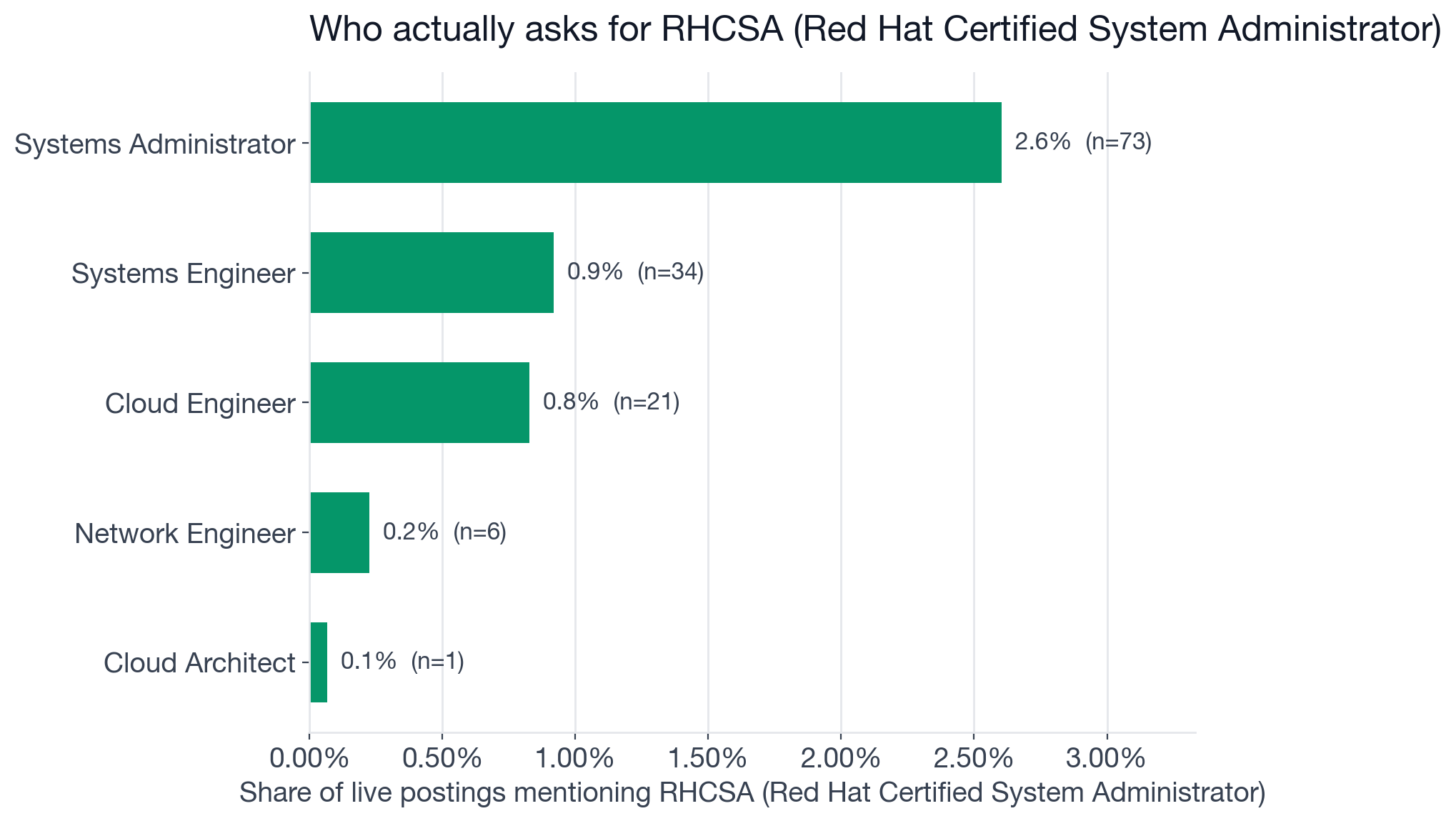 Systems Administrator's 2.60% mention rate stands well clear of the field; Network Engineer and Cloud Architect are both close to zero.
| Role | Postings Scanned | RHCSA Mentions | Mention Rate | Share of All RHCSA Mentions |
|---|---|---|---|---|
| Systems Administrator | 2,804 | 73 | 2.60% | 54.1% |
| Systems Engineer | 3,706 | 34 | 0.92% | 25.2% |
| Cloud Engineer | 2,542 | 21 | 0.83% | 15.6% |
| Network Engineer | 2,664 | 6 | 0.23% | 4.4% |
| Cloud Architect | 1,506 | 1 | 0.07% | 0.7% |
| Site Reliability Engineer (SRE) | N/A | 0 | N/A | N/A |
None of this needs an elaborate explanation, and it's worth ruling out the more common alternative story in this series before accepting the obvious one: that concentration tracks pay tier rather than job title. It doesn't hold up cleanly here. Systems Administrator is also the lowest-paying of the five roles with data ($112,000 median base without the certification), which could support a "cheap role over-mentions" story on its own. But Network Engineer, the second-cheapest role at $132,998, has one of the lowest over-index scores in the whole scope (0.22x), not a high one, and Systems Engineer and Cloud Engineer, both paid well above Network Engineer, mention RHCSA more relative to their size than Network Engineer does. The concentration follows the job title, not the paycheck.
Required or Preferred: Where Most RHCSA Mentions Actually Land
Slightly more than half of RHCSA mentions in this dataset don't specify one way or the other, which caps how confidently the required-versus-preferred split below should be read; treat it as a floor, not the full picture. Of the 135 total mentions, 69 (51%) carry no required-or-preferred wording nearby. Among the 66 mentions with clear wording, only 11, roughly 1 in 6 (16.7%), call RHCSA required. The other 55 (83.3%) list it as preferred.
| Classification | Count | Share of Classified Mentions | Share of All Mentions |
|---|---|---|---|
| Required | 11 | 16.7% | 8.1% |
| Preferred | 55 | 83.3% | 40.7% |
| Unspecified | 69 | N/A | 51.1% |
For a candidate deciding whether to sit the exam, the practical read is that RHCSA functions as a credibility signal on a resume more often than a hard gate on an application. That fits its role in the market: a hands-on, performance-based Linux certification that demonstrates real administration skill, not a compliance checkbox most postings feel obligated to mandate.
RHCSA's Headline Pay Gap Is Bigger Than the Level-by-Level Data Supports
Postings that mention RHCSA advertise a median US base salary of $112,450, compared with $135,000 for postings in the same six-role scope that don't mention it, a 16.7% gap. This is base salary only, on the subset of postings that disclose it; equity, bonus, and other compensation aren't captured, and the comparison is against other postings in this same role scope, not the broader job market.
Read the level-by-level breakdown before trusting that headline number. Entry, senior, and staff levels don't have enough RHCSA-mentioning postings with disclosed salary to report reliably (1, 11, and 5 postings, respectively, all below the 25-posting floor this analysis requires). Mid-level is the only band with enough data on both sides, 52 RHCSA-mentioning postings against 3,094 that don't, and there the gap is smaller: 11.8% ($112,225 vs $127,250).
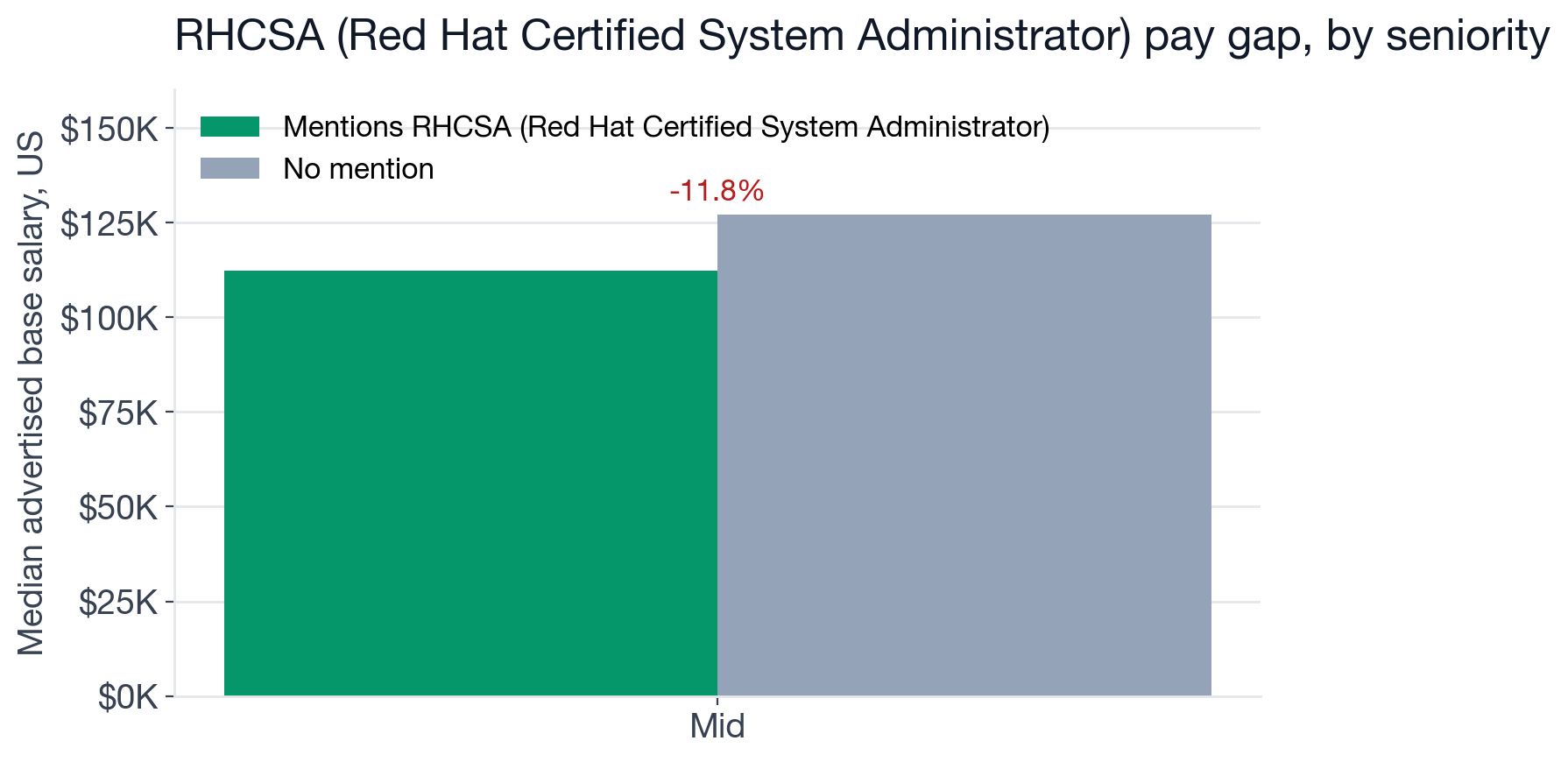 Mid-level is the only band with enough RHCSA-mentioning postings to compare directly; the aggregate gap is wider than the mid-level gap because of how the RHCSA sample is distributed across levels.
| Seniority Level | Median US Base, With RHCSA | Median US Base, Without RHCSA | Gap | Sample (With / Without) |
|---|---|---|---|---|
| Entry | Not reportable (n=1) | $81,213 | N/A | 1 / 95 |
| Mid-level | $112,225 | $127,250 | -11.8% | 52 / 3,094 |
| Senior | Not reportable (n=11) | $147,000 | N/A | 11 / 1,051 |
| Staff | Not reportable (n=5) | $171,750 | N/A | 5 / 610 |
| All levels (aggregate) | $112,450 | $135,000 | -16.7% | 69 / 4,850 |
The extra few points in the aggregate trace to composition, not a bigger real gap. RHCSA-mentioning postings sit overwhelmingly at mid-level (74.8%, versus 64.6% for postings that don't mention it) and are thin at staff level (4.4%, versus 10.4%), the band where non-RHCSA postings pay the most: $171,750. A pool that skews toward mid-level and away from the highest-paying band will look worse in aggregate than a level-matched comparison shows, simply because it carries less of the expensive band. The honest number is the mid-level one, 11.8%, not the aggregate 16.7%.
Seniority here is inferred from title keywords, and a posting with no explicit level word (a plain "Systems Administrator," for instance) defaults to mid-level. That's true of about two-thirds of this dataset's sampled job titles, which means the 74.8%/64.6% mid-level split above is probably a little too clean, not an exact read of the underlying seniority mix.
There's a third, more precise cut worth checking too: by role rather than by level. Systems Administrator alone supplies 45 of the 69 RHCSA-mentioning postings with disclosed US salary, 65% of the entire with-cert sample, and its own with-cert-versus-without comparison is close to flat: $110,850 versus $112,000, about a 1% gap. Systems Engineer, Cloud Engineer, and Network Engineer's own with-cert salary samples are too small to check the same way (14, 6, and 4 postings, all below the 25-posting floor), but the one role that can be checked cleanly, and that supplies most of the with-cert sample, shows next to no premium or penalty at all. Layered together, RHCSA's measured pay signal shrinks the more precisely it's controlled: -16.7% in aggregate, -11.8% within mid-level, and close to flat within the specific role that actually drives the with-cert sample.
The Skills and Certifications That Stack on Top of RHCSA
CompTIA Security+ shows up in 47.4% of RHCSA mentions, more often than RHCE (Red Hat Certified Engineer) itself, which appears in 40.0%. That is likely the same government-contracting pattern visible in the employer table below: many of these postings sit inside organizations that require a baseline security certification on every technical hire, regardless of the role's actual security scope. RHCE, built on the same core skills and one tier above RHCSA in Red Hat's own certification path, is the more functionally related pairing; CompTIA Security+'s own demand and pay pattern and CCNA's are covered in their own posts in this series.
| Certification | Co-occurs With RHCSA (% of Mentions) |
|---|---|
| CompTIA Security+ | 47.4% |
| RHCE (Red Hat Certified Engineer) | 40.0% |
| CCNA | 22.2% |
| VMware VCP | 19.3% |
| CompTIA CySA+ | 14.8% |
| SSCP | 14.1% |
| CISSP | 10.4% |
On the skills side, Linux itself appears in 91.1% of RHCSA-mentioning postings, close to universal for a Linux certification, followed by Automation (58.5%), Ansible (54.8%, Red Hat's own configuration-automation tool and the focus of the RHCE exam), Monitoring (53.3%), and Bash (51.1%). VMware (50.4%) and Virtualization (48.9%) show up almost as often, which points to RHCSA-certified administrators typically managing virtualized or hybrid environments, not just standalone Linux servers.
Government Contractors Lead RHCSA Hiring, With NVIDIA the Biggest Exception
CACI International (15 mentions) is the single most frequently cited employer in this dataset, with Leidos and General Dynamics Information Technology tied at 7 each (the General Dynamics figure combines a raw ATS-token listing with its named entry). Together with Booz Allen Hamilton, Peraton, PingWind, A&M Technologies, Nakupuna Companies, and SOSi, defense and government-services contractors account for about 72.9% (43 of 59), nearly three in four, of the mentions among the top 13 employers kept in this table. That pattern shows up across several Linux- and security-adjacent certifications in this series: RHCSA often functions as a baseline requirement on government IT contracts rather than a market-scarcity signal.
NVIDIA is the clearest exception, the largest non-government employer at 5 mentions. The dataset doesn't attribute specific job titles to specific companies, so this is general industry context rather than a dataset finding, but it's a plausible fit: large-scale GPU and AI-infrastructure operations lean heavily on hands-on Linux administration, the kind of work RHCSA is built to demonstrate, which makes a hardware and AI-infrastructure company showing up here unsurprising rather than anomalous. Kyndryl, Datamatics Technologies, and Analog Devices round out the rest of the kept, non-government roster. PingWind, A&M Technologies, and Nakupuna Companies are smaller federal IT or consulting contractors, and SOSi (SOS International) is a defense and intelligence contractor, again general industry context layered on top of the raw mention counts rather than a dataset finding. One company in the raw dataset, Inabia Solutions & Consulting, was excluded from this table: alongside its consulting work, the firm's own site markets an IT staffing and recruiting practice, and its listings likely reflect contractor placements rather than its own headcount.
| Employer | RHCSA Mentions |
|---|---|
| CACI International | 15 |
| Leidos | 7 |
| General Dynamics Information Technology | 7 |
| NVIDIA | 5 |
| Kyndryl | 4 |
| Datamatics Technologies | 4 |
| Analog Devices | 3 |
| Booz Allen Hamilton | 3 |
| Peraton | 3 |
| PingWind, Inc. | 2 |
| A&M Technologies, Inc. | 2 |
| Nakupuna Companies | 2 |
| SOSi | 2 |
Using This Data in Your RHCSA Job Search
If RHCSA is already on your resume, the fastest way to see where it actually counts is filtering by role: Systems Administrator openings show the certification's real market, while Cloud Architect openings confirm how little it comes up outside that lane. The full six-role scope behind this analysis is also browsable from the link in the first section above.
RHCSA is a hands-on, performance-based exam rather than multiple-choice, and the interview conversations it feeds into tend to be scenario-based too: how would you troubleshoot a failed mount, harden SSH access, or automate a configuration rollout. Practicing with AI mock interviews is a reasonable way to rehearse explaining that kind of hands-on troubleshooting out loud before a real interview.
The skills that travel with RHCSA in this dataset, Ansible, Bash scripting, DNS and DHCP configuration, and Active Directory integration, are also common interview topics on their own. The question bank covers each of those individually if the goal is drilling a specific weak spot rather than restudying the whole exam objectives list.
If the goal is building the underlying Linux administration foundation rather than just passing an exam, interactive courses covering systems administration, networking, and cloud fundamentals are a lower-stakes way to close gaps before committing exam-fee money.
FAQ
Q. What percentage of postings ask for RHCSA?
RHCSA appears in about 1.02% of postings (135 of 13,222) across six roles, Cloud Architect, Cloud Engineer, Network Engineer, Site Reliability Engineer (SRE), Systems Administrator, and Systems Engineer, analyzed over a 90-day window on the InterviewStack.io job board.
Q. Which role asks for RHCSA the most?
Systems Administrator, by a wide margin. It mentions RHCSA in 2.60% of its own postings and carries 54.1% of every RHCSA mention in the dataset (73 of 135), despite being only about a fifth of the postings scanned. That tracks the certification's own name: RHCSA stands for Red Hat Certified System Administrator.
Q. Does RHCSA matter for roles other than Systems Administrator?
Only marginally in this dataset. Systems Engineer (0.92%) and Cloud Engineer (0.83%) mention it at under half the Systems Administrator rate, Network Engineer drops to 0.23%, and Cloud Architect mentions it just once out of 1,506 postings scanned. Site Reliability Engineer (SRE) contributed zero postings to this window under the current role-matching filter.
Q. Is RHCSA usually required or just preferred?
Preferred, in most of the mentions specific enough to classify. Of the 66 mentions with clear required-or-preferred wording, 83.3% (55) call RHCSA preferred and 16.7% (11), roughly 1 in 6, call it required. Another 69 mentions (51% of all 135) don't specify either way.
Q. Do RHCSA-mentioning postings pay more?
Less, in aggregate, though the headline number overstates the real gap. RHCSA-mentioning postings advertise a median US base salary of $112,450 versus $135,000 for postings in the same six-role scope that don't mention it, a 16.7% gap. The only seniority band with enough RHCSA-mentioning postings to compare directly is mid-level, where the gap is smaller, 11.8% ($112,225 vs $127,250, n=52). Entry, senior, and staff levels don't have enough disclosed-salary RHCSA postings to report reliably, and RHCSA postings skew toward mid-level and away from the higher-paying staff band, which explains most of the difference between the two figures. Cut by role instead of level, the gap narrows further still: Systems Administrator alone supplies 65% of the with-cert salary sample, and its own with-cert-versus-without comparison is close to flat, about -1% ($110,850 vs $112,000).
Q. What certifications and skills usually appear alongside RHCSA?
CompTIA Security+ appears in 47.4% of RHCSA mentions, more often than RHCE (Red Hat Certified Engineer), which appears in 40.0% despite being Red Hat's own next-tier credential. CCNA (22.2%) and VMware VCP (19.3%) follow. On skills, Linux appears in 91.1% of RHCSA-mentioning postings, alongside Automation (58.5%), Ansible (54.8%), Monitoring (53.3%), and Bash (51.1%).
Q. Which companies most often ask for RHCSA?
CACI International (15 mentions), Leidos, and General Dynamics Information Technology (7 each) are the most frequently cited employers in this dataset. Government and defense contractors make up nearly three in four (72.9%, 43 of 59) of the mentions among the top 13 employers, though NVIDIA is the largest employer outside that group, a plausible fit given how much large-scale GPU and AI-infrastructure work relies on hands-on Linux administration.
RHCSA's Signal Is Narrow, But It's Exactly Where You'd Expect
RHCSA's demand pattern in this dataset resolves to one clean read: it is a Systems Administrator credential, mentioned overwhelmingly by employers hiring for that exact job title, at a modest pay discount that traces mostly to which level of that job asks for it, not to what the certification itself is worth. For every other role in this six-role scope, RHCSA registers as background noise at best. That is not a weakness in the data. A certification whose own name matches the one job where it actually matters is, if anything, doing exactly what its name promises.
Topics
Ready to practice?
Put what you've learned into practice with AI mock interviews and structured preparation guides.