
A Correct PKI Answer Can Still Lose This Interview
A mid-level Security Architect gets handed this scenario and reaches for what feels like expertise: certificate chain construction, handshake internals, maybe a diagram of exactly how mutual TLS negotiates a session. It sounds like the right move. It isn't. This interview's blueprint explicitly rules deep cryptographic protocol invention and PKI-internals optimization out of scope, this is a design interview about trust boundaries and operational judgment, not a cryptography defense, and spending the first several minutes proving protocol depth is exactly how a technically strong candidate loses points.
This walkthrough is built from a real AI-interview blueprint, the same phases, checklist items, and rubric weights the InterviewStack.io AI mock interviewer scores a candidate against live, for a mid-level Security Architect answering a distributed systems security and trust question. The scenario: a multi-tenant SaaS platform splitting a monolith into microservices across two cloud regions, with a real incident history behind it, leaked long-lived API keys, overly broad internal network access, and no way to prove which service touched which customer's data. The candidate who reads that incident history as the actual grading rubric, and designs against it, outperforms the one chasing protocol trivia.
Key Findings
- The interview runs 30 minutes across three phases: trust-boundary framing (0-7 minutes), core service-to-service design (7-20 minutes), and operational trade-offs and containment (20-30 minutes).
- Interviewer Objectives Alignment and Level-Specific Expectations each carry 30 of the 100 rubric points, 60 combined, while Technical Proficiency, the accuracy of the mechanisms proposed, caps out at 20.
- Phase 2 (7-20 minutes, the longest stretch) carries 6 separate checklist items on its own, more than either of the other two phases individually (4 in Phase 1, 5 in Phase 3).
- Custom cryptographic protocol invention sits on the interview's explicit forbidden-skills list; deep PKI-internals optimization is separately flagged as not expected of a mid-level candidate. Neither is extra credit.
- Phase 1 (7 minutes) requires naming at least 2-3 concrete risks from the scenario before proposing a single control.
- Phase 3's 5 checklist items include ranking a first-controls rollout order against the company's specific incident history, not a generic best-practices list.
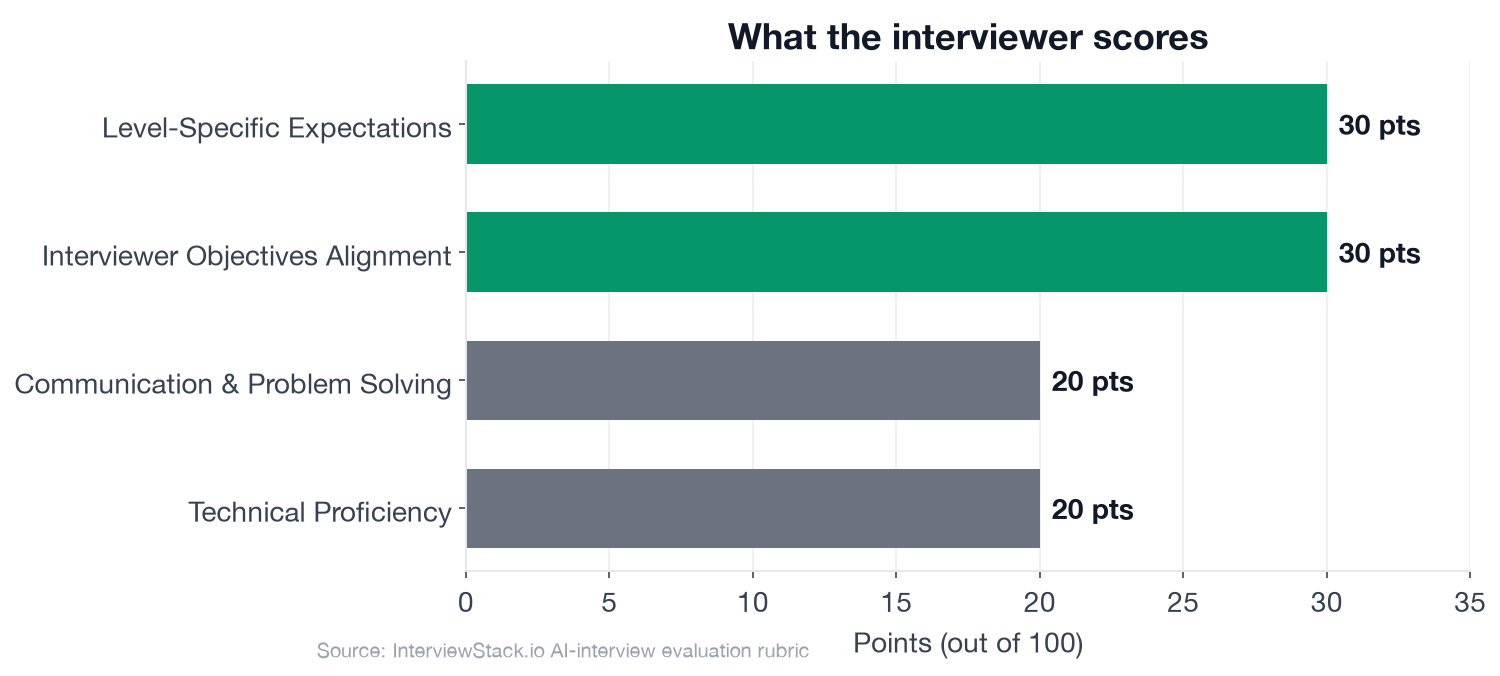 Framing and level-appropriate judgment together outweigh raw technical accuracy, which is exactly why an answer heavy on protocol detail and light on trust-boundary reasoning underperforms.
Inside a Security Architect Distributed Systems Security and Trust Interview
This is the scenario a mid-level Security Architect candidate is handed, word for word from the blueprint:
The interview question
A company is modernizing a multi-tenant SaaS platform from a mostly monolithic application into microservices running across multiple Kubernetes clusters in two cloud regions. The platform handles sensitive customer workflow data and integrates with internal services for billing, notifications, search, and analytics. Some services are customer-facing through an API gateway, while others are internal-only. Teams deploy independently, and incidents in the past have included leaked long-lived API keys, overly broad internal network access, and difficulty proving which service accessed which customer data.
Your task is to propose a security architecture for trust and communication across this distributed system. How would you design the service-to-service security model for this platform so that teams can ship independently while the company maintains strong trust boundaries and auditable access across services?
The interviewer's objective, per the blueprint, is narrower than "design a secure system": evaluate whether the candidate can reason about workload identity and mTLS, define trust boundaries that don't default to trusting the internal network, protect data across service and tenant boundaries, and name failure modes like credential leakage, over-privileged services, and missing audit lineage, all at a scope appropriate for a mid-level architect, not an unlimited greenfield redesign. Reverse-engineering, physical security, and frontend security details unrelated to distributed trust are explicitly off the table too; the interview stays tightly scoped to this one problem.
The Walkthrough: Four Turns Where the Points Move
A prepared candidate, call them Rowan, walks in with solid instincts and a real security background. Here's where four of those instincts cost points anyway, and what a stronger version of each answer sounds like.
Turn 1: Identity Without a PKI Lecture
Interviewer: "How would workloads obtain and rotate identities and secrets without relying on long-lived shared credentials?"
Turn 2: The Legacy Service Trap
Interviewer: "How would your design change for cross-region traffic and for a small number of legacy services that cannot immediately support mTLS?"
Turn 3: Containment After a Breach
Interviewer: "Suppose one internal service is compromised; how would your design limit lateral movement and reduce blast radius across clusters and tenant data?"
Turn 4: Which Control Ships First
Interviewer: "What are the main operational risks in your design, and which controls would you roll out first if engineering capacity is limited?"
Why Doesn't Spotting These Mistakes on the Page Stop You From Making Them Live?
Reading Rowan's four mistakes above is easy. Every one of them looks obvious in hindsight: over-explain the crypto, stall the rollout on legacy services, describe detection instead of containment, present an unordered list instead of a priority. But an interviewer who follows up on your own answer, changes a constraint mid-sentence, and gives you 30 minutes on the clock is a different environment than reading a blog post at your own pace. Translating judgment calls into fast, ordered decisions under a real time limit and unscripted follow-ups is the actual skill this interview tests, and it only gets built through live reps against a real mock interview, not recognition.
If threat modeling and risk prioritization is the shakier part of your own prep rather than trust boundaries, the Security Architect threat modeling walkthrough covers that adjacent scenario in the same format.
What Does the Blueprint Say a Strong Candidate Actually Covers?
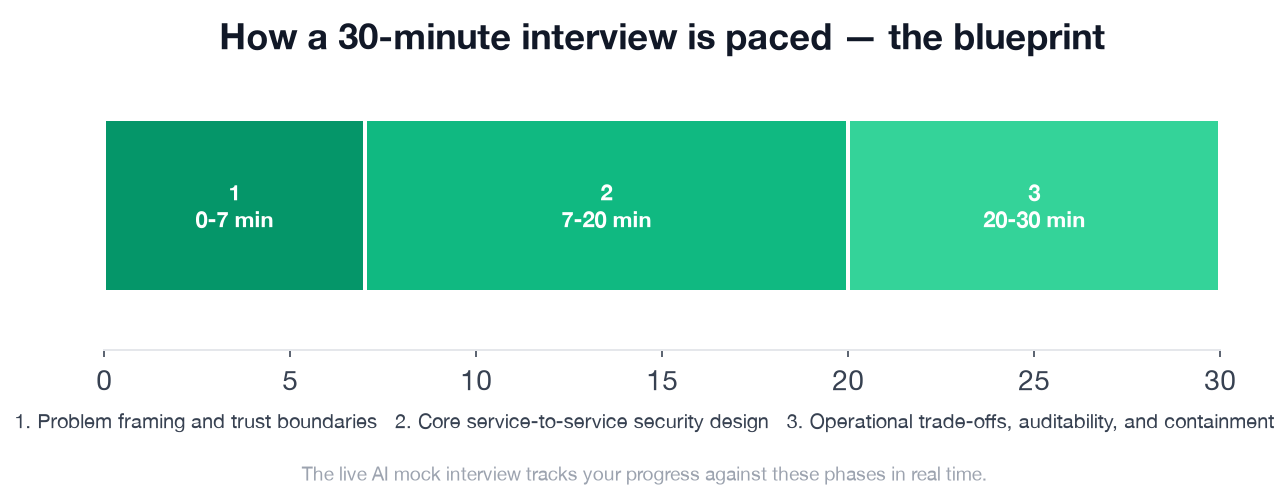 The same 30 minutes broken into the three phases the AI interviewer paces against in real time.
This is the complete blueprint: every phase, every checklist item, the exact thing the AI mock interviewer tracks while you talk.
- ✓Clarifies core actors such as users, edge components, internal services, platform components, and data stores.
- ✓Separates user identity from workload identity and recognizes that internal network location is not sufficient trust.
- ✓Calls out multi-tenancy and the need to preserve tenant context across service calls.
- ✓Identifies at least 2-3 concrete risks from the scenario such as leaked long-lived keys, lateral movement, or weak auditability.
- ✓Proposes workload identities for services, ideally tied to orchestrator or cloud identity rather than static secrets.
- ✓Uses short-lived credentials and describes rotation or issuance flow in a way that could operate across clusters and regions.
- ✓Includes mTLS or equivalent authenticated encrypted east-west traffic for service-to-service communication.
- ✓Describes authorization between services with scoped policies, not just binary connectivity; examples may include service identity, tenant scope, action, and resource.
- ✓Explains how services obtain secrets from centralized management and avoids embedding secrets in config or images.
- ✓Addresses legacy or non-compliant services with transitional controls such as gateways, sidecars, segmented zones, or compensating policy.
- ✓Explains how to trace a request or access event across multiple services with service identity and tenant context.
- ✓Describes controls to limit blast radius of a compromised service, such as least-privilege authorization, network segmentation, namespace or cluster isolation, and short-lived credentials.
- ✓Mentions practical rollout order or phased adoption plan rather than all-at-once transformation.
- ✓Acknowledges operational costs or failure modes such as certificate outages, policy misconfiguration, or secret manager dependency and gives a mitigation.
- ✓Prioritizes a reasonable first set of controls for the given incident history.
A strong candidate doesn't necessarily say all 15 of these lines out loud, verbatim, but their answer touches nearly every one of them, and never spends time on PKI internals or a custom protocol.
Ready to Run This Scenario Live?
Reading the fix isn't the same as producing it under pressure. Start a live AI mock interview on Security Architect distributed systems security and trust at the mid-level bar: same phases, same rubric, real follow-up questions that adapt to what you actually say. If you'd rather drill the underlying concepts first, the distributed systems security and trust question bank breaks the topic into individual practice questions with sample answers. Pair either with our preparation guides if you're prepping for a specific company's process.
FAQ
Q. What does a Security Architect distributed systems security interview actually test?
Whether you can design practical trust boundaries for service-to-service communication under real constraints: workload identity and mTLS, secrets management, tenant isolation, and how a compromised service gets contained, not whether you can reproduce cryptographic protocol theory. The 100-point rubric splits 30 points to Interviewer Objectives Alignment, 30 to Level-Specific Expectations, 20 to Technical Proficiency, and 20 to Communication and Problem Solving.
Q. Do I need deep PKI or cryptography knowledge to pass this interview?
No. The blueprint explicitly lists deep cryptographic protocol invention and optimizing PKI internals as out of scope for a mid-level Security Architect. You're expected to know where trust anchors, certificate issuance, and policy enforcement fit into an architecture, not to design the protocol yourself.
Q. How long is the interview and how is it paced?
30 minutes across three phases: problem framing and trust boundaries (0-7 minutes), core service-to-service security design (7-20 minutes, the longest phase with 6 checklist items), and operational trade-offs, auditability, and containment (20-30 minutes).
Q. How should I handle legacy services that cannot support mTLS?
Use transitional controls instead of blocking the rollout: an authenticating gateway or sidecar proxy that terminates mTLS on the legacy service's behalf, or a segmented network zone with compensating controls, while the rest of the platform adopts native workload identity. The interview rewards a phased, realistic rollout plan over an all-at-once redesign.
Q. What's the most common mistake mid-level candidates make in this interview?
Over-indexing on cryptographic depth, certificate chains, handshake internals, instead of naming a workable identity, secrets, and rotation flow, then failing to prioritize controls against the scenario's actual incident history when asked what ships first.
Q. What counts as a strong answer to the lateral-movement follow-up?
One that treats containment as an architecture property, not a monitoring outcome: scoped least-privilege authorization by service and tenant, network or namespace isolation, and short-lived credentials that limit how long a compromised identity is useful, so a breach is contained by design before any alert fires.
Q. How can I practice a Security Architect interview like this one before the real thing?
Run a live AI mock interview that follows the same phases, checklist items, and rubric weights described here, so you get timed practice defending trust-boundary and rollout decisions under follow-up questions instead of just reading about them.
Judgment Beats Cryptography
Rowan's four mistakes share one root cause: reaching for depth in the wrong place. At a mid-level bar, distributed systems security architecture is judged on trust boundaries, pragmatic rollout, contained blast radius, and priorities that match a real incident history, not on how well you can whiteboard a certificate chain. Know the difference before the clock starts.
Topics
Ready to practice?
Put what you've learned into practice with AI mock interviews and structured preparation guides.