
The Checkout Tests Aren't Wrong. The Data Under Them Is.
The scenario handed to this SDET candidate doesn't name a single bug. It says the checkout suite already runs about 1,200 automated tests, and they fail anyway: stale test accounts, reused promo codes, inventory conflicts, and tests that depend on data another suite created first. None of that is a code defect. It's a data problem wearing a test-flakiness costume, and it's easy to walk straight past that framing to talk about coverage instead.
We pulled the real interview package InterviewStack.io's AI interviewer runs for a mid-level Software Development Engineer in Test (SDET) on data-driven testing and test data management, the same blueprint, rubric, and follow-up questions used in a live 30-minute session. Below, we walk it turn by turn: a common but costly answer, what it misses, and what a stronger answer sounds like instead.
Key Findings
- The interview runs 30 minutes across 3 phases: 0-8 min problem framing, 8-20 min (12 minutes) data model design and isolation, and 20-30 min (10 minutes) reliability and rollout.
- Interviewer Objectives Alignment and Level-Specific Expectations each carry 30 of the 100 rubric points; Technical Proficiency and Communication & Problem Solving carry 20 each.
- The 8-20 minute design phase packs 6 checklist items, the most of any phase; the framing phase and the reliability phase carry 4 each.
- The scenario opens with a suite of roughly 1,200 existing automated tests already dealing with frequent failures from stale accounts, reused promo codes, inventory conflicts, and cross-suite data dependencies.
- The team's pipeline has a fixed 30-minute CI budget that "cannot become much slower," even as coverage expands across tax region, payment method, and promo combinations.
- Candidates face 1 initial question plus up to 6 follow-ups spanning provisioning, collision handling, coverage selection, downstream flakiness, reproducibility, and long-term ownership.
- The interview explicitly excludes deep database administration and manual-exploratory-testing-only answers, keeping the 30 minutes scoped to test architecture and data lifecycle.
What Is This SDET Test Data Interview Actually Testing?
The interview question
You're supporting a team that owns a checkout platform for a large e-commerce company, covering cart, pricing, promotions, payment authorization, and order placement. About 1,200 automated API and UI tests already run in CI against multiple shared test environments used by several teams, and failures keep coming from stale test accounts, reused promo codes, inventory conflicts, and tests that depend on data an earlier suite created. The team is also pushing to add coverage for country-specific tax rules, payment methods, and promotion combinations, inside a 30-minute pipeline budget that cannot get much slower. Test runs happen in parallel, and both functional correctness and long-term suite reliability matter.
How would you design a data-driven testing and test data management approach for this checkout platform so the tests are scalable, maintainable, and reliable in shared environments?
The interviewer isn't grading whether the candidate can name a testing framework. The objective is whether they can turn "1,200 flaky tests" into a structured plan that separates parameterized test design from test data lifecycle, isolates concurrent runs from each other, and makes deliberate trade-offs between realism, speed, coverage, and maintenance cost, the kind of judgment a mid-level SDET is expected to bring into a real checkout team.
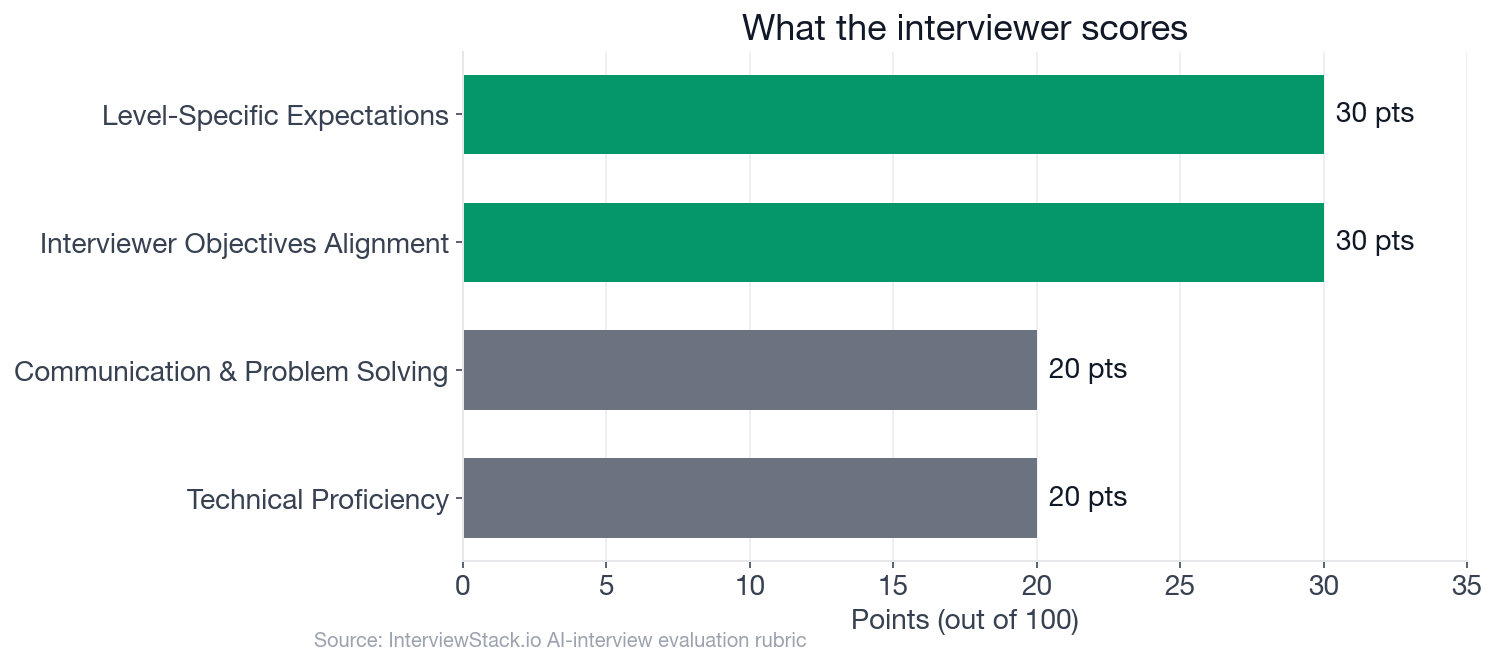 Interviewer Objectives Alignment and Level-Specific Expectations each carry 30 of the 100 points, so framing and judgment outweigh raw technical execution before a single line of test code comes up.
Inside the 30-Minute Checkout Data Walkthrough
Four follow-ups from the real interview package, dramatized with a common shallow answer and a stronger one. Candidate name is Nash throughout; treat every answer below as illustrative, not a transcript of a real session.
Turn 1: Where Collisions Start
Interviewer: "If multiple pipelines run in parallel against the same environment, how would you prevent collisions between test runs without making the data strategy overly complex?"
Turn 2: The Combination Trap
Interviewer: "How would you keep parameterized coverage useful for combinations like tax region, promo type, payment method, and inventory state without causing an explosion in test count?"
Turn 3: Reproducing a Ghost Failure
Interviewer: "If a test fails in CI and passes locally, what information or artifacts would you want captured to make the test data state reproducible and debuggable?"
Turn 4: Who Owns the Drift
Interviewer: "How would you evolve this strategy over time as new countries, payment providers, and promotion rules are added by different teams?"
Could You Catch These Live, Not Just on the Page?
Every mistake above is obvious once it's sitting in a box with a red border and no clock running. Spotting a brute-force combination trap on a blog post, with time to reread the scenario, is not the same skill as catching it out loud, in the middle of a follow-up you did not expect, partway through a session you cannot pause. That gap only closes with reps in a live mock interview.
What Does the Full 30-Minute Blueprint Actually Reward?
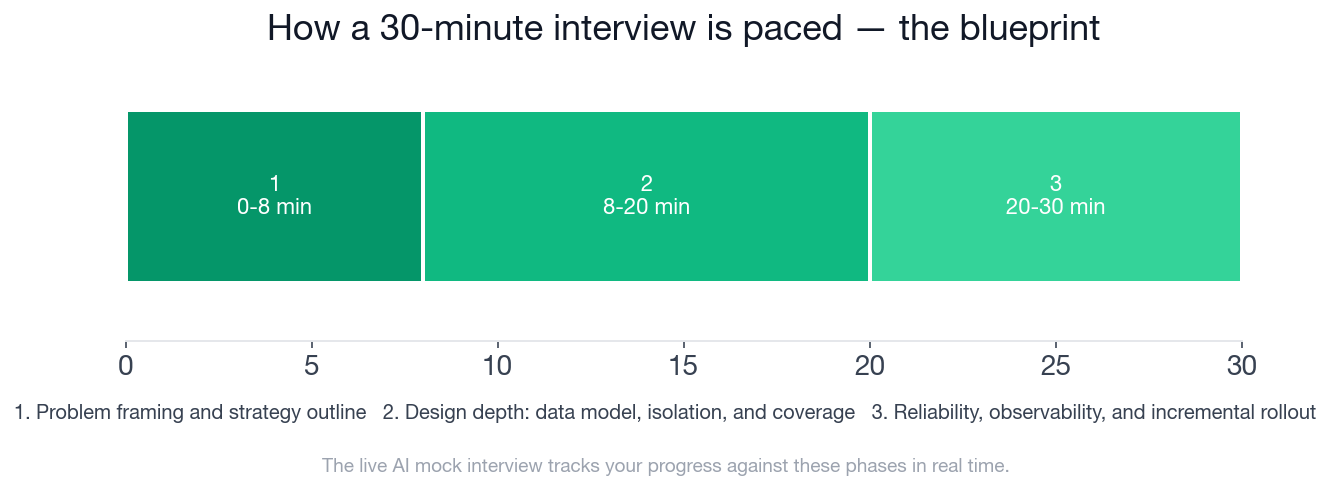 The 30 minutes split into problem framing (0-8 min), data model and isolation design (8-20 min), and reliability and rollout (20-30 min), with the middle phase carrying the most checklist weight.
This is the same blueprint a strong candidate hits phase by phase, and it's the exact structure InterviewStack.io's AI mock interviewer tracks a candidate against in real time.
- ✓Clarifies key assumptions such as environment constraints, parallelism, external dependencies, and whether setup APIs exist
- ✓Separates concerns between test case parameterization and test data lifecycle management
- ✓Identifies current pain points from the scenario such as stale accounts, promo reuse, and cross-suite dependencies
- ✓Outlines a high-level approach with components like data factories, seed datasets, run isolation, and cleanup/reset
- ✓Explains how test inputs would be modeled, such as dimensions for country, payment type, promo, user/account state, and inventory state
- ✓Avoids brute-force Cartesian combinations and proposes a targeted coverage matrix or representative scenarios
- ✓Describes how unique test entities would be created or namespaced per run to avoid collisions
- ✓Discusses when to use static baseline data versus dynamically generated data
- ✓Addresses cleanup or expiry strategy for created data, including what happens if teardown fails
- ✓Considers how shared downstream dependencies or unavailable setup hooks influence the test design
- ✓Explains what metadata should be logged or attached to each run, such as dataset version, seed, generated IDs, and environment details
- ✓Describes how failures could be reproduced locally or in reruns using the same data inputs
- ✓Prioritizes a realistic rollout, for example stabilizing critical flows first before expanding coverage
- ✓Mentions ownership or guardrails to keep data definitions and factories from drifting as features evolve
Try the Same 30-Minute Interview Yourself
Reading Nash's mistakes costs nothing. Making the same call live, twenty minutes into a session with a follow-up you didn't see coming, is the actual test.
Start the AI mock interview for this exact SDET scenario and get scored against this same 100-point rubric with live, adaptive follow-ups. To drill the underlying concepts first, the data-driven testing and test data management question bank breaks the topic into individual practice questions, and InterviewStack.io's interactive courses cover test architecture and CI fundamentals if any of the stronger-move answers above felt unfamiliar. When you want a reality check on what teams actually expect from this role, current SDET openings show what "test data strategy" means in a real job description.
FAQ
Q. What does the SDET data-driven testing and test data management interview actually evaluate?
It evaluates whether a candidate can design a coherent test data strategy, covering both parameterized test coverage and the lifecycle of the data behind it, for a checkout platform running in shared, parallel CI environments. The 100-point rubric splits 30 points to Interviewer Objectives Alignment, 30 to Level-Specific Expectations, 20 to Technical Proficiency, and 20 to Communication & Problem Solving.
Q. How long does this interview run and what happens in each phase?
It runs 30 minutes across three phases: 0 to 8 minutes on problem framing and strategy outline, 8 to 20 minutes (12 minutes) on data model design, isolation, and coverage, and 20 to 30 minutes (10 minutes) on reliability, observability, and incremental rollout. The middle phase carries 6 checklist items, more than either of the other two phases.
Q. Why do candidates lose points for adding more test data instead of isolating it?
Because the scenario's failures, stale test accounts, reused promo codes, inventory conflicts, and tests that depend on data another suite created, are caused by shared, unisolated state, not insufficient data. Growing the size of a shared pool only lowers the collision rate; it does not remove it, and it misses the checklist item on creating unique, namespaced test entities per run.
Q. How should a candidate handle tax region, promo type, payment method, and inventory state without an explosion in test count?
By selecting a targeted coverage matrix, using equivalence classes, risk-based prioritization, or a curated set of representative scenarios, instead of running every combination. A full combination across four dimensions would blow past the pipeline's fixed 30-minute CI budget long before it improved real coverage.
Q. What should be captured when a test fails in CI but passes locally?
The data inputs behind that specific run: the seed value used for any generated data, the IDs of entities that were created, the version of any fixtures or baseline datasets, and relevant environment details. Without that artifact, a candidate can only guess at what made the CI run different, which is exactly what this interview's reliability phase checks for.
Q. Do I need to design an org-wide test data platform to pass at mid-level?
No. The level-specific bar expects a workable test architecture and data lifecycle for this one team's checkout platform, sound judgment on when to mock, stub, or use shared integrated environments, and a design detailed enough for another engineer to implement, not a company-wide platform built from scratch.
Q. Where can I practice this exact interview scenario?
InterviewStack.io's AI mock interview runs this same checkout test-data scenario live, asks the same follow-up questions in real time, and scores the response against the identical 100-point rubric described here.
The Fix Was Never More Tests
The throughline across this interview is the same call: the checkout suite doesn't need more test data, it needs test data that belongs to the run that created it. Candidates who diagnose that in the first 8 minutes spend the rest of the interview building on solid ground. For a different angle on the same role, see how the SDET assertions and behavior verification interview grades a completely different failure mode: tests that pass while the behavior underneath them is broken.
Topics
Ready to practice?
Put what you've learned into practice with AI mock interviews and structured preparation guides.