
Two candidates walk into this interview. One proposes a polished event-driven platform and cannot say why a 5-person team should build it in 4 months. The other says "just extend the monolith" and cannot say what happens at 10x. Both lose points they never see coming, because a mid-level Solutions Architect is scored on one defended choice, not on the fanciest diagram.
This walkthrough follows a mid-level cloud architecture trade-offs interview from a real AI-interview blueprint, with a dramatized candidate, Marisol, making mistakes many candidates make. The answers are illustrative, not a transcript of a real person or a real company's questions. You can browse live Solutions Architect openings to see where this skill gets used.
Key Findings
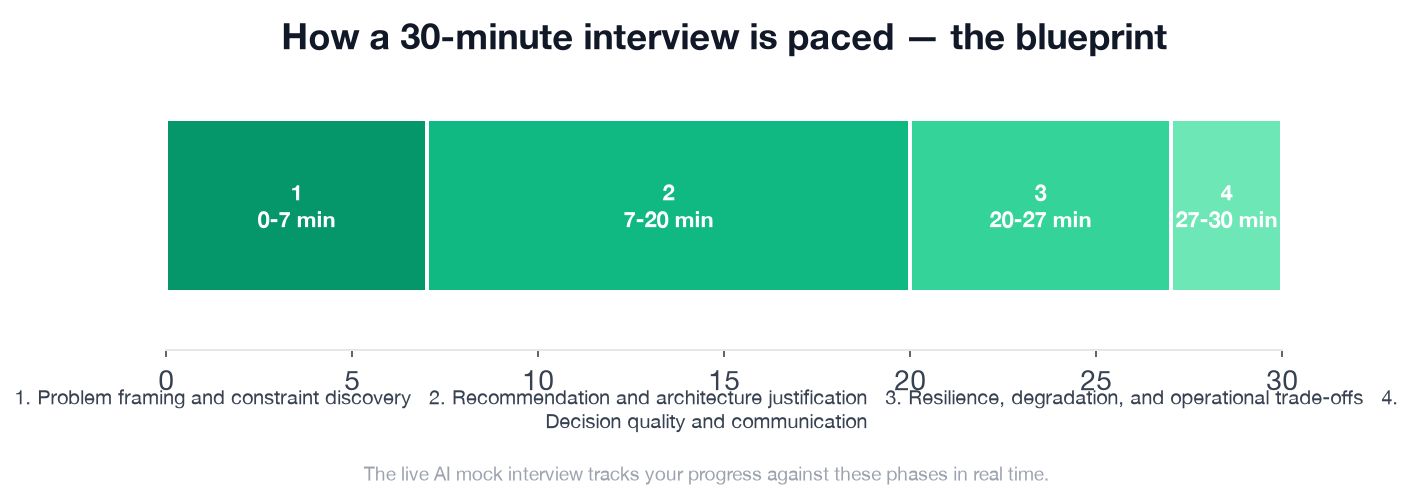
- The sample interview runs 30 minutes in 4 phases: 0-7, 7-20, 20-27, and 27-30 minutes.
- Recommendation and justification is the longest phase at 13 minutes, nearly half the interview.
- The rubric totals 100 points: 30 for Interviewer Objectives Alignment, 30 for Level-Specific Expectations, 20 for Technical Proficiency, 20 for Communication & Problem Solving.
- Technical Proficiency is only 20 of 100 points; the two 30-point dimensions (alignment and level-appropriate judgment) are the largest slices of the rubric.
- The scenario gives a 4-month deadline and a team of 5 engineers plus 1 shared security engineer.
- Growth from 40,000 to 320,000-400,000 documents a day (8-10x) is the stress test for every choice.
- The resilience phase expects at least 3 concrete failure scenarios, and the framing phase expects 2-4 clarifying questions or stated assumptions.
What Does a Solutions Architect Cloud Trade-offs Interview Actually Ask?
It asks you to make one call under constraints and defend it. Here is the question as presented.
The interview question
You are joining a team that needs to launch a new document-processing capability for a B2B SaaS product within 4 months. Customers upload PDF and image files through the product UI, and the system extracts structured fields that downstream workflows use for approvals and reporting.
Constraints: a single-region cloud deployment already runs the main product. The team is 5 engineers plus 1 shared security engineer. Initial traffic is about 40,000 documents per day, possibly 8-10x within a year. Most documents should finish within 2 minutes. Leadership wants to avoid overbuilding before product-market fit. Some customers are in regulated industries. If processing is delayed, the core product must stay usable. The team is weighing a tightly integrated extension of the existing application against a more separate cloud-native architecture with managed components.
How would you architect this document-processing capability, and what is the main architectural choice you would recommend given these constraints?
The interviewer is probing whether you can weigh reliability, scalability, security, performance, and cost against each other, find the blast radius of a failure, and explain a recommendation clearly enough for engineering and product to act on. It is not a subsystem deep dive: detailed IAM policy design, multi-region disaster recovery, and Kubernetes internals are out of bounds, and drifting into them burns your clock.
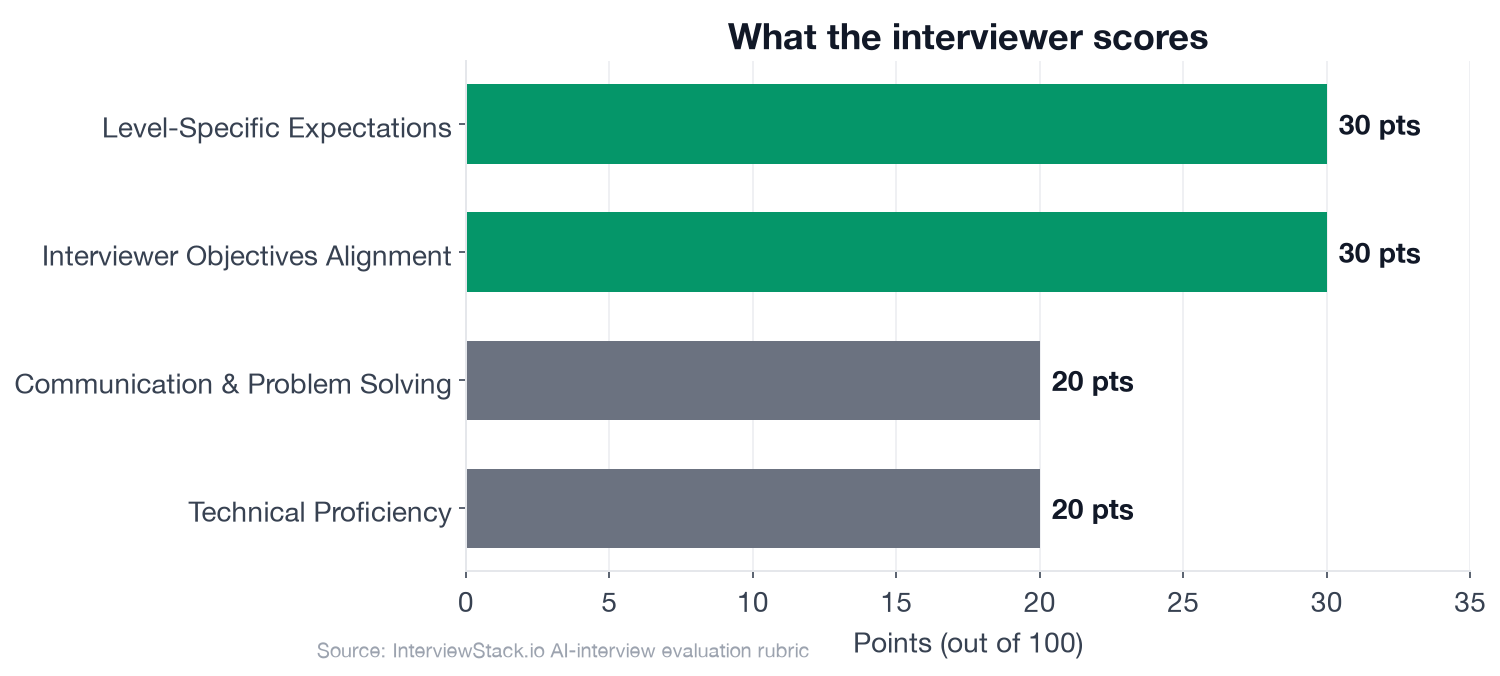
Sixty of the 100 points reward alignment and level-appropriate judgment, so how you reason beats which boxes you draw.
The Interview, Turn by Turn
Four of the interview's six follow-up prompts are dramatized here. Each shows a common mistake and the move that earns the points.
Turn 1: Name Your Assumptions
Interviewer: "What assumptions are you making about throughput, concurrency, and document size, and how do those assumptions affect your design choice?"
Turn 2: Managed or Operated?
Interviewer: "Which parts would you strongly prefer to use as managed services versus building or operating directly, and what trade-offs are you accepting?"
Turn 3: Backlog Without Blast Radius
Interviewer: "If the extraction pipeline becomes backlogged during an enterprise customer rollout, how should the system degrade without impacting the core product?"
Turn 4: Justify the Complexity
Interviewer: "Suppose leadership asks why your recommendation is better than the simplest monolithic extension to the current app. How would you justify the extra complexity or argue against it?"
Why Isn't Reading This Enough?
Spotting Marisol's mistakes on the page is easy. Avoiding them live is the actual skill: the clock is running, the interviewer changes a constraint mid-answer, and you have to convert a vague scenario into a number and a decision out loud. That only comes from reps. If you are also preparing for neighboring rounds, our requirements elicitation walkthrough and compute options walkthrough cover them.
The Blueprint a Strong Candidate Hits
This is the checklist a strong candidate clears, phase by phase, and the same blueprint the AI mock interview tracks you against in real time.
- ✓Asks 2-4 focused clarifying questions or states explicit assumptions about latency targets, failure tolerance, security sensitivity, and expected growth
- ✓Separates core product availability from document-processing availability as a key requirement
- ✓Recognizes team size, timeline, and budget as first-class architecture drivers
- ✓Frames the decision as a trade-off such as integrated extension versus separate asynchronous service, not as a subsystem deep dive
- ✓Proposes a clear high-level architecture with major components and request/data flow
- ✓Makes one main architectural choice explicit, for example an asynchronous decoupled processing capability using managed building blocks, or a tightly integrated path with justification
- ✓Explains why the choice fits a 4-month timeline and small team better than at least one credible alternative
- ✓Addresses secure file handling and extracted-data protection at a high level
- ✓Discusses scaling behavior and operational burden in practical terms rather than abstract ideals
- ✓Avoids drifting into unrelated deep dives such as detailed IAM policy design, DR strategy across regions, or orchestration internals
- ✓Identifies at least 3 concrete failure scenarios such as backlog growth, worker failure, duplicate events, poison documents, or dependency timeouts
- ✓Explains how the system degrades gracefully, such as asynchronous status reporting, delayed processing, or partial feature unavailability without taking down the main app
- ✓Describes a simple idempotency approach for duplicate uploads or retried processing
- ✓Shows awareness of blast radius containment through decoupling, isolation, or resource boundaries
- ✓Makes sensible trade-offs about what reliability mechanisms are worth implementing now versus later
- ✓Summarizes the recommendation in 1-2 minutes with clear rationale
- ✓Names the main trade-offs accepted, such as eventual consistency or higher latency in exchange for isolation and lower ops burden
- ✓States what they would validate first after launch, such as queue depth, processing latency, failure rates, or unit economics
Where Should You Practice This Next?
Start the AI mock interview on this exact topic and get scored against the 100-point rubric, with follow-ups you cannot predict. Do it twice: once cold, once after fixing what the feedback flagged. For targeted drilling first, use the cloud architecture trade-offs question bank, and browse preparation guides for company-specific formats.
FAQ
Q. What does a Solutions Architect cloud architecture trade-offs interview test?
It tests whether you can recommend ONE architecture for a realistic scenario and justify it against constraints like a 4-month timeline, a 5-engineer team, and a limited budget. The sample blueprint scores four dimensions out of 100 points: Interviewer Objectives Alignment (30), Level-Specific Expectations (30), Technical Proficiency (20), and Communication & Problem Solving (20).
Q. How long is the interview and how is it paced?
The sample blueprint runs 30 minutes in four phases: problem framing (minutes 0-7), recommendation and justification (7-20), resilience and degradation (20-27), and decision summary (27-30). The recommendation phase is the longest at 13 minutes.
Q. Should a mid-level Solutions Architect pick microservices or the monolith?
Neither by default. The mid-level bar asks for a moderately evolvable design that avoids both overengineering for extreme scale and defaulting to the easiest short-term build. Whichever you pick, tie it explicitly to the constraints and name the trade-offs you accept.
Q. How many failure scenarios do I need to name?
The resilience phase expects at least 3 concrete failure scenarios, such as backlog growth, worker failure, duplicate events, poison documents, or dependency timeouts. Pair each with a proportionate mitigation and say which ones you would defer until after launch.
Q. Do I need to know a specific cloud vendor's services?
No. This topic is provider-agnostic, and vendor-specific service catalog trivia is explicitly out of scope. Talk in components (object storage, queue, workers, status API) and justify managed versus self-operated for each.
Q. How do I practice this live instead of just reading?
Start an AI mock interview on this exact topic. It tracks you against the same four-phase blueprint in real time and asks unscripted follow-ups, which is where you have to apply the framework rather than recite it.
Where the Trade-off Actually Lives
The right answer is rarely the architecture itself. It is the sentence that connects it to a 4-month clock, a small team, and a budget leadership will not stretch, plus the honest list of what you gave up. Rehearse that sentence out loud before the real interview.
Topics
Ready to practice?
Put what you've learned into practice with AI mock interviews and structured preparation guides.