
The Fastest-Looking Move Is the One the Rubric Penalizes
Ninety seconds into a mid-level Solutions Architect interview on sales engineering fundamentals, the instinctive opening move is to come in sharp, show command of the platform, and start selling. This scenario is built to reward the opposite instinct. A regional bank is evaluating a competitive vendor, the deal is time-pressured, and the fastest-looking move, pitching hard and reaching for a big validation step, is exactly what two of the interview's four rubric dimensions are built to catch.
Below is a live walkthrough of that interview, mirrored from the production interview generator, turn by turn, including exactly where a well-prepared candidate still gives away points.
Key Findings
- The rubric splits 100 points across four dimensions: 30 for Interviewer Objectives Alignment, 30 for Level-Specific Expectations, 20 for Technical Proficiency, and 20 for Communication and Problem Solving.
- The interview runs 30 minutes across three phases: minutes 0 to 8 open the meeting, minutes 8 to 20 test technical-commercial balance, and minutes 20 to 30 test partnership and risk management.
- Phase 1 carries 4 expected-behavior checklist items, phase 2 carries 5, and phase 3 carries 4, 13 checklist items in total across the interview.
- 4 skill areas are explicitly out of scope for this scenario: hands-on coding, deep contract negotiation, post-close implementation management, and low-level network troubleshooting.
- 5 level-specific expectations set the mid-level bar, including running discovery independently and proposing a validation motion with manageable scope.
- The interviewer can pull from 6 distinct follow-up scenarios; this walkthrough dramatizes 4 of them.
- This is a mid-level (2 to 5 year) Solutions Architect scenario, scored against a single 30-minute first technical meeting with a competitive, quarter-end-pressured prospect.
The interview question
A regional bank is evaluating your company's cloud-based customer communications platform for outbound notifications, document delivery, and two-way messaging across SMS, email, and mobile app. The account executive tells you the opportunity is competitive, the prospect wants to move quickly, and there is pressure to prove both technical fit and business value before the end of the quarter.
You are joining the first deep technical meeting with the customer after an introductory sales call.
How would you lead this opportunity from the presales side in that first technical meeting, and set up the next steps to maximize the chances of winning the deal?
What the interviewer is actually scoring is whether a mid-level Solutions Architect can run a structured discovery conversation on a live, competitive deal: framing technical value in business terms, balancing the customer's requirements against real platform capabilities, handling objections and gaps without overcommitting, and partnering with the account executive to keep the deal moving, not whether the meeting sounds impressive in the room.
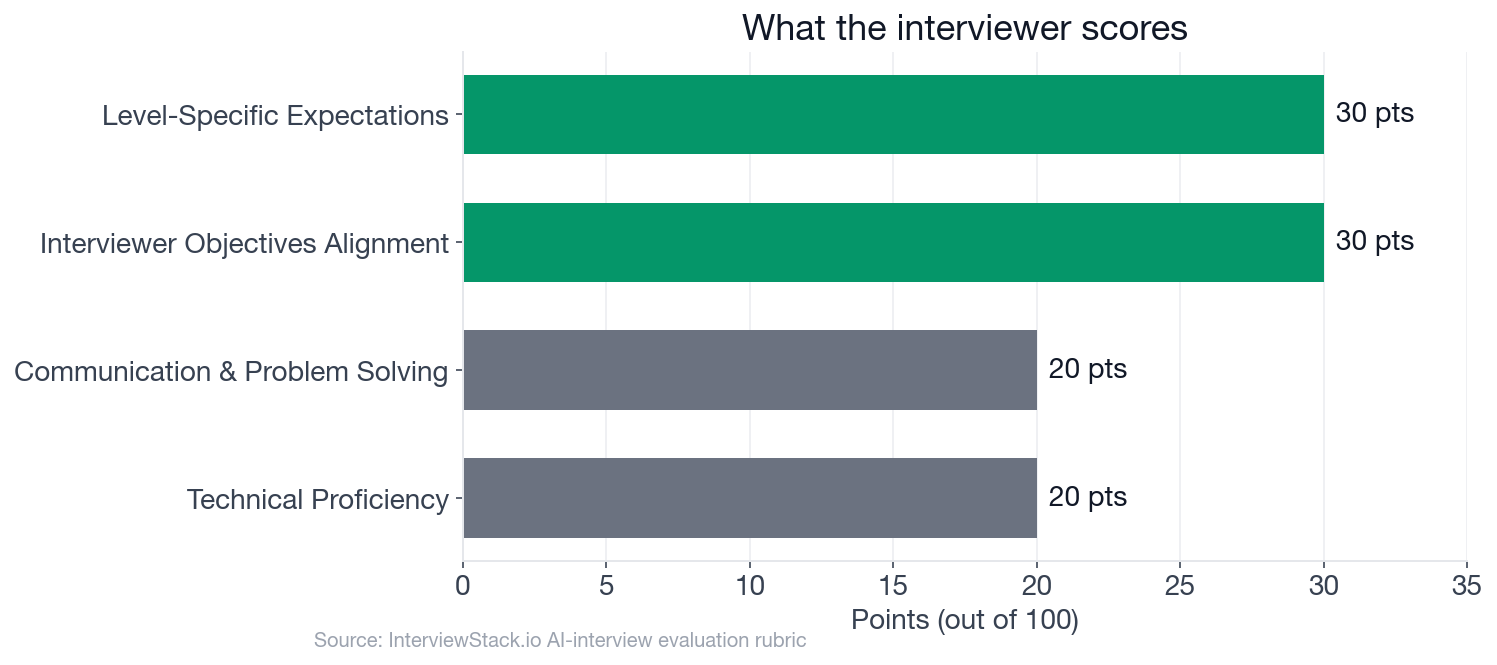 Sixty of the interview's 100 points reward how you structure and frame the presales conversation; the other forty reward execution and communication.
Does the Solutions Architect Sales Engineering Fundamentals Interview Reward Speed or Structure?
The scenario is designed to make speed feel like the right answer. The deal is competitive, the account executive wants momentum, and the quarter is closing. Phase 1's checklist rewards the opposite move: confirming meeting goals and attendees, running a discovery-first conversation instead of a feature walkthrough, and surfacing business pain, current-state process, timeline, stakeholders, and success criteria before proposing anything. A candidate who opens with a platform walkthrough because the deal feels urgent has already given up the discovery-first behavior this phase is scored on, before the account executive's competitive-pressure framing even becomes relevant.
Phase 2 (minutes 8 to 20) then tests whether that discovery converts into a scoped plan: mapping customer needs to real capabilities, separating must-haves from nice-to-haves, and recommending a next step, demo, proof of concept, or lighter validation, sized to what's actually still unknown. Phase 3 (minutes 20 to 30) checks whether the candidate can close the loop with the account executive and name real risks instead of assuming the meeting alone wins the deal.
Four Follow-Ups, One Recurring Instinct
Below are four moments from this interview where a well-prepared mid-level candidate, call him Devon, gives an answer that sounds confident and still costs rubric points. Each one is a version of the same instinct: move fast and look decisive, instead of matching the response to what the rubric actually rewards.
Turn 1: The Incumbent Objection
Interviewer: "If the customer says, 'We already have a vendor that covers most of this,' how would you steer the conversation to uncover whether there is a real opportunity for differentiation?"
Turn 2: Demo, POC, or Lighter
Interviewer: "What information would you need to decide whether to recommend a demo, a proof of concept, or a lighter-weight validation step?"
Turn 3: The Partial Capability
Interviewer: "Suppose the customer asks for a capability your platform only partially supports today. How would you handle that in the meeting without weakening trust or stalling the deal?"
Turn 4: Champion vs. Economic Buyer
Interviewer: "If the customer's technical team is enthusiastic but the business sponsor is focused on cost and procurement risk, how would you adapt your approach?"
What Happens When the Interviewer Asks What You Promised the Account Executive?
Every mistake above is easy to spot once it is laid out with the wrong sentence in red and the fix in green. Under real interview conditions you do not get that framing. You get a clock that does not pause while you weigh a validation plan, an interviewer who does not announce which checklist item a follow-up is testing, and a question you did not prepare for, like being asked what you actually told the account executive before walking into the room, whether you agreed on who owns the next message to the customer, or whether your read on the sponsor's cost concerns matches what the AE already knows. Closing the gap between reading this walkthrough and running the meeting live is reps: doing this out loud, on the clock, in the AI mock interview, until discovery-first becomes the first move instead of the one you remember only after the interviewer pushes.
Three Phases, Thirteen Checklist Items, One 30-Minute Meeting
Here's how the phases break down against the clock:
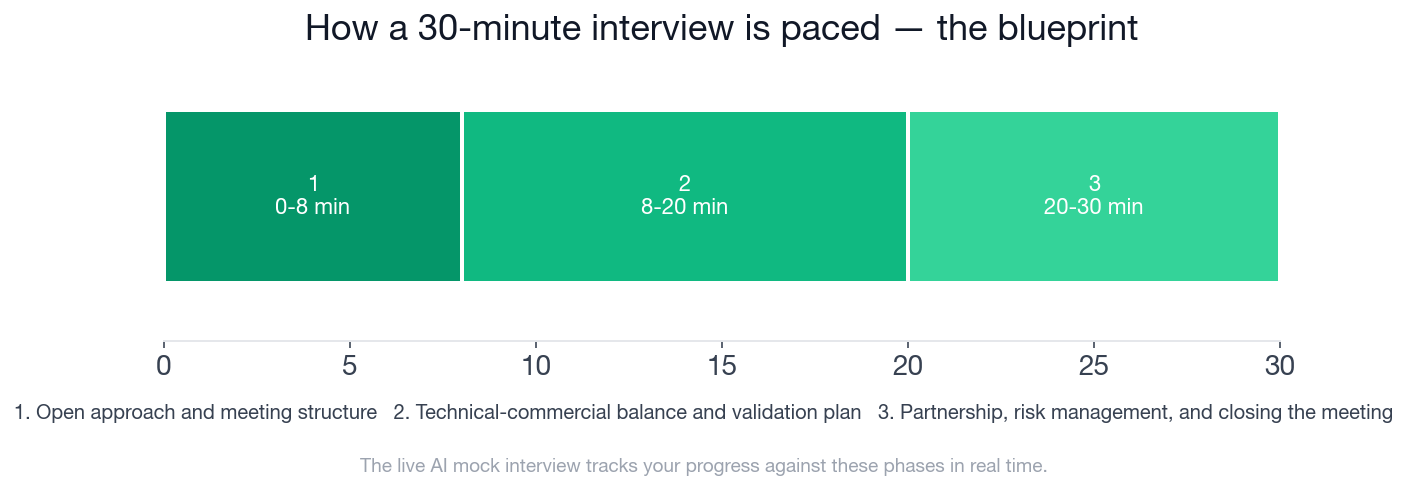 Opening and structure gets 8 minutes, technical-commercial balance and the validation plan gets the most time at 12 minutes, and partnership, risk, and closing gets the final 10.
- ✓States they would begin by confirming meeting goals, attendees, and desired outcomes
- ✓Explains a discovery-first approach instead of defaulting immediately to a feature walkthrough
- ✓Surfaces key dimensions such as business pain, current-state process, timeline, stakeholders, and success criteria
- ✓Acknowledges competitive context and need to progress the deal, not just gather information
- ✓Maps customer needs to platform capabilities in a way that distinguishes must-haves from nice-to-haves
- ✓Explains what evidence is needed to prove fit, such as integration feasibility, compliance considerations, channel support, scale, or reporting needs
- ✓Recommends an appropriately scoped next step with explicit success criteria and owners
- ✓Mentions business value framing alongside technical fit, such as consolidation, delivery reliability, customer experience, or operational efficiency
- ✓Avoids promising unsupported features; offers alternatives, workarounds, or escalation paths where needed
- ✓Describes how they would align with the account executive before and after the meeting on roles and messaging
- ✓Identifies common risks such as vague success criteria, missing stakeholders, product gaps, security or compliance blockers, or unrealistic timelines
- ✓Closes with a mutual action plan including next meeting objective, technical validation scope, customer responsibilities, and internal follow-ups
- ✓Shows practical mid-level judgment on when to bring in specialists such as security, product, or implementation teams
This is the blueprint a strong candidate hits, phase by phase, checklist item by checklist item, and it's the exact structure the AI mock interview tracks you against in real time, not just at the end.
Can You Run This Meeting Without a Script?
Reading the mistakes above is the easy part. The harder part is running discovery-first when the deal feels urgent, the customer is testing you, and the account executive is waiting on a plan. Start the Solutions Architect sales engineering fundamentals mock interview and get scored against this exact rubric, with feedback on where you actually lost points. If you want to drill the underlying concepts first, work through the Solutions Architect sales engineering fundamentals question bank, build foundational judgment with the interactive courses, or browse open Solutions Architect roles and Solutions Architect preparation guides to see what teams are actually asking for.
FAQ
Q. How is the Solutions Architect sales engineering interview scored?
The rubric splits 100 points across four dimensions: 30 for Interviewer Objectives Alignment, 30 for Level-Specific Expectations, 20 for Technical Proficiency, and 20 for Communication and Problem Solving. The two 30-point dimensions both reward how you structure the presales conversation, not how confidently you pitch.
Q. How long does this interview run and what happens in each phase?
Thirty minutes across three phases: opening the meeting and setting structure from minute 0 to 8, balancing technical fit with a validation plan from minute 8 to 20, and handling risk, account executive partnership, and closing the meeting from minute 20 to 30.
Q. How should a Solutions Architect align with the account executive after a meeting like this?
Before the meeting, agree on who owns which parts of the conversation and how technical findings get messaged back to the customer. After it, close with a shared summary: the next meeting's objective, the technical validation scope, what the customer still owns, and which internal follow-ups the account executive is tracking. Phase 3 of this interview scores that alignment explicitly.
Q. What signals mean a presales opportunity isn't qualified yet?
Vague or missing success criteria, no clear economic buyer or decision process, a timeline that doesn't match the customer's stated urgency, or a technical champion who can't name who else needs to sign off. Any of those should shrink the validation plan, not expand it, until the gaps close.
Q. Does this interview involve coding, pricing strategy, or hands-on implementation?
No. Hands-on coding or algorithm design, deep contract negotiation or pricing strategy, post-close implementation project management, and low-level network or infrastructure troubleshooting are all explicitly out of scope for this scenario. The interview stays focused on presales judgment: discovery, technical-commercial balance, and deal partnership.
Q. What's the difference between a strong mid-level answer and a stronger senior one here?
A mid-level Solutions Architect (2 to 5 years) is expected to run structured discovery independently, propose a validation motion with manageable scope, and escalate major product gaps rather than solving everything solo. Senior-level answers would additionally shape account-level deal strategy, lead pricing conversations, and navigate complex multi-stakeholder politics, none of which this scenario expects at the mid-level bar.
Q. Can I practice this exact interview?
Yes. The AI mock interview runs this same Solutions Architect sales engineering scenario live, asks unscripted follow-up questions, and scores your answers against the same rubric described here.
Patience Outscores Momentum
There is no version of this scenario where pitching faster wins more points than discovering more precisely. The deal is competitive and the quarter is closing, and the rubric still spends 60 of its 100 points on how a Solutions Architect frames the conversation, scopes the next step, and manages the people in the room, not on how quickly the meeting reaches a proposal. That's a two-minute idea to explain and a genuinely hard habit to hold under a ticking clock and a customer who wants an answer now, which is exactly what the mock interview is built to pressure-test. If you want to see this same discipline applied to a technical-architecture scenario instead of a sales one, the Solutions Architect compute options and trade-offs walkthrough runs the same rubric structure against a cloud architecture deal.
Topics
Ready to practice?
Put what you've learned into practice with AI mock interviews and structured preparation guides.