
SQL Is Everywhere in Tech Hiring, and Its Pay Gap Points Both Ways
SQL is asked for in 28,862 of 157,833 active postings (18.3%) on the InterviewStack.io job board in the 90 days ending November 13, 2026, and its share edged up from 16.4% to 19.2% across that window. Compare postings with and without SQL inside the same role and seniority level, and US advertised base pay comes out 5.7% lower on average: higher for analysts and data scientists, lower for software engineers and, surprisingly, data engineers.
That is the opposite of the usual "learn SQL, earn more" line, and it is worth reading carefully. A single average hides a split: SQL is a baseline for data roles and a minority requirement for most others, and the postings that mention it sit at different pay points in different jobs. We compared postings that ask for SQL against postings that do not, role by role and level by level, across 69 role-and-level cells covering 95% of SQL postings. Nothing here says SQL changes anyone's pay; it describes what employers advertise. Two measurement notes: SQL is detected from the extracted skills field, not a full-text search, so every SQL share here is likely a floor rather than a ceiling; and the older windows only contain postings still active today, so treat the roughly 3-point rise as modest rather than a sharp trend.
Key Findings
- SQL appears in 28,862 of 157,833 active postings (18.3%), across 38 of 39 tracked roles.
- Its share rose from 16.4% to 19.2% across the 90-day window, about 3 points.
- About 7 in 10 Data Engineer postings (70%) ask for SQL, against 58% of Data Analyst and 48% of Data Scientist postings.
- Software Engineer is the largest source of SQL postings (5,808), yet SQL appears in only 18% of that role.
- Within the same role and level, US advertised base pay for SQL postings is 5.7% lower on average; the gap is higher in 18 cells and lower in 39.
- Data Analyst mid-level is +10.0% ($110,000 vs $100,000); Software Engineer mid-level is -20.6% ($134,250 vs $169,050).
- Of 6,175 SQL mentions with clear wording, 78% are phrased as preferred and 22% as required.
- Tableau (lift 4.2), Snowflake Data Cloud (3.8) and Power BI (3.7) are the strongest pairings by lift.
Does SQL Come With Higher Pay? Only for Some Roles
The honest answer is "it depends on your role." Scope first: everything in this section is US advertised base pay on postings that disclose a salary, matched by role and seniority. Equity, bonuses and sign-on are not in postings, so total compensation at top employers is higher than these figures. The gap is the difference in median base pay between postings that mention SQL and postings in the same cell that do not, weighted by how many SQL postings sit in each cell.
The cells where SQL postings advertise more are mostly analytics-flavored:
| Role and level | With SQL | Without SQL | Gap | Postings (with / without) |
|---|---|---|---|---|
| Business Intelligence Analyst, mid-level | $114,875 | $102,307 | +12.3% | 190 / 108 |
| Data Analyst, mid-level | $110,000 | $100,000 | +10.0% | 440 / 315 |
| Data Scientist, staff | $203,500 | $187,500 | +8.5% | 156 / 111 |
| Data Scientist, senior | $171,000 | $162,500 | +5.2% | 248 / 117 |
| Data Scientist, mid-level | $142,500 | $138,000 | +3.3% | 403 / 379 |
Two caveats sit on top of those rows. QA Engineer mid-level shows the largest gap of any cell we list (+15.5%, $110,100 vs $95,358), but only 132 SQL postings disclose pay there, and the comparison group is a very different job mix. And senior Data Analyst is flat: $130,000 against $129,250, a gap of +0.6%, effectively flat.
The cells that go the other way are bigger and more numerous:
| Role and level | With SQL | Without SQL | Gap | Postings (with / without) |
|---|---|---|---|---|
| Solutions Architect, mid-level | $118,207 | $161,500 | -26.8% | 226 / 569 |
| Software Engineer, mid-level | $134,250 | $169,050 | -20.6% | 783 / 4,336 |
| Software Engineer, senior | $152,955 | $184,413 | -17.1% | 535 / 2,932 |
| Software Engineer, staff | $186,795 | $218,000 | -14.3% | 311 / 1,974 |
| Full-Stack Developer, senior | $152,125 | $175,000 | -13.1% | 94 / 180 |
| Engineering Manager, mid-level | $180,000 | $206,467 | -12.8% | 140 / 1,309 |
| Data Engineer, mid-level | $134,650 | $150,000 | -10.2% | 486 / 217 |
| Data Engineer, staff | $180,000 | $195,550 | -8.0% | 171 / 118 |
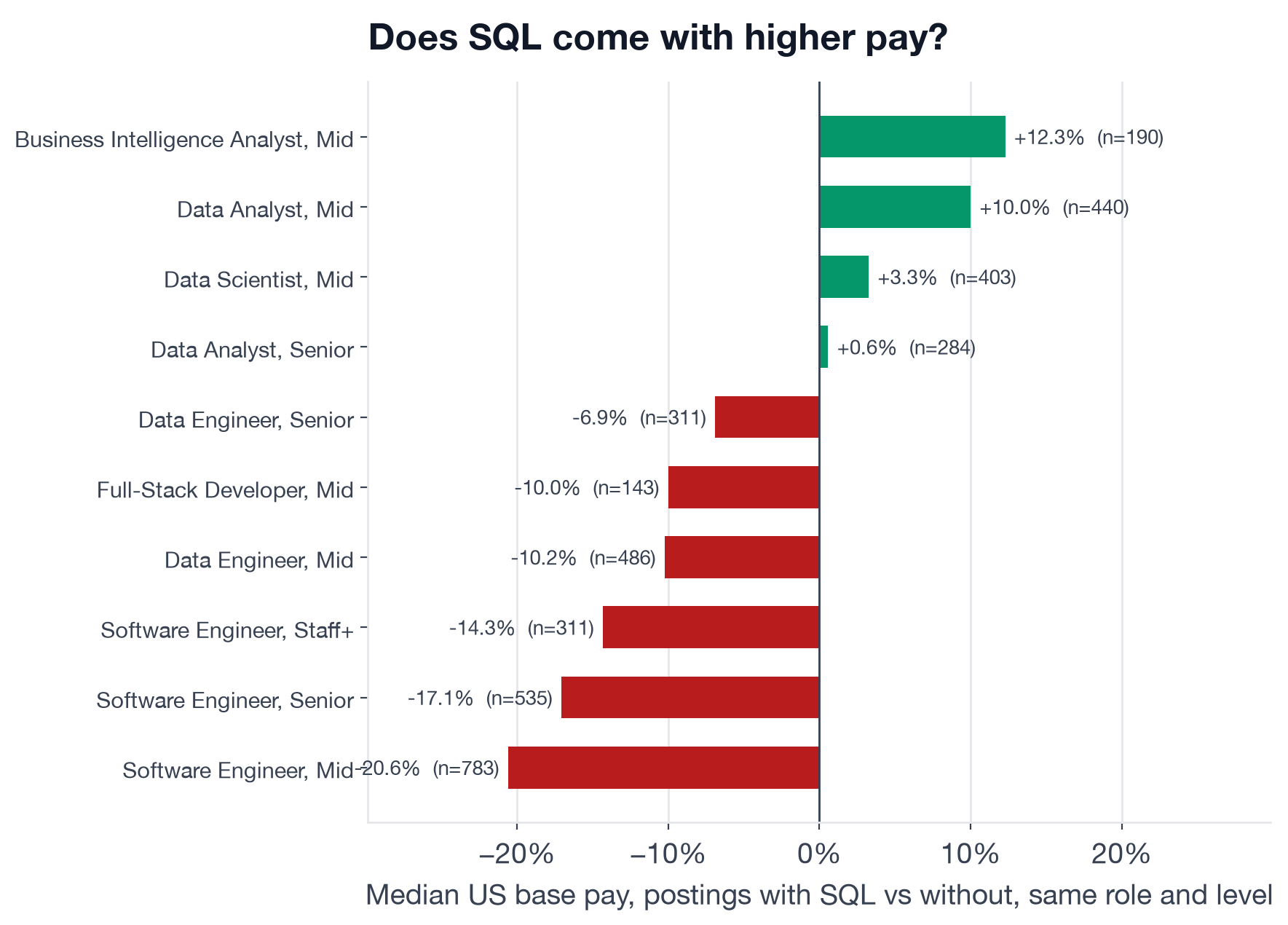
The chart makes the split visible: the gap leans positive for analyst and data-science cells and negative for engineering cells, which is why one blended number misleads in both directions.
The Data Engineer result is the one worth pausing on. SQL appears in nearly 7 in 10 Data Engineer postings, so the "without SQL" side is the small minority of postings that do not mention it (as few as 122 at senior level), and those postings advertise more. The data does not tell us why, and we are not going to guess. The practical read: for a software or data engineer, SQL is not a differentiator in advertised pay. If you are an analyst or data scientist, the postings that ask for it advertise somewhat more, but treat that as a loose pattern, not a promise.
Which Roles Ask for SQL, and How Standard Is It There?
SQL demand comes from two different places: data roles by habit, and software roles by sheer volume. The four data roles (Data Engineer, Data Analyst, Data Scientist, Business Intelligence Analyst) account for about 41% of all SQL postings, and in each of them SQL is a default. Software Engineer alone supplies 20% of SQL postings, but only because the role is so large; fewer than 1 in 5 Software Engineer postings mentions it.
| Role | Postings asking for SQL | Share of that role's postings | Share of all SQL postings |
|---|---|---|---|
| Software Engineer | 5,808 | 17.6% | 20.1% |
| Data Engineer | 4,525 | 69.7% | 15.7% |
| Data Analyst | 3,225 | 57.7% | 11.2% |
| Data Scientist | 2,740 | 48.5% | 9.5% |
| Full-Stack Developer | 1,731 | 37.1% | 6.0% |
| Business Intelligence Analyst | 1,331 | 66.1% | 4.6% |
| Product Manager | 1,098 | 7.7% | 3.8% |
| QA Engineer | 960 | 8.0% | 3.3% |
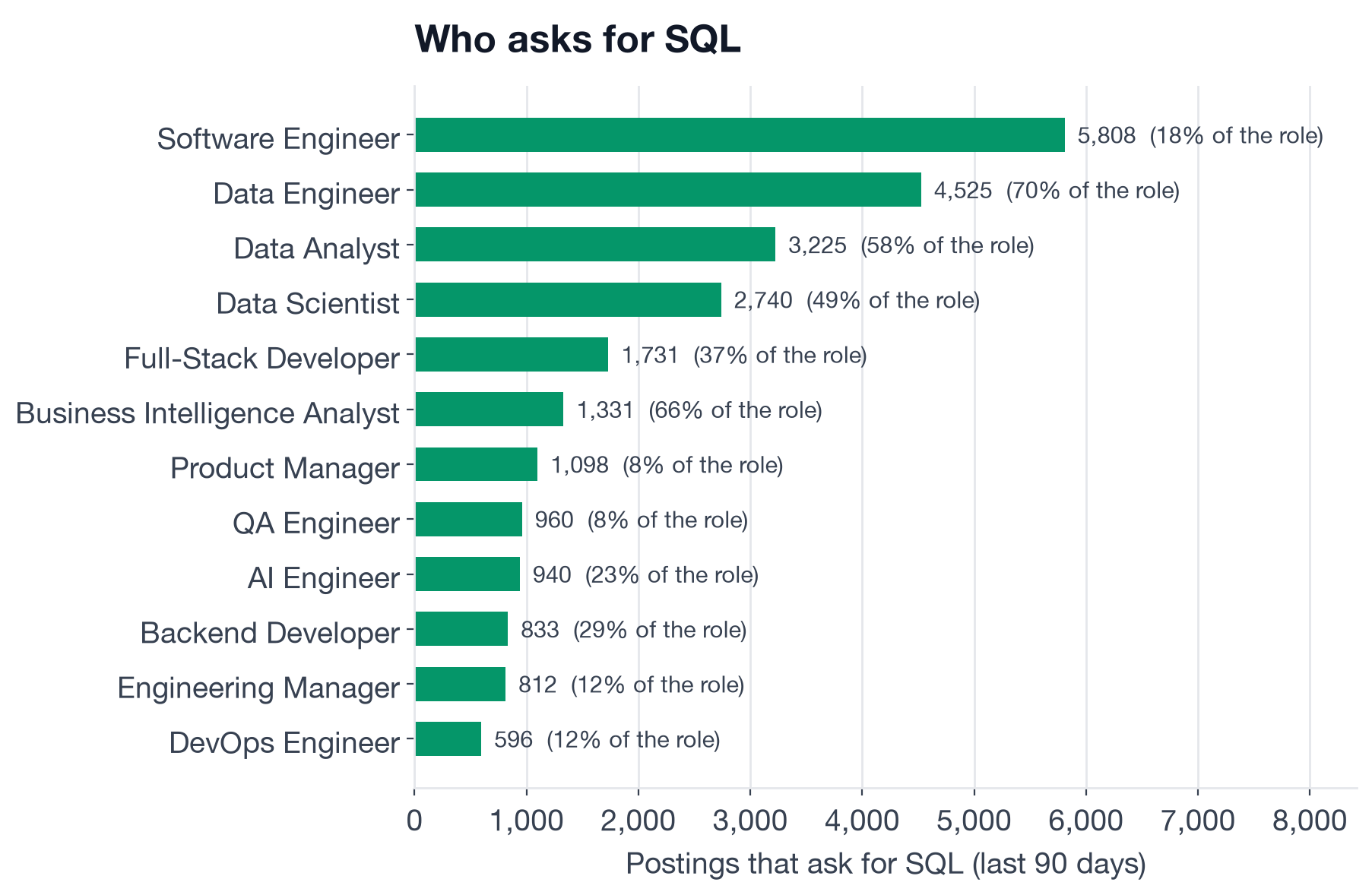
The chart's takeaway is breadth: no single role is much more than a fifth of SQL demand, so this is a cross-functional skill rather than one job's property. If you are targeting Data Engineer or Data Analyst roles, expect SQL to be assumed. For Software Engineer roles it is a useful secondary skill that roughly 1 in 6 postings names. Seniority skews slightly: 29% of SQL postings are senior level against 23% of postings without it, and only 5.6% are entry level.
Required or Nice-to-Have? Four in Five Classified Mentions Say Preferred
SQL is more often a preference than a hard requirement. Where nearby wording makes the intent clear (6,175 of 28,862 mentions), 78% are phrased as preferred or a plus and 22% as required, so roughly 1 in 5. The other mentions sit in plain skills lists with no signal either way, so this split describes about a fifth of postings, not all of them. Where wording is mixed, our classifier counts the mention as preferred, so the preferred share is, if anything, overstated.
The read for job seekers: a missing SQL line will rarely disqualify you by itself outside the data roles, but it is a cheap thing to have on a resume given how often it appears as a tiebreaker.
What Should You Learn With SQL? Rank by Lift, Not Share
Python shows up in 57% of SQL postings and AWS in 30%, but that is mostly because those tools are everywhere: their lift is 1.8 and 1.5. The real pairings are the tools that show up with SQL far more often than they do across the whole corpus.
| Tool | Share of SQL postings | Lift |
|---|---|---|
| Tableau | 12.4% | 4.2 |
| Snowflake Data Cloud | 13.5% | 3.8 |
| Power BI | 16.5% | 3.7 |
| Databricks (a lakehouse analytics platform) | 14.0% | 3.5 |
| Apache Spark | 14.1% | 2.9 |
| PostgreSQL | 12.4% | 2.5 |
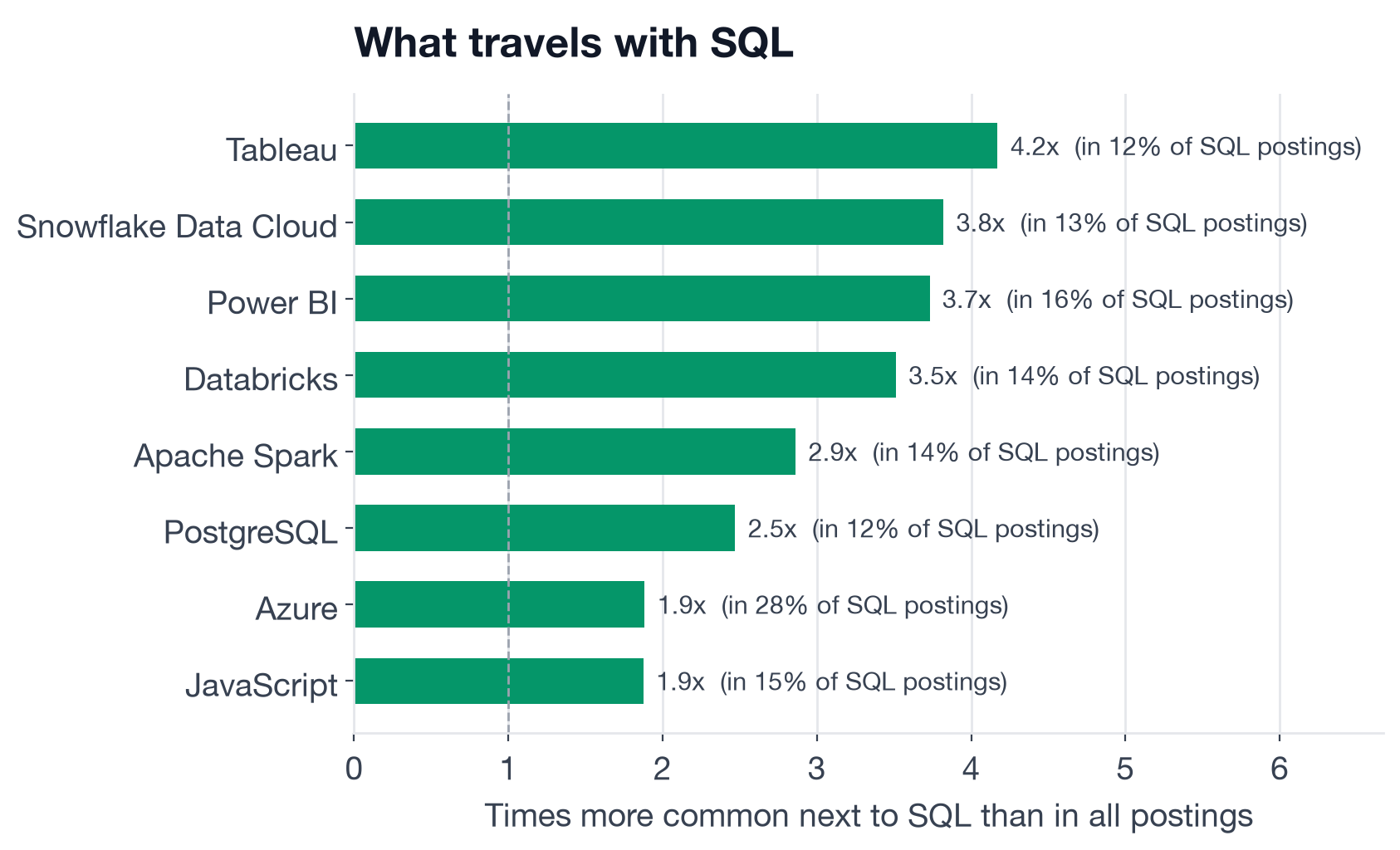
Two stacks fall out of the chart. One is analytics: SQL plus Tableau or Power BI, with Data Analysis in 49% of SQL postings and Data Visualization in 28%. The other is the warehouse and big-data side: SQL plus Snowflake, Databricks and Spark, alongside Data Pipelines in 29%. Pick the stack that matches the role you want rather than collecting all six.
Who Hires for SQL? Big Tech, Banks and Consultancies, and Federal Contractors
No single industry owns SQL demand. The top employers by distinct openings are Amazon (576), Citi (250), PricewaterhouseCoopers (186), Cognizant (152), Google (149), UnitedHealth Group (118, listed as Uhg), Booz Allen Hamilton (117) and Microsoft (107). Accenture (102), Databricks, General Dynamics Information Technology, Intuit, Leidos, SpaceX and Micron each post roughly 75 to 95.
Three clusters show up: large tech firms, financial and consulting services (Citi, PwC, Cognizant, Accenture), and federal contractors (Booz Allen, GDIT, Leidos). Counts are distinct openings, not repostings, and employer labels are approximate, but the shape is clear: SQL is hired for across sectors, not in one niche.
How Should You Use This in a Job Search?
Start from the role, not the tool. Browse current openings on the job board and notice how often SQL appears in the roles you want, then drill the skill with the Question Bank and AI mock interviews. Once the basics are solid, add one paired tool from the lift table that fits your target role rather than learning several at once.
FAQ
Q. Is SQL worth learning in 2026?
SQL is asked for in 28,862 of 157,833 active postings (18.3%) on the InterviewStack.io job board in the 90 days to November 13, 2026, across 38 of 39 tracked roles. Its share edged up from 16.4% to 19.2% across the window. It is a baseline expectation in data roles (about 7 in 10 Data Engineer postings) and a minority requirement elsewhere.
Q. Do job postings that ask for SQL advertise higher pay?
Not consistently. Comparing postings with and without SQL inside the same role and seniority level, US advertised base pay is 5.7% lower on average. The gap is higher in 18 role-and-level cells (for example Data Analyst mid-level, +10.0%, and Data Scientist staff, +8.5%) and lower in 39, including every Software Engineer level. This is a correlation in advertised pay, not an effect of learning SQL.
Q. Which roles ask for SQL the most?
Data Engineer (70% of postings), Business Intelligence Analyst (66%), Data Analyst (58%) and Data Scientist (48%) ask for it most often. Software Engineer postings supply the largest volume, 5,808 postings, but SQL appears in only 18% of that role.
Q. Is SQL required or just preferred in job postings?
Among the 6,175 SQL mentions where nearby wording makes the intent clear, 22% are phrased as required and 78% as preferred. Most mentions carry no clear wording, so the split covers about a fifth of all SQL postings.
Q. What should you learn alongside SQL?
Rank by lift, not share. Tableau (lift 4.2), Snowflake Data Cloud (3.8), Power BI (3.7) and Databricks (3.5) are the strongest pairings, followed by Apache Spark (2.9) and PostgreSQL (2.5). Python appears in 57% of SQL postings but has a lower lift of 1.8 because it appears next to almost everything.
Q. Which employers post the most SQL openings?
Amazon leads with 576 distinct openings, followed by Citi (250), PricewaterhouseCoopers (186), Cognizant (152) and Google (149). The list mixes big tech, banks and consulting firms, and federal contractors, with no single industry dominating.
What to Do With a Skill Everyone Already Lists
SQL is table stakes where data is the job and a quiet bonus where it is not, and the advertised pay data refuses to turn it into a simple premium. Treat it as the entry ticket, then spend your differentiating effort on the paired tool and the role-specific skills that separate postings within your own level.
Topics
Ready to practice?
Put what you've learned into practice with AI mock interviews and structured preparation guides.