
Only One of These Titles Pays Extra for What Defines It
Network Engineer and Systems Administrator postings ask for nearly the same footprint of monitoring, automation, and cloud skills, and hiring volume between them is close to a dead heat. But a title's most-defining skills don't automatically earn a raise, and here the two roles split hard: Network Engineer's own specialty, BGP, OSPF, and network security, clears a real premium over its baseline pay, while Systems Administrator's specialty, Active Directory, PowerShell, Windows Server, mostly sits at or below its own median. We compared every active posting for both roles on the InterviewStack.io job board as of July 2026, 4,256 Systems Administrator listings against 4,062 for Network Engineer, and the pay gap between them turns out to be less about the size of the job market and more about which title's skills the market actually pays extra for.
| Systems Administrator | Network Engineer | |
|---|---|---|
| Median US base salary | $115,000 | $126,800 |
| Active postings | 4,256 | 4,062 |
| Top skill | Monitoring (39.2%) | Monitoring (43.7%) |
| Senior + staff share | 21.2% | 31.3% |
| Entry-level share | 2.9% | 2.7% |
| Skill overlap (Jaccard) | 46% (across top 30 skills) | 46% (across top 30 skills) |
Key Findings
- Systems Administrator (4,256 active postings) and Network Engineer (4,062) are nearly tied in volume, a 1.05x ratio.
- Network Engineer pays a median $126,800 US base salary versus $115,000 for Systems Administrator, an $11,800 (9.3%) gap.
- The two roles share a moderate 46% skill overlap (Jaccard on top-30 skills); 15 skills clear the 5% threshold in both.
- Network Engineer's own defining skills pay above baseline: BGP (+$6,200), OSPF (+$5,700), and Network Security (+$5,700) each clear the role's $126,800 median.
- Systems Administrator's defining skills mostly don't: Windows Server sits $12,500 below the role's $115,000 median and Active Directory sits $9,000 below it.
- Network Engineer skews more senior: 31.3% of postings are senior or staff level versus 21.2% for Systems Administrator, though entry-level share is nearly identical (2.7% vs 2.9%).
- Automation, one of the largest shared skills (about 30% to 32% of both roles' postings), pays a bigger premium for Network Engineer (+$13,200) than for Systems Administrator (+$6,600).
- Both roles are dominated by onsite work (65% to 66%), and defense and government contractors appear among the top employers for both.
Same Infrastructure Floor, Different Daily Work
A Systems Administrator keeps the organization's core computing environment running: provisioning and patching Windows and Linux servers, managing Active Directory and identity, backing up and restoring data, and troubleshooting whatever lands in the help-desk queue. The work is broad and reactive, spanning whichever box or account is misbehaving that day.
A Network Engineer owns the plumbing those servers talk over: routing and switching, BGP and OSPF peering between sites, firewall policy, and the WAN and VPN links connecting offices and data centers. The work is narrower but deeper, closer to protocol-level troubleshooting than to a general-purpose IT queue. Systems Administrator's exclusive skills (Active Directory, Windows Server, backups) point to a generalist keeping many systems alive; Network Engineer's exclusive skills (BGP, OSPF, MPLS) point to a specialist who owns one layer of the stack.
What Skills Do Both Roles Actually Share?
Monitoring and automation top both lists. Monitoring appears in 39.2% of Systems Administrator postings and 43.7% of Network Engineer postings, the single most-requested skill for either role. Automation follows close behind, 29.8% for Systems Administrator and 32.2% for Network Engineer, essentially config-management and scripting work (Ansible, PowerShell, Terraform) rather than anything AI-specific.
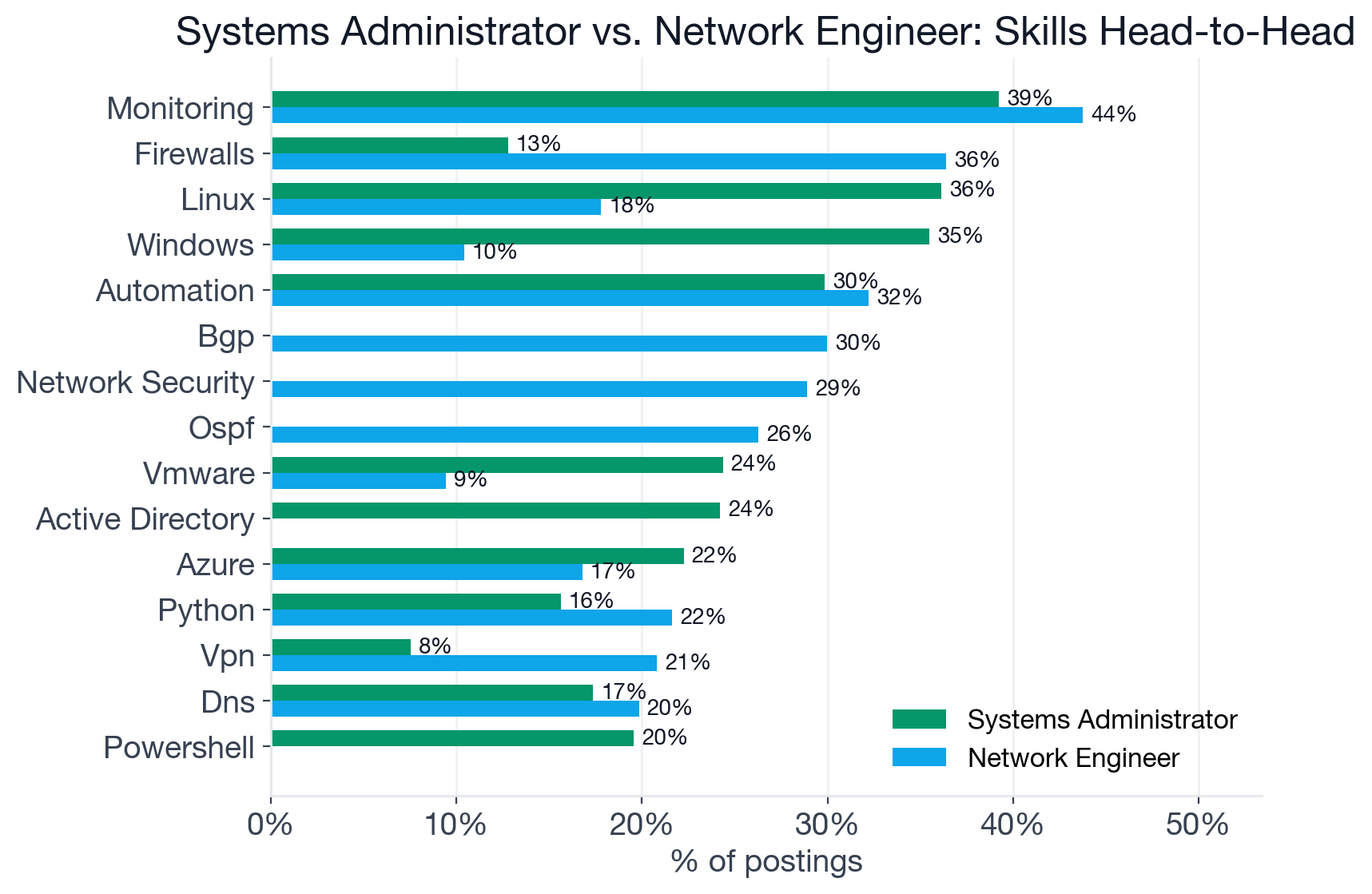 Shared skills across both roles' top-30 lists, ranked by average frequency. Linux and Windows skew toward Systems Administrator; Firewalls and VPN skew toward Network Engineer.
Fifteen skills clear the 5% threshold in both roles, a 46% Jaccard overlap across their top-30 lists. Beyond monitoring and automation, both ask for Linux, Windows, Azure, Python, DNS, AWS, VMware, VPN, Ansible, DHCP, and TypeScript, though the split within each pair tells its own story: Linux leans Systems Administrator (36.1% vs 17.8%), Windows leans Systems Administrator even harder (35.5% vs 10.4%), while Firewalls and VPN lean Network Engineer (36.4% vs 12.8%, and 20.8% vs 7.5%). If you already hold one of these titles, that shared 46% is close to your transferable floor; the rest is what you'd need to learn moving between them.
TypeScript is worth a second look: it clears the top-30 list for both roles (13.1% Systems Administrator, 11.7% Network Engineer) despite neither being a software-development title. That almost certainly reflects the web-based dashboards and internal tooling both roles now build or extend (NetBox, internal admin portals, network-automation UIs), not a requirement to ship production frontend code, so read it as a "can extend a tool" signal rather than a "learn a JS framework" signal.
Neither role's top-30 list carries a distinct generative-AI or LLM skill tag, which tracks with what we'd expect: postings only list a skill when it is an explicit requirement, and few infrastructure roles frame AI tooling that way yet. That doesn't mean AI is absent from either job day to day. Broader developer and IT-practitioner surveys put AI tool usage at 84% to 85% and find 51% of IT operations teams already running AI in production, and vendors have started shipping AI directly into the tools both roles already use: Ansible Lightspeed generates playbook suggestions inside the automation workflow Systems Administrators already run, and AI-driven anomaly detection is becoming a standard feature of network-operations tooling. Treat AI fluency as a baseline expectation for both roles even though neither posting set states it explicitly.
Where Do the Two Skill Stacks Split?
Systems Administrator's exclusive cluster, Active Directory (24.2%), PowerShell (19.6%), System Administration (17.9%), Virtualization (17.2%), Windows Server (17.0%), Bash (14.0%), SQL (11.7%), Customer Service (10.7%), Backups (9.9%), and Configuration Management (9.4%), is a Windows-and-virtualization-admin stack: identity, endpoint management, and keeping data recoverable. Browse Systems Administrator postings asking for Active Directory to see the pattern directly. A minority of postings under this title administer a narrower system than general IT infrastructure, financial or ERP systems, CMS/portal platforms, QA test-automation tooling, so read the skill frequencies above as a dataset-wide signal rather than a guarantee for every individual posting.
Network Engineer's exclusive cluster, BGP (30.0%), Network Security (28.9%), OSPF (26.3%), MPLS (12.5%), Root Cause Analysis (10.4%), Fiber (9.3%), Project Management (8.6%), Incident Response (8.4%), and Terraform (8.3%), is routing-protocol and network-security depth: the job is keeping traffic moving correctly and securely between sites, not keeping any one machine alive. Browse Network Engineer postings asking for BGP to see that pattern.
Neither role's exclusive list includes a genuine AI or ML skill tag, so the divergence here is entirely about which layer of infrastructure each title owns: the compute and identity layer for Systems Administrator, the transport layer for Network Engineer.
Does Network Engineer's Specialty Actually Pay More Than Systems Administrator's?
Network Engineer earns more. The median US base salary is $126,800 (n=1,296) for Network Engineer versus $115,000 (n=1,233) for Systems Administrator, an $11,800 (9.3%) gap. These are base salaries only, disclosed in US postings; equity, bonus, and sign-on aren't captured in job-board data, so total compensation at top employers runs higher than either figure.
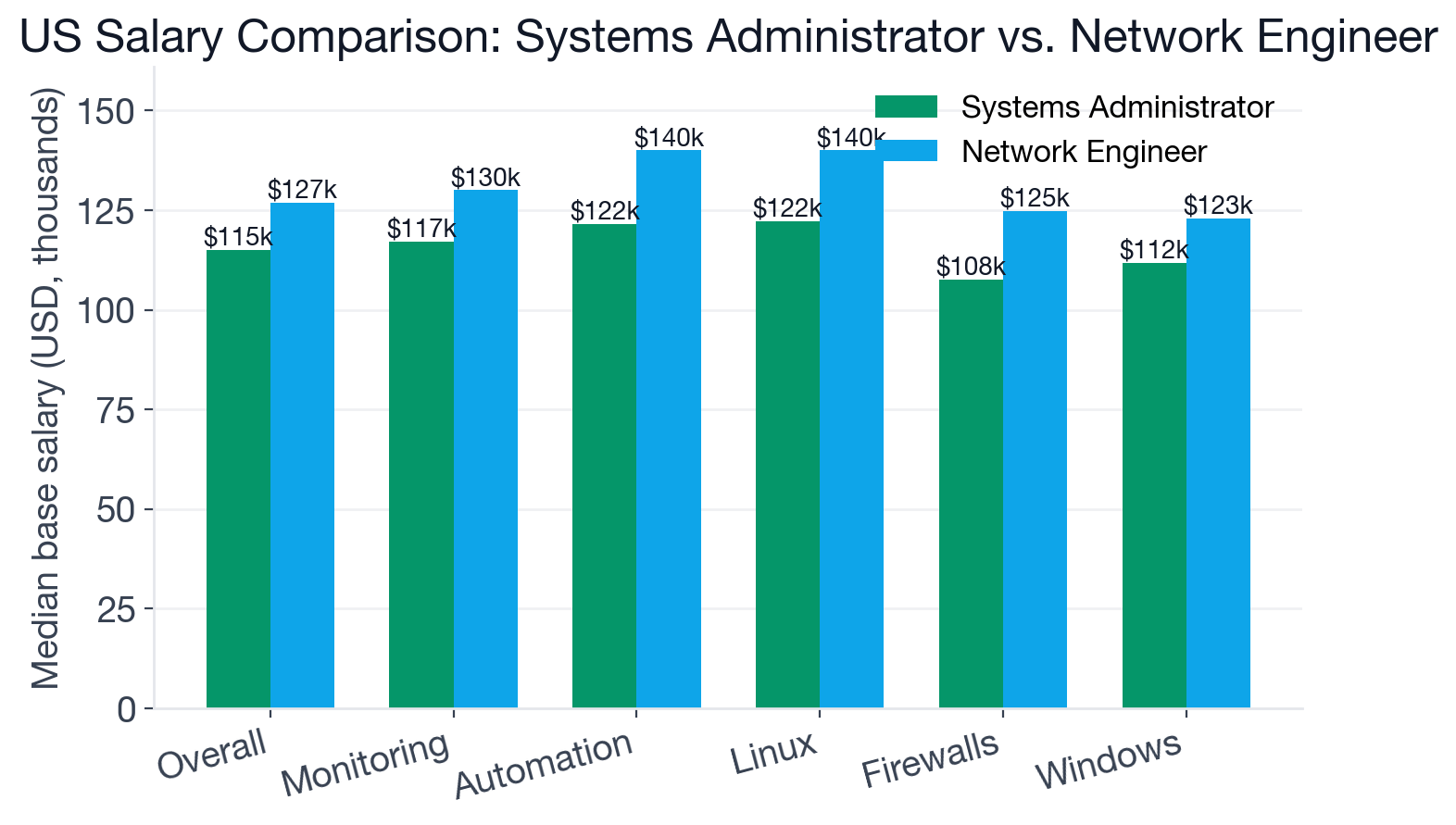 Median US base salary by role, plus a sample of shared skills. Network Engineer's baseline sits $11,800 above Systems Administrator's.
The more interesting number sits one layer down. Network Engineer's own defining protocol skills clear that baseline: BGP pays $133,000 (+$6,200 over the role's own median, n=427), OSPF pays $132,500 (+$5,700, n=397), and Network Security pays $132,500 (+$5,700, n=388). Adjacent skills pay more still: Project Management adds $13,200 (n=140), Terraform adds $10,000 (n=112), and Root Cause Analysis and Incident Response each add $8,200 (n=109 and n=106).
Systems Administrator's own defining skills mostly don't clear its baseline. Windows Server pays $102,500, $12,500 below the role's own median (n=220); Active Directory pays $106,000, $9,000 below it (n=346); Virtualization pays $110,500, $4,500 below it (n=276); and PowerShell pays $112,700, $2,300 below it (n=262). Configuration Management (+$11,800, n=193) and Bash (+$9,300, n=204) are the exceptions that do pay above baseline, but they're less common in postings than the skills that don't.
The pattern extends to the one skill both roles share at real scale. Automation appears in roughly 30% of postings for each role, but it pays $140,000 for Network Engineer (+$13,200 over baseline, n=442) and only $121,600 for Systems Administrator (+$6,600, n=393). The same skill, held by both titles, is worth roughly twice the premium to a Network Engineer that it is to a Systems Administrator.
Which Role Is Easier to Land, and Where?
Volume is close to a wash: 4,256 Systems Administrator postings versus 4,062 for Network Engineer, a 1.05x ratio. Entry-level access is nearly identical too: 2.9% of Systems Administrator postings and 2.7% of Network Engineer postings are explicitly entry-level, so neither title is meaningfully easier to break into at the junior end.
The real difference shows up further up the ladder. Network Engineer postings skew more senior overall: 31.3% are senior or staff level (22.3% senior + 9.0% staff) versus 21.2% for Systems Administrator (17.0% senior + 4.2% staff). Close to a third of the Network Engineer market sits above mid-level, versus roughly a fifth of the Systems Administrator market, which lines up with the specialty-premium pattern above: a role whose defining skills pay off also tends to carry more senior headcount.
Geography is close for both: the US accounts for 51.8% of Systems Administrator postings and 53.9% of Network Engineer postings. One wrinkle is Germany, Systems Administrator's second-largest market at 9.6% versus just 2.4% for Network Engineer, while India is proportionally larger for Network Engineer (6.0% vs 4.5%). Work mode is essentially flat between the two: both are onsite-dominant (66.3% Systems Administrator, 65.5% Network Engineer) with remote share around 9% to 10% for each. Government and defense contractors, Leidos, CACI International, General Dynamics Information Technology, Peraton, and Booz Allen Hamilton, appear among the top employers for both roles, consistent with the onsite-heavy split: cleared, on-premises IT and network work is still a large share of both markets.
Choosing Between the Two
Choose Systems Administrator if you:
- Want breadth over depth: identity, virtualization, backups, and general Windows/Linux server care, rather than one specialized layer of the stack.
- Are coming from a general IT support or help-desk background; Customer Service clears 10.7% of Systems Administrator postings but doesn't crack Network Engineer's top-30 skill list at all.
- Can accept that your core skills (Active Directory, Windows Server, PowerShell) will mostly sit at or below the role's median pay; the ceiling comes from adding cloud and automation depth (AWS, Ansible, CI/CD) on top of the base admin skill set, not from the admin skills themselves.
Choose Network Engineer if you:
- Want to go deep on one layer: routing, protocol-level troubleshooting, and network security rather than general system upkeep.
- Want your specialty to actually move your pay; BGP, OSPF, and Network Security each clear the role's own baseline, and the role carries more senior and staff headcount overall.
- Can work within a narrower, more protocol-specific skill set with less crossover into general IT work.
How to Use This in Your Job Search
If you're deciding between the two, practice with AI mock interviews for the role you're leaning toward. A Network Engineer interview will drill into BGP path selection and OSPF area design; a Systems Administrator interview leans on Active Directory troubleshooting and Windows Server recovery scenarios, and rehearsing the actual questions is the fastest way to find out which one you can talk through confidently.
If your protocol depth is thin, the Question Bank has focused drill sets for BGP, OSPF, and network security topics. If you're earlier in your infrastructure career, our interactive courses cover the networking and systems fundamentals both roles build on.
Browse current openings for either role directly: Systems Administrator jobs or Network Engineer jobs. For a deeper dive on skills, salary, and seniority within each role individually, see our Systems Administrator skills report and Network Engineer skills report.
FAQ
Q. Does a Systems Administrator or a Network Engineer earn more in 2026?
Network Engineer earns more. The median US base salary is $126,800 for Network Engineer versus $115,000 for Systems Administrator, a gap of $11,800 (9.3%), based on 1,296 and 1,233 postings with disclosed US salary data.
Q. Are Systems Administrator and Network Engineer equally available as jobs?
Nearly. Systems Administrator carries 4,256 active postings versus 4,062 for Network Engineer, a volume ratio of 1.05, one of the closest head-to-head matchups in this comparison series.
Q. How much do Systems Administrator and Network Engineer skill sets overlap?
About 46% (Jaccard overlap across each role's top 30 skills). Fifteen skills, including Monitoring, Linux, Windows, Automation, and Azure, appear at meaningful frequency in both roles' postings.
Q. Do Network Engineer's core specialty skills actually pay more?
Yes. BGP (30.0% of postings), Network Security (28.9%), and OSPF (26.3%), the three skills that most define the title, each carry a $5,700 to $6,200 premium over the role's own $126,800 baseline. Adjacent infrastructure skills pay even more: Terraform adds $10,000 and Project Management adds $13,200.
Q. Do Systems Administrator's core specialty skills pay a premium too?
Not consistently. Windows Server sits $12,500 below the Systems Administrator baseline and Active Directory sits $9,000 below it, despite both being among the most common skills in Systems Administrator postings. Configuration Management (+$11,800) and Bash (+$9,300) are the exceptions that clear the baseline.
Q. Which role skews more senior, Systems Administrator or Network Engineer?
Network Engineer. Senior and staff postings make up 31.3% of the Network Engineer market versus 21.2% for Systems Administrator. Entry-level access is nearly identical for both, at 2.7% and 2.9%.
Q. Are Systems Administrator and Network Engineer remote-friendly roles?
Not especially. Both are dominated by onsite work: 66.3% of Systems Administrator postings and 65.5% of Network Engineer postings are onsite, with remote share around 9% to 10% for each. Defense and government contractors make up a large share of the top employers for both roles, which helps explain the onsite requirement.
The Line Between the Two Titles
Systems Administrator and Network Engineer sit close together on paper: nearly the same number of jobs, a moderate 46% skill overlap, and an $11,800 gap that looks like ordinary title-to-title variance. What the skill-level data actually shows is a different kind of gap: one role's defining skills earn their keep, the other's mostly don't. If you already hold either title, the fastest way to move your own pay isn't to lean harder on the skill your job title already implies; it's to add the adjacent layer, cloud, automation, protocol depth, that this data shows actually moves the median.
Topics
Ready to practice?
Put what you've learned into practice with AI mock interviews and structured preparation guides.