
A Systems Engineer Interview With Two Plausible Causes Isn't Testing Which One You Pick
The application is down. Users can't reach it. Before anyone touches a single log, two suspects are already sitting on the table: routine system updates ran overnight, and another team changed a Group Policy tied to the same users this week. Either one is a plausible story, and a confident-sounding candidate can build a whole answer around either. That is exactly the trap.
This is a mid-level Systems Engineer interview on Linux and Windows System Administration, built from the real blueprint InterviewStack.io's production AI interviewer uses to run and score this scenario: a mixed-stack outage spanning a Linux application host, Active Directory authentication, and a Windows file server, all under a 30-minute clock. The rubric does not reward guessing correctly between the two named causes. It rewards ruling systems in or out with evidence before committing to either one.
Key Findings
- The 100-point rubric splits 30/30/20/20 across Interviewer Objectives Alignment, Level-Specific Expectations, Technical Proficiency, and Communication and Problem Solving.
- The interview runs exactly 30 minutes across 3 phases: 0-8 minutes for triage, 8-22 minutes (the longest, 14-minute stretch) for technical investigation, and 22-30 minutes for the restoration decision.
- Those 3 phases carry 14 total expected-checklist items: 4 in triage, 6 in investigation, 4 in decision-making.
- 2 recent changes are named directly in the scenario before any evidence is gathered: the overnight system updates and the same-day Group Policy change.
- A strong opening answer isolates failure across 3 distinct systems before proposing a fix: the Linux app host, Active Directory authentication, and the Windows file server.
- 4 topics are explicitly out of scope for this round: kernel driver development, large-scale infrastructure-as-code design, machine learning systems, and deep application source-code debugging.
- The real interview package includes 6 follow-up prompts; this walkthrough dramatizes 4 of them, and folds the other 2 into the FAQ below.
The interview question
Your team owns a small but business-critical internal service used by support and finance. This morning, users report they can no longer access the application. The application runs on a Linux server, authenticates users through Active Directory, and depends on a Windows file server for shared documents.
There were routine system updates overnight, and another team says they recently changed a Group Policy tied to the application users. You are the on-call systems engineer joining the incident bridge.
How would you approach diagnosing and restoring this service?
The objectives behind this question go beyond "can you fix a Linux box." The interviewer is watching whether a candidate can reason across a real dependency chain (application, OS, authentication, file storage), use practical Linux and Windows tooling rather than describing it in the abstract, and make operational decisions that hold up under time pressure without making the outage worse.
What Does the Systems Engineer Linux and Windows System Administration Interview Look For?
Two named suspects, three systems in the dependency chain, and a 30-minute clock make this a framing test before it is a tooling test. The mixed Linux, Windows, and Active Directory stack in this scenario is a familiar shape for anyone tracking live Systems Engineer openings: a Linux service depending on Windows infrastructure it doesn't own.
The checklist rewards a candidate who resists picking a side early. Naming both changes out loud, then deliberately deferring judgment on which one (if either) actually caused the outage, is worth more than sounding decisive about either theory. That single habit, isolate before you commit, is also what determines whether the four follow-ups below go well or badly.
The Walkthrough: Four Follow-Ups, One Habit Under Pressure
We're following a candidate we'll call Idris through four of the interview's real follow-up prompts. Each dramatized answer below is illustrative, a common way candidates respond under time pressure, not a transcript of an actual session.
Turn 1: Check the host before the theory
Interviewer: "What would you check first on the Linux host to determine whether the application failure is due to the service itself, the OS, or an external dependency?"
Turn 2: Some users, not all users
Interviewer: "If users can reach the application but authentication is failing for only some users, how would you investigate Active Directory and Group Policy involvement?"
Turn 3: The share fails, the process doesn't
Interviewer: "Suppose the application process is healthy, but access to the Windows file share is intermittently failing from the Linux server. How would you narrow that down?"
Turn 4: Fast and safe aren't the same move
Interviewer: "How would you balance restoring service quickly with avoiding risky changes that could make the outage worse?"
What Happens When You Can't Just Call the Active Directory Team?
Every one of those four corrections is easy to nod along to on a page. None of it is easy live, with a clock counting down and an interviewer adding pressure of their own: what if the file-server owner is unreachable for the next ten minutes, or the interviewer asks you to justify your next move before you've finished checking the last one? Reading the fix is not the same skill as generating it in real time, under the same constraint the rubric is actually built to test.
That gap, between recognizing a mistake here and not making it live, is exactly what practicing this scenario in a real, timed AI mock interview closes. It runs the same two-suspect, three-system incident, on the same clock, and scores you against the same 14 checklist items.
What Does the Blueprint Reward Once You've Ruled Out Both Suspects?
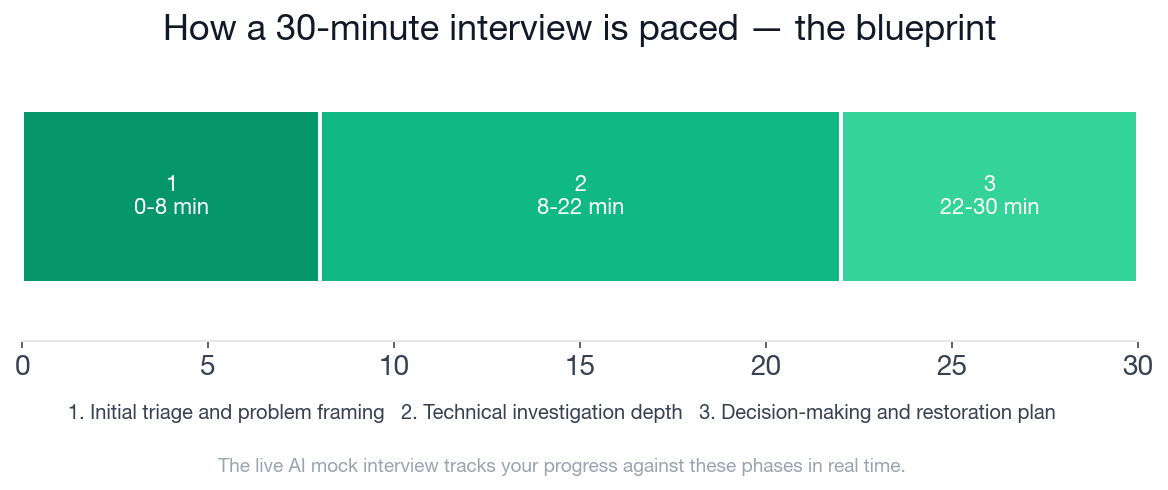
The chart above is the pacing a strong candidate actually keeps: roughly a quarter of the clock on framing, almost half on investigation, and the rest on a safe restoration call. The card below is the exact blueprint, phase by phase and checklist item by checklist item, that the live AI interviewer tracks your answer against in real time.
- ✓Clarifies user impact and symptoms at a high level (app down, auth failing, file access issue, full vs partial outage)
- ✓Mentions checking recent changes such as overnight updates and Group Policy modifications
- ✓Breaks the problem into components: Linux app host, AD auth, Windows file share, DNS/network/time
- ✓States an order of operations for isolating the fault domain instead of proposing random commands
- ✓On Linux, checks service/process state with tools such as systemctl, ps, ss/netstat, journalctl, and application logs
- ✓Checks host basics such as disk, memory, CPU pressure, filesystem availability, name resolution, time sync, and network reachability
- ✓Considers permissions or credential issues affecting app access to the Windows share
- ✓On Windows/AD side, references event logs, service state, share/NTFS permissions, AD user/group changes, and Group Policy application
- ✓Explains how to verify whether authentication failures affect all users or a subset, and how to test with a known-good account
- ✓Discusses update verification and rollback/mitigation options with awareness of operational risk
- ✓Prioritizes low-risk validation before disruptive actions like rebooting servers or broadly reverting policy
- ✓Proposes a credible mitigation path such as failing over, temporarily bypassing a dependency, restoring prior config, or targeted rollback
- ✓Mentions coordinating with owners of AD or the Windows file server when evidence points there
- ✓Articulates how they would confirm recovery and monitor for recurrence after mitigation
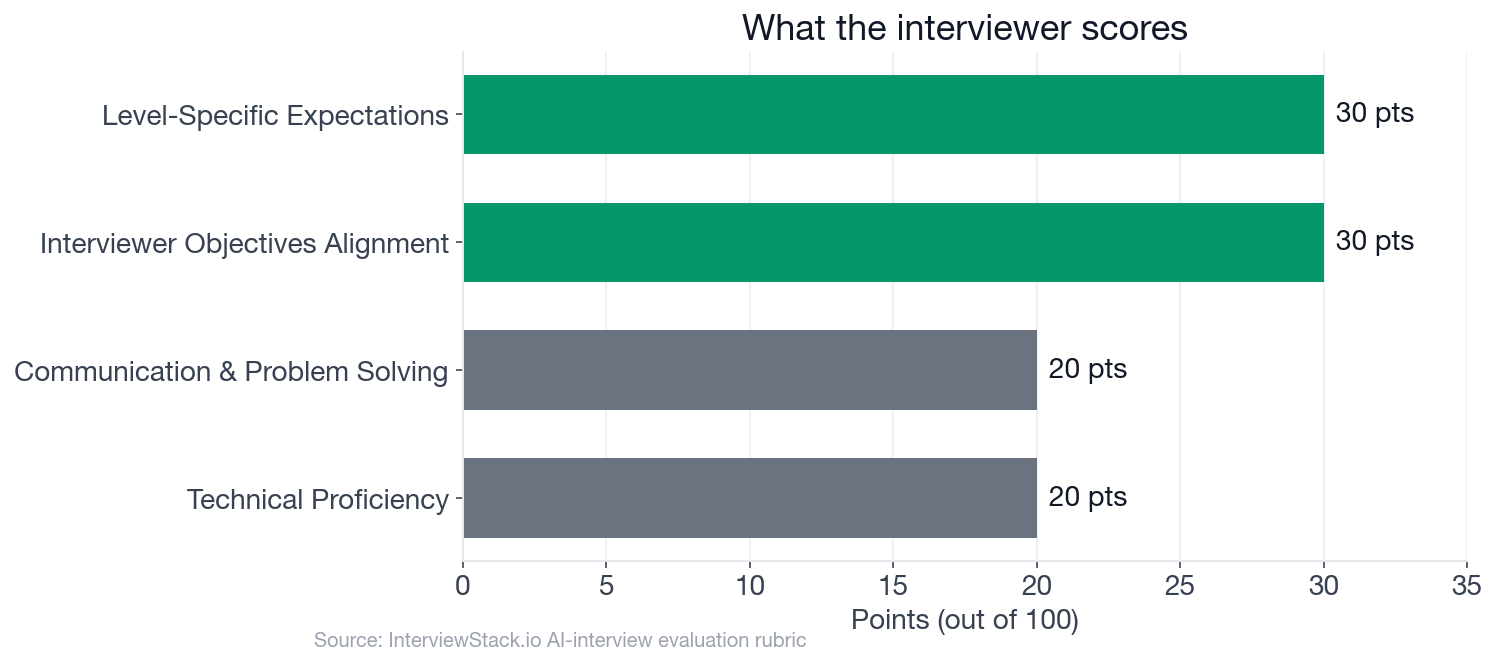
Interviewer Objectives Alignment and Level-Specific Expectations carry 60 of the 100 points between them, which is exactly where the isolate-before-you-commit habit from all four turns above pays off or costs you.
Take This Incident Bridge Call Yourself
Reading the four mistakes above is the easy half. The AI mock interview puts you on the same incident bridge, with the same two suspects, the same three systems, and the same 30-minute clock, then scores your actual answers against this exact blueprint and gives you turn-by-turn feedback afterward.
Start with the Systems Engineer Linux and Windows mock interview if you want the full timed scenario, or warm up first in the Linux and Windows System Administration question bank on individual checks like service diagnostics, Active Directory troubleshooting, and safe rollback decisions. If networking fundamentals are the shakier half of your Systems Engineer prep, the subnetting interview walkthrough covers the other core round. Company-specific process questions live in the preparation guides.
FAQ
Q. What does the Systems Engineer Linux and Windows System Administration interview actually evaluate?
It evaluates whether a mid-level systems engineer can run a structured incident response across a mixed Linux and Windows environment: isolating whether a failure sits in the application, the Linux host, Active Directory authentication, or a Windows file share, using real diagnostic tooling on both platforms, and proposing a safe, low-risk path to restore service under a 30-minute clock.
Q. How is this Linux and Windows systems engineer interview scored?
A 100-point rubric splits into four dimensions: 30 points for Interviewer Objectives Alignment, 30 for Level-Specific Expectations, 20 for Technical Proficiency, and 20 for Communication and Problem Solving, tracked across three timed phases (minutes 0-8, 8-22, and 22-30).
Q. How do you confirm whether overnight updates actually caused the outage?
Check package or update logs against the exact time the outage started, compare service configuration before and after the update where possible, and test a rollback path on a single host before reverting broadly. Update timing alone is a lead, not proof; a strong answer correlates it against real evidence, such as service logs or config drift, before committing to a rollback.
Q. What logs and tools matter most in this incident?
On Linux: systemctl, ps, ss or netstat, and journalctl for service and process state, plus application logs. On Windows and Active Directory: the Windows Event Log, service status, share and NTFS permissions, and Group Policy application results. The interview rewards knowing which tool answers which question, not reciting a full command list.
Q. What happens in the first 8 minutes of this interview?
The opening phase rewards fast problem framing over fast fixes: clarifying user impact and symptoms, naming both recent changes on the table (the overnight updates and the Group Policy change), and breaking the incident into its component systems, the Linux app host, Active Directory authentication, and the Windows file share, before proposing a single command.
Q. What is out of scope for this Systems Engineer round?
Kernel driver development, large-scale infrastructure-as-code design, machine learning systems, and deep application source-code debugging are all explicitly out of scope. The focus stays on host and platform-level administration across Linux and Windows.
Q. How can candidates practice this exact scenario before a real interview?
The AI mock interview runs this same mixed Linux and Windows incident live, with the same 30-minute clock and rubric, and gives turn-by-turn feedback. You can also drill individual Linux and Windows administration checks first in the question bank.
The Two Suspects Were Never the Point
Whichever of the two named changes turns out to matter here doesn't decide how this interview is scored. The interview isn't measuring whether you happen to guess right between them. It's measuring whether you can hold off guessing at all, isolate the failure domain with real evidence, and only then move, in a way that survives contact with a system you don't fully control. That habit is what the 30-minute clock is actually built to catch.
Topics
Ready to practice?
Put what you've learned into practice with AI mock interviews and structured preparation guides.