
Protocol Depth Doesn't Buy a Salary Premium
Network Engineers have one of the most focused skill stacks in infrastructure. BGP (Border Gateway Protocol), OSPF (Open Shortest Path First), MPLS (Multiprotocol Label Switching), firewalls, DHCP: these protocol and security skills are specific to networking work and simply do not appear in Systems Engineer postings. By that measure, Network Engineering is the more specialized role. Yet Systems Engineers earn a median $138,000 in the US while Network Engineers earn $126,800 - an $11,200 gap in favor of the broader discipline, with nearly three times as many open positions.
This comparison covers 9,182 active Systems Engineer postings and 3,358 Network Engineer postings on the InterviewStack.io job board as of June 2026, with salary restricted to US postings for comparability. The gap holds at the median, and the volume story makes it starker: Systems Engineering is 2.74x larger by posting count.
| Systems Engineer | Network Engineer | |
|---|---|---|
| Median US base salary | $138,000 | $126,800 |
| Active postings | 9,182 | 3,358 |
| Volume advantage | 2.74x | (pairwise) |
| Remote share | 10% | 10% |
| Entry-level share | 3% | 3% |
| Skill overlap (Jaccard) | 40% shared | (pairwise) |
Key Findings
- Systems Engineer has 9,182 active postings vs 3,358 for Network Engineer: a 2.74x volume advantage for the broader role.
- Median US base salary: $138,000 for Systems Engineers (n=3,695) vs $126,800 for Network Engineers (n=993), an $11,200 gap in SE's favor.
- Skill overlap (Jaccard) is 40%: a genuine shared foundation of Automation, Python, Linux, Monitoring, AWS, and Azure.
- Network Engineer has 10 exclusive skills in its top-30 (all protocol or security); Systems Engineer has only 4. NE is the more specialized role by this measure.
- Entry-level share is 3.2% for SE and 3.1% for NE: neither role has an easy on-ramp for career changers.
- Both roles are predominantly onsite: 68% for Systems Engineer, 62% for Network Engineer.
- Protocol skills like BGP and firewalls pay at the NE baseline, not above it. Platform skills (Prometheus, Grafana, CI/CD) carry $35-48K premiums for Network Engineers who add them.
What Does Each Role Actually Do?
Systems Engineers integrate complex technical systems where hardware, software, networking, and operations intersect. The scope is deliberately wide: at a defense contractor, an SE writes system requirements, coordinates hardware and software integration, and runs validation testing for a communications or weapons platform. At a cloud or tech company, they architect distributed infrastructure and own the reliability and lifecycle of compute resources. MATLAB in 8% of SE postings signals the embedded and controls engineering subset; System Integration (13%) and System Design (13%) point to the broader architecture layer. The role spans industries precisely because "systems" is not a narrow category.
Network Engineers design, build, and operate network infrastructure: routing, switching, firewalls, VPNs, and increasingly the automation of those functions. The day-to-day is more focused: configuring BGP in 32% of postings and OSPF in 28% for routing; maintaining firewall rulesets and VPN tunnels for secure connectivity; writing Python and Ansible scripts to automate repetitive configuration tasks. An NE at a telecom manages backbone routing; at a defense contractor, they secure classified network enclaves. The vocabulary is specific by design - there is no equivalent of MATLAB or System Integration in the NE posting.
What Skills Do Both Roles Share?
Both roles share a meaningful infrastructure foundation. Automation (SE: 25%, NE: 33%), Python (22% each), Linux (17% each), Monitoring (SE: 21%, NE: 48%), AWS (SE: 13%, NE: 19%), and Azure (SE: 11%, NE: 20%) all appear prominently in both top-30 skill lists. Ansible, VMware, Windows, and TypeScript round out the shared cluster. (TypeScript's 11% share in SE postings is concentrated in software-platform and cloud-native SE roles , it appears far less in defense, embedded, or traditional systems engineering postings.)
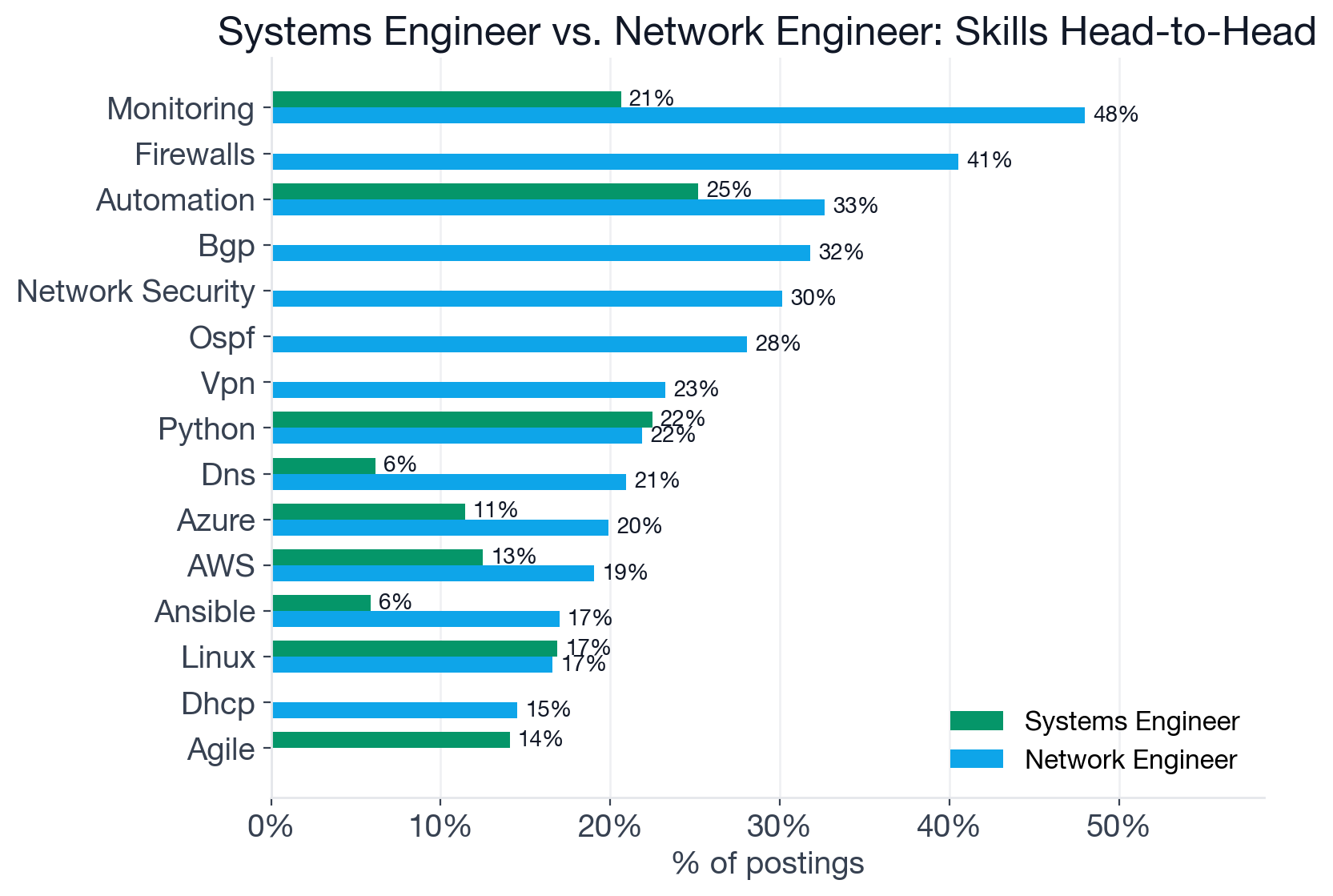
Frequency of top skills across Systems Engineer (emerald) and Network Engineer (blue) postings. Skills at or above 5% in both roles form the shared foundation; divergences represent specialization.
The 40% Jaccard overlap means a Python-fluent infrastructure engineer already holds a meaningful fraction of either role's baseline expectations. The relevant question is what that foundation gets directed toward - and the exclusive skills answer it clearly.
Where the Skill Stacks Diverge
Systems Engineer exclusive skills (in SE top-30 but absent from NE top-30): Agile (14%), System Design (13%), System Integration (13%), MATLAB (8%). These reflect lifecycle scope: requirements analysis, architecture, integration testing, and program management that extend beyond any single network layer.
Network Engineer exclusive skills (in NE top-30 but absent from SE top-30): Firewalls (41%), BGP (32%), Network Security (30%), OSPF (28%), VPN (23%), DHCP (15%), High Availability (14%), MPLS (13%), Change Management (10%), Fiber (10%). This is a genuine protocol and security stack. BGP and OSPF govern how traffic moves across networks at scale; MPLS optimizes routing for high-throughput wide-area links; firewalls and VPNs enforce access control at the perimeter. None of these appear among Systems Engineers' top requirements.
Ten exclusive skills vs four is the clearest signal: Network Engineering has a better-defined hiring vocabulary, but Systems Engineering is the more industry-agnostic role.
On the AI question: neither role lists AI or ML among its top-30 explicit requirements. Both are infrastructure disciplines where AI enters as a workflow assumption, not a hiring criterion. Per the Stack Overflow 2025 Developer Survey, 84% of developers now use AI tools weekly - a floor that applies to both roles. Systems Engineers who write Python and automation scripts are natural adopters of AI coding assistants. Network Engineers are watching a different kind of shift: 87% of network professionals want AI-powered management tools for remediation and optimization (IDC, April 2026), but only 3% of enterprises have AI-driven network automation in production. The SE's AI adoption is inside the daily workflow; the NE's is an approaching wave from outside.
Which Role Pays More?
Systems Engineer commands the higher baseline. Among US postings with disclosed compensation, the median base salary is $138,000 for Systems Engineers (n=3,695) vs $126,800 for Network Engineers (n=993). These are US-only base salaries; equity, bonuses, and sign-on are not captured in job posting data and would push total compensation meaningfully higher at many employers.
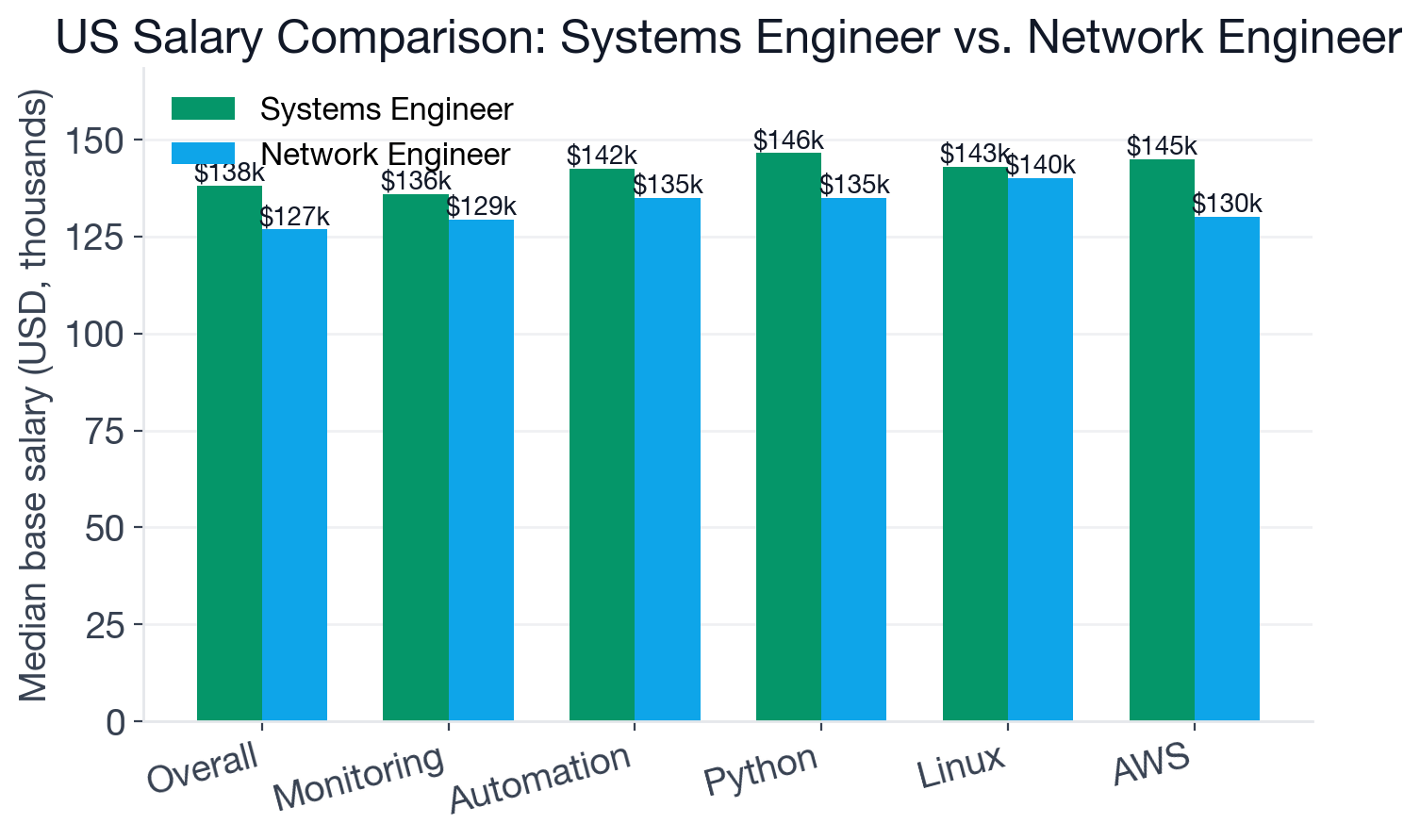
Median US base salary (base compensation only; equity and bonus excluded). SE baseline: $138,000. NE baseline: $126,800.
The skills that move pay are different for each role. For Systems Engineers, the premium attaches to distributed systems and ML-adjacent infrastructure: Distributed Systems carries a $178K median (+$40K above the SE baseline), Observability $175K (+$37K), Machine Learning $162K (+$24K), and Kubernetes $162K (+$24K). These are the skills of SEs building high-scale, observable systems at tech and AI-focused companies.
For Network Engineers, the counterintuitive finding is which skills pay most. Protocol expertise does not earn a premium above the $126,800 baseline: BGP ($129.6K median) and OSPF ($130K) pay roughly at the NE floor. The skills that break above it are platform engineering skills. Prometheus (an open-source metrics collection system) carries a $175K median for NEs - $48K above their baseline (n=27; treat as directional given the small sample). Grafana (a dashboards and visualization platform) adds $41K; CI/CD adds $36K; Kubernetes adds $35K. An NE who layers observability and automation tooling onto their protocol foundation can close most of the gap with Systems Engineering pay.
Which Has More Job Openings?
Systems Engineering is the larger market: 9,182 active postings vs 3,358 for Network Engineer, a 2.74x volume advantage. For someone building a career, that gap matters at every stage - more roles mean more interviews, more lateral options, and more room to specialize over time.
Seniority profiles are similar but not identical. Both sit at 3% entry-level, confirming that neither role is genuinely accessible to career changers without domain experience. Mid-level dominates both (SE: 59%, NE: 66%). Staff-level roles are notably more common for Systems Engineers (14%) than Network Engineers (8%), suggesting the SE career ladder extends higher in organizational terms.
Geographically, Systems Engineering is 62% US postings, a reflection of its heavy defense and aerospace concentration. Network Engineering is 54% US, with stronger presence in India, the Philippines, and Malaysia - where network operations roles in global IT service firms are concentrated. Both roles share the same dominant employers domestically: Northrop Grumman, Leidos, General Dynamics, and Booz Allen Hamilton appear in both hiring rosters. NE adds more telco and managed-services presence (NTT, Kyndryl, AT&T) that partly explains why NE has slightly more hybrid availability (31% hybrid vs 27% for SE), even as both remain primarily onsite.
Which Should You Choose?
Choose Systems Engineer if you:
- Want broad scope across requirements, architecture, integration, and lifecycle management spanning hardware and software
- Are pursuing a defense or aerospace career where clearance-eligible SE roles are the dominant employer and the largest job pool
- Want the larger job market with the ability to move across industries over time
- Are drawn to Python, automation, and cloud infrastructure as the technical core of the work
Choose Network Engineer if you:
- Want to go deep on network architecture: routing protocols, firewall design, VPN configuration, and network security as genuine specializations
- Value a well-mapped credential ladder (CCNA, CCNP, and CCIE align directly with NE career stages in a way that SE credentials do not)
- Plan to add platform and observability skills (Prometheus, Grafana, Kubernetes) to maximize your pay within the role
- Are interested in the AI-powered network management wave that is early-stage today - the 87% of NE professionals who want those tools, but only 3% have yet, represents coming demand
Neither role is a reasonable choice for someone who requires remote flexibility. Both sit at approximately 10% remote share.
FAQ
Q. What is the median salary for Systems Engineer vs Network Engineer in 2026?
The median US base salary is $138,000 for Systems Engineers (n=3,695 postings with US salary data) and $126,800 for Network Engineers (n=993 postings), a $11,200 gap in Systems Engineer's favor. Both figures are base salary only; equity, bonuses, and sign-on are not captured in job postings.
Q. What skills do Systems Engineers and Network Engineers share?
Automation (25% SE / 33% NE), Python (22% both), Linux (17% both), Monitoring (21% SE / 48% NE), AWS (13% SE / 19% NE), and Azure (11% SE / 20% NE) all appear in both roles' top-30 skill lists. The Jaccard overlap coefficient across both roles' top-30 skill sets is 40%.
Q. Which role has more job openings in 2026, Systems Engineer or Network Engineer?
Systems Engineer has 9,182 active postings compared to 3,358 for Network Engineer, a 2.74x volume advantage. Both roles are predominantly mid-level (SE: 59%, NE: 66%) with about 3% entry-level share each.
Q. What skills are exclusive to Network Engineers?
The top skills exclusive to Network Engineers are Firewalls (41%), BGP (32%), Network Security (30%), OSPF (28%), VPN (23%), DHCP (15%), High Availability (14%), MPLS (13%), Change Management (10%), and Fiber (10%). None of these appear in Systems Engineer's top-30 requirements.
Q. Which salary-boosting skills pay most for Network Engineers?
Platform and observability skills carry the highest premiums: Prometheus adds $48K above the NE baseline ($175K median, n=27), Grafana adds $41K ($167.8K, n=32), CI/CD adds $36K ($162.7K, n=46), and Kubernetes adds $35K ($162K, n=30). Protocol skills like BGP and OSPF pay at or near the $126,800 NE baseline, not above it.
Q. How remote-friendly are Systems Engineer and Network Engineer roles?
Both roles are among the least remote-friendly in infrastructure: roughly 10% of postings for each are explicitly remote, while 68% of Systems Engineer postings and 62% of Network Engineer postings are onsite. Neither role is a strong choice for those prioritizing remote work.
What This Means for Your Next Move
Systems Engineering offers $11,200 more pay, nearly three times the job volume, and broader industry applicability. Network Engineering offers genuine protocol specialization and a well-mapped credential path, with the best pay outcomes for those who layer platform and observability skills onto their routing and security foundation. Browse open Systems Engineer postings or Network Engineer openings on InterviewStack.io, filtered to your seniority and location.
For interview preparation, the shared skill base (Python, automation, Linux, cloud) is the right starting point for either path. The AI mock interview tool covers infrastructure, systems design, and troubleshooting scenarios for both tracks. The question bank supports focused drilling on networking fundamentals, cloud architecture, and systems integration. Our interactive courses cover the foundations for both paths. If you are still mapping how Systems Engineer compares to its closest neighbors, the Systems Engineer vs Systems Administrator and Systems Engineer vs Cloud Engineer comparisons complete the picture.
Topics
Ready to practice?
Put what you've learned into practice with AI mock interviews and structured preparation guides.