
Most candidates walk into this interview ready to be impressive. The prompt quietly asks for the opposite: your team has capacity for one meaningful bet in 12 months, "not a full suite." A Technical Product Manager who answers with a three-pillar AI platform has just shown the interviewer they did not hear the constraint.
This is a simulated mid-level Technical Product Manager interview on product strategy, built from a real InterviewStack.io AI mock interview blueprint. The dramatized answers below are illustrative, not a transcript of a real person, and the scenario does not reflect any specific company's actual questions. If you are also targeting these roles, you can browse current Technical Product Manager openings.
Key Findings
- The rubric totals 100 points, and 60 of them (30 + 30) go to interviewer objectives and level-specific expectations.
- Technical Proficiency is worth only 20 of 100 points; Communication & Problem Solving is the other 20.
- The scenario allows exactly 1 meaningful bet over 12 months, set against a 2-3 year strategic horizon.
- The 30-minute interview runs in 3 phases: 0-8, 8-18, and 18-30 minutes.
- Each phase carries 4 expected checklist items, 12 in total.
- Phase 2 (10 minutes) opens its checklist with simply picking one clear direction.
- 4 topics are explicitly out of scope: code or model architectures, deep legal analysis, valuation, and low-level capacity planning.
The Interview Hands You Capacity for One Bet and Grades You on Picking It
The question is a creator-platform dilemma. Short-form video is growing, creator retention is flattening, and creators are quietly moving ideation, thumbnails, dubbing, and clipping to third-party AI tools.
The interview question
You are a Technical Product Manager on a large consumer video platform at a leading tech company. Short-form video consumption is growing quickly, but creator retention is flattening and there is internal debate about whether the company should make a bigger strategic bet on generative AI tools for creators.
Today, creators use the platform for distribution, monetization, and basic editing, but many are experimenting with third-party AI tools for ideation, thumbnail generation, dubbing, clipping, and lightweight video creation. Leadership is concerned that if the platform remains only a distribution endpoint, it may lose strategic control over creator workflows over the next 2-3 years.
At the same time, there are risks: low-quality AI content could hurt viewer trust, infrastructure costs may be high, and policy/legal teams are worried about copyright, impersonation, and disclosure requirements.
Your team has enough engineering capacity over the next 12 months to make one meaningful product bet in this area, not a full suite. How would you define the product strategy for the platform’s creator-side generative AI investment over the next 2-3 years, and what would you recommend the team do first over the next 12 months?
The prompt is not really asking for a feature idea. It probes whether you see the real stake (who controls the creator workflow), whether you can choose where to play, and whether you can connect a 2-3 year end state to a first move you could defend in a planning meeting.
What Does a Technical Product Manager Product Strategy Interview Actually Score?
Think of it as a judgment audit. Technical depth carries one of the two smallest weights (20 of 100 points); narrowing, tradeoffs, and recovery under pushback do.
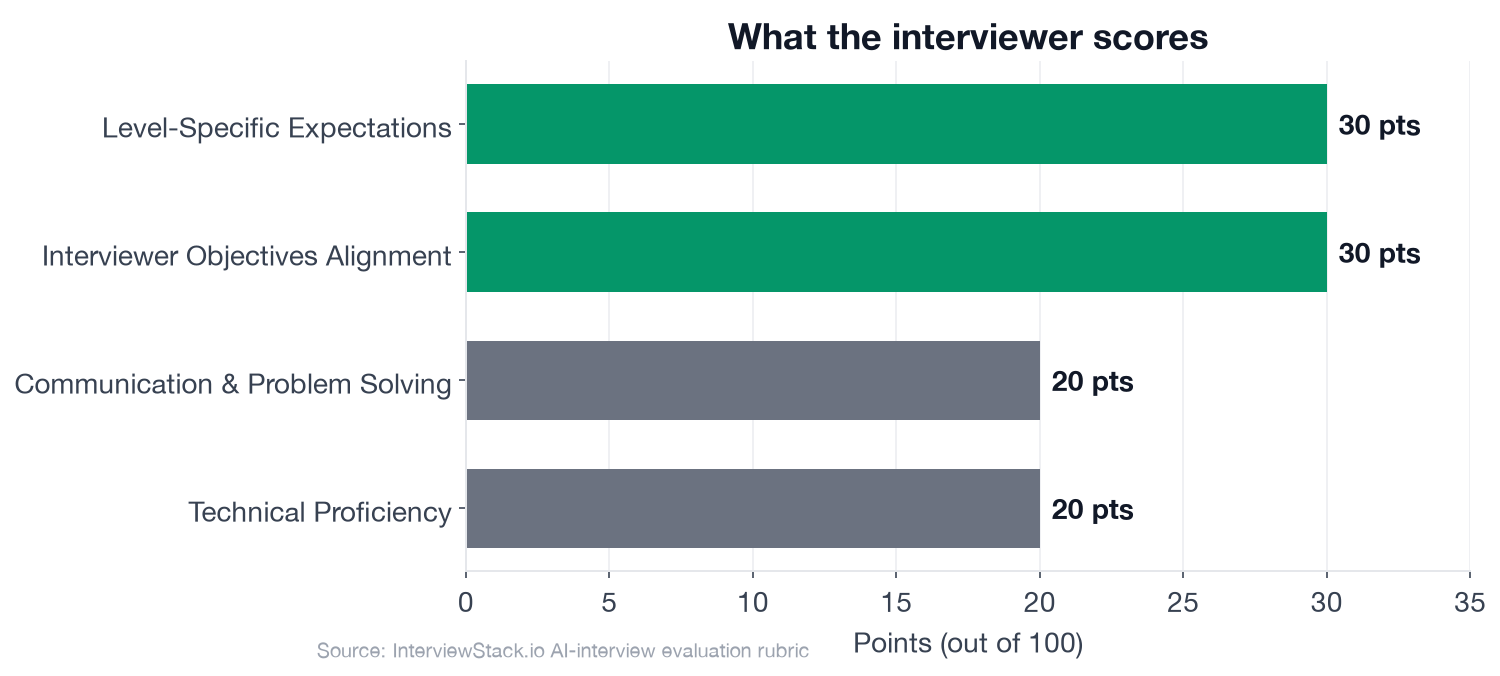
The chart makes the weighting plain: 60 points reward aiming at the right problem at the right altitude, and only 20 reward technical accuracy. For the mid-level bar, that means a structured recommendation and sound scoping, not market sizing or a financial model.
Four Follow-Ups, Four Places Strong Candidates Slip
The interviewer picks from a bank of follow-ups. Here are four that hit different phases. Each shows a common mistake from a candidate we will call Priya, then a stronger move.
Turn 1: Choosing where to play
Interviewer: "How would you decide whether this should be a workflow tool for existing creators, a creation tool for new creators, or primarily a defensive platform capability?"
Turn 2: Success before revenue
Interviewer: "What would success look like, and which leading indicators would you track before revenue impact is visible?"
Turn 3: Trust and ecosystem risk
Interviewer: "What are the biggest risks to viewer trust and ecosystem quality, and how would those risks change your recommendation?"
Turn 4: The moonshot push
Interviewer: "If leadership pushed for a more ambitious moonshot, how would you evaluate that against a narrower, execution-focused bet?"
Why Isn't Reading This Enough?
Spotting these mistakes on a page is easy. Avoiding them live is the actual skill: you are 20 minutes in, the interviewer has just changed a constraint, and the tidy structure you rehearsed no longer fits. Narrowing under pressure, naming a guardrail without drifting into legal detail, and adjusting without folding are habits. They come only from reps with follow-ups you did not script.
What Does the Blueprint Track Minute by Minute?
A strong candidate hits every item below inside 30 minutes. This is exactly what the AI mock interview tracks you against in real time, so you see which items you covered and which you skipped.
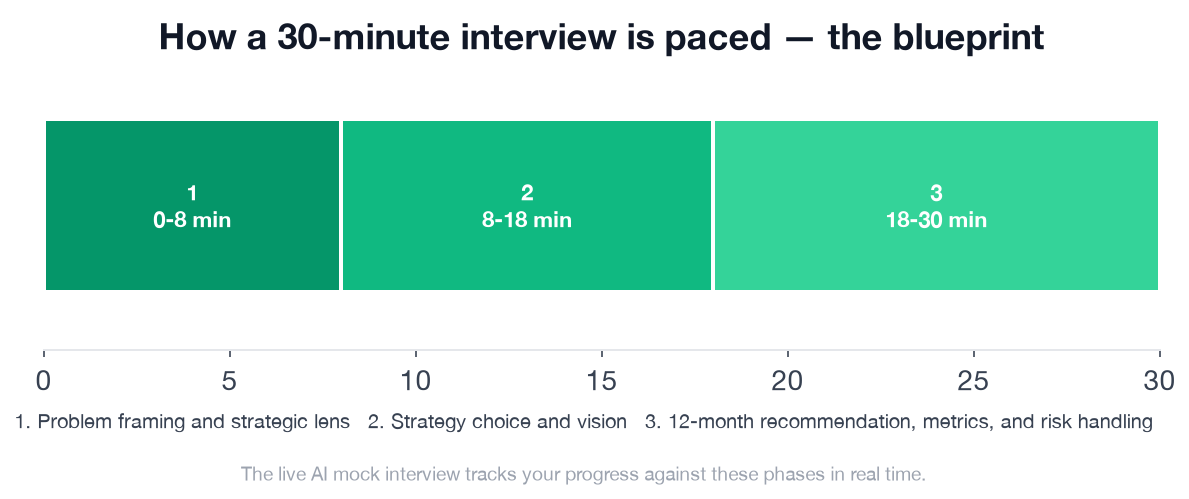
The timeline shows where the vision gets tested: phase 2 (8-18 minutes) is where the vision and the single direction have to land.
- ✓Clarifies the objective as more than shipping AI features; discusses platform position in creator workflow
- ✓Identifies relevant stakeholders or ecosystem actors such as creators, viewers, advertisers, trust/policy, and recommendation systems
- ✓Segments the opportunity in a useful way, such as by creator type, workflow stage, or strategic posture
- ✓States key assumptions explicitly and proposes a decision framework before jumping into solutions
- ✓Picks a clear strategic direction instead of offering multiple unprioritized options
- ✓Explains why the chosen bet is defensible given company assets such as distribution, creator data, monetization, or recommendation loops
- ✓Addresses why alternative paths are less attractive under the stated constraints
- ✓Articulates a 2-3 year end state that is ambitious but not detached from operational reality
- ✓Recommends one concrete 12-month investment area with rationale tied back to the strategy
- ✓Defines success using a mix of adoption, retention, quality, and ecosystem-health metrics
- ✓Names major risks such as spam, low-quality content, copyright, impersonation, disclosure, or compute cost and proposes practical guardrails
- ✓Shows willingness to adjust recommendation when the interviewer introduces new constraints while preserving strategic coherence
Run This Scenario Against the Clock
Start the AI mock interview for this exact topic and get a live, unscripted version of this scenario, with follow-ups that adapt to what you say. It scores you on the same four dimensions and tracks you against the blueprint above. Then use the Technical Product Manager question bank to drill adjacent strategy prompts, or browse our interview prep guides. For the neighboring round, see the business and product strategy alignment walkthrough. You can also build foundations with interactive courses.
FAQ
Q. What does a Technical Product Manager product strategy interview test?
It tests whether you can choose where to play, defend differentiation, and turn a 2-3 year vision into one concrete 12-month bet. In this mid-level mock, 60 of 100 points go to meeting the interviewer's objectives and the level-specific bar.
Q. How long is the AI mock interview for this topic?
30 minutes, split into three phases: problem framing (0-8 minutes), strategy choice and vision (8-18 minutes), and the 12-month recommendation with metrics and risk handling (18-30 minutes).
Q. How many options should I recommend in a product strategy interview?
One. The scenario gives your team capacity for a single meaningful bet in 12 months, and the mid-level bar is judgment in narrowing scope. Listing several unprioritized options misses an explicit checklist item.
Q. Do I need to write code or model architectures?
No. Writing code or model architectures, deep legal analysis, detailed valuation, and low-level infrastructure capacity planning are all out of scope. Treat compute cost and copyright as product constraints, not engineering or legal deep dives.
Q. What metrics should I name for a strategy bet before revenue shows up?
A mix of four kinds: adoption, retention, quality, and ecosystem health. A single vanity number such as videos generated misses the metrics checklist item and weakens the Interviewer Objectives Alignment score (30 points).
Q. What if the interviewer pushes me toward a bigger moonshot?
Evaluate it against the same criteria as your narrow bet, make your assumptions explicit, and adjust while keeping the strategy coherent. Holding your position rigidly or abandoning it entirely are both common misses.
A Strategy Is Mostly What You Decline
The best answer in this interview is short on features and long on reasons. Choose one bet, show what you are leaving out, and be ready to move without losing the thread.
Topics
Ready to practice?
Put what you've learned into practice with AI mock interviews and structured preparation guides.