
The Four Bugs Already Wrote Your Coverage Matrix
Four production bugs are sitting in the interview prompt before you say a word: a Safari-iPhone sign-in failure, a Firefox rendering bug on the promo field, an Android autofill overlay, and an intermittent 3DS redirect failure. A strong mid-level Test Automation Engineer candidate treats those four bugs as the seed of the coverage matrix. A weaker one recites "test the top browsers by market share" and never connects the two.
This walkthrough runs through one real 30-minute AI mock interview blueprint for a mid-level Test Automation Engineer on cross-browser and cross-platform testing, the exact package InterviewStack.io's AI interviewer uses to score a live session, and traces where a prepared candidate still loses points.
The scoring is unforgiving of generic answers. Two of the four rubric dimensions, worth 60 of 100 points combined, reward judgment and framing over raw technical correctness, so what you say in the first 8 minutes matters as much as anything you say after.
Key Findings
- The rubric totals 100 points across four dimensions: Interviewer Objectives Alignment (30), Level-Specific Expectations (30), Technical Proficiency (20), and Communication & Problem Solving (20).
- The interview runs 30 minutes across three phases: scoping and risk framing (0-8 minutes), coverage matrix and automation approach (8-20 minutes), and defect isolation and execution trade-offs (20-30 minutes).
- The scenario hands candidates 4 real production incidents, a Safari iPhone sign-in bug, a Firefox promo-field rendering bug, an Android autofill overlay, and intermittent 3DS return failures, before the first follow-up question.
- Phase 2 (coverage matrix and automation approach) carries the most checklist weight: 6 expected items versus 4 in Phase 1 and 5 in Phase 3.
- Level-Specific Expectations, worth 30 of 100 points, explicitly caps the bar at judgment for a single release cycle, not a company-wide test infrastructure overhaul.
- 4 skill areas are explicitly out of scope for this interview: native mobile app automation framework design, performance and load testing, security penetration testing, and machine learning techniques.
- The interviewer's stated objectives span 5 distinct capabilities, from risk framing and coverage-matrix design to platform-specific debugging and communicating trade-offs under shifting constraints.
Where Does a Test Automation Engineer Cross-Browser and Cross-Platform Testing Interview Put Its Points?
The scenario below is the exact opening prompt from the blueprint. Read it the way an interviewer would send it, then decide what you would say in the first 60 seconds.
The interview question
You are supporting the release of a consumer web checkout flow for a large e-commerce platform. The flow includes sign-in, address entry, saved payment methods, a 3DS redirect, promo code application, and order confirmation, and the product team is launching a refreshed responsive UI globally.
Recent production issues include Safari on iPhone failing to keep users signed in during checkout, Firefox desktop rendering the promo code field incorrectly at one breakpoint, Android Chrome autofill covering the primary call-to-action on smaller screens, and intermittent failures after users return from an external 3DS authentication page.
Your team has a Selenium-based UI automation suite in CI, access to a small pool of real devices and a cloud browser grid, and limited time before release, so testing every browser and device combination is not possible. How would you design and execute a cross-browser and cross-platform testing approach for this release?
The interviewer is not running a browser trivia check. The objectives behind this question span five distinct capabilities: designing a practical test strategy, translating product risk into an efficient coverage matrix, deciding what to automate versus validate manually, reasoning about platform-specific defects, and communicating trade-offs clearly for a mid-level scope.
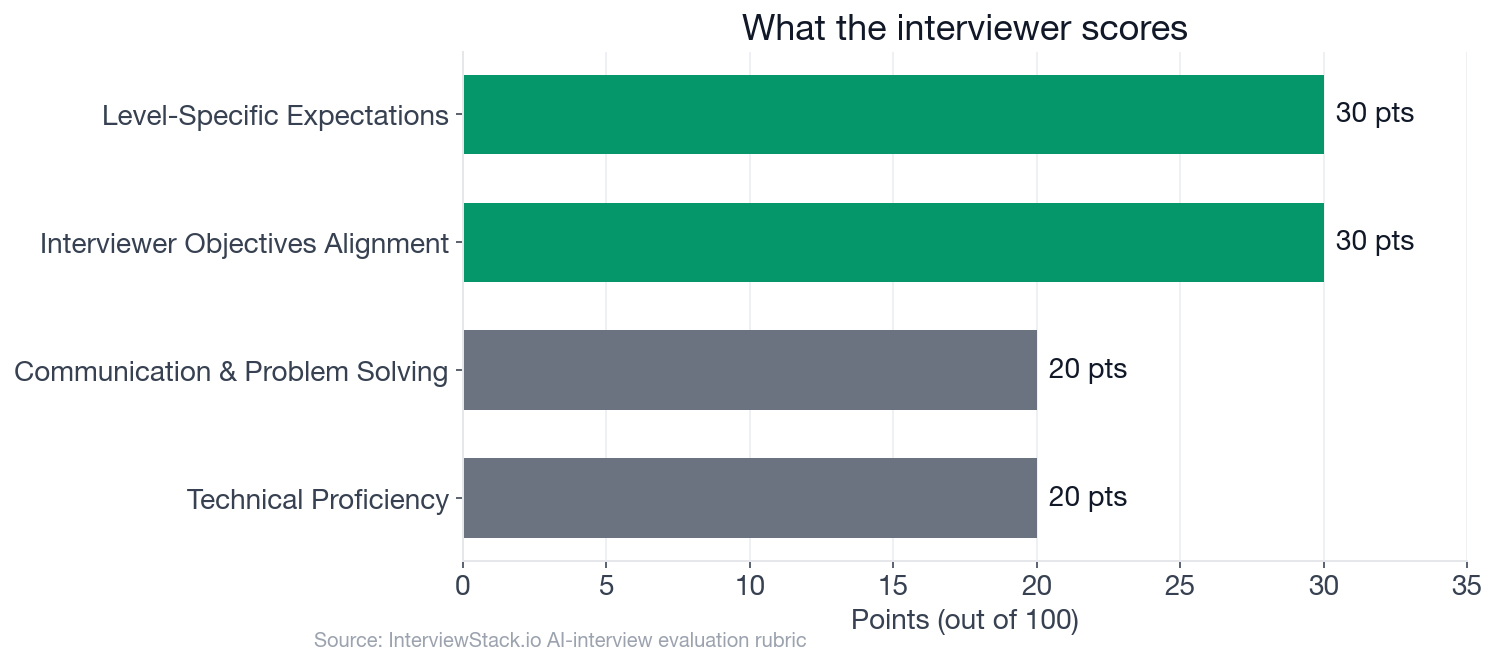 Sixty of the 100 points sit in judgment and framing, not raw technical execution.
Four Turns, One Missed Signal
Meet Soren, a mid-level candidate with solid Selenium chops walking into this interview. Soren's technical instincts are fine. What costs points, turn after turn, is treating the four incidents in the prompt as background color instead of the actual coverage strategy.
Turn 1: Picking the Platform Matrix
Interviewer: "How would you decide which browser, OS, and device combinations make it into the final coverage matrix for this release?"
Turn 2: Automate vs Manual Split
Interviewer: "What parts of this checkout flow would you automate across many platforms, and what would you keep for targeted manual validation?"
Turn 3: Isolating the Safari 3DS Bug
Interviewer: "If a defect only reproduces on Safari on iPhone after returning from the 3DS page, how would you isolate whether the problem is in the app, session handling, browser behavior, or the external redirect flow?"
Turn 4: Fixing a Flaky Suite
Interviewer: "Suppose your full cross-browser suite takes too long and is flaky on the cloud grid. How would you restructure execution to keep signal high before release?"
What Happens When the Interviewer Pushes Past One Flagged Breakpoint?
Every mistake above is obvious once it is laid out on a page with a red box around it. Spotting Soren's blind spot in writing, with time to think and no interviewer waiting, is the easy version of this skill. The real version happens when the interviewer follows up on responsive UI validation across breakpoints, without creating a brittle test suite, thirty seconds after you thought you had closed the topic, and you have to reprioritize out loud, under time pressure, with no draft to edit. That gap between reading and doing is exactly what an AI mock interview is built to close, since it keeps following up the way a real interviewer would.
The Blueprint Behind a Signal-Driven Answer
Here is the full 30-minute blueprint a strong candidate hits, phase by phase, and the exact structure InterviewStack.io's AI interviewer tracks a live session against in real time.
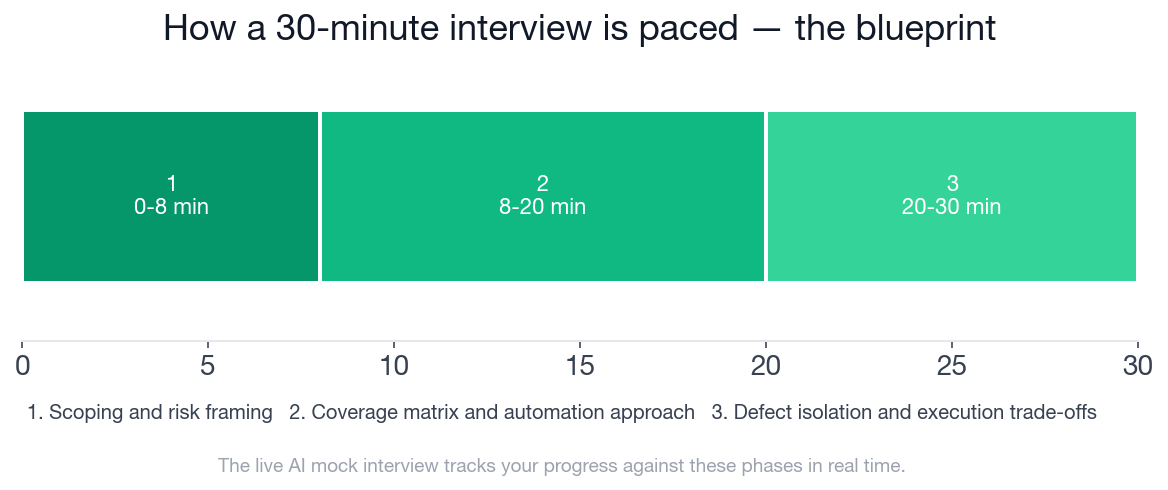 Phase 2 alone holds 6 of the interview's 15 checklist items, more than either of the other two phases.
- ✓Identifies checkout as a revenue-critical flow requiring high confidence
- ✓Calls out major risk areas from context such as authentication persistence, responsive layout, autofill behavior, and external redirect/3DS return flow
- ✓States that exhaustive combination testing is not feasible and proposes risk-based prioritization
- ✓References inputs such as browser usage share, device family distribution, geography, recent defects, and critical user journeys
- ✓Proposes a tiered matrix, for example core platforms for blocking signoff and broader platforms for extended regression
- ✓Includes realistic major coverage dimensions such as Chrome/Edge desktop, Firefox desktop, Safari macOS, Safari iPhone, and Chrome Android
- ✓Explains why certain combinations get priority based on traffic, payment flow risk, or known issue history
- ✓Separates high-value automated smoke coverage from deeper manual or exploratory passes
- ✓Uses real devices where browser behavior matters most, especially iOS Safari and Android Chrome, instead of relying only on emulation
- ✓Mentions maintainability concerns such as avoiding duplicate test logic per browser and keeping selectors/workflows resilient
- ✓Describes concrete isolation steps for a platform-specific defect, such as reproducing on real device, narrowing to minimal flow, checking cookies/session storage/network redirects, and comparing browser versions
- ✓Suggests collecting useful artifacts like screenshots, console logs, HAR/network traces, video, and timestamps around redirect return
- ✓Proposes execution tiers such as PR smoke, scheduled broader coverage, and manual signoff for high-risk scenarios
- ✓Addresses flakiness with pragmatic actions like retry policy only for known infrastructure issues, quarantine of unstable tests, and reducing dependence on brittle visual assertions
- ✓Makes a sensible recommendation on release confidence or gating based on defect severity and affected user share
Every checkmark above maps to a specific moment where Soren's answer could have gone differently.
Could You Build This Matrix Live, in 8 Minutes?
Reading Soren's mistakes is not the same as avoiding your own. Start a free AI mock interview built on this exact blueprint, same scenario, same 30-minute clock, same rubric, and find out where your own answer would lose points. If you want to drill the underlying concepts first, InterviewStack.io's question bank for cross-browser and cross-platform testing breaks the same checklist into individual practice questions, or pair it with our preparation guides for company-specific process notes. If automation-versus-coverage trade-offs are more your interest, the data-driven testing walkthrough covers an adjacent scenario in the same format.
FAQ
Q. What does a Test Automation Engineer interview on cross-browser and cross-platform testing actually cover?
This scenario centers on a consumer web checkout flow launching a responsive UI globally, with four real production issues already reported: a Safari iPhone sign-in failure, a Firefox promo-field rendering bug, an Android autofill overlay, and intermittent 3DS redirect failures. The 30-minute interview moves through three phases: scoping and risk framing (0-8 minutes), coverage matrix and automation approach (8-20 minutes), and defect isolation and execution trade-offs (20-30 minutes).
Q. How is a Test Automation Engineer cross-browser testing interview scored?
The rubric totals 100 points across four dimensions: Interviewer Objectives Alignment (30 points), Level-Specific Expectations (30 points), Technical Proficiency (20 points), and Communication & Problem Solving (20 points). Sixty of the 100 points reward judgment and framing rather than raw technical execution.
Q. Is it realistic to test every browser and device combination before a release?
No, and the interview is built to penalize candidates who try. The scoping phase explicitly rewards stating that exhaustive combination testing is not feasible and proposing risk-based prioritization instead, using inputs like browser usage share, device family distribution, geography, recent defects, and critical user journeys.
Q. What should be automated versus tested manually in a cross-browser testing interview?
The coverage-matrix phase rewards separating a lean, high-value automated smoke suite from deeper manual or exploratory passes on areas that are brittle to automate broadly, such as autofill behavior, native rendering quirks, and visual breakpoint issues. It also credits using real devices where browser behavior matters most, particularly iOS Safari and Android Chrome, instead of relying only on emulation.
Q. How do you debug a defect that only reproduces on Safari on iPhone?
The defect-isolation phase expects concrete steps: reproduce the failure on a real device, narrow it to the minimal flow, and check cookies, session storage, and network redirects around the point of failure. Comparing behavior against a passing run on another browser, and collecting screenshots, console logs, and network traces, helps isolate whether the fault sits in the app, session handling, browser behavior, or the redirect flow itself.
Q. What is out of scope for this Test Automation Engineer interview?
Four skill areas are explicitly out of scope: native mobile app automation framework design, performance and load testing, security penetration testing, and machine learning or data science techniques. The interview stays focused on cross-browser and cross-platform test strategy for a single release.
Q. Can I practice this exact cross-browser and cross-platform testing scenario?
Yes. InterviewStack.io's AI mock interview runs the same 30-minute blueprint, scenario, and rubric described here, and scores your live answers against the same checklist. It is the fastest way to find out whether your own coverage matrix would hold up under follow-up questions.
The Signals Were Already There
Nothing in this interview asks you to predict the unpredictable. Every signal Soren needed, the four incidents, the limited time, the tooling on hand, was already in the prompt. The candidates who score well are the ones who use it.
Topics
Ready to practice?
Put what you've learned into practice with AI mock interviews and structured preparation guides.