
TypeScript Is Common in Full-Stack and Frontend Ads, and Named in a Minority of Software Engineer Ads
TypeScript is named in 11,577 of 149,729 active postings (7.7%) on the InterviewStack.io job board, counted over the 90 days to 20 November 2026, and that share was flat across the three 30-day windows (7.8%, 7.9%, 7.8%). Older windows only contain postings that are still active, so they undercount postings that have since closed; treat this as a rough check, not a trend. Among US postings that disclose base pay and sit in the same role and title level, the ones naming TypeScript list about 3% more on average, but the gap is not uniform: it is positive for full-stack, frontend and AI Engineer cells and negative for Software Engineer mid-level, senior and staff cells.
Those two facts pull in different directions for different readers. If you are aiming at full-stack or frontend work, TypeScript is named in roughly 4 in 10 ads for the role, so it is a skill a large part of those ads name. If you are aiming at general Software Engineer postings, it is named in about 1 in 7, and the ads that name it list less pay at three of four levels. A posting is an advertisement, so every share below is how often ads use a word, not what a job requires or what a worker earns.
Key Findings
- 11,577 postings (7.7% of 149,729) name TypeScript, and 36 of 39 roles on the board name it at least once.
- The share was 7.8%, 7.9% and 7.8% in the three 30-day windows of the last 90 days: flat within this period.
- 41.5% of Full-Stack Developer postings (2,095) and 37.2% of Frontend Developer postings (758) name it, against 13.8% of Software Engineer postings (4,922).
- Software Engineer is still 42.5% of all TypeScript postings, because that role is so large.
- Within the same role and title level, the weighted gap in US posted base pay is about +2.7% across 30 cells: 22 up, 5 down.
- Software Engineer cells go down: -6.1% mid-level, -4.6% senior, -2.1% staff.
- Where required or preferred wording can be read (2,648 mentions), 24.7% say required and 75.3% say preferred.
- Ranked by lift, Node.js (7.2x), React (6.8x) and JavaScript (5.3x) are the strongest pairings; 47.7% of TypeScript postings also name React.
Who Hires for TypeScript?
Software Engineer ads supply the most TypeScript postings, but Full-Stack and Frontend Developer ads are where it is closest to a default.
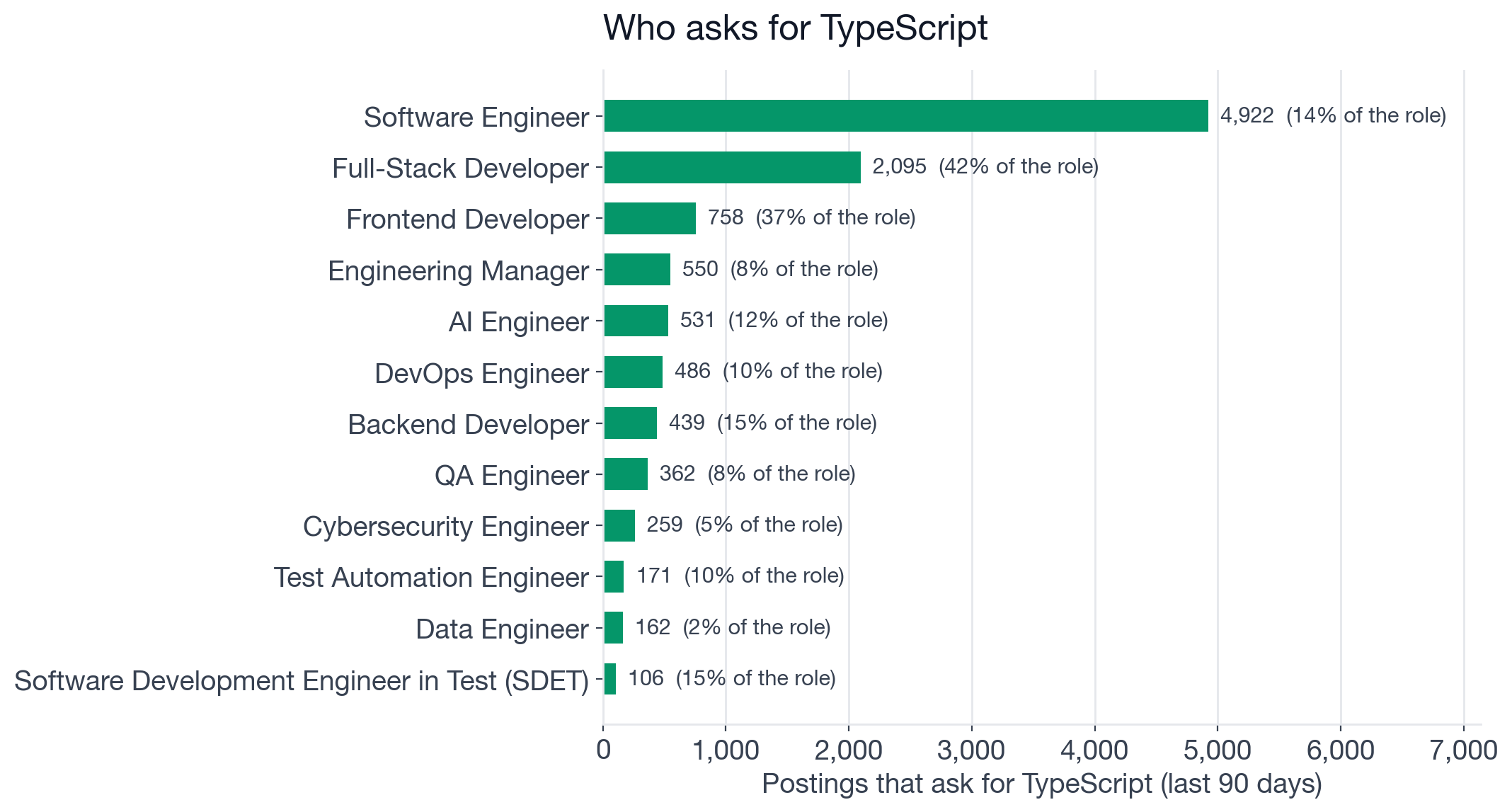
Postings naming TypeScript by role on the InterviewStack.io job board, last 90 days; the percentage is the share of that role's own postings.
| Role | Postings naming TypeScript | Share of the role's postings | Share of all TypeScript postings |
|---|---|---|---|
| Software Engineer | 4,922 | 13.8% | 42.5% |
| Full-Stack Developer | 2,095 | 41.5% | 18.1% |
| Frontend Developer | 758 | 37.2% | 6.5% |
| Engineering Manager | 550 | 8.0% | 4.8% |
| AI Engineer | 531 | 12.4% | 4.6% |
| DevOps Engineer | 486 | 9.6% | 4.2% |
| Backend Developer | 439 | 15.4% | 3.8% |
Read the last two columns together. A role can be a big source of TypeScript postings without TypeScript being standard in it: Software Engineer is the largest buyer by count, yet 86% of its ads do not name it. Full-stack and frontend are the reverse, smaller roles where it is named in close to 4 in 10 ads. Outside software roles it barely registers: 2.4% of Data Engineer, 0.7% of Data Scientist and 0.6% of Data Analyst postings.
For the wider skill picture in each role, see our posts on Software Engineer skills, Full-Stack Developer skills and Frontend Developer skills.
Does TypeScript Come With Higher Pay? Only for Some Roles
Pay is where a single "TypeScript pays more" sentence breaks: the ads that name it list more in some role and level cells and less in others.
A scope note first. Pay here is US posted base salary on postings that disclose it, so equity, bonus and undisclosed pay are not in it, and it says nothing about what anyone is paid. The comparison is between postings that name TypeScript and postings that do not, inside the same role and the same title level (level is read from title words), using cells with at least 15 salaries on each side. Those 30 cells cover 90.1% of the TypeScript postings.
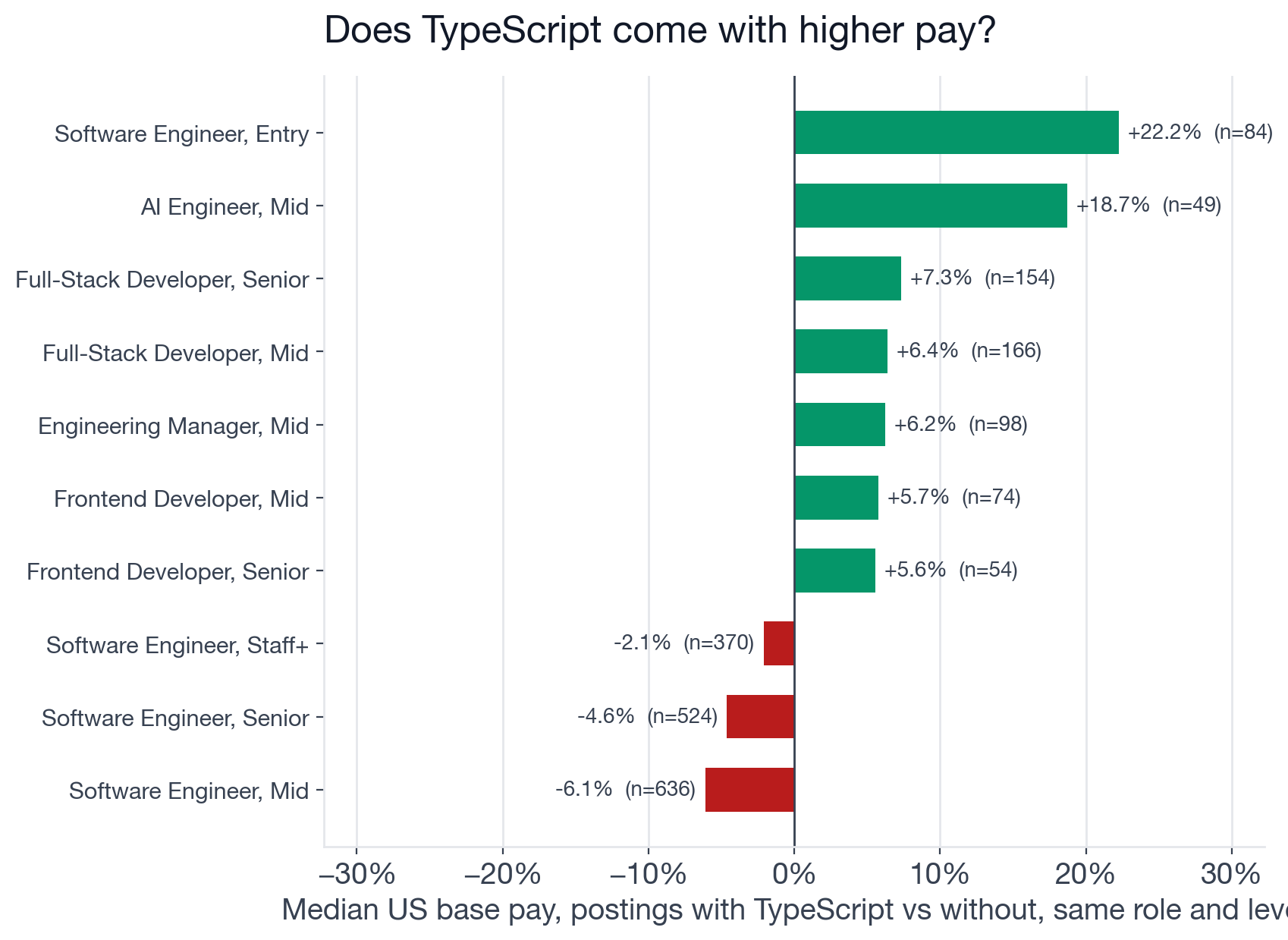
Difference in median US base pay between postings naming TypeScript and postings that do not, within the same role and title level; n is the number of TypeScript postings with pay in that cell.
| Role and level | Median with TypeScript | Median without | Gap | Postings with / without |
|---|---|---|---|---|
| Software Engineer, entry | $106,790 | $87,360 | +22.2% | 84 / 498 |
| Software Engineer, mid-level | $156,050 | $166,224 | -6.1% | 636 / 4,575 |
| Software Engineer, senior | $175,500 | $184,000 | -4.6% | 524 / 3,057 |
| Software Engineer, staff | $210,000 | $214,500 | -2.1% | 370 / 1,985 |
| Full-Stack Developer, mid-level | $151,488 | $142,400 | +6.4% | 166 / 250 |
| Full-Stack Developer, senior | $169,000 | $157,500 | +7.3% | 154 / 146 |
| Full-Stack Developer, staff | $198,470 | $185,000 | +7.3% | 68 / 75 |
| Frontend Developer, mid-level | $141,900 | $134,200 | +5.7% | 74 / 167 |
| Frontend Developer, senior | $166,250 | $157,500 | +5.6% | 54 / 65 |
| AI Engineer, mid-level | $174,800 | $147,250 | +18.7% | 49 / 430 |
| Engineering Manager, mid-level | $217,917 | $205,175 | +6.2% | 98 / 1,396 |
| Backend Developer, senior | $180,000 | $181,000 | -0.6% | 23 / 114 |
Across all 30 cells, weighted by how many TypeScript postings sit in each, the gap averages about +2.7%, with 22 cells up and 5 down. Four of the five down cells are in the table: the three Software Engineer cells at mid-level, senior and staff, which include the two largest cells by TypeScript postings, and a near-flat senior Backend Developer cell. For a reader aiming at a general Software Engineer role, "TypeScript comes with higher pay" is false in this data. For a full-stack or frontend reader, the ads that name it list 5.6% to 7.3% more in every cell shown.
We did not measure why. These are medians of two groups of advertisements that can differ in employer, city, company type and what the job really is, so a gap says nothing about what TypeScript is worth to you. The largest positive gaps (entry Software Engineer, AI Engineer mid-level) come from small groups of ads and should be read as a prompt to look at those postings, not as a rate.
Is TypeScript Required or a Nice-to-Have?
Where the wording can be read, about 3 in 4 mentions are framed as preferred, not required.
Of the 11,577 postings, 2,648 have required or preferred wording close enough to the mention to classify. In that subset, 24.7% say required (655 postings) and 75.3% say preferred (1,993). The rest, including 8,897 with no such wording nearby, are outside the split, and "preferred" wins when both appear, so read the 75% as a ceiling on how often the ask is soft. A skill can be assumed and left unwritten, and a posting that lists TypeScript among many tools is not saying it is optional. The practical reading: most ads that frame it at all frame it as a plus, and about 1 in 4 say it is needed.
TypeScript ads also lean senior on titles. 34.1% of postings naming it carry a senior word and 15.9% a staff or principal word, against 25.0% and 14.0% for postings that do not; only 4.3% are entry-level titles (4.9% for postings without it). Titles with no level word count as mid-level, so the entry share is a floor.
What Should You Learn With TypeScript? Rank by Lift, Not Share
The tools most worth pairing with TypeScript are the ones that appear far more often next to it than anywhere else on the board.
Raw share misleads here. Python is named in 49.5% of TypeScript postings and AWS in 41.3%, but both are named in so many postings across the board that their lift is only 1.5x and 1.8x. Lift divides a tool's share among TypeScript postings by its share across all postings, so a 7x tool is a real pairing.
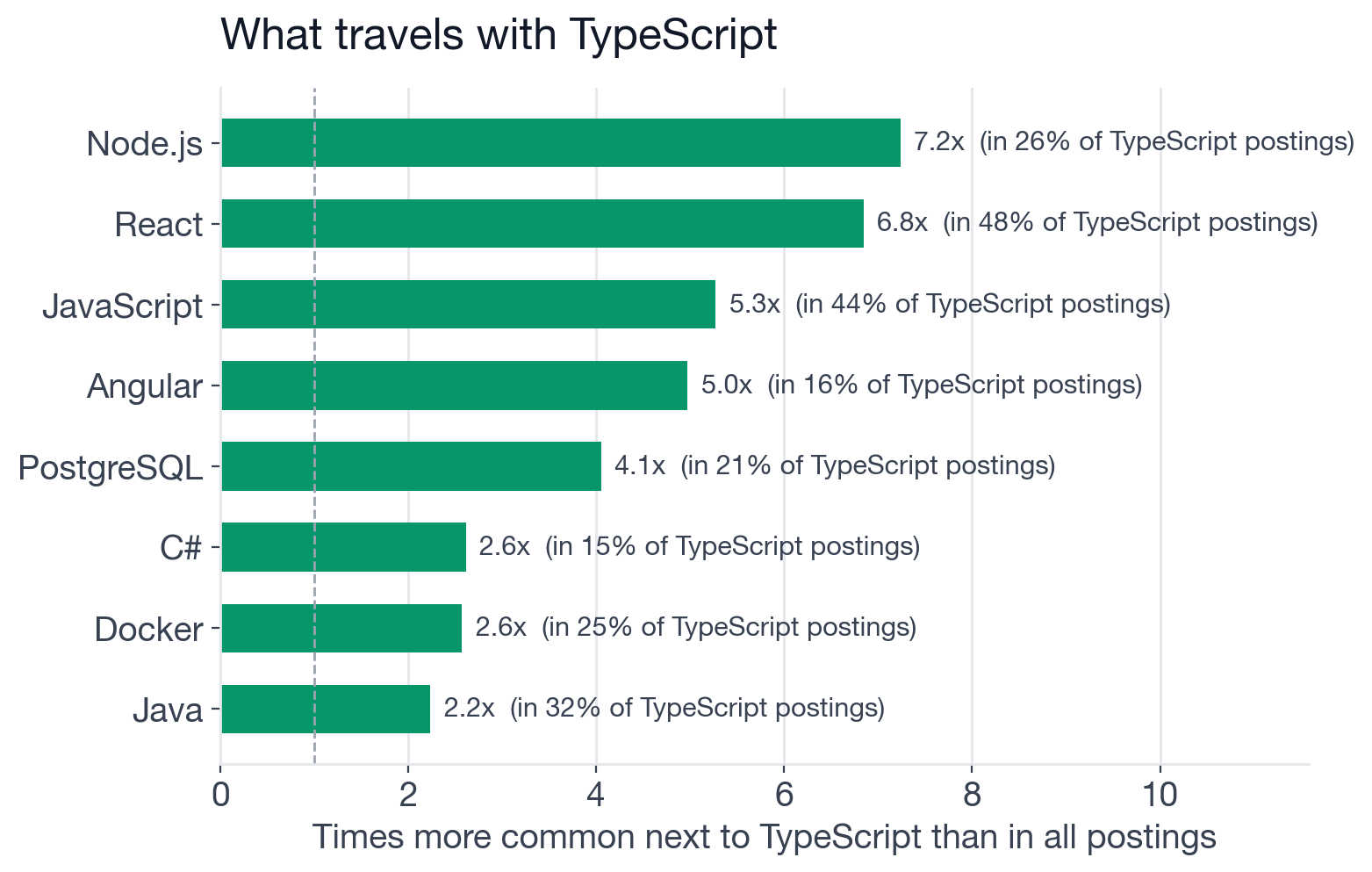
Tools named in TypeScript postings, ranked by lift against the whole board.
| Tool | Share of TypeScript postings | Lift |
|---|---|---|
| Node.js | 26.4% | 7.2x |
| React | 47.7% | 6.8x |
| JavaScript | 44.3% | 5.3x |
| Angular | 16.1% | 5.0x |
| PostgreSQL | 21.4% | 4.1x |
| C# | 15.2% | 2.6x |
| Docker | 25.4% | 2.6x |
| Java | 32.0% | 2.2x |
| Kubernetes | 27.2% | 2.1x |
The top of the list reads like a web stack: a UI framework (React or Angular), a server runtime (Node.js) and a relational database (PostgreSQL). Angular at 5.0x is a reminder that React is not the only partner; the two are separate framework families, so check which one the roles you want name. Below the tool pairings, the concepts named most often in TypeScript postings are CI/CD (48.2%), APIs (43.3%) and code review (37.2%), and LLMs appear in 24.0%, which counts how often employers write about them, not how many roles build with them. Lift is only computed against other tools in our catalog, so the concept shares are context, not pairings.
Which Employers Name TypeScript Most?
No single industry owns TypeScript demand on this board: big tech, financial firms and IT services all sit near the top.
Ranked by distinct openings (a repeated title at one employer counts once), the leaders are Amazon (168), Citi (93), Google (78), Cognizant (62), Accenture (53), Salesforce (49), PricewaterhouseCoopers (48), Anduril Industries (41), Booz Allen Hamilton (40) and Microsoft (39). Cisco appears under two labels that together come to roughly 75. That is a mix of large technology companies, two large financial firms (Citi and Fidelity Investments, with 32), and consulting and IT-services firms. These are the employers with the most openings on our board, not a ranking of who hires most, and the counts are approximate. The longest list is a long tail: the top company is about 1.5% of the 11,577 postings.
What to Do With This
Decide by the role you want, then use the ads to check the stack.
- Aiming at full-stack or frontend work: expect to see TypeScript often, since roughly 4 in 10 ads for those roles name it. Pair it with React or Angular and Node.js, the strongest pairings above.
- Aiming at general Software Engineer roles: learn it for access to the roughly 14% of ads that name it, not for pay. In this data, matched Software Engineer ads that name it list less at mid, senior and staff levels.
- Aiming at data, product or analyst roles: it is rare there (under 3% of postings in each of those roles), so other skills come first.
- If you already know JavaScript: JavaScript is named in 44.3% of TypeScript postings, so the two are often listed together.
- Ready to apply: browse current openings on the job board, then rehearse the stack with AI mock interviews, drill topics in the Question Bank or build foundations in the interactive courses. The roles index shows what else each role asks for.
FAQ
Q. How many job postings ask for TypeScript in 2026?
TypeScript is named in 11,577 of 149,729 active postings (7.7%) on the InterviewStack.io job board, counted over the 90 days to 20 November 2026. The share was 7.8%, 7.9% and 7.8% in the three 30-day windows, so it was flat within this period. 36 of the 39 roles on the board name it at least once.
Q. Which roles ask for TypeScript most?
By volume, Software Engineer leads with 4,922 postings, 42.5% of all TypeScript postings. By how standard it is inside a role, Full-Stack Developer is highest at 41.5% of its postings (2,095), then Frontend Developer at 37.2% (758). Only 13.8% of Software Engineer postings name it.
Q. Does TypeScript come with higher pay?
Not consistently. Comparing US posted base pay for postings with and without TypeScript inside the same role and title level, the weighted gap is about +2.7% across 30 cells, with 22 cells up and 5 down. Software Engineer mid-level (-6.1%), senior (-4.6%) and staff (-2.1%) cells go down, while full-stack, frontend and AI Engineer cells go up. This is a correlation between ads, not what TypeScript pays.
Q. Is TypeScript required or just preferred in job postings?
Where the wording near the mention could be read (2,648 of 11,577 postings), 24.7% say required and 75.3% say preferred. The other mentions carry no nearby required or preferred wording, so this is a split of a subset, not of all postings.
Q. What should you learn alongside TypeScript?
Ranked by how much more often a tool appears in TypeScript postings than in the whole board (lift), Node.js leads at 7.2x, then React at 6.8x, JavaScript at 5.3x, Angular at 5.0x and PostgreSQL at 4.1x. Python appears in 49.5% of TypeScript postings but with a lift of only 1.5x, because it is named in many postings everywhere.
The Short Version
TypeScript is named in about 4 in 10 full-stack and frontend ads and about 1 in 7 Software Engineer ads. Learn it for the postings that name it, not for a pay bump: the data shows no consistent pay gap in ads, and it is lower for the largest Software Engineer cells.
Topics
Ready to practice?
Put what you've learned into practice with AI mock interviews and structured preparation guides.