
The Portfolio Presentation Rubric Barely Grades the Work Itself
You get one project and fifteen minutes. A hiring manager, a product designer, a PM, and an engineer are in the room, none of whom have seen the work before, and once you finish they start asking questions. It feels like a design review, so the instinct is to prepare like one: polish the final screens, rehearse the reveal, make the work look as finished as possible.
That instinct misreads what's actually being scored. Across the three phases of this mid-level UI Designer mock interview, the panel tracks 14 specific checkpoints, and only one of them asks anything about the visual work itself. The other thirteen score how you frame the problem, defend a decision, choose what to leave out, and talk about what didn't go well. The project is the excuse for the conversation. The conversation is the interview.
Key Findings
- The rubric splits 100 points across 4 dimensions: 30 for Interviewer Objectives Alignment, 30 for Level-Specific Expectations, 20 for Technical Proficiency, 20 for Communication & Problem Solving.
- Across all 3 phases, the interview tracks 14 scored checklist items, and only 1 explicitly asks about visual craft (consistency, hierarchy, usability, or design system implications).
- Phase 1 (narrative framing, minutes 0-8) holds 4 checklist items, all about context and structure, before a single design decision gets explained.
- Phase 2 (decision-making and craft, minutes 8-20) is the longest stretch at 12 minutes and carries 5 checklist items.
- Phase 3 (impact, reflection, and discussion, minutes 20-30) closes with 5 checklist items, including one specifically about naming a lesson learned in hindsight.
- 4 skill areas are explicitly out of scope: front-end coding implementation, visual design tool shortcuts, brand marketing campaign strategy, and quantitative experimentation design.
- The full case study has to fit inside a 15-minute slot, out of a 30-minute interview total, before discussion even starts.
What Does a UI Designer Design Storytelling and Portfolio Presentation Interview Actually Test?
Here's the scenario a strong mid-level candidate walks into.
The interview question
Imagine you're in a portfolio presentation round for a mid-level UI Designer role on a consumer product team at a large tech company. The audience includes a hiring manager, a product designer, a PM, and an engineer. They have not seen your work before, and you have about 15 minutes to present one project, followed by discussion. Choose one real or representative UI design project and walk through how you would present it in this setting.
How would you structure and deliver that case study so the panel understands the problem, your decisions, and the impact of the work?
The panel isn't grading the project you pick. They're grading whether you can compress it into a structured story for people who don't share your context: state the problem fast, own your specific piece of it, explain the reasoning behind at least one real decision, and close with enough self-awareness to sound credible instead of rehearsed. The four turns below show where that discipline holds, and where it quietly falls apart.
Turn 1: The Sixty-Second Reframe
Interviewer: "If the panel interrupts early and asks why this project matters, how would you reframe the story in one minute for a mixed audience?"
Turn 2: Deciding What to Cut
Interviewer: "What parts of the process would you intentionally leave out of the presentation, and how would you decide that?"
Turn 3: When the Outcome Was Weak
Interviewer: "Suppose the project did not ship or the outcome metrics were weak. How would you still present it credibly?"
Turn 4: Growth Beyond the Screens
Interviewer: "What signals in your presentation would help us see your growth as a designer rather than just the final screens?"
What Changes When You're Telling This Story Out Loud, on the Clock?
Every mistake above reads as obvious once it's sitting in a red box with a label on it. Nobody plans to dump the full process, defend an expensive decision on principle, or end on a re-show of the final screens. Those choices happen live, mid-sentence, when the panel interrupts early or asks a question you didn't rehearse, and the safe-sounding answer is usually the one that gives points away.
Spotting the trap on the page and not falling into it while a hiring manager watches the clock are two different skills. The second one only comes from saying the words out loud, under real time pressure, enough times that the sixty-second reframe and the honest close stop being something you have to think about mid-sentence. That's what the AI mock interview runs: this exact scenario, unscripted follow-ups, scored against the same 14 checkpoints in real time.
What Does the Panel Actually Want to Hear in the Last Ten Minutes?
Phase 3 ties Phase 2 for the most checklist items in the interview, 5 of 14 apiece, and it's where turns three and four above both live: presenting a weak outcome credibly and showing growth instead of a highlight reel. Below is the complete blueprint, phase by phase, the same structure the AI interviewer tracks in real time as you talk.
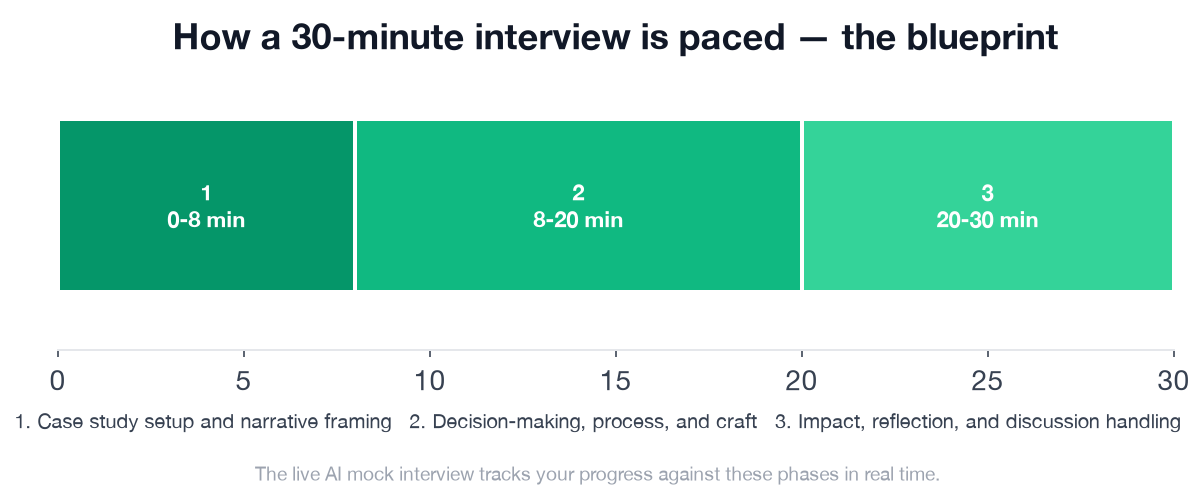 Framing gets 8 minutes, decision-making and craft take the longest stretch at 12 minutes, and impact and reflection close out the final 10.
- ✓Introduces the product/problem space in plain language within the first few minutes
- ✓States the project goal or user/business need clearly
- ✓Clarifies their role, scope, and collaborators without ambiguity
- ✓Chooses a narrative structure that feels intentional rather than chronological by default
- ✓Explains at least one key decision with the alternatives considered
- ✓Connects design choices to user needs, product constraints, or implementation realities
- ✓Avoids exhaustive process dumping and instead selects the most relevant artifacts or moments
- ✓Demonstrates awareness of consistency, hierarchy, usability, or design system implications
- ✓Speaks concretely about collaboration points with PM, engineering, or research
- ✓Describes results, learning, or next steps in a credible way even if metrics are incomplete
- ✓Answers follow-up questions directly without becoming defensive or vague
- ✓Distinguishes clearly between what shipped, what was proposed, and what changed over time
- ✓Identifies at least one lesson or improvement they would make in hindsight
- ✓Ends with a concise summary that reinforces problem, contribution, and outcome
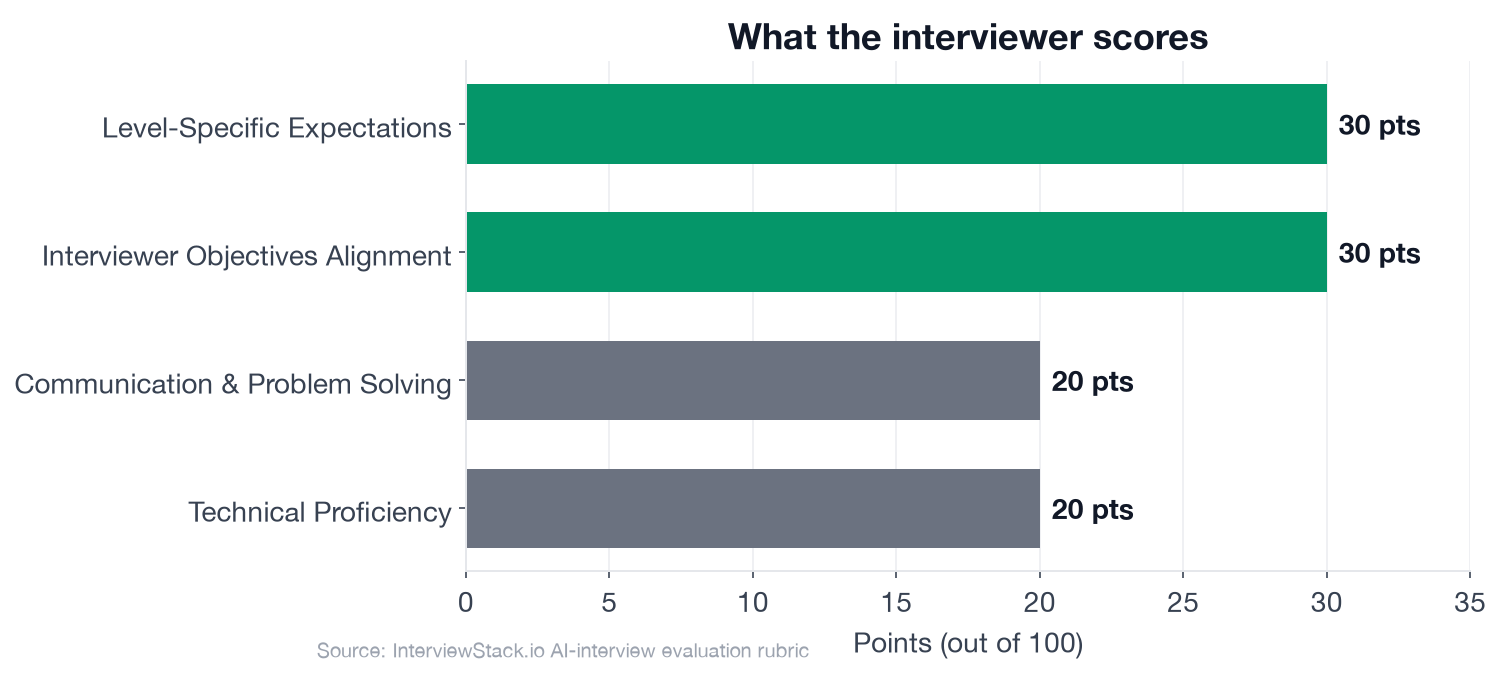 Interviewer Objectives Alignment and Level-Specific Expectations together hold 60 of the 100 points, 20 more than Technical Proficiency and Communication & Problem Solving combined.
Practice This Case Study Live
Every mistake above is fixable once it's named. What's harder is catching yourself mid-sentence, live, when the panel just interrupted and is waiting on your next line. The AI mock interview runs this exact 30-minute scenario end to end and scores your actual answers against the same 14 checkpoints, phase by phase, as you talk. If you'd rather warm up on one piece first, like compressing a reframe or defending a trade-off, the question bank breaks this topic into focused drills, and the prep guides cover how case study rounds run at specific companies. Preparing your component-system story instead of your case-study story? The design systems walkthrough runs that scenario the same way.
FAQ
Q. What does a mid-level UI Designer interview on design storytelling and portfolio presentation actually test?
It tests whether you can turn one project into a structured 15-minute case study for a mixed audience: framing the problem quickly, explaining design decisions with real trade-offs, showing craft and systems thinking, and handling follow-up questions with reflective honesty. The 100-point rubric splits 30 points to Interviewer Objectives Alignment, 30 to Level-Specific Expectations, 20 to Technical Proficiency, and 20 to Communication & Problem Solving.
Q. Why does the rubric barely score the visual work itself?
Across the interview's 14 scored checklist items spanning all three phases, only one explicitly names visual craft: consistency, hierarchy, usability, or design system implications. The rest reward narrative structure, decision rationale, collaboration clarity, and honest reflection, because the panel already assumes competent screens. What they're testing is whether you can explain and defend the thinking behind them.
Q. How is the 30-minute mock interview structured?
Three phases: case study setup and narrative framing from minute 0 to 8, decision-making, process, and craft from minute 8 to 20, and impact, reflection, and discussion handling from minute 20 to 30. Phase 2 is the longest stretch, packing 5 checklist items into 12 minutes.
Q. How do you make your individual contribution clear when the project involved other designers, researchers, and engineers?
Name your specific scope and decisions explicitly rather than describing the team's work in the collective "we," and be ready to say which calls were yours versus shared. This maps directly to the Phase 1 checklist item on clarifying role, scope, and collaborators without ambiguity, one of only 4 items scored before minute 8.
Q. How should you respond if an engineer says one of your UI decisions is too expensive to build?
Acknowledge the constraint as real, then explain the trade-off you were solving for and whether a cheaper version still satisfies it, rather than defending the original decision as-is or immediately caving. This is scored under Phase 2's collaboration and trade-off-analysis checklist items, and under Level-Specific Expectations, which expects practical trade-off reasoning over either pure aesthetics or pure deference.
Q. What's out of scope for this interview?
Four areas are explicitly excluded from the rubric: front-end coding implementation details, visual design tool shortcuts or software-specific workflows, brand marketing campaign strategy, and quantitative experimentation design beyond a basic outcome discussion. The interview stays focused on narrative, decision-making, and reflection.
Q. What's the difference between reading this walkthrough and practicing it live, and where can I practice it?
Reading shows you each mistake after it's already labeled. The live AI mock interview asks unscripted follow-ups in real time and scores your actual answers against the same rubric and 14 checklist items used here, so you find out whether you can make these calls under pressure, not just recognize them afterward. Start a free mock interview scoped to UI Designer, mid-level, on Design Storytelling and Portfolio Presentation, or warm up in the question bank first.
The Story Is What Gets Scored
The candidates who score well here aren't the ones with the most polished final screens. They're the ones who can compress a project into sixty seconds, name a cut without apologizing for it, and talk about a weak outcome without flinching. None of that is hard to understand on the page. It's hard to do live, which is exactly why it's worth rehearsing before the interview that counts.
Topics
Ready to practice?
Put what you've learned into practice with AI mock interviews and structured preparation guides.