
Six product teams, six different buttons, and a hiring manager asking you to fix it in two quarters without slowing anyone down. In a mid-level UX Designer design system interview, a polished component list is not what loses points. The quiet losses come from vague scope, fuzzy rules for variants, and a plan that falls apart the moment a team pushes back.
This walkthrough follows one illustrative 30-minute round with a composite candidate we call Mira, built from a real InterviewStack.io interview blueprint. The answers are dramatized composites ("a common answer here is..."), not a transcript of a real person, and the scenario is not any specific company's question.
Key Findings
- The round is scored out of 100 points: 30 for objectives alignment, 30 for level-specific expectations, 20 for technical proficiency, 20 for communication.
- Judgment-heavy dimensions carry 60 of the 100 points, so trade-offs outweigh component detail.
- The 30 minutes split into three phases: framing (0-7), system definition (7-18), and rollout and governance (18-30).
- The final phase is 12 minutes, the longest, so adoption and evolution get more airtime than component design.
- The scenario spans 6 product teams on weekly releases, so any plan needs to coexist with active delivery.
- The blueprint lists 14 expected checklist items across 3 phases, and 4 level-specific expectations for mid-level.
- This walkthrough dramatizes 4 mistakes, each tied to a named rubric item.
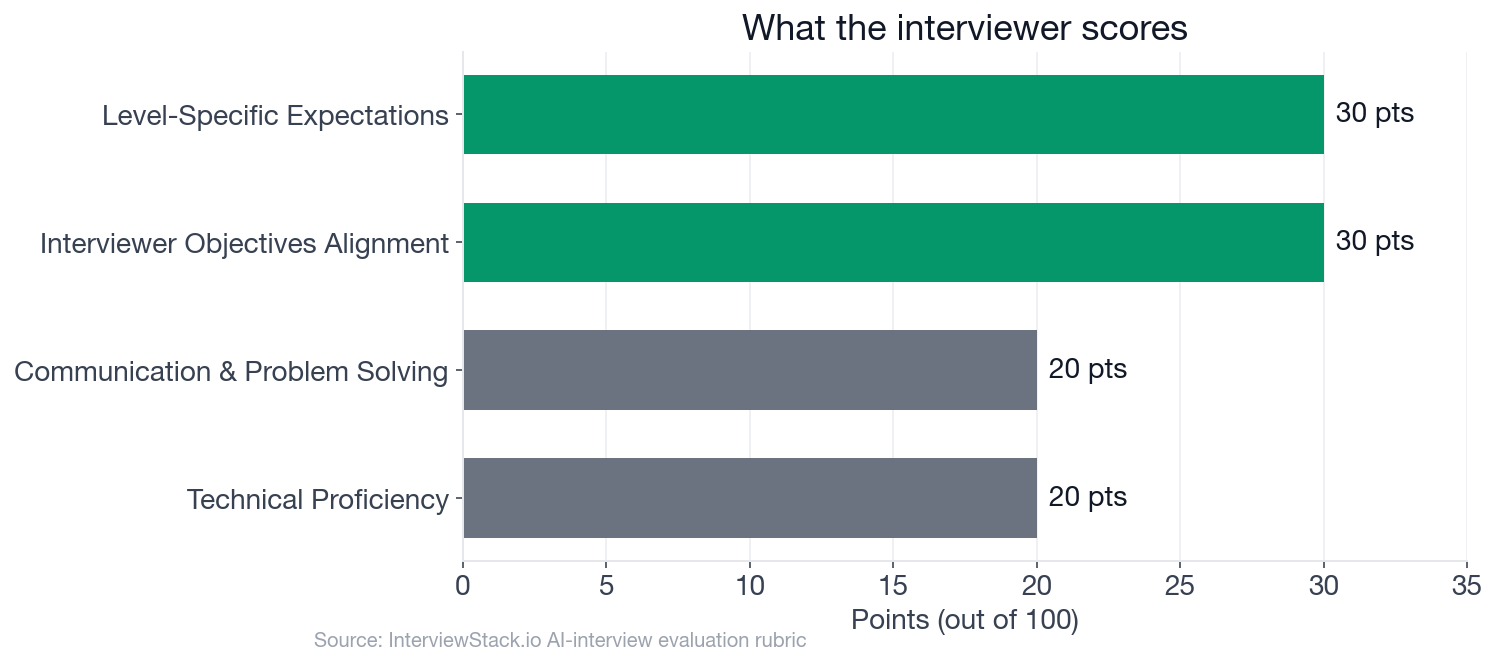
Judgment-heavy dimensions hold 60 of the 100 points, so the plan outweighs the component list.
What Is This Design System Interview Really Asking You to Own?
You are not being asked to design a button. You are being asked to run a platform effort with partners who have their own deadlines. Here is the question as the interviewer sets it.
The interview question
You’ve joined a product organization with 6 web product teams working on account setup, search, checkout, support, internal admin tools, and growth experiments. Each team ships independently and has created its own buttons, form fields, modals, tables, and navigation patterns. Designers work in Figma, engineers use React, and releases happen weekly. The company wants to create a shared design system that improves consistency and accessibility without slowing teams down or forcing a full rewrite.
Your task is to propose how you would approach designing and rolling out this system over the next two quarters. How would you define the design system strategy and the first version of the component library for this organization?
Underneath, the interviewer probes five things: how you define component boundaries, how you set tokens and patterns, how you balance consistency against product flexibility, how you reason about accessibility, and how you drive adoption. The mid-level bar is a practical, scoped plan with clear trade-offs, not an org-wide transformation.
Four Turns Where Scope, Variants, Versioning, and Adoption Cost Points
Turn 1: Scoping a Realistic v1
Interviewer: "How would you decide which components or patterns should be included in the first release versus left to product teams for now?"
Turn 2: Shared or Local Variant
Interviewer: "If two teams need similar but not identical variants of a component, how would you decide whether that belongs in the shared system or should remain local?"
Turn 3: Changing a Widely Used Component
Interviewer: "What would your versioning and change-management process look like when updating a widely used component that could break existing flows?"
Turn 4: Handling Slow Adoption
Interviewer: "Suppose adoption is slow because teams think the system is too restrictive or not production-ready. How would you respond?"
Why Knowing Tokens and Variants on Paper Falls Short Live
Spotting these mistakes on the page is easy. Avoiding them live is the real skill: the clock is running, the follow-up is one you did not script, and "it depends" is not an answer. Each mistake above came from an unprepared pivot, not from missing knowledge. The only fix is repetitions, speaking your reasoning out loud and getting scored on it. Our design and UX prep guides help you build the material, and the mock interview tests whether it holds up under pressure.
The Three-Phase Blueprint Behind a Strong System Plan
This is the blueprint a strong candidate covers, and exactly what the AI mock interview tracks you against in real time as the 30 minutes run.
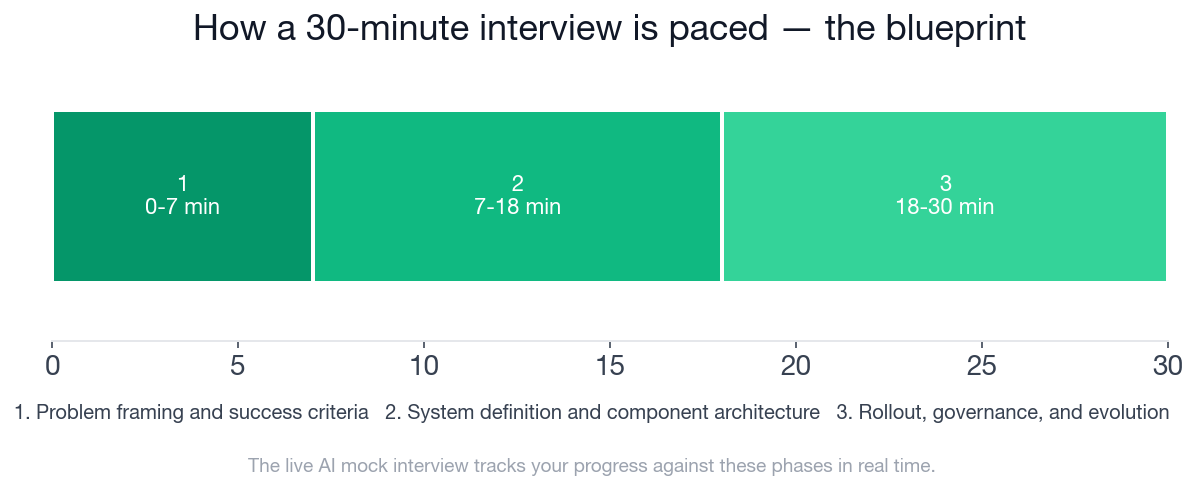
The longest phase, 12 minutes, is rollout and governance, where pushback handling is the final checklist item.
- ✓Clarifies or states reasonable assumptions about teams, products, current inconsistencies, and delivery constraints
- ✓Defines success in concrete terms beyond visual consistency
- ✓Recognizes that rollout must work incrementally alongside active product development
- ✓Distinguishes between foundational work and team-specific needs
- ✓Prioritizes a realistic starter set such as color/type/spacing tokens and high-use components like buttons, inputs, form controls, modals, navigation, and tables
- ✓Explains components in terms of structure, variants, states, behavior, and usage guidance
- ✓Accounts for accessibility needs such as contrast, focus states, keyboard behavior, error states, and screen-reader implications
- ✓Shows a clear approach for deciding shared patterns versus local extensions
- ✓Avoids excessive customization that would undermine consistency
- ✓Describes an incremental rollout path, such as piloting with a few teams or a few high-impact flows
- ✓Includes documentation, contribution requests, review criteria, and ownership expectations
- ✓Addresses versioning or deprecation in a practical way that reduces disruption for consuming teams
- ✓Proposes measurable indicators of adoption and quality
- ✓Responds to pushback with collaborative tactics rather than top-down enforcement alone
Try the Six-Team Design System Round Live
Start the AI mock interview for this exact scenario and get scored on the same four dimensions, with follow-ups you have not seen. Want more first? Work through the design systems question bank, or browse UX Designer openings to see what teams are hiring for.
FAQ
What does a UX Designer design system interview cover?
It tests whether you can turn six inconsistent product teams into one scalable system: problem framing and success criteria (0-7 minutes), system definition and component architecture (7-18), and rollout, governance, and evolution (18-30). Pixel polish matters less than scope, trade-offs, and adoption.
How is a mid-level design system interview scored?
Out of 100 points: Interviewer Objectives Alignment 30, Level-Specific Expectations 30, Technical Proficiency 20, and Communication and Problem Solving 20. Judgment and trade-offs carry 60 points, so a prioritized, well-reasoned plan beats a long component list.
What should be in version 1 of a design system?
A manageable foundation: color, type, and spacing tokens plus the highest-use components such as buttons, inputs, form controls, modals, navigation, and tables. Each needs structure, variants, states, behavior, and usage guidance. Mid-level candidates are expected to avoid an enterprise-scale rewrite.
How do you decide if a component variant belongs in the shared system?
Set explicit criteria before the debate starts: how many teams need it, whether it follows the same behavior and accessibility rules, and who will maintain it. Variants that fail the test stay local as sanctioned extensions.
How do you update a widely used component without breaking teams?
Version the change, announce it early, ship the old and new side by side, and give a deprecation window with migration guidance. The goal is to reduce disruption for consuming teams, not to force a big-bang upgrade.
How do you measure whether a design system is working?
Combine adoption (component usage, duplicate pattern reduction) with quality (accessibility compliance, implementation consistency) and team feedback from both designers and engineers. Consistency of visuals alone is not a success criterion.
What do you do when teams say the system is too restrictive?
Treat it as product feedback, not defiance. Find the specific blockers, open a contribution path with clear review criteria, pilot with a few willing teams, and fix the gaps they report. Enforcement alone does not earn adoption.
Which Design System Turn to Rehearse Next
Pick the turn that stung most, scope, variants, versioning, or pushback, and say your answer out loud against a clock. Then take it to a live round, where the follow-up is never the one you rehearsed.
Topics
Ready to practice?
Put what you've learned into practice with AI mock interviews and structured preparation guides.