
The Divergence Test Starts Before the First Sketch
Most candidates treat a UX ideation round as a drawing test. The sketch is the output; what is actually being evaluated is whether you generate multiple conceptually distinct directions before you converge. Candidates who produce one strong concept plus two visual variations fail the divergence test and lose up to 30 points before the interviewer asks a single follow-up. This walkthrough shows where those points go and what a stronger approach looks like, grounded in the live blueprint the InterviewStack.io AI mock interview tracks you against in real time.
Key Findings
- The 30-minute session runs across 4 phases: problem framing (0-6 min), concept generation (6-18 min), trade-off analysis and refinement (18-27 min), and testing approach (27-30 min).
- Phase 2, concept generation, is the longest phase at 12 minutes and carries 5 of the 16 total checklist items across the interview.
- 60 of 100 rubric points go to Interviewer Objectives Alignment (30 pts) and Level-Specific Expectations (30 pts): the framing and judgment dimensions, not visual execution.
- The Level-Specific bar for mid-level requires independently generating 2-3 plausible concepts with clear pros and cons; producing one concept and iterating on its visuals does not meet it.
- Phase 1 (just 6 minutes) must yield 2-4 clarifying questions or explicit assumptions, a defined primary user, and at least 2 constraints called out; skipping directly to drawing leaves Phase 2 sketches without a foundation to defend.
- The testing phase (27-30 min) expects 1 riskiest assumption named, 1 prototype or usability test approach, and 1-2 concrete success signals.
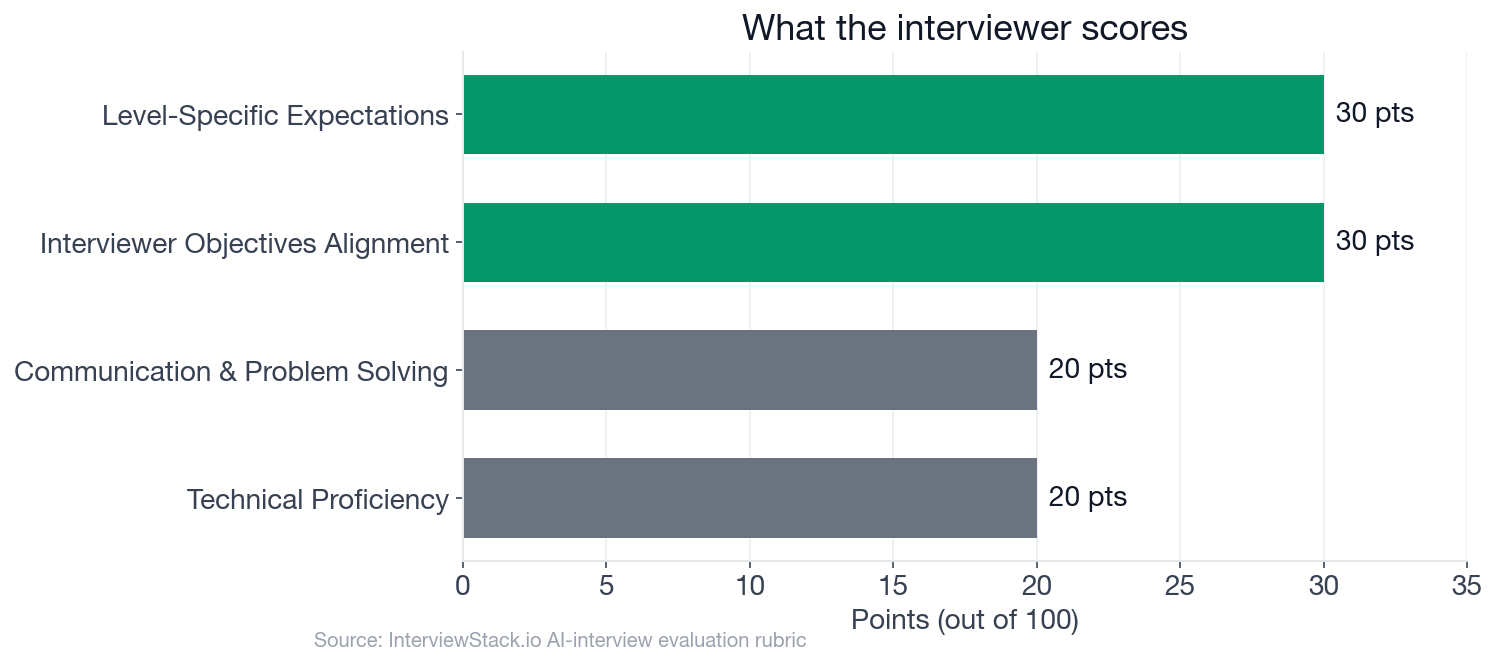 60 of 100 rubric points sit in the two framing-and-judgment dimensions; Technical Proficiency and Communication account for the remaining 40.
What Does a UX Designer Ideation and Sketching Interview Actually Test?
Here is the question as it opens the session. Below it, a note on what the interviewer's objectives are probing beneath the restaurant scenario.
The interview question
You're interviewing for a UX Designer role on a team at a leading tech company that owns a mobile maps and local discovery product. The team is exploring ways to help people make faster decisions when choosing a place to eat with friends while they're already out.
Current constraints:
- Primary platform: mobile app
- Users are often on the go and may be distracted
- Decisions are usually made in small groups, but one person is driving the app
- The team wants to reduce the time from opening the app to selecting a restaurant
- Assume the product already has reliable data for restaurants, hours, ratings, distance, and saved places
Please use sketches, wireframe descriptions, and annotations as if this were a whiteboard exercise.
How would you sketch and explore a mobile experience that helps a small group quickly choose a restaurant together when one person is using the app in the moment?
The interviewer's objectives reach beyond the surface scenario: can you impose structure on an ambiguous problem and define a workable scope; explore distinct layout and interaction approaches rather than converging too quickly; and articulate trade-offs, assumptions, and rationale in a way that mirrors a real onsite whiteboard round?
How the Interview Unfolds: Four Turns
The follow-ups below are the highest-signal moments in this 30-minute session. Each probes a different checklist item; together they account for most of the rubric.
Turn 1: Surfacing Assumptions
Interviewer: "What assumptions are you making about the group decision process, and which one would you validate first?"
Turn 2: The Divergence Test
Interviewer: "Can you show me a second or third concept that solves the same problem in a meaningfully different way?"
Turn 3: Adapting to a Physical Constraint
Interviewer: "If the user is standing on a busy street and only has one hand free, how would that change your sketch?"
Turn 4: Identifying What to Test First
Interviewer: "Which part of your concept would you prototype or test first, and what would you want to learn from it?"
Spotting Mistakes on the Page Is the Easy Part
Catching those errors here, in a coaching post with labels and time to think, takes a few seconds. Catching yourself mid-session, under time pressure, with an unscripted follow-up arriving before you have finished sketching your second concept, is a different skill entirely. Turn 2 does not come with a label in a real interview. The interviewer asks a neutral question and waits. Whether you produce a genuinely new interaction model or redress the first one depends entirely on whether you have practiced that exact moment enough times to recognize it. The UX Designer ideation AI mock interview surfaces the same follow-ups in real time, scores you against the same 4-dimension rubric, and shows you exactly which phase you are in as the session moves.
The Full 30-Minute Blueprint
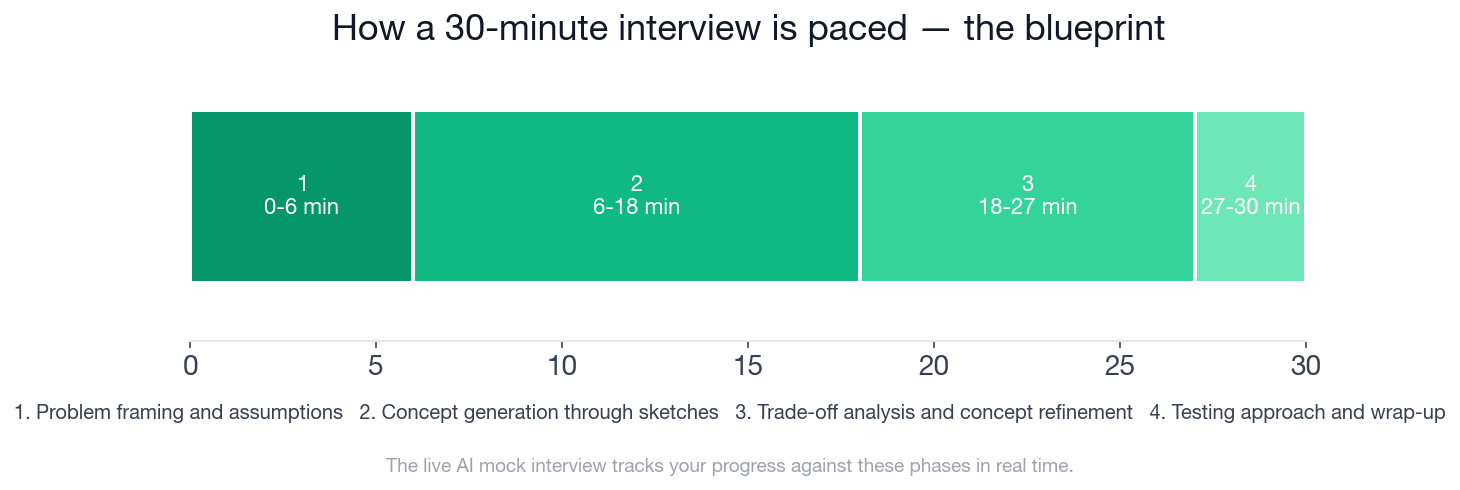 Phase-by-phase timeline: problem framing (0-6 min), concept generation (6-18 min), trade-off analysis (18-27 min), testing approach (27-30 min).
This is the blueprint a strong candidate hits across the full 30 minutes. It is also the live structure the AI mock interview tracks you against in real time.
- ✓Asks 2-4 focused clarifying questions or explicitly states assumptions when unanswered
- ✓Defines a primary user and a moment-of-use scenario
- ✓Identifies success as faster, lower-friction group decision-making rather than generic restaurant browsing
- ✓Calls out at least 2 relevant constraints such as distraction, one-handed use, group input, or time pressure
- ✓Produces at least 2 distinct concepts, ideally 3 if moving efficiently
- ✓Shows core screens or steps for each concept rather than discussing only in abstract terms
- ✓Annotates important interactions, inputs, or decision moments
- ✓Explains how each concept helps a group converge faster
- ✓Avoids overinvesting in polish; prioritizes clarity, structure, and alternative directions
- ✓Compares concepts against explicit criteria such as speed, cognitive load, collaboration, and implementation complexity
- ✓Selects one direction with a clear rationale tied to the scenario
- ✓Refines the chosen concept by adjusting flow, layout, or interaction details
- ✓Addresses at least one realistic complication such as conflicting preferences, low attention, or limited time
- ✓Identifies one riskiest assumption in the chosen concept
- ✓Suggests a simple prototype or usability test approach appropriate to low-fidelity design
- ✓Names 1-2 success signals such as time to decision, completion rate, or user confidence
Practice This Live
The best next step is not more reading; it is 30 minutes in the chair. The UX Designer ideation and sketching AI mock interview runs a full session with a live interviewer agent, scores you on the same 4-dimension rubric, and shows you the blueprint in real time so you see exactly which phase you are in. If you want to drill the question types before going live, the UX Designer ideation question bank has the full topic collection to work through at your own pace. For structured prep across all UX design topics, the UX Designer preparation guide lays out the full scope.
FAQ
Q. How is a UX Designer ideation and sketching interview scored?
The rubric totals 100 points across 4 dimensions: Interviewer Objectives Alignment (30 points), Level-Specific Expectations (30 points), Technical Proficiency (20 points), and Communication and Problem Solving (20 points). For a mid-level ideation round, 60 of those points depend on whether you framed the problem well and produced genuinely distinct concepts at the right level of judgment.
Q. How many concepts should I produce in a UX ideation and sketching interview?
The Phase 2 checklist (minutes 6-18) expects at least 2 distinct concepts, ideally 3 if you are moving efficiently. Distinct means the interaction model or user flow differs meaningfully, not the same list view with different card sizes or visual treatment.
Q. What happens in the first 6 minutes of a UX Designer ideation round?
Phase 1 (minutes 0-6) is entirely about problem framing. The checklist expects 2-4 focused clarifying questions or explicit assumptions, a defined primary user and moment of use, and at least 2 constraints called out. Candidates who skip directly to drawing lose those points and often produce concepts that solve the wrong problem.
Q. What is the difference between distinct concepts and visual variations in a UX ideation interview?
Distinct concepts have different interaction models or user flows, such as a swipe-to-decide pattern versus a map-first spatial view versus a group-share shortlist model. Visual variations are the same flow with different button sizes or card layouts. The Level-Specific Expectations dimension (30 points) scores on whether you show genuine divergent thinking.
Q. How should I approach the trade-off analysis phase of a UX ideation interview?
Phase 3 (minutes 18-27) expects you to compare concepts against explicit criteria such as speed, cognitive load, collaboration, and implementation complexity. Select one direction with a clear rationale tied to the scenario, then refine it to address at least one realistic complication such as conflicting group preferences or limited attention.
Q. How do I prepare for a UX Designer ideation and sketching interview?
Practice generating 2-3 meaningfully different concepts from a single prompt in 12 minutes, then articulating a rationale for choosing one. Work through the full 30-minute arc, from framing to divergence to convergence to a testing plan, to build the pacing instinct that separates candidates who know ideation from those who perform it well live.
Two Concepts and a Rationale Is the Bar
The blueprint's Phase 2 checklist has five items. One of them is "avoids overinvesting in polish; prioritizes clarity, structure, and alternative directions." That item exists because the most common failure in this round is not a candidate who does not know UX: it is one who spends 12 minutes perfecting a single idea and arrives at Phase 3 with nothing to compare. Two distinct concepts with annotated trade-offs, sketched loosely enough to revise, is exactly what the bar requires.
Topics
Ready to practice?
Put what you've learned into practice with AI mock interviews and structured preparation guides.