
Instructional Design Beats User Research by Nearly 3 to 1
If you're a UX Designer scanning "Design Researcher" postings as a next step, the single most common skill you'll run into isn't research at all. Instructional Design shows up in 40.6% of active Design Researcher postings, more than double the rate of User Research (14.9%) or Usability Testing (14.7%), the skills closest to what most people mean by "design research." UX Designer has no such identity problem: its top skill is Figma, at 29.9%, followed by a mix of conceptual UX skills (User Experience, User Research) and hands-on production tools (Wireframes, Design Systems, Prototyping), all pointing at the same interface-focused job.
We pulled every active posting for both roles on the InterviewStack.io job board as of August 2026, 3,740 UX Designer and 456 Design Researcher listings, with skills extracted and normalized the same way the live filters work. The two roles share just 28% of their top-30 skill sets (a Jaccard overlap of 0.28), and UX Designer posts 8.2 times more openings. Yet at the median, the two roles pay almost the same: $130,000 versus $124,300, a gap of just $5,700.
Key Findings
- UX Designer posts 3,740 active listings versus 456 for Design Researcher, an 8.2x volume gap.
- Median US base salary is nearly even: $130,000 for UX Designer vs. $124,300 for Design Researcher, a $5,700 (4.6%) gap.
- The two roles share just 28% of their top-30 skill sets (Jaccard overlap coefficient 0.28).
- Instructional Design is Design Researcher's single most common skill at 40.6% of postings, more than double User Research (14.9%) or Usability Testing (14.7%).
- UX Designer's own identity skills price highest: Wireframes, Design Systems, UX Design, and Interaction Design all sit $30,000 to $32,100 above its $130,000 baseline.
- Design Researcher's pattern runs the opposite direction: Instructional Design, its most common skill, prices $38,300 below its own $124,300 baseline, while User Experience and User Research price $41,900 to $54,800 above it.
- Design Researcher postings are remote almost twice as often as UX Designer postings (33.6% vs. 17.1%).
- Entry-level access is nearly identical, and tight, for both: 3.6% for UX Designer, 3.7% for Design Researcher.
| UX Designer | Design Researcher | |
|---|---|---|
| Median US base salary | $130,000 | $124,300 |
| Active postings | 3,740 | 456 |
| Top skill | Figma (29.9%) | Instructional Design (40.6%) |
| Remote share | 17.1% | 33.6% |
| Entry-level share | 3.6% | 3.7% |
| Skill overlap (Jaccard) | 28% shared (pairwise) | 28% shared (pairwise) |
A Day in Each Role Looks Nothing Alike
A UX Designer's week runs through Figma: wireframes, interactive prototypes, and design-system components that hand off directly to engineering. The role's exclusive skills (Wireframes, Design Systems, Interaction Design, User Flows) all describe production work: turning a concept into a spec someone else can build.
The "UX Designer" label has a breadth problem too, just on the title side rather than the skill side. Its title sample includes postings like "Equipment Drafter/Designer," "Footwear Designer," "Marine Designer/Drafter," and "Production Sock Designer," titles from engineering, apparel, and industrial-design fields that the job board groups under the same role label. That doesn't change the skill story above: Figma, Wireframes, and Design Systems stay genuinely UX-specific regardless. But it does mean the 3,740 raw posting count, and any volume comparison built on it, includes some non-digital-design roles alongside the UX Designer postings.
A genuine design researcher's week looks different: recruiting participants, running usability sessions or interviews, and synthesizing findings into something that shapes what gets designed next. But postings labeled "Design Researcher" don't only describe that work. The title sample behind this role includes "Senior Instructional Designer (Contract, Remote)" sitting in the same bucket as "Staff UX Researcher, Personalization." Same label, different job.
How Much of a UX Designer's Toolkit Transfers to Design Research?
About a quarter of it, and unevenly. Thirteen skills clear the 5% threshold in both roles' top-30 lists, and two of them are nearly perfectly balanced regardless of which title the posting uses:
| Skill | UX Designer | Design Researcher |
|---|---|---|
| User Experience | 21.6% | 20.6% |
| User Research | 15.2% | 14.9% |
| Usability Testing | 11.4% | 14.7% |
| Figma | 29.9% | 12.1% |
| Storytelling | 11.1% | 24.3% |
| Accessibility | 14.5% | 27.2% |
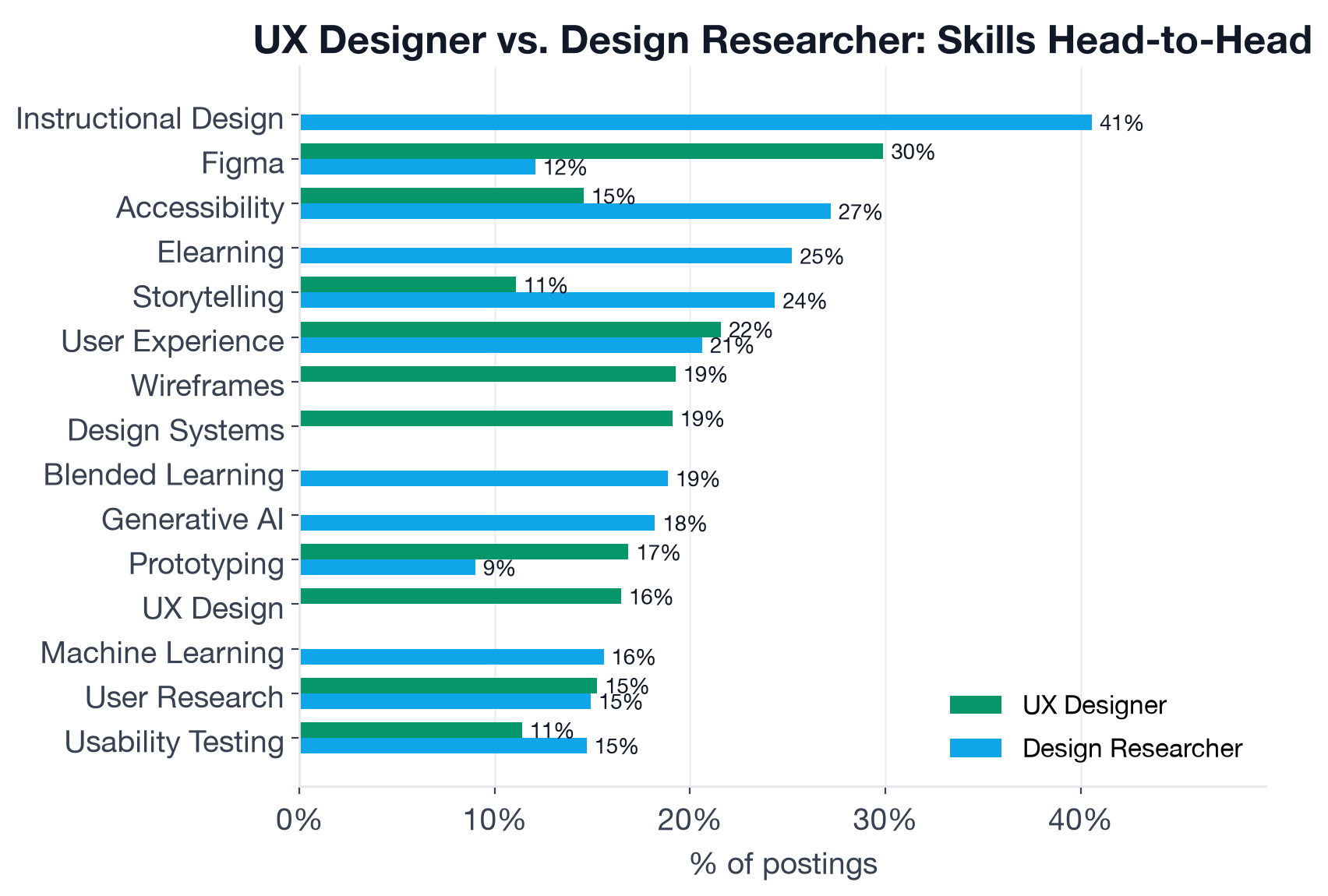
Top skills across both roles. User Experience and User Research are the closest thing to a genuine bridge; Figma, Storytelling, and Accessibility split hard toward one side.
User Experience (21.6% vs. 20.6%) and User Research (15.2% vs. 14.9%) show up at almost identical rates no matter which title the posting uses. That's the real bridge: UX Designers already do meaningful research work, and the design researchers doing product work already think in UX terms. What doesn't transfer evenly is tooling and narrative. Figma is 2.5 times as common in UX Designer postings; Storytelling runs more than twice as heavily toward Design Researcher, and Accessibility runs nearly twice as heavily.
The Real Skill Split Sits Inside Design Researcher, Not Between the Two Roles
UX Designer's ten exclusive skills (8%+ of its postings, under 5% of Design Researcher's) form a coherent set: Wireframes (19.3%), Design Systems (19.1%), UX Design (16.5%), Interaction Design (11.5%), User Flows (11.0%), plus Adobe Creative Suite, Html, Sketch, Typography, and Css. Every one is a production or front-end-adjacent skill. No ambiguity about what the role does.
Design Researcher's ten exclusive skills tell a different story: Instructional Design (40.6%), eLearning (25.2%), Blended Learning (18.9%), Virtual Training (13.4%), and Andragogy (12.9%, adult-learning theory) anchor a corporate learning-design cluster, not a research one. We've mapped this split in depth in our Design Researcher skills breakdown: the label covers two genuinely different jobs on this board, a UX/product-research track and a learning-design track, and none of Design Researcher's ten exclusive skills belong to the research track. One entry needs a caveat: Demand Generation (12.9%) tracks almost exactly with INFUSE, a B2B marketing firm that alone accounts for 12.8% of Design Researcher's distinct postings, a single-employer artifact rather than a genuine skill requirement.
Generative AI (18.2%), Machine Learning (15.6%), and LLMs (13.4%) also sit inside that exclusive list, more than three times UX Designer's rate (Generative AI doesn't clear UX Designer's top-30 cutoff, staying below roughly 5.4%). Read that gap carefully: it's mostly the learning-design cluster, AI-assisted course authoring, not evidence that design researchers use AI for research three times as often. Separate 2025-2026 industry surveys tell a different story about day-to-day use: a design-tool adoption survey puts AI-tool usage at 72-91% among design professionals broadly, and a UX research industry roundup puts it at 69-80% among UX researchers specifically, so the postings numbers for both roles are a floor on who's hired to build with AI, not a read on who uses AI tools day to day.
Is There Really a Pay Gap Between These Two Roles?
Barely, and that's the surprise. UX Designer's median US base salary is $130,000 (n=744 postings with US salary disclosed); Design Researcher's is $124,300 (n=142), a $5,700 gap (4.6%), UX Designer ahead. Both are base salaries only: equity, bonus, and sign-on aren't disclosed in postings, so total comp at top employers runs higher for both roles.
The near-parity at the top hides a sharper split underneath. On UX Designer's own numbers, the role's core identity skills all price comfortably above baseline:
| Skill | Median US salary | Premium | Sample |
|---|---|---|---|
| Interaction Design | $162,100 | +$32,100 | 129 |
| UX Design | $160,500 | +$30,500 | 149 |
| Wireframes | $160,000 | +$30,000 | 151 |
| Design Systems | $160,000 | +$30,000 | 168 |
| Figma | $138,900 | +$8,900 | 187 |
On Design Researcher's own numbers, the pattern flips depending on which track a posting belongs to:
| Skill | Median US salary | Premium | Sample |
|---|---|---|---|
| User Experience | $179,100 | +$54,800 | 41 |
| User Research | $166,200 | +$41,900 | 25 |
| Usability Testing | $165,400 | +$41,100 | 28 |
| Project Management | $87,400 | -$36,900 | 25 |
| Instructional Design | $86,000 | -$38,300 | 49 |
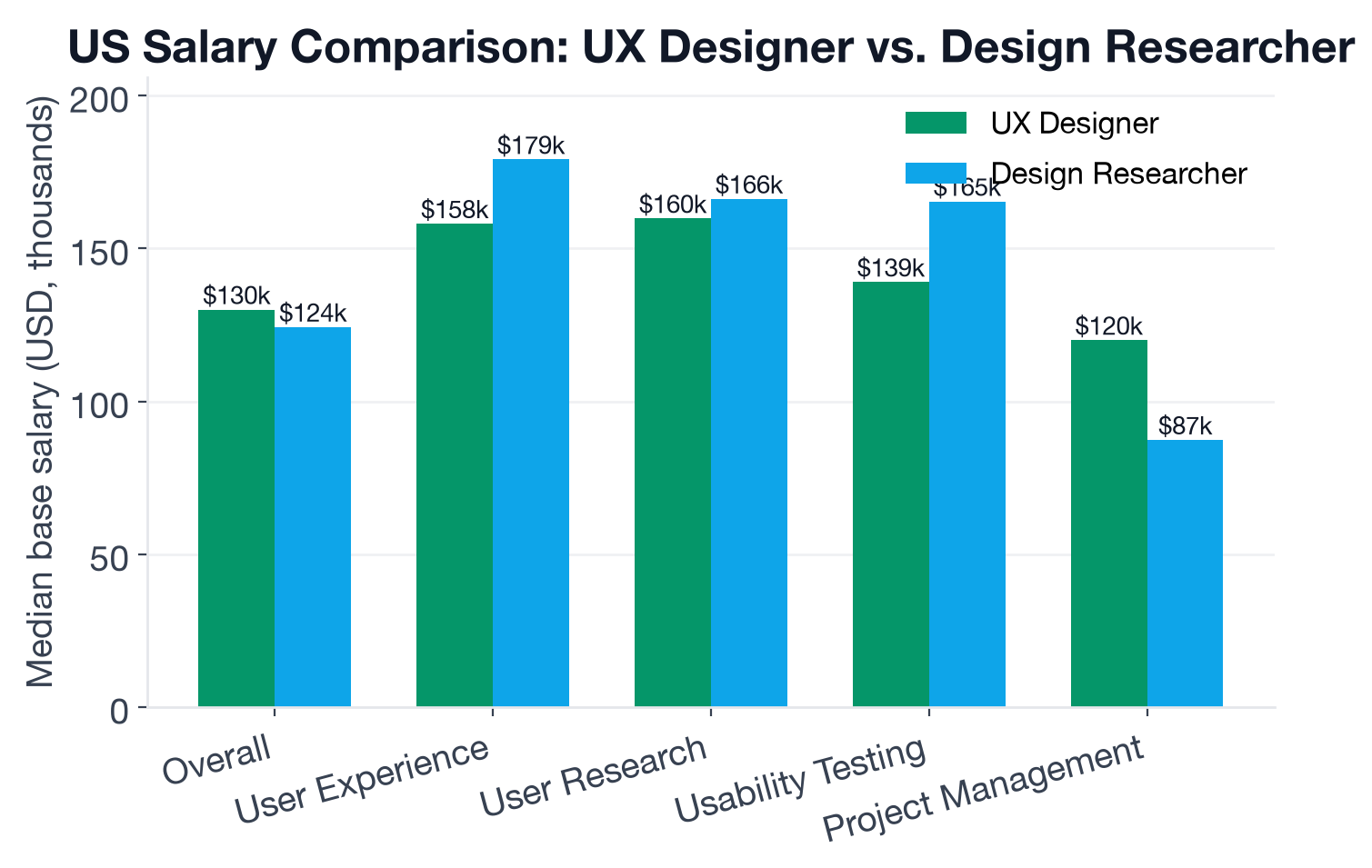
Median US base salary. Base only; equity and bonus excluded.
Instructional Design, Design Researcher's most common skill by a wide margin, is also its lowest-paid one on the role's own numbers: $38,300 below baseline. UX Designer has no equivalent problem; its own most common skill, Figma, still clears baseline, just by a smaller amount than the strategy-adjacent skills above it.
Which Role Is Easier to Land, and From Where?
Neither is an easy first job, but UX Designer offers far more attempts: 3,740 active postings against 456 for Design Researcher, an 8.2x overall gap that stays wide at every seniority level, from 6.1x at senior to 9.5x at mid-level. Entry-level share is nearly identical and tight for both, 3.6% versus 3.7%. Design Researcher skews a bit more senior overall (30.7% senior-level vs. UX Designer's 23.0%), plausibly reflecting the learning-design track's overlap with tenured corporate-training hires rather than a research-specific pattern.
Design Researcher is nearly twice as remote-friendly (33.6% vs. 17.1%), likely tracing to that same learning-design cluster: contract instructional-design work travels remote more easily than in-house product design. Geography runs the other direction: Design Researcher postings are more US-concentrated (46.5% vs. 38.3%), consistent with corporate training hiring staying closer to a company's US headquarters.
Which Role Fits You?
Choose UX Designer if you:
- Want the larger, faster-moving market: 8.2 times more open roles right now
- Want work centered on interface production: wireframes, design systems, prototypes that hand off to engineering
- Want the skill-side clarity: once you're inside a posting, Figma, Wireframes, and Design Systems describe one coherent production-focused job, even though the title itself pulls in some non-digital-design postings
Choose Design Researcher if you:
- Have a genuine strength in structured inquiry, and check each posting for Usability Testing or User Research before applying, not just the title
- Are comfortable with a smaller, more remote-friendly, slightly more senior-skewed market
- Want the ceiling that comes with research skills specifically: User Experience and User Research both price at or above $41,900 over the role's own baseline
How to Use This in Your Job Search
If you're targeting UX Designer roles, invest in systems thinking over raw tool fluency: Interaction Design and UX Design carry bigger premiums than Figma alone (see our UX Designer skills deep dive for the full breakdown). Practice explaining design decisions with AI mock interviews, and drill portfolio-review scenarios through the question bank.
For Design Researcher openings, read past the title before you apply. A posting heavy on Instructional Design, eLearning, or Andragogy is a learning-design role; one built around Usability Testing or User Research is the product-research track, and it's the one that pays like specialized research work. Our interview-prep courses cover research methodology and case-study structure for that track specifically.
FAQ
Q. What's the salary difference between UX Designer and Design Researcher in 2026?
UX Designer's median US base salary is $130,000 (n=744 postings with US salary disclosed) versus $124,300 for Design Researcher (n=142), a $5,700 (4.6%) gap. Both figures are base salary only: equity, bonus, and sign-on aren't disclosed in postings, so total comp at top employers runs higher for both roles.
Q. Do UX Designer and Design Researcher share many of the same skills?
Not many, by the numbers: the two roles share just 28% of their top-30 skill sets (a Jaccard overlap coefficient of 0.28). Thirteen individual skills clear the 5% threshold in both roles' postings, and the two most evenly shared are User Experience (21.6% UX Designer, 20.6% Design Researcher) and User Research (15.2% vs. 14.9%).
Q. Is "Design Researcher" really one job?
Not consistently. Instructional Design, an enterprise learning-and-development skill, is Design Researcher's single most common skill at 40.6% of postings, well ahead of User Research (14.9%) or Usability Testing (14.7%), the skills closer to product or UX research. The label covers both a product-research track and a corporate learning-design track; see our Design Researcher skills breakdown for the full split.
Q. Which role has more job openings?
UX Designer, by a wide margin: 3,740 active postings versus 456 for Design Researcher, an 8.2x overall gap. The gap stays wide at every seniority level, from 6.1x at senior to 9.5x at mid-level, and across geographies, from 6.8x in the US to over 11x in some other countries.
Q. Do UX Designer or Design Researcher jobs require AI skills?
Explicit mentions are low for UX Designer (Generative AI doesn't clear the top-30 cutoff, below roughly 5.4% of postings) and higher for Design Researcher (Generative AI 18.2%, Machine Learning 15.6%, LLMs 13.4%), though that gap mostly reflects Design Researcher's learning-design cluster rather than AI-assisted research specifically. Ambient usage runs much higher for both: a 2025-2026 design-tool adoption survey (Designlab's State of AI in UX & Product Design report) puts AI-tool adoption at 72-91% among design professionals broadly, and UX-research-specific industry reports (Maze's Future of User Research Report and User Interviews' State of User Research Report, summarized by Koji) put it at 69-80% among UX researchers, so postings numbers understate day-to-day use for both roles.
Q. Which role is easier to break into?
Neither is a strong first job: entry-level postings are 3.6% for UX Designer and 3.7% for Design Researcher, essentially identical. UX Designer's much larger posting volume (8.2x) means more total entry-level openings in absolute terms even at a similar rate.
Q. Which role offers more remote work?
Design Researcher, by a wide margin: 33.6% of its postings are remote versus 17.1% for UX Designer. Part of that gap likely reflects Design Researcher's learning-design cluster, where contract instructional-design work is commonly remote.
Know Which Job Is Behind the Title
UX Designer and Design Researcher sound like neighboring rungs on the same design ladder. The data says otherwise: they share little skill territory, one offers eight times the openings, and "Design Researcher" itself splits into two jobs that price in opposite directions relative to their own baseline. The $5,700 pay gap between the two roles isn't the number that matters here. The number that matters is 40.6%, the share of Design Researcher postings where the top requirement has nothing to do with research. Read the skill list before the title. Browse open UX Designer or Design Researcher roles on InterviewStack.io.
Topics
Ready to practice?
Put what you've learned into practice with AI mock interviews and structured preparation guides.