
Add "Product Design" to a UX Posting, and the Pay Gap Disappears
UX Designer and Product Designer read like two different jobs on the org chart, but the postings barely agree. Their top-30 skill sets overlap by 76% (a Jaccard similarity score), tying for the third-highest overlap we've measured across this comparison series, behind only the 82% tie between Data Analyst and Business Intelligence Analyst and UX Designer and UI Designer. Only three skills combined separate the two rosters by any meaningful margin. And yet Product Designer carries a $42,500 higher median salary, a gap that puts UX Designer pay 25% below the Product Designer number.
We pulled every active posting for both roles on the InterviewStack.io job board as of August 2026, 3,677 UX Designer listings and 3,452 Product Designer listings, with skills extracted from descriptions and synonyms collapsed. Title-based role matching is keyword-driven, so a slice of both samples pulls in adjacent disciplines that happen to share the word "Designer": industrial and structural design titles bleed into UX Designer, brand and marketing design titles bleed into Product Designer. The skill and salary figures throughout this post are computed from full posting content rather than title text alone, which keeps them the more reliable read on each role. The gap turns out to live inside one specific line item, covered below: UX Designer postings that explicitly ask for Product Design report the exact median Product Designer carries across its entire sample.
| UX Designer | Product Designer | |
|---|---|---|
| Median US base salary | $127,500 | $170,000 |
| Active postings | 3,677 | 3,452 |
| Top skill | Figma (30.3%) | Product Design (45.6%) |
| Remote share | 16.8% | 29.3% |
| Entry-level share | 4.0% | 4.4% |
| Skill overlap (Jaccard) | 76% (pairwise) | 76% (pairwise) |
Key Findings
- Product Designer's median US base salary is $170,000 (n=861) versus UX Designer's $127,500 (n=691), a $42,500 gap that puts UX Designer pay 25% below the Product Designer median.
- The two roles share 76% of their top-30 skill sets (Jaccard overlap), tying for the third-highest overlap measured across the entire comparison series, behind only the 82% tie between Data Analyst vs Business Intelligence Analyst and UX Designer vs UI Designer.
- Only 3 skills combined clear the exclusivity threshold: Project Management (10.1%) for UX Designer; Product Strategy (10.1%) and Product Management (9.1%) for Product Designer.
- UX Designer postings that explicitly list Product Design report a $170,000 median salary (n=135), identical to Product Designer's overall US median.
- Product Designer postings skew far more senior: 49.7% are senior or staff-level versus 30.0% for UX Designer.
- Job volume is nearly tied: 3,677 active UX Designer postings versus 3,452 for Product Designer, a 1.07x ratio.
- Product Designer offers more remote flexibility (29.3% remote) than UX Designer (16.8% remote); both roles remain majority onsite.
- Entry-level access is thin for both roles: 4.0% of UX Designer postings and 4.4% of Product Designer postings.
The Day-to-Day Looks Almost the Same
A UX Designer typically starts from a research question: how users move through a flow, where they get stuck, what needs to change. The output is wireframes, user flows, and usability-test findings handed off to whoever owns the roadmap. A Product Designer usually starts one step earlier, closer to "what should we build at all," and carries the work further into how it ships.
That difference in scope tracks with the skill data. Product Strategy and Product Management are exclusive to Product Designer, and nearly half of its postings (49.7%) are tagged senior or staff, versus 30.0% for UX Designer. The tools barely change between the two titles. Who signs off on the direction does.
Which Skills Do Both Roles Actually Share?
Both roles run through nearly the same toolkit before any title-specific skill shows up: Figma, Design Systems, Product Design, Prototyping, and User Experience each clear meaningful share of postings on both sides.
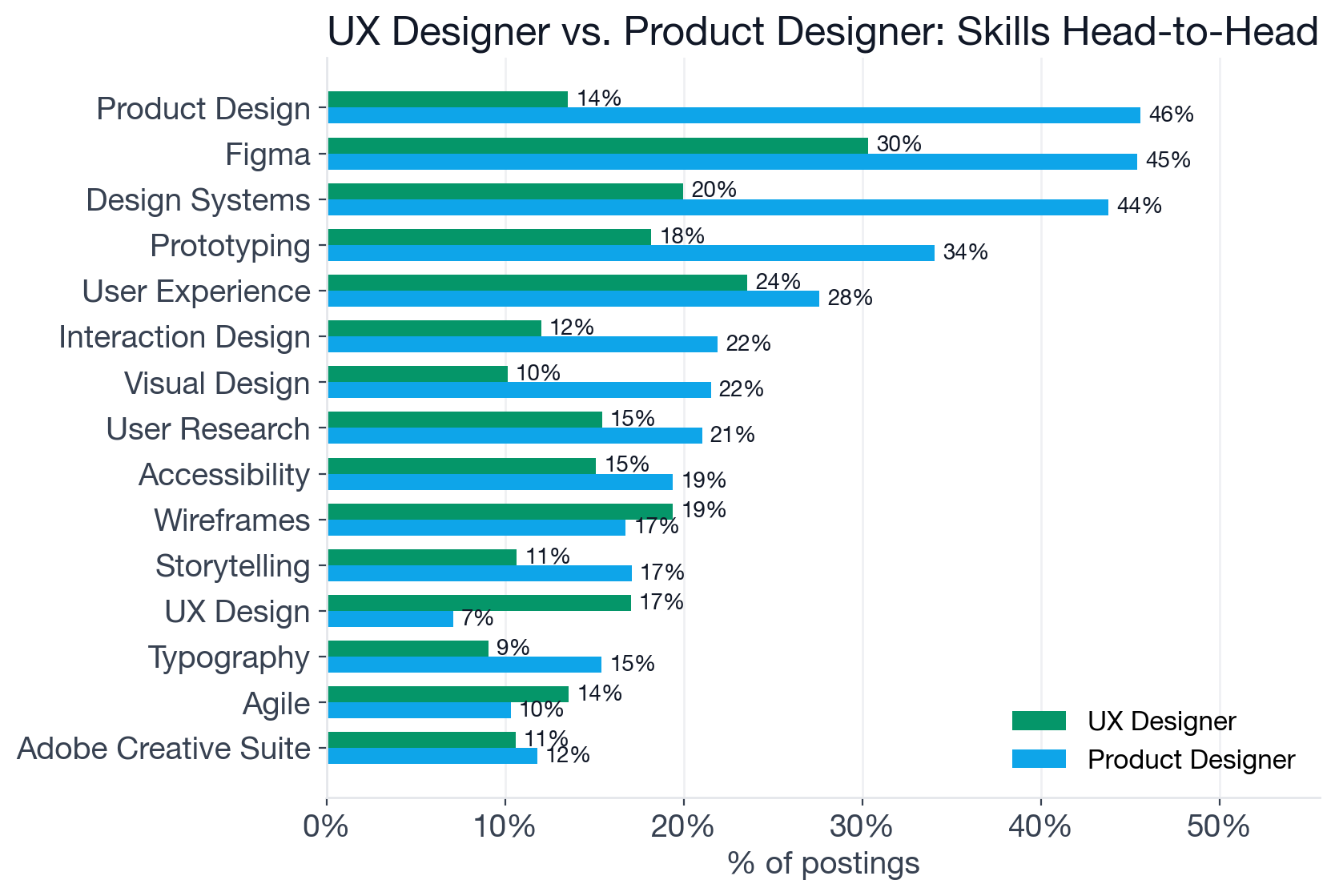
Figma, Design Systems, and Product Design lead both rosters, but each sits meaningfully higher in Product Designer postings, evidence that Product Designer treats the deeper end of the shared toolkit as a baseline expectation rather than a specialty.
| Skill | UX Designer | Product Designer |
|---|---|---|
| Figma | 30.3% | 45.4% |
| Design Systems | 20.0% | 43.8% |
| Product Design | 13.5% | 45.6% |
| Prototyping | 18.2% | 34.0% |
| User Experience | 23.6% | 27.6% |
| User Research | 15.4% | 21.0% |
| Wireframes | 19.4% | 16.7% |
| UX Design | 17.1% | 7.1% |
| Agile | 13.6% | 10.3% |
| Usability Testing | 11.4% | 11.4% |
Figma, Design Systems, and Product Design are all more common in Product Designer postings, the clearest sign Product Designer treats the deeper shared toolkit as a default rather than a differentiator. Three shared skills run the other way, each more common in UX Designer postings: Wireframes, UX Design, and Agile. UX Design shows the widest gap of the three, more than double the frequency (17.1% versus 7.1%), the clearest sign the "UX" in the title still gets written into the posting as an explicit requirement more often than it does for Product Designer. Usability Testing is the tightest tie in the dataset: 11.4% for each role, effectively identical.
Where the Two Titles Genuinely Diverge
Only three skills combined separate these rosters enough to count as exclusive (meaningfully present in one role and essentially absent from the other): Project Management for UX Designer (10.1% of postings), and Product Strategy (10.1%) plus Product Management (9.1%) for Product Designer. That is a thin list for two titles that supposedly describe different jobs, and it says something specific: Product Designer's two exclusives put the person closer to the roadmap, deciding what gets built, not only how it looks, while UX Designer's one exclusive, Project Management, is a coordination skill: keeping design work on schedule, not owning the plan itself.
The pay data backs up that read. Product Strategy and Product Management both clear a real premium over Product Designer's own $170,000 baseline ($196,300, a $26,300 premium, n=139; and $191,300, a $21,300 premium, n=112). Project Management, UX Designer's lone exclusive, pays $122,900, which is $4,600 below UX Designer's own $127,500 median (n=82). Product Designer's differentiator skills are genuinely worth more. UX Designer's differentiator isn't a pay differentiator at all: it reads more like a job requirement that happens to not move salary.
UX Designer vs Product Designer: Which Role Pays More?
Product Designer's median US base salary is $170,000 (n=861) against UX Designer's $127,500 (n=691), a $42,500 gap that puts UX Designer pay 25% below the Product Designer median. Both figures are base salary only: equity, bonus, and sign-on aren't disclosed in job postings and aren't reflected here.
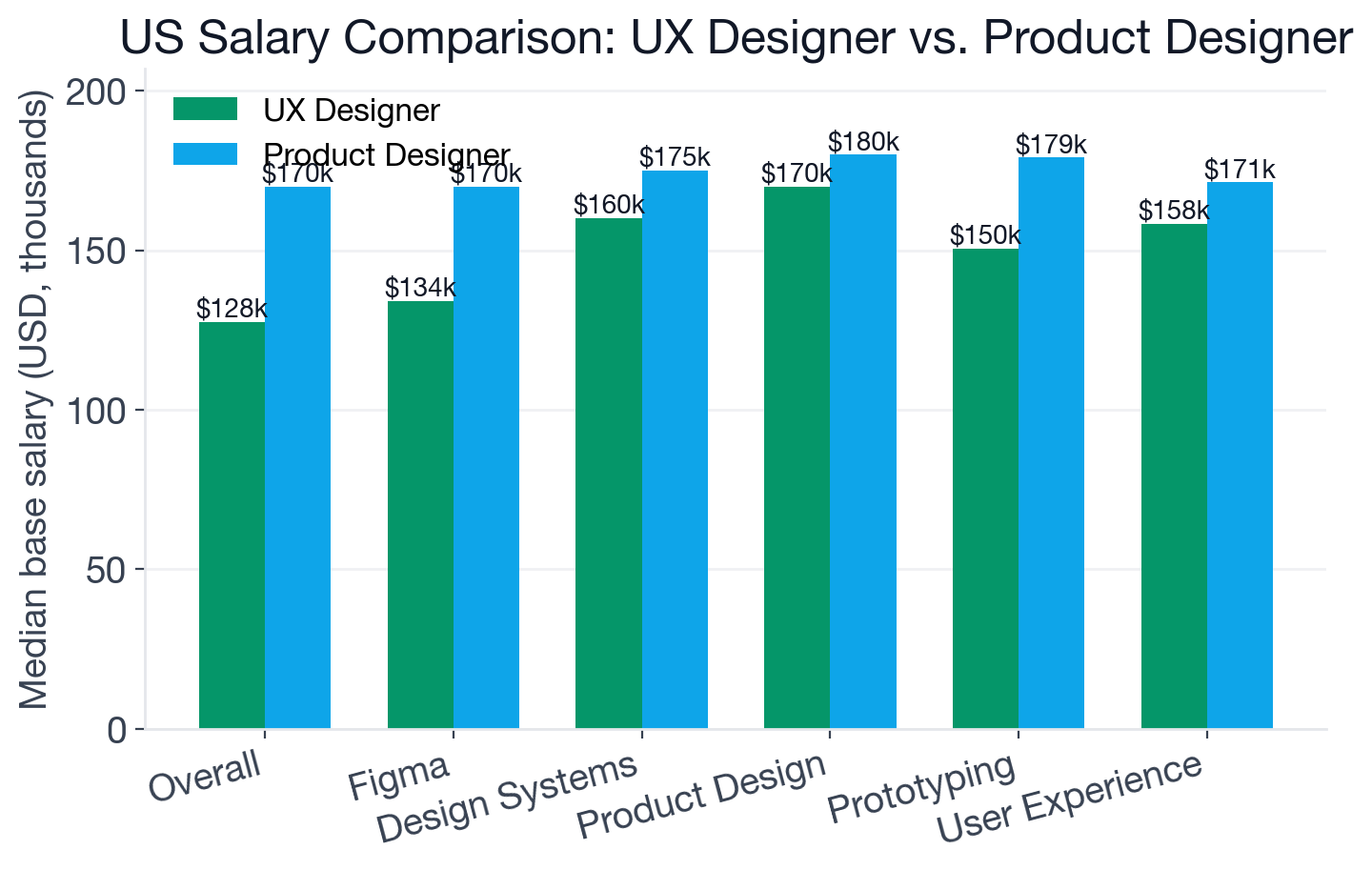
Product Designer's $170,000 median clears UX Designer's $127,500 baseline before a single extra skill is added; the shared skills that carry the biggest premium (Product Design, Interaction Design, Design Systems) move UX Designer's number the hardest.
Part of the gap is seniority mix, not scope: 49.7% of Product Designer postings are tagged senior or staff, versus 30.0% for UX Designer (staff alone: 21.0% versus 6.7%). Some of that skew likely reflects the same title-classification noise flagged above (senior- and lead-titled brand-design postings picked up by the generic "Designer" match), so read 49.7% as a soft upper bound on Product Designer's true seniority mix rather than an exact figure.
The sharper finding sits inside UX Designer's own salary-by-skill data. When a UX Designer posting explicitly lists Product Design as a requirement, it reports a $170,000 median (n=135), the exact figure Product Designer carries across its entire sample. The $42,500 gap isn't really between two different jobs; it's between two scopes of largely the same one, and "Product Design" as a listed skill is the clearest marker of which scope a given UX Designer posting sits in.
The rest of the shared skill list tells the same story at smaller scale. Design Systems adds $32,500 to UX Designer's baseline (n=159) but only $5,000 to Product Designer's (n=411); User Experience adds $30,800 for UX Designer (n=195) against just $1,300 for Product Designer (n=272). The skills that separate a well-paid UX Designer posting from an average one are largely the skills Product Designer already assumes, which is why they barely move Product Designer's own number.
UX Designer skills paying above the $127,500 baseline
| Skill | Median US salary | Premium | Sample size |
|---|---|---|---|
| Product Management | $187,400 | +$59,900 | 63 |
| Product Strategy | $187,400 | +$59,900 | 39 |
| Design Strategy | $183,600 | +$56,100 | 37 |
| Product Design | $170,000 | +$42,500 | 135 |
| Interaction Design | $162,100 | +$34,600 | 121 |
Product Designer skills paying above the $170,000 baseline
| Skill | Median US salary | Premium | Sample size |
|---|---|---|---|
| Design Strategy | $220,300 | +$50,300 | 80 |
| Design | $210,300 | +$40,300 | 26 |
| Data Science | $203,800 | +$33,800 | 40 |
| Product Strategy | $196,300 | +$26,300 | 139 |
| React | $195,000 | +$25,000 | 31 |
Do Either Role Actually Need AI Skills?
Barely, by the letter of the posting. Generative AI shows up in roughly 4.6% of UX Designer's US salary-disclosed postings and 6.7% of Product Designer's (LLMs adds another 3.4% for Product Designer). Neither term cracks either role's top-30 skill list, and these are estimates from the salary-disclosed subset, not the full posting corpus. Read literally, that suggests AI is a niche add-on for both roles.
It isn't. The 2026 AI in Design Report puts weekly AI-tool usage among practicing designers at 91% and daily usage at 75% (up from 54% weekly a year earlier), a daily rate that now exceeds the 51% daily-use rate software developers report in the 2025 Stack Overflow Developer Survey, a reversal of the old assumption that engineers lead on AI adoption. No survey splits that figure by UX Designer versus Product Designer, so treat AI fluency (ChatGPT, Figma's AI features, AI-assisted prototyping) as a shared baseline for both titles, not a differentiator between them. The rare postings that do name Generative AI or LLMs explicitly (Product Designer: +$22,500 and +$19,000) are paying for owning an AI-native product surface, not for using AI tools day to day.
Which Has More Openings, and Where?
Volume is close to a dead heat: 3,677 active UX Designer postings versus 3,452 for Product Designer, a 1.07x ratio in UX Designer's favor. Neither title is an easy first job: entry-level share sits at 4.0% for UX Designer and 4.4% for Product Designer, both thin.
Work mode is where the roles genuinely separate. Product Designer offers meaningfully more remote work (29.3% remote, 30.7% hybrid) than UX Designer (16.8% remote, 25.0% hybrid); both remain majority onsite (52.3% and 59.3%, respectively). Geographically, Product Designer postings skew slightly more US-concentrated (44.0% versus 36.7%), consistent with a role that leans a bit more toward product-org headcount at US-headquartered companies.
Match the Title to the Kind of Design Work You Want
Choose UX Designer if you:
- Want the slightly larger, currently more open market: 3,677 active postings versus 3,452.
- Are strongest in the research-to-wireframe pipeline (User Research, Wireframes, Usability Testing) over roadmap ownership.
- Are building toward the premium rather than starting with it: Product Design, Design Systems, and Interaction Design move a UX Designer posting's pay closest to Product Designer's.
Choose Product Designer if you:
- Want the higher baseline pay and already own a product surface end to end, not just the interface layer.
- Have, or want, Product Strategy or Product Management experience: Product Designer's only two real skill exclusives, and both pay above its own baseline.
- Are targeting senior or staff-level scope: 49.7% of Product Designer postings sit there versus 30.0% for UX Designer.
How to Use This in Your Job Search
Practice explaining the difference between execution and ownership, the exact question a hiring manager is asking when sorting UX Designer from Product Designer, with AI mock interviews tuned to whichever title you're targeting.
To close the $42,500 gap from the UX Designer side, drill Product Strategy and Product Management questions in the Question Bank, and use our interactive courses to build product-thinking skills a typical UX portfolio skips. Then browse live UX Designer postings that ask for Product Design or Product Designer postings that name Product Strategy, and read our deeper breakdowns of UX Designer skills and Product Designer skills.
FAQ
Q. What's the salary difference between UX Designer and Product Designer in 2026?
Among US postings, Product Designer carries a $170,000 median base salary (n=861) versus $127,500 for UX Designer (n=691), a $42,500 gap that puts UX Designer pay 25% below the Product Designer median. Equity, bonus, and sign-on aren't disclosed in postings and aren't reflected in either figure.
Q. Do UX Designer and Product Designer really require different skills?
Not many. The two roles share 76% of their top-30 skill sets (a Jaccard overlap score), tying for the third-highest overlap measured across InterviewStack.io's whole role-comparison series, behind only the 82% tie between Data Analyst vs Business Intelligence Analyst and UX Designer vs UI Designer. Only 3 skills combined clear the exclusivity threshold between the two roles.
Q. Which skills are exclusive to Product Designer?
Product Strategy (10.1% of postings) and Product Management (9.1%) are the only skills that appear meaningfully more often in Product Designer postings than in UX Designer postings. Both pay above Product Designer's own baseline: $196,300 and $191,300 respectively, versus a $170,000 median.
Q. Which skill is exclusive to UX Designer?
Project Management is the only skill that clears the exclusivity threshold for UX Designer, appearing in 10.1% of postings. Unlike Product Designer's exclusive skills, it pays below UX Designer's own baseline ($122,900 versus a $127,500 median), so it functions as a coordination skill rather than a pay driver.
Q. Can a UX Designer earn Product Designer-level pay?
The data suggests yes, for a specific slice of the role. UX Designer postings that explicitly list Product Design as a requirement report a $170,000 median base salary (n=135), identical to Product Designer's overall US median (n=861).
Q. Is remote work more available for one role than the other?
Yes. Product Designer postings offer more remote flexibility (29.3% remote) than UX Designer postings (16.8% remote), though both roles remain majority onsite (52.3% and 59.3%, respectively).
Q. Do either of these roles require AI skills?
Only a small share of postings for either role explicitly name an AI skill: about 4.6% of UX Designer postings and 6.7% of Product Designer postings mention Generative AI, and neither term cracks either role's top-30 skill list. That's not evidence designers skip AI. 2026 design-industry surveys report 91% weekly and 75% daily AI tool usage among practicing designers, both above the 51% daily-use rate reported by software developers. Treat AI fluency as an assumed baseline for both roles, not a differentiator between them.
Same Ladder, Different Rung
UX Designer and Product Designer aren't two different crafts competing for the same candidates; on this data, they look more like two altitudes of the same one. The skill list barely changes. The pay and seniority mix do, and the clearest marker of which altitude a posting sits at is whether it asks for Product Design, Product Strategy, or Product Management rather than just Figma and wireframes. Browse live UX Designer openings or Product Designer openings to see which altitude fits what you've already built.
Topics
Ready to practice?
Put what you've learned into practice with AI mock interviews and structured preparation guides.