
What's the Difference Between Account Manager and Sales Engineer?
Sales Engineers earn a median $125,000 US base salary vs. $90,000 for Account Managers, a $35,000 premium. Account Manager roles outnumber Sales Engineer roles by more than 6 to 1 (16,232 vs. 2,636 active postings). The roles share roughly 43% of their top-30 skill sets, with CRM, Excel, and Salesforce as the common foundation. If the higher salary ceiling matters more than job supply, Sales Engineer is the harder but better-paid path. If volume and accessibility matter more, Account Manager is the larger and more forgiving market.
We analyzed 16,232 Account Manager and 2,636 Sales Engineer postings on the InterviewStack.io job board as of May 2026. Only postings where the job title literally contains the role name were included, which produces a clean, unambiguous sample with minimal classifier noise.
Key Findings
- Account Managers earn a median US base salary of $90,000 (n=3,137 postings with disclosed salary); Sales Engineers earn $125,000 (n=519).
- The salary gap is $35,000, which is 28% in favor of Sales Engineer.
- Account Manager postings outnumber Sales Engineer postings 6.2 to 1 (16,232 vs. 2,636).
- Skill overlap (Jaccard coefficient) is 0.43: the two roles share roughly 43% of their top-30 skill sets.
- Cloud platforms (AWS 13%, Azure 12%, Google Cloud 9%) and Python (9%) appear exclusively in Sales Engineer's top skills.
- Entry-level postings are rare for both: 2.6% for Account Manager, 2.0% for Sales Engineer.
- Sales Engineers are more likely to work remotely (30% of postings) than Account Managers (21%).
| Account Manager | Sales Engineer | |
|---|---|---|
| Median US base salary | $90,000 | $125,000 |
| Active postings | 16,232 | 2,636 |
| Top skill | CRM (28%) | CRM (18%) |
| Remote share | 21% | 30% |
| Entry-level share | 2.6% | 2.0% |
| Skill overlap (Jaccard) | 43% | 43% |
What Does Each Role Actually Do?
Account Managers own the commercial relationship after the contract is signed. A typical week involves check-ins with active accounts, coordinating renewals, identifying upsell opportunities, and troubleshooting client issues with internal teams. The output is retention and revenue expansion from an existing book of business, not new logo acquisition. The role is measured on net revenue retention and renewal rates, which is why CRM is the dominant tool: tracking every interaction, every risk signal, every expansion conversation.
Sales Engineers operate in the pre-sale phase as the technical counterpart to the Account Executive. Where the AE runs the deal, the SE runs the product demonstration, fields deep technical questions, and builds proof-of-concept integrations to show the prospect that the product works in their environment. That requires real engineering fluency: understanding the customer's cloud infrastructure, scripting a live demo, and prototyping an integration in Python on a tight timeline. Note: "Sales Engineer" also spans industrial and manufacturing contexts (packaging equipment, marine systems, cutting tools) where the role centers on product specification and application rather than cloud architecture; both segments appear in this dataset. The cloud and scripting skills exclusive to the SE role (AWS, Azure, Python, Google Cloud) are not incidental. They reflect what the technology pre-sales variant of the job actually is; the dataset also includes industrial and manufacturing Sales Engineers (evident in employers like Teekay Marine Services, Spirax Group, and Carrier) for whom cloud fluency is less central. The frequencies above apply across both populations, so the tech-SE market demand for cloud skills is, if anything, somewhat understated by these numbers.
What Skills Do Both Roles Require?
Both roles treat CRM as non-negotiable: it appears in 28% of Account Manager postings and 18% of Sales Engineer postings. CRM is the lowest-common-denominator tool of the commercial world, and that holds whether you are managing a renewal pipeline or demoing a product.
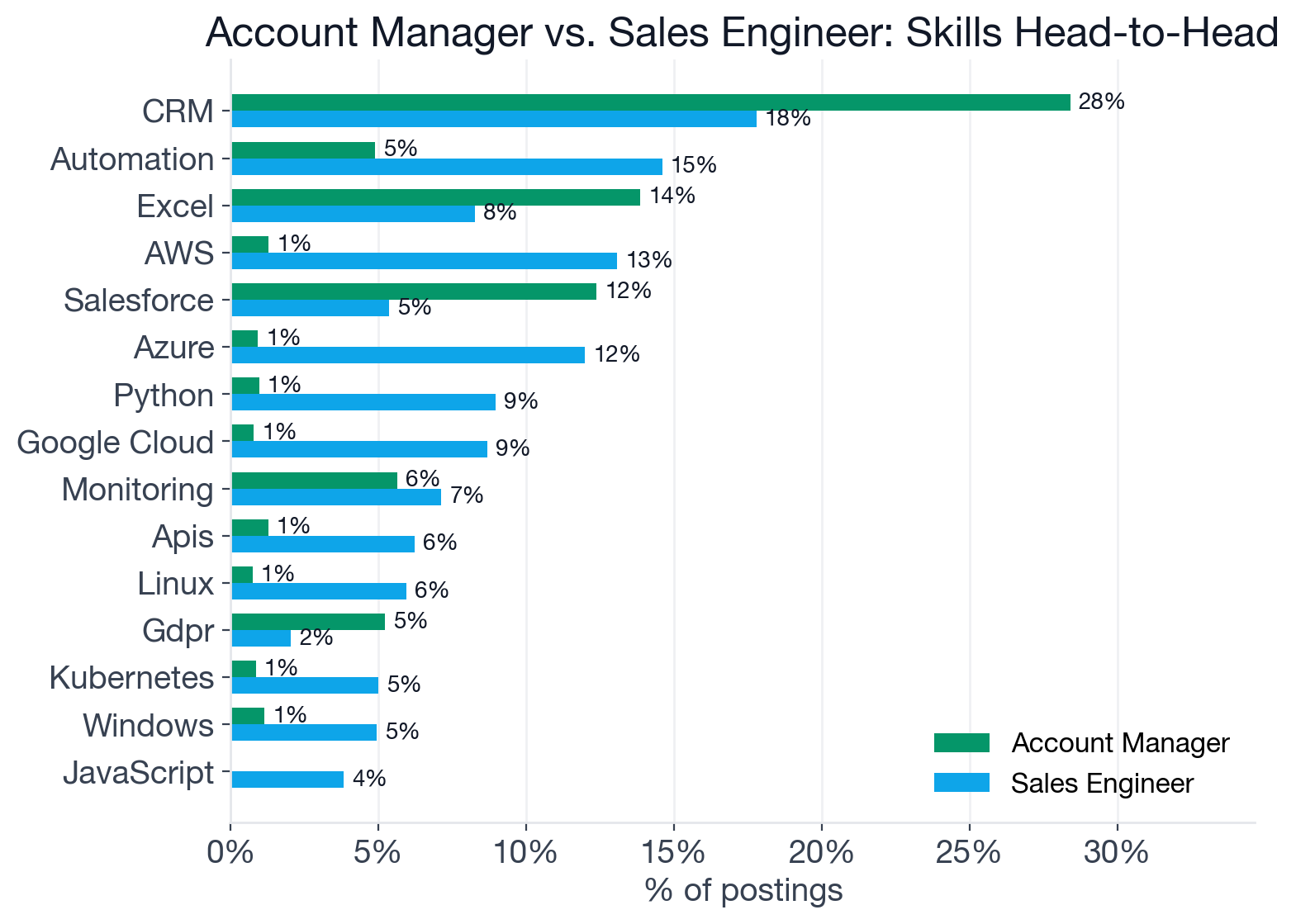
Top skills for each role by share of postings analyzed. Skills toward the left cluster are shared; those concentrated on the Sales Engineer side reflect technical pre-sales requirements.
Beyond CRM, Excel (14% AM / 8% SE) and Salesforce (12% AM / 5% SE) appear in both roles' top skills. Together, these three form the commercial baseline: track data in a CRM, report in Excel, and log everything in Salesforce. Monitoring appears at lower rates in both (5.6% AM / 7.1% SE), often reflecting the expectation that client-facing staff can interpret platform health metrics during account reviews.
The Jaccard overlap of 0.43 tells you the roles are meaningfully related but distinct. Roughly 4 in 10 skills on the top-30 lists are shared. The other 6 in 10 belong to one side. For a full breakdown of the Account Manager skill stack by frequency and industry, see our Account Manager skills analysis for 2026.
Where Do the Roles Diverge?
The divergence runs almost entirely in one direction. Account Manager has no skills in its top 30 that are exclusive to the role (meeting the >=8% AM / <5% SE threshold). Sales Engineer has five:
- Automation: 14.6% of SE postings vs. under 5% in AM. This reflects the expectation that SEs can configure workflow integrations and scripted demonstrations, not just describe them.
- AWS: 13.1% of SE postings. If the product runs on AWS, the SE must be able to discuss IAM, networking, and deployment architecture with the customer's infrastructure team.
- Azure: 12.0%. Same pattern on the Microsoft cloud stack.
- Python: 9.0%. Enough to write a proof-of-concept integration, call an API, or build a working demo. Not software-engineer-level Python, but real scripting fluency.
- Google Cloud: 8.7%. Customer-environment fluency on the GCP side.
The absence of exclusive AM skills is itself a finding. Account Managers are differentiated by what they do relationally (relationship management, negotiation, stakeholder alignment) rather than technically, and those competencies don't surface cleanly in job-posting skill tags.
On AI: Generative AI appears explicitly in 0.7% of Account Manager postings and 2.7% of Sales Engineer postings. Neither figure reflects actual AI usage in these roles. The Salesforce State of Sales 2026 survey found that 87% of sales organizations now use AI in some form, and 56% of sales professionals report using AI tools daily (Cirrus Insight, citing LinkedIn 2025). For Account Managers, that AI is already embedded in the tools they use: Salesforce Einstein, HubSpot's AI features, and AI-drafted email workflows. For Sales Engineers, the technical bar goes further: 85% of developers use AI tools regularly (JetBrains 2025), and SEs increasingly use AI coding assistants to draft demo scripts and prototype integrations. In both roles, AI fluency is a baseline expectation the industry has largely stopped advertising.
Which Pays More?
Sales Engineers earn more. Among US postings (where wage-transparency laws produce consistent salary disclosure), the median base salary for Sales Engineers is $125,000 vs. $90,000 for Account Managers, a $35,000 gap. These are base salaries only; commissions, OTE, equity, and bonus are not captured in posting data, so total compensation in high-performing sales roles is meaningfully higher than what these numbers reflect. Two caveats on the medians: the SE figure blends tech/SaaS pre-sales SEs (typically $140K–$200K+ at companies like CrowdStrike, Datadog, and Zscaler) with industrial/manufacturing SEs (typically $75K–$110K), and the AM figure spans pharma, insurance, automotive, and tech industries that each carry different salary norms.
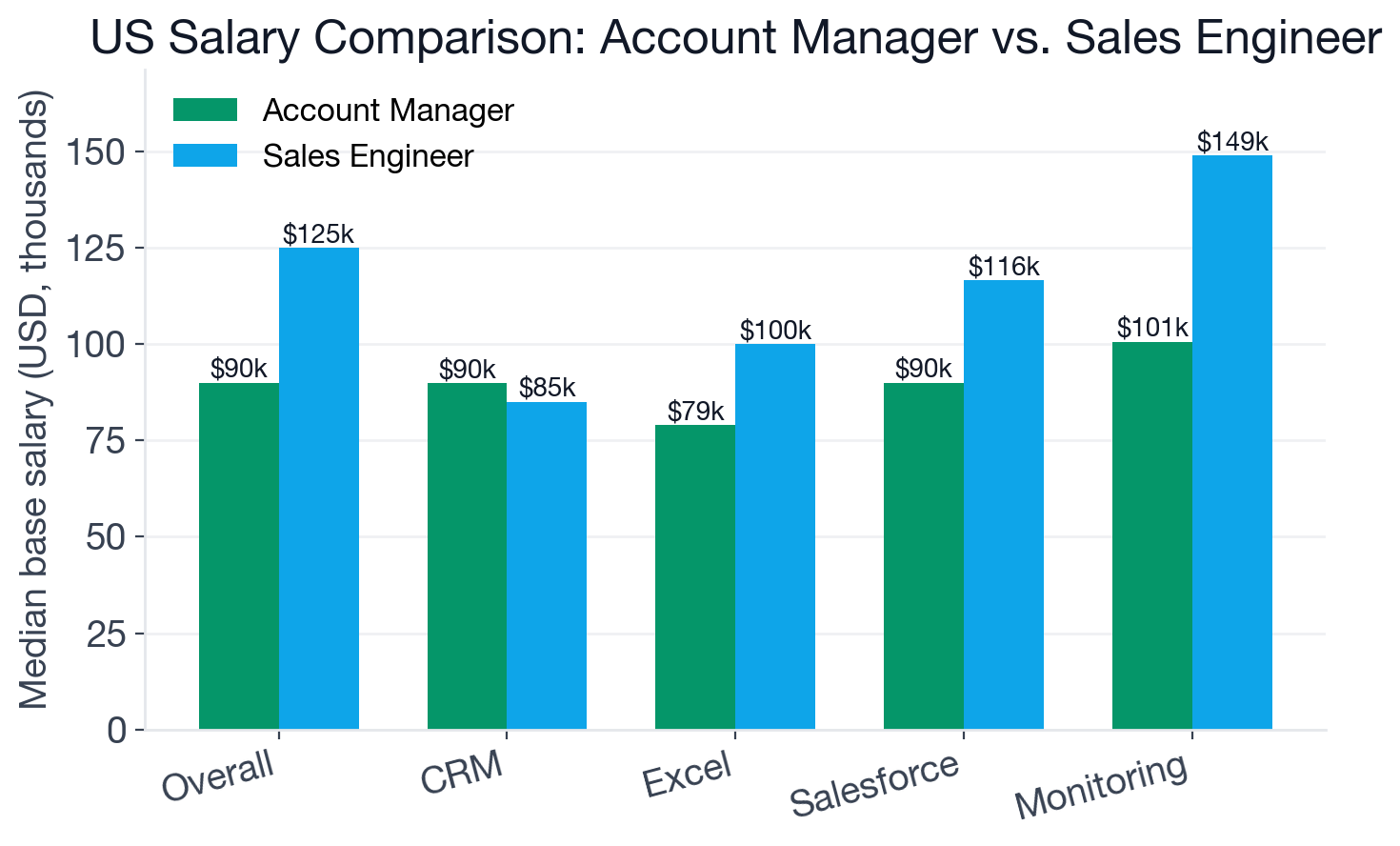
Median US base salary for each role and for selected skills with comparable data across both roles. Base salary only; US postings with disclosed salary data only (AM n=3,137; SE n=519).
Technical depth moves the needle in both roles, but from very different floors. For Account Managers, postings that list cloud skills show salaries of $136,000 to $142,000: AWS ($138,700, n=31), Azure ($136,000, n=27), and Google Cloud ($142,000, n=27) each sit $46-52K above the AM baseline. These are almost certainly Technical Account Manager and cloud-specialist roles, not traditional relationship-management AMs. For AMs who want to push well above $90K without switching to SE, adding cloud fluency is the clearest path the data shows.
For Sales Engineers, the cloud premium exists but from a higher floor. AWS and Azure each sit at $160,000 (n=89 each), Kubernetes at $160,000 (n=40), and Linux at $155,000 (n=43), each $30-35K above the $125,000 SE baseline. Python ($149,000, n=78) and Monitoring ($149,000, n=48) add $24K each.
The pattern is consistent across both roles: cloud and infrastructure skills command the largest premiums, but the absolute level for Sales Engineers is higher at every point.
Which Has More Job Openings?
Account Manager is the larger market by a wide margin. At 16,232 active postings vs. 2,636 for Sales Engineers, the volume ratio is 6.2 to 1. If job availability is the constraint, Account Manager is the significantly less competitive path.
The seniority distribution reinforces this. Account Manager hiring skews heavily mid-level: 86.7% of postings sit there, with only 9.9% senior and 0.8% staff. Sales Engineer hiring is more senior-weighted at 19.6% senior and 2.4% staff, reflecting the years of product and industry context the role typically requires.
Entry-level is rare for both: 2.6% of AM postings and 2.0% of SE postings are explicitly entry-level. Neither role is a typical first-job hire, but the AM market's sheer volume means there are still roughly 420 entry-level AM openings active in this dataset.
On location: Account Manager concentrates heavily in the US (39% of postings) with a meaningful European presence (Germany 7.6%, UK 4.8%). Sales Engineer has a more Asia-Pacific footprint, with Singapore as the second-largest named market at 5.9%. On remote work, Sales Engineer postings offer remote at 30% vs. 21% for Account Manager, a gap that reflects how technical pre-sales work translates more naturally to async product demonstrations.
Which Should You Choose?
Choose Account Manager if you:
- Prefer relationship management and commercial negotiation over technical problem-solving. The AM day centers on stakeholder conversations, retention targets, and expansion opportunities, not architecture reviews.
- Want a larger job market. With 16,232 postings and 86.7% of them at the mid-level, you are not competing for rare senior seats to get hired.
- Already have CRM, Excel, and Salesforce fluency and want to apply those tools in a commercial role without investing in cloud or scripting skills.
Choose Sales Engineer if you:
- Have a technical background (cloud, scripting, infrastructure) and want to apply it in a high-impact customer-facing role. AWS, Azure, and Python appear in 9-13% of SE postings as genuine requirements, not nice-to-haves.
- Can accept a 6x smaller job market in exchange for the $35,000 salary premium at the median.
- Value remote flexibility: SE postings offer remote at 30% and reach a more global job market (Singapore, India, and Asia-Pacific alongside the US and Europe).
If you're also weighing Account Manager against a more solutions-oriented technical role, our Account Manager vs. Solutions Architect comparison maps a related trade-off.
Where to Start Your Search
Account Manager and Sales Engineer share a CRM-and-Salesforce foundation, but diverge sharply once you move past that overlap. Account Managers operate in a high-volume, relationship-driven market with a $90,000 median US base. Sales Engineers operate in a smaller, technically demanding pre-sales function at $125,000, where cloud fluency and scripting skills are explicit requirements in roughly 1 in 8 postings.
Browse live Account Manager openings or Sales Engineer openings on the InterviewStack.io job board, filtered for active, quality-gated postings. To prep for the technical portions of a Sales Engineer interview (cloud architecture, API concepts, live demo questions), AI mock interviews let you practice under realistic conditions with on-demand feedback. For Account Manager interview prep focused on CRM strategy, renewal scenarios, and stakeholder management, the question bank covers behavioral and situational topics by role.
FAQ
Q. What is the salary difference between Account Manager and Sales Engineer?
Sales Engineers earn a median US base salary of $125,000 vs. $90,000 for Account Managers, a $35,000 (28%) premium. Both figures are base salary only; equity and bonus are not reflected. US data covers 519 Sales Engineer postings and 3,137 Account Manager postings with disclosed salary.
Q. What skills do Account Managers and Sales Engineers share?
CRM (28% AM / 18% SE), Excel (14% / 8%), and Salesforce (12% / 5%) appear in both roles' top skills. The overall Jaccard overlap on the top-30 skill sets is 0.43, meaning the roles share roughly 43% of their skill profiles.
Q. Is it easier to find an Account Manager or Sales Engineer job?
Account Manager roles are far more abundant: 16,232 active postings vs. 2,636 for Sales Engineer, a 6.2-to-1 ratio. Account Manager is also a more accessible entry point, with 2.6% of postings at the entry level vs. 2.0% for Sales Engineer.
Q. Which role requires more technical skills?
Sales Engineer is more technical. AWS (13%), Azure (12%), Python (9%), and Google Cloud (9%) appear exclusively in Sales Engineer's top skills. Account Manager's top-cited technical skills are CRM and Excel; cloud skills appear in fewer than 2% of Account Manager postings.
Q. How transferable are Account Manager skills to a Sales Engineer role?
CRM, Excel, and Salesforce transfer directly. But cloud platforms (AWS, Azure, GCP), Python, and automation tools that Sales Engineers need in 9% to 15% of postings are largely absent from Account Manager postings. Candidates moving from AM to SE typically invest in cloud fundamentals and scripting skills to bridge the gap.
Q. How does AI affect Account Manager and Sales Engineer roles?
Explicit AI requirements appear in fewer than 3% of postings for both roles. But 87% of sales organizations now use AI in some form (Salesforce 2026), and 56% of sales professionals report using AI tools daily (Cirrus Insight, citing LinkedIn 2025). For Sales Engineers, who are technical practitioners, developer AI baselines also apply: 85% of developers use AI regularly (JetBrains 2025). In both roles, AI is now ambient, assumed by employers even when not listed.
Final Thoughts
The AM-to-SE path is one of the cleaner sales transitions available: the CRM and stakeholder foundation carries over, and the investment needed is primarily cloud fluency and basic scripting. The data shows a $35,000 median salary premium in exchange for a 6x smaller job market and a higher technical bar. Whether that trade-off is right depends on how technical you want the work to be and how much competition you are willing to accept in the search.
Topics
Ready to practice?
Put what you've learned into practice with AI mock interviews and structured preparation guides.